Взаимосвязь между интериктальными параметрами сердечно-сосудистой вегетативной регуляции и исходами хирургического лечения эпилепсии
Журнал: Журнал неврологии и психиатрии им. С.С. Корсакова. 2025;125(9):50-59.
DOI: 10.17116/jnevro202512509150
Прочитано: 1633 раза
Резюме
ЦЕЛЬ ИССЛЕДОВАНИЯ
Проверить гипотезу о более выраженной дооперационной вегетативной дисфункции среди пациентов, не достигших полного контроля над приступами после нейрохирургического лечения.
МАТЕРИАЛ И МЕТОДЫ
Пациентам с фармакорезистентной фокальной эпилепсией, проходящим предоперационное обследование, регистрировали сердечный ритм (RR-интервалы, RRI), систолическое артериальное давление на каждый сердечный удар (BPsys) и частоту дыхания в течение 5 мин покоя лежа, 3 мин метрономного дыхания и 5 мин активной ортостатической пробы. Анализировали параметры вариабельности сердечного ритма во временной (SDNN, CV-RRI, RMSSD) и спектральной (LF-RRI, HF-RRI, TP-RRI, LF/HF-RRI) областях, низкочастотную вариабельность BPsys (LF-BPsys), чувствительность артериального барорефлекса (BRS), индексы «выдох:вдох» и «30:15». Дооперационные параметры пациентов с отсутствием (Engel Ia) и наличием (Engel Ib-IV) через 12 мес. приступов сравнивали с параметрами здоровых испытуемых.
РЕЗУЛЬТАТЫ
При сравнении с контролем (n=46, возраст 31 [27; 37] год, 17 мужчин), пациенты как с отсутствием приступов (n=20, возраст 35 [25; 43] лет, 8 мужчин), так и с сохраняющимися приступами (n=21, возраст 37 [29; 44] лет, 4 мужчин) демонстрировали сниженные значения SDNN, CV-RRI, TP-RRI, LF-RRI, BRS в покое и индекса 30:15. Только пациенты с сохраняющимися приступами имели повышенные значения LF-BPsys в ортостатическом положении (23,4 [16,2; 58,5] vs 14,4 [9,9; 23,9] mmHg2, p<0,005) и патологически низкие значения BRS в покое в 28,6% случаев (p=0,012), свидетельствующие о барорефлекторной дисфункции.
ЗАКЛЮЧЕНИЕ
Барорефлекторная дисфункция может быть ассоциирована с меньшей вероятностью достижения ремиссии приступов после хирургического лечения эпилепсии.
Ключевые слова
- эпилепсия
- хирургия эпилепсии
- исходы
- вегетативная дисфункция
- автономная дисфункция
- барорефлекс
Дата поступления: 21.07.2025
Дата принятия в печать: 26.07.2025
Дата публикации: 06.10.2025
Из полумиллиона пациентов с эпилепсией [1] в России не менее 20 тыс. являются кандидатами на хирургическое лечение этого заболевания [2]. Проведение оперативного лечения позволяет уменьшить частоту или полностью избавиться от эпилептических приступов у 65—70% пациентов, однако в остальных случаях эпилептические приступы сохраняются или возобновляются после проведения операции [2—4]. Поэтому поиск факторов риска сохранения приступов после оперативного лечения эпилепсии не теряет своей актуальности. Одним из наиболее значимых прогностических факторов исходов хирургического лечения эпилепсии является длительность течения этого заболевания. Так, длительность эпилепсии более 10 лет ассоциирована с увеличением риска неблагоприятного исхода оперативного лечения [5—7]. При этом средняя продолжительность заболевания до момента проведения операции составляет 18—20 лет [8, 9]. В качестве иных прогностических факторов описаны возраст начала эпилептических приступов [10], частота фокальных и билатеральных тонико-клонических приступов [11], наличие или отсутствие структурных изменений головного мозга по данным нейровизуализации [10, 12, 13], а также наличие иктальной и интериктальной эпилептиформной активности по данным скальпового видео-электроэнцефалографического (ЭЭГ) мониторинга [14, 15] и др. Сердечно-сосудистая вегетативная дисфункция также рассматривается в качестве возможного прогностического фактора исхода хирургического лечения эпилепсии [16].
Для больных эпилепсией в целом характерна вегетативная дисфункция, которая в интериктальном периоде проявляется снижением активности вегетативной модуляции сердечного ритма [17] и артериального давления (АД) [18]. При этом одним из распространенных субклинических проявлений вегетативной дисфункции у пациентов с эпилепсией является относительное преобладание симпатических влияний на сердечный ритм над парасимпатическими, что может быть ассоциировано с повышенным риском жизнеугрожающих сердечно-сосудистых состояний [19, 20]. Предполагается, что сердечно-сосудистая вегетативная дисфункция у пациентов с эпилепсией обусловлена преимущественно сохраняющейся эпилептиформной активностью и непосредственно процессом эпилептогенеза, нарушающими работу и функциональные связи структур центральной вегетативной сети [21]. Сердечно-сосудистая вегетативная дисфункция наиболее выражена среди пациентов с медиальной височной эпилепсией и длительным фармакорезистентным течением заболевания [17, 22], т.е. среди пациентов, наиболее часто являющихся кандидатами на нейрохирургическое лечение. Учитывая тесную связь вегетативной дисфункции с эпилептогенезом, можно предположить, что уровень активности вегетативной регуляции сердечно-сосудистой системы может являться одним из предикторов исхода хирургического лечения эпилепсии.
Цель исследования — проверка гипотезы о более выраженной сердечно-сосудистой вегетативной дисфункции в дооперационном периоде среди пациентов с продолжающимися после хирургического лечения эпилептическими приступами по сравнению с пациентами, достигшими полного контроля над приступами.
Материал и методы
Дизайн исследования. Сплошное обсервационное исследование проводилось на базах ГБУЗ «НПЦ им. Соловьева ДЗМ», Научно-образовательного института «Высшая школа клинической медицины им. Н.А. Семашко» и ГБУЗ «НИИ СП им. Н.В. Склифосовского ДЗМ».
Критерии включения: пациенты в возрасте от 18 до 59 лет с фокальной фармакорезистентной эпилепсией, являвшиеся кандидатами на хирургическое лечение и проходившие предоперационное обследование.
Критерии невключения: пациенты с хроническими соматическими или неврологическими заболеваниями с проявлениями вегетативной недостаточности (например, с сахарным диабетом, последствиями инсульта, демиелинизирующими или онкологическими заболеваниями), с психотическими психическими расстройствами, с эпизодами злоупотребления алкоголем или наркотическими веществами в анамнезе, а также принимающие лекарственные средства с известным вегетотропным эффектом (например, бета-адреноблокаторы).
Всем участникам исследования проводили магнитно-резонансную томографию (МРТ) головного мозга в объеме эпилептического протокола на аппарате с напряженностью магнитного поля не менее 1,5 Тл, а также скальповый видео-ЭЭГ-мониторинг в соответствии с международными стандартами. В случае если данные МРТ головного мозга в совокупности с данными скальпового видео-ЭЭГ-мониторинга не позволяли точно локализовать границы эпилептогенной зоны и зоны начала приступа, пациентам проводилась установка глубинных электродов с последующим длительным стерео-ЭЭГ-мониторингом. Установка электродов осуществлялась в соответствии с индивидуальной электроклинической гипотезой под рамной навигацией.
После госпитализации в отделение нейрохирургии у всех пациентов анализировали медицинскую документацию и собирали подробный анамнез, включая дату первого приступа, частоту всех приступов за последние 12 мес., наименования и дозировки принимаемых препаратов. Длительность эпилепсии рассчитывалась как количество полных лет с момента первого приступа. Через 12 мес. после проведения оперативного лечения пациентам проводили дистанционное интервью, во время которого уточняли исход эпилепсии в отношении контроля над приступами по шкале Engel [23]. Данная шкала широко применяется для оценки исходов хирургического лечения эпилепсии как в раннем, так и отдаленном послеоперационном периоде [24].
С целью проверки гипотезы пациенты были разделены на две группы: с полным отсутствием приступов (Engel 1a) и сохраняющимися приступами (Engel 1b — Engel 4c) после хирургического лечения, а также была набрана контрольная группа здоровых испытуемых. Дооперационные параметры вегетативной регуляции сердечно-сосудистой системы пациентов обеих групп сравнивались с параметрами контрольной группы.
Исследование было одобрено локальным этическим комитетом ГБУЗ НПЦ им. Соловьева ДЗМ и локальным этическим комитетом ФГАОУ ВО «РНИМУ им. Н.И. Пирогова». Все участники подписали добровольное информированное согласие на участие в исследовании.
Оценка функционального состояния вегетативной нервной системы
Оценку вегетативной регуляции сердечно-сосудистой системы проводили в условиях палаты нейрохирургического отделения или в специально оборудованном кабинете. За 2 ч. до исследования пациентов просили исключить курение, употребление кофеина и физическую активность. Все участники не менее 15 мин находились в горизонтальном положении для обеспечения стабилизации параметром гемодинамики перед началом записи.
Всем участникам исследования регистрировали электрокардиограмму (ЭКГ), АД на каждый сердечный удар с пальцевой артерии по методу разгруженной артерии Пеназа и АД с плечевой артерии аускультативным и осциллометрическим методом, также частоту дыхания методом реопневмографии («САКР», НАО «Инкарт», Санкт-Петербург, Россия). Частота дискретизации — 1000 Гц. Параметры регистрировались в течение 5 мин покоя лежа, 3 мин метрономного дыхания с частотой 6 дыхательных циклов в мин, а также в течение 5 мин во время проведения активной ортостатической пробы, интервал между пробами составлял 10 минут или более до стабилизации параметров гемодинамики.
R-зубцы сердечных комплексов определялись автоматически с помощью программного обеспечения. После выявления и коррекции артефактов выполнялось построение динамического ряда последовательных RR-интервалов (RRI). Значения АД на каждый сердечный удар определялись с привязкой к R-зубцам и корректировались с поправкой на значения плечевого АД. Перед анализом вариабельности сердечного ритма и систолического АД (САД) проводилось детрендирование данных путем вычитания среднего из всех значений ряда.
Оценка вегетативной модуляции сердечного ритма проводилась с помощью анализа вариабельности сердечного ритма во временной и частотной (спектральный анализ) областях. В рамках анализа вариабельности сердечного ритма во временной области рассчитывали стандартное отклонение нормальных RR-интервалов (SDNN) и коэффициент вариации RR-интервалов (CV-RRI), которые отражают суммарный уровень активности регуляторных систем организма, а также квадратный корень разностей нормальных RR-интервалов (RMSSD), который отражает парасимпатическую активность. Спектральный анализ вариабельности сердечного ритма проводили с помощью авторегрессионного анализа с порядком авторегрессии 16, рассчитывали следующие параметры: спектральная плотность мощности вариабельности сердечного ритма в низкочастотном диапазоне 0,04—0,14 Гц (LF-RRI), отражает смешанную, преимущественно симпатическую активность; спектральная плотность мощности вариабельности сердечного ритма в высокочастотном диапазоне 0,15—0,5 Гц (HF-RRI), отражает преимущественно парасимпатическую активность; общая спектральная плотность мощности вариабельности сердечного ритма в диапазоне 0,04—0,5 Гц (TP-RRI=LF-RRI+HF-RRI), отражает общий уровень вегетативной активности; отношение спектральной плотности мощности вариабельности сердечного ритма в низкочастотном диапазоне к плотности мощности вариабельности сердечного ритма в высокочастотном диапазоне (LF/HF-RRI), отражает соотношение симпатической и парасимпатической активности.
С целью оценки вегетативной модуляции артериального давления проводился анализ вариабельности СВД в частотной области с расчетом спектральной плотности мощности в низкочастотном диапазоне 0,04—0,14 Гц (LF-BPsys), которая отражает симпатическую активность.
Также проводился расчет чувствительности артериального барорефлекса (BRS), которая определялась с помощью метода последовательностей. Синхронные однонаправленные изменения систолического АД ≥1 mmHg и RR-интервалов ≥4 мс на каждый сердечный удар на протяжении не менее трех сердечных ударов считались за одну последовательность. Далее, по наклону линейной регрессии всех (как восходящих, так и нисходящих) последовательностей рассчитывалась взаимосвязь изменений RR-интервалов и систолического АД, которая отражает чувствительность артериального барорефлекса и выражается в мс/mmHg.
Дополнительно мы рассчитывали отношение максимального RR-интервала к минимальному за время проведения метрономного дыхания (индекс выдоха:вдоха, E:I, отражает парасимпатическую модуляцию сердечного ритма) и отношение максимального RR-интервала около 30 сердечного удара к минимальному RR-интервалу около 15 сердечного удара после начала вертикализации (индекс 30:15, отражает парасимпатический компонент барорефлекторной реакции на вертикализацию).
Статистический анализ проведен с использованием программного пакета IBM SPSS Statistics вер. 27.0. Данные представлены в виде медианы с указанием нижнего и верхнего квартилей (Me [Q1; Q3]). Для качественного сравнения параметров независимых выборок применяли точный тест Фишера. Для количественного сравнения параметров независимых выборок мы применяли критерий Краскела—Уоллиса для сравнения трех групп и U-критерий Манна—Уитни для последующего попарного сравнения различавшихся параметров. Уровень значимости — p<0,05. Для контроля ожидаемой доли ложных отклонений гипотезы (установлен на уровне 10%) применяли метод Бенжамини—Хохберга.
При оценке выявленных различий вегетативных параметров между тремя группами дополнительно сравнивали с помощью точного теста Фишера долю пациентов в каждой группе, имевших значения, выходящие за порог в 2,5 процентиля, определенного в контрольной группе здоровых испытуемых (ниже или выше порога в зависимости от различий Me). Уровень значимости — p<0,05.
Клиническая характеристика
За время проведения исследования был прооперирован и опрошен через 12 мес. после операции 41 пациент (Me возраста 35 [26; 43] лет, 17 мужчин, 24 женщины). Среди них 20 пациентов сообщили об отсутствии приступов (35 [25; 43] лет, 8 мужчин, 12 женщин, индекс массы тела 22,2 [20,5; 26,3]), 21 пациент — о сохраняющихся приступах (37 [29; 44] лет, 4 мужчины, 9 женщин, индекс массы тела 23,9 [22,2; 27,5]). В контрольную группу были включены 46 здоровых испытуемых (31 [27; 37] год, 17 мужчин, 29 женщин, индекс массы тела 23,7 [20,9; 26,8]). Все три группы значимо не различались по полу, возрасту и индексу массы тела. Медикаментозная терапия после проведения оперативного лечения не менялась.
Клинические характеристики пациентов с отсутствием эпилептических приступов и пациентов с сохраняющимися приступами приведены в табл. 1, между группами отсутствовали отличия по основным клиническим характеристикам. Все пациенты имели фокальную форму эпилепсии, при этом билатеральные тонико-клонические приступы с фокальным началом до проведения оперативного лечения фиксировались у 75% пациентов, в последующем достигших полного контроля над приступами, и у 57,1% пациентов с сохраняющимися приступами. Все пациенты имели данные инструментальных методов обследования, подтверждающие фокальный характер эпилепсии, в виде наличия локализованной эпилептиформной иктальной активности на скальповой ЭЭГ (39%) и/или ассоциированных с эпилепсией структурных изменений головного мозга по данным МРТ (92,7%). У большинства наблюдалась неокортикальная локализация структурных изменений изолированно (53,7%) или в сочетании со структурными изменениями в области лимбических структур (29,3%, двойная патология), в то время как случаи изолированного поражения лимбических структур были относительно редкими (9,8%). У небольшой части пациентов не выявлены структурные изменения по данным МРТ (7,3%, МРТ-негативные формы). Дополнительная установка глубинных электродов для более точного определения зоны начала приступов потребовалась 59% пациентов. Преобладающим типом морфологических изменений были фокальные кортикальные дисплазии (n=22, 54%), а также опухоли, ассоциированные с длительным течением эпилепсии (LEAT) (n=15, 37%). Более редкими типами, установленными по данным патоморфологического исследования, являлись артериовенозные мальформации (каверномы) (n=3, 7%) и полимикрогирии (n=1, 2%). Группы пациентов не различались между собой по латерализации эпилептогенного очага, длительности эпилепсии, среднегодовой частоте приступов и количеству принимаемых противоэпилептических препаратов (табл. 1).
Таблица 1. Демографические и клинические данные пациентов на момент проведения предхирургического обследования
Параметр | Все пациенты с эпилепсией, n=41 | Пациенты с регрессом приступов, n=20 | Пациенты с сохраняющимися приступами, n=21 | Уровень статистической значимости* p |
Мужчины, n (%) | 17 (41,5) | 8 (40) | 9 (42,8) | 0,999* |
Женщины, n (%) | 24 (58,5) | 12 (60) | 12 (57,2) | |
Возраст, лет | 35 [26; 43] | 35 [25; 43] | 37 [28,5; 43,5] | 0,712** |
ИМТ | 22,7 [21,4; 27,4] | 22,2 [20,5; 26,3] | 23,8 [22,2; 27,5] | 0,113** |
Приступы до операции, n (%): | ||||
тонико-клонические | 27 (65,9) | 15 (75) | 12 (57,1) | 0,326* |
не переходящие в тонико-клонические: | ||||
с нарушением сознания | 25 (60,9) | 12 (60) | 13 (61,9) | 0,999* |
без нарушения сознания | 2 (4,9) | 0 (0) | 2 (9,5) | 0,487* |
Патологическая активность на скальповой ЭЭГ, n (%) | 16 (39) | 10 (50) | 6 (29) | 0,208* |
Установка глубинных электродов, n (%) | 24 (59) | 9 (45) | 15 (76,2) | 0,118* |
Локализация структурных изменений, n (%): | 38 (92,7) | 19 (95) | 19 (90,4) | 0,999* |
лимбические структуры | 4 (9,8) | 3 (15) | 1 (4,7) | 0,603* |
неокортикальные структуры | 22 (53,7) | 12 (60) | 10 (47,6) | 0,535* |
двойная патология (лимбические структуры+неокортикальные) | 12 (29,3) | 4 (20) | 8 (38,1) | 0,305* |
отсутствие структурных изменений на МРТ | 3 (7,3) | 1 (5) | 2 (9,5) | 0,999* |
Латерализация зоны начала приступа, n (%): | ||||
левое полушарие | 26 (63,4) | 13 (65) | 13 (61,9) | 0,999* |
правое полушарие | 15 (36,6) | 7 (35) | 8 (38,1) | 0,999* |
Длительность эпилепсии, лет | 17 [9,5; 27] | 15,5 [11,2; 26] | 21 [6,5; 30] | 0,821** |
Частота тонико-клонических приступов до операции, n (%): | ||||
1 раз в год и реже | 10/27 (37) | 7/15 (46,7) | 3/12 (25) | 0,245* |
от 2 до 11 раз в год | 14/27 (51,9) | 7/15 (46,7) | 7/12 (58,3) | 0,703* |
1 раз в месяц и чаще | 3/27 (1,1) | 1/15 (6,7) | 2/12 (16,7) | 0,569* |
Количество всех типов приступов за 12 мес., предшествующих операции | 96 [72; 150] | 102 [63; 153] | 96 [72; 192] | 0,921** |
Число принимаемых противоэпилептических препаратов, n (%): | ||||
0 | 0 (0) | 0 (0) | 0 (0) | — |
1 | 4 (9,8) | 2 (10) | 2 (9,5) | 0,999* |
2 | 8 (19,5) | 5 (25) | 3 (14,3) | 0,453* |
3 и более | 29 (70,7) | 13 (65) | 16 (76,2) | 0,505* |
Примечание. ИМТ — индекс массы тела; МРТ — магнитно-резонансная томография; ЭЭГ — электроэнцефалография; * — точный тест Фишера; ** — критерий Манна—Уитни.
Параметры вегетативной регуляции
Три группы исследуемых не различались между собой по значениям частоты дыхания, систолического и диастолического артериального давления и частоты сердечных сокращений (табл. 2).
Таблица 2. Вегетативные параметры здоровых испытуемых и пациентов, прошедших хирургическое лечение эпилепсии, на момент проведения предхирургического обследования, Me [Q1; Q3]
Вегетативные параметры | Здоровый контроль, n=46 | Пациенты с регрессом приступов, n=20 | Пациенты с сохраняющимися приступами, n=21 | Уровень статистической значимости* |
Покой лежа: | ||||
САД, mmHg | 118 [111; 126] | 112 [106; 120] | 117 [111; 129] | 0,356 |
ДАД, mmHg | 75 [70; 81] | 71 [63; 76] | 73 [70; 76] | 0,223 |
ЧД, 1/мин | 15,7 [13,3; 17,3] | 15,8 [12,6; 18,0] | 15,0 [13,9; 18,2] | 0,959 |
ЧСС, уд/мин | 67,4 [60,9; 71,3] | 69,2 [62,4; 76,4] | 73 [63,1; 78,4] | 0,264 |
RRI, мс | 890 [842; 986] | 867 [786; 962] | 822 [765; 951] | 0,264 |
SDNN, мс | 39,1 [26,4; 48,6] | 29,6 [21,7; 40,7] | 26,4 [17,3; 44,3] | 0,012 |
CV-RRI | 4,36 [3,41; 5,90] | 3,36 [2,30; 4,91] | 3,26 [2,17; 5,06] | 0,013 |
RMSSD, мс | 36,4 [26,9; 59,3] | 32,1 [21,2; 48,7] | 25,1 [15,4; 44,1] | 0,093 |
TP-RRI, мс2 | 1318 [608; 2304] | 800 [394; 1279] | 633 [240; 1796] | 0,011 |
LF-RRI, мс2 | 668 [300; 1118] | 250 [172; 670] | 267 [137; 885] | 0,004 |
HF-RRI, мс2 | 557 [318; 1664] | 399 [143; 690] | 367 [59; 999] | 0,051 |
LF/HF-RRI | 0,91 [0,61; 1,59] | 0,89 [0,55; 1,26] | 0,95 [0,62; 1,66] | 0,774 |
LF-BPsys, mmHg2 | 5,7 [2,5; 10,8] | 5,0 [2,1; 10,9] | 6,6 [2,7; 13,8] | 0,701 |
BRS, мс/mmHg | 19,3 [12,0; 27,2] | 14,1 [9,7; 18,1] | 13,9 [6,1; 22,2] | 0,029 |
МД: | ||||
Индекс E:I | 1,52 [1,38; 1,62] | 1,52 [1,30; 1,67] | 1,40 [1,31; 1,50] | 0,197 |
Ортостатическая проба: | ||||
Индекс 30:15 | 1,46 [1,33; 1,70] | 1,32 [1,24; 1,42] | 1,37 [1,17; 1,54] | 0,006 |
САД, mmHg | 117 [110; 128] | 122 [115; 126] | 118 [111; 129] | 0,633 |
ДАД, mmHg | 83 [78; 92] | 83 [72; 91] | 82 [76; 93] | 0,683 |
ЧСС, уд./мин | 82,9 [74,5; 89,8] | 84,3 [77,7; 90,4] | 92,7 [76,8; 98,1] | 0,095 |
RRI, мс | 724 [668; 806] | 712 [664; 773] | 647 [612; 782] | 0,095 |
SDNN, мс | 32,2 [25,2; 39,7] | 28,0 [22,2; 35,7] | 24,9 [17,3; 38,6] | 0,188 |
CV-RRI | 4,52 [3,33; 5,44] | 3,89 [3,02; 5,06] | 3,64 [2,60; 5,25] | 0,218 |
RMSSD, мс | 22,0 [14,6; 26,4] | 19,0 [15,6; 24,8] | 15,5 [8,9; 23,7] | 0,092 |
TP-RRI, мс2 | 913 [539; 1448] | 672 [396; 1029] | 547 [273; 1279] | 0,139 |
LF-RRI, мс2 | 717 [465; 1151] | 569 [249; 970] | 466 [198; 991] | 0,134 |
HF-RRI, мс2 | 171 [65; 311] | 125 [72; 208] | 133 [19; 191] | 0,154 |
LF/HF-RRI | 4,71 [2,46; 7,40] | 4,60 [2,08; 9,88] | 6,18 [2,61; 10,6] | 0,652 |
LF-BPsys, mmHg2 | 14,4 [9,9; 23,9] | 19,0 [8,4; 32,8] | 23,4 [16,2; 58,5] | 0,024 |
BRS, мс/mmHg | 7,7 [6,2; 11,5] | 6,7 [5,8; 12,4] | 6,1 [3,4; 9,9] | 0,165 |
Примечание. Здесь и в табл. 3 и 4: МД — метрономное дыхание; АД — артериальное давление; САД — систолическое АД; ДАД — диастолическое АД; ЧД — частота дыханий; ЧСС — частота сердечных сокращений; RRI — RR-интервалы; SDNN — стандартное отклонение нормальных RRI; CV-RRI — коэффициент вариации RRI; RMSSD — квадратный корень разностей нормальных RRI; TP-RRI — общая спектральная плотность мощности вариабельности RRI; LF-RRI — спектральная плотность мощности вариабельности RRI в низкочастотном диапазоне; HF-RRI — спектральная плотность мощности вариабельности RRI в высокочастотном диапазоне; LF-BPsys — спектральная плотность мощности вариабельности систолического артериального давления в низкочастотном диапазоне; BRS — чувствительность артериального барорефлекса; индекс E:I — отношение максимального RR-интервала к минимальному при МД; индекс 30:15 — отношение максимального RR-интервала к минимальному после вертикализации.
Среди анализируемых вегетативных параметров между группами различались SDNN, CV-RRI, TP-RRI, LF-RRI, BRS в покое, а также индекс 30:15 и LF-BPsys при проведении ортостатической пробы. Наблюдалась тенденция к различиям в отношении параметров RMSSD (p=0,093) и HF-RRI (p=0,051) в покое, а также ЧСС (p=0,095) и RMSSD (p=0,092) в ортостатическом положении, однако выбранный уровень статистической значимости достигнут не был. Остальные вегетативные параметры не различались между группами.
При попарном сравнении группы пациентов не различались между собой по вегетативным параметрам (табл. 3).
Таблица 3. Попарное сравнение вегетативных параметров, значимо различавшихся при сравнении трех групп, Me [Q1; Q3]
Вегетативные параметры | Здоровый контроль, №1, n=46 | Пациенты с регрессом приступов, №2, n=20 | Пациенты с сохраняющимися приступами, №3, n=21 | p №1 vs №2 | p №1 vs №3 | p №2 vs №3 |
Покой: | ||||||
SDNN, мс2 | 39,1 [26,4; 48,6] | 29,6 [21,7; 40,7] | 26,4 [17,3; 44,3] | 0,012 | 0,023 | 0,735 |
CV-RRI | 4,36 [3,41; 5,90] | 3,36 [2,30; 4,91] | 3,26 [2,17; 5,06] | 0,022 | 0,014 | 0,639 |
TP-RRI, мс2 | 1318 [608; 2304] | 800 [394; 1279] | 633 [240; 1796] | 0,007 | 0,032 | 0,917 |
LF-RRI, мс2 | 668 [300; 1118] | 250 [172; 670] | 267 [137; 885] | 0,003 | 0,018 | 0,791 |
BRS, мс/mmHg | 19,3 [12,0; 27,2] | 14,1 [9,7; 18,1] | 13,9 [6,1; 22,2] | 0,042 | 0,027 | 0,498 |
ОП: | ||||||
Индекс 30:15 | 1,46 [1,33; 1,70] | 1,32 [1,24; 1,42] | 1,37 [1,17; 1,54] | 0,006 | 0,017 | 0,917 |
LF-BPsys, mmHg2 | 14,4 [9,9; 23,9] | 21,7 [12,3; 44,8] | 39,2 [17,0; 78,1] | 0,521 | 0,005 | 0,121 |
Примечание. ОП — ортостатическая проба; p — попарное сравнение методом Манна—Уитни. Жирным выделены различия, сохраняющие значимость после теста на множественное сравнение Бенжамини-Хохберга с допустимой частотой ложноположительного результата 10% (p≤0,042).
При сравнении с группой контроля как пациенты с ремиссией приступов, так и пациенты с сохраняющимися приступами демонстрировали более низкие значения SDNN, CV-RRI, TP-RRI, LF-RRI, BRS в покое и индекса 30:15 при активной вертикализации. При этом пациенты с сохраняющимися приступами имели повышенные значения LF-BPsys в ортостатическом положении по сравнению с группой контроля (рис. 1).
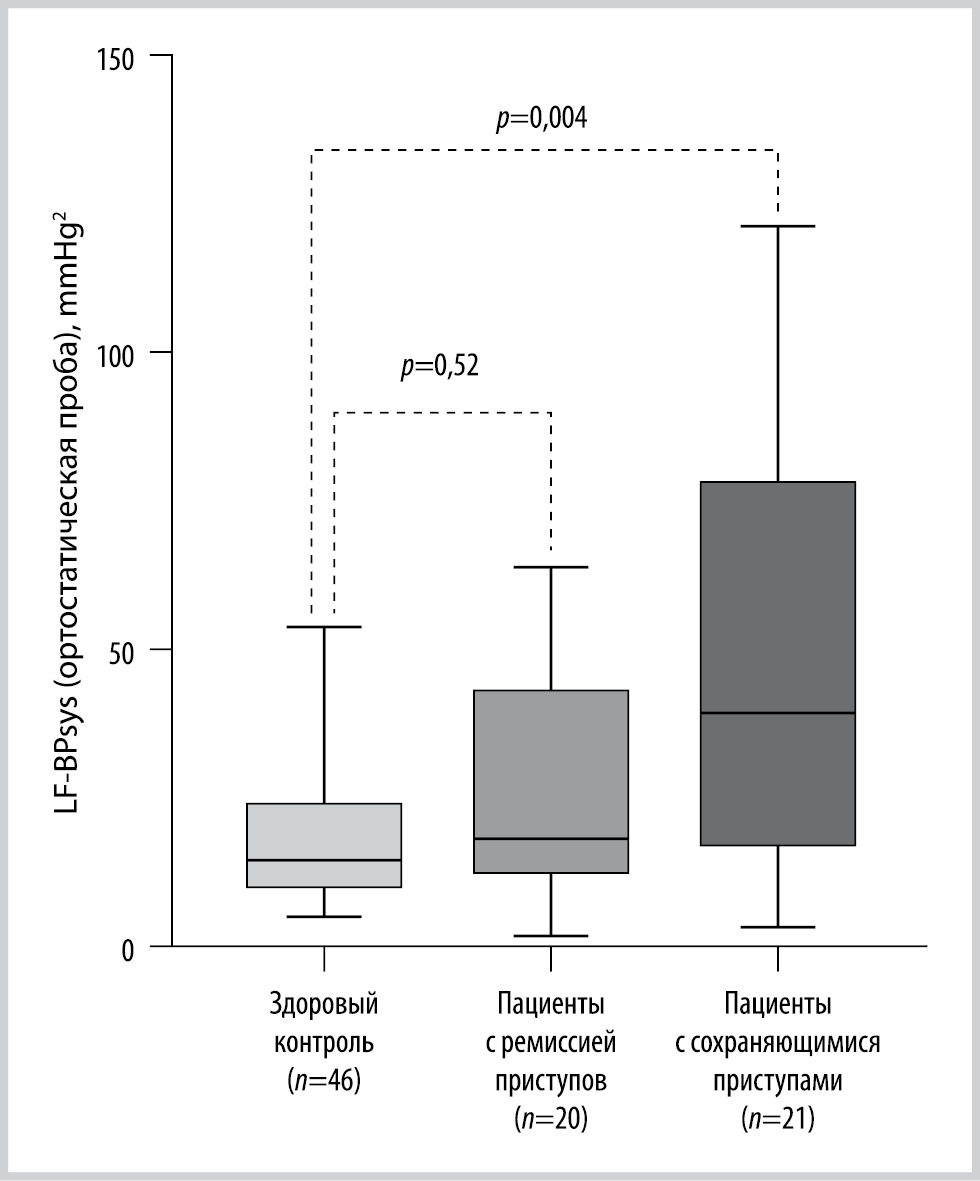
Рис. 1. Спектральная плотность мощности вариабельности систолического артериального давления в низкочастотном диапазоне (LF-BPsys) в ортостатическом положении у здоровых испытуемых и пациентов, прошедших хирургическое лечение эпилепсии, на момент проведения предхирургического обследования.
Доля пациентов со значениями вегетативных параметров, выходящими за порог в 2,5 процентиля от значений группы контроля, была больше в группе с сохраняющимися приступами по всем параметрам, различавшимся между группами, однако статистическая значимость была достигнута только в отношении BRS: патологически низкие значения BRS наблюдались только у пациентов с продолжающимися приступами (6 из 21 против 0 из 20 пациентов в группе с ремиссией приступов, p=0,012) (табл. 4; рис. 2).
Таблица 4. Количество пациентов со значениями вегетативных параметров, выходящими за порог в 2,5 процентиля от значений группы здорового контроля, n, %
Вегетативные параметры | Пациенты с регрессом приступов, n=20 | Пациенты с сохраняющимися приступами, n=21 | p* | Порог 2,5 процентиля от значений группы контроля |
Покой: | ||||
SDNN, мс | 3/20 | 7/21 | 0,158 | <20,7 |
CV-RRI | 1/20 | 4/21 | 0,187 | <2,03 |
TP-RRI, мс2 | 3/20 | 7/21 | 0,158 | <342 |
LF-RRI, мс2 | 4/20 | 6/21 | 0,468 | <167 |
BRS, мс/mmHg | 0/20 | 6/21 | 0,012 | <6,7 |
ОП: | ||||
Индекс 30:15 | 0/20 | 2/21 | 0,256 | <1,11 |
LF-BPsys, mmHg2 | 3/20 | 5/21 | 0,377 | >52,5 |
Примечание. * — точный критерий Фишера. ОП — ортостатическая проба; RRI — RR-интервалы; SDNN — стандартное отклонение нормальных RRI; CV-RRI — коэффициент вариации RRI; TP-RRI — общая спектральная плотность мощности вариабельности RRI; LF-RRI — спектральная плотность мощности вариабельности RRI в низкочастотном диапазоне; LF-BPsys — спектральная плотность мощности вариабельности систолического артериального давления в низкочастотном диапазоне; BRS — чувствительность артериального барорефлекса; индекс 30:15 — отношение максимального RR-интервала к минимальному после вертикализации.
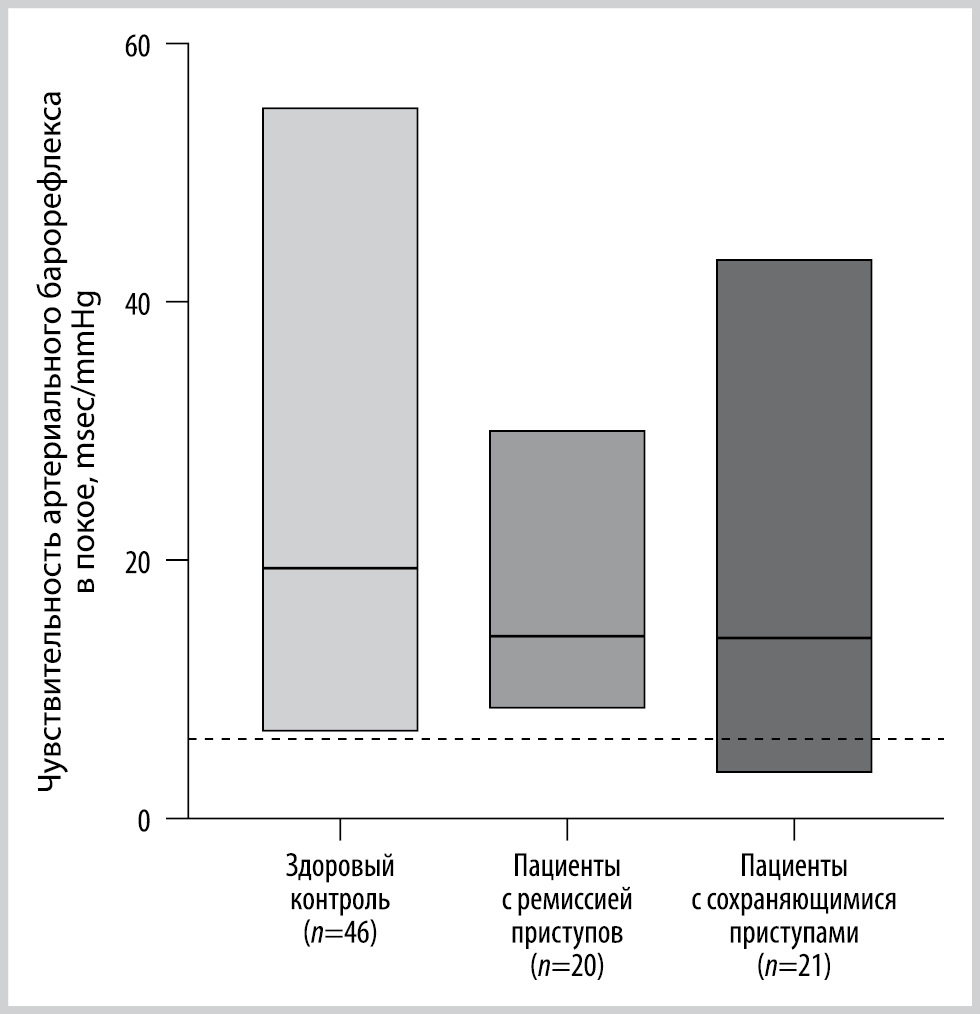
Рис. 2. Чувствительность артериального барорефлекса в покое у здоровых испытуемых и пациентов, прошедших хирургическое лечение эпилепсии, на момент проведения предхирургического обследования.
Пунктирная линия — граница в 2,5 процентиля от значений контрольной группы здоровых испытуемых. Значения чувствительности артериального барорефлекса ниже данной границы наблюдались только в группе пациентов с сохраняющимися приступами.
Обсуждение
Сердечно-сосудистая вегетативная дисфункция в виде снижения уровня активности автономной регуляции сердечного ритма и чувствительности артериального барорефлекса характерна для пациентов с эпилепсией и описана во многих опубликованных ранее исследованиях [17, 25]. В исследовании Persson и соавт. пациенты с сохраняющимися после оперативного лечения приступами имели сниженные дооперационные значения параметров вариабельности сердечного ритма, отражающих общую суммарную и преимущественно симпатическую вегетативную активность, по сравнению со здоровым контролем, в то время как пациенты с ремиссией приступов не отличались от своей контрольной группы, иными словами, у пациентов с менее благоприятным исходом оперативного лечения исходно наблюдалась более выраженная вегетативная дисфункция [16]. В нашем исследовании пациенты с фармакорезистентной эпилепсией обеих групп имели вегетативную дисфункцию в виде значимого снижения параметров вариабельности сердечного ритма в интериктальном периоде, отражающих общую (SDNN, CV-RRI, TP-RRI) и преимущественно симпатическую (LF-RRI) вегетативную регуляцию, а также демонстрировали тенденцию к снижению параметров, отражающих парасимпатическую модуляцию сердечного ритма (RMSSD, HF-RRI). Кроме того, у пациентов обеих групп наблюдалось снижение чувствительности артериального барорефлекса в покое и индекса 30:15, отражающего опосредованную барорефлексом парасимпатическую реакцию сердечного ритма в ответ на активную вертикализацию [26].
Особого внимания заслуживает наблюдение, что у пациентов с сохраняющимися приступами, но не у пациентов с их ремиссией, в ортостатическом положении выявлялось значимое повышение вариабельности систолического артериального давления в низкочастотном диапазоне (LF-BPsys). Ранее Devinsky и соавт. описывали повышение LF-BPsys у пациентов с эпилепсией при проведении ортостатической пробы [27]. По их мнению, повышение вариабельности артериального давления обусловлено изменениями в работе структур центральной нервной системы, регулирующих деятельность сердечно-сосудистой системы. Известно также, что во время эпилептического приступа одним из проявлений нарушений системной гемодинамики является повышение вариабельности систолического давления [28]. Предполагается, что возникающая эпилептическая активность характеризуется резким повышением уровня катехоламинов в крови, а повышение вариабельности АД может свидетельствовать об активации симпатического звена вегетативной нервной системы в момент эпилептического приступа [29, 30]. Спектральная плотность мощности вариабельности систолического АД в диапазоне низких частот отражает нервную симпатическую активность, влияющую преимущественно на сосудистый тонус [31, 32]. Низкочастотные колебания систолического АД генерируются осцилляторами стволовых структур, которые, вероятно, модулируются барорефлекторными механизмами [33], что может иметь особое значение при интерпретации данного параметра при ортостатической нагрузке. О барорефлекторной дисфункции у пациентов с эпилепсией писали Dütsch и соавт., они предположили, что ее причиной может являться вовлечение стволовых центров барорефлекторной регуляции в патологический процесс, связанный с эпилептогенезом, а повышенная вариабельность артериального давления во время ортостатической пробы может быть субклиническим проявлением барорефлекторной дисфункции [18]. Любопытно, что среди наших пациентов патологически низкие дооперационные значения чувствительности артериального барорефлекса в покое (<6,7 msec/mmHg) были обнаружены только у пациентов с продолжающимися после оперативного лечения приступами и наблюдались в 28,6% случаев. Таким образом, можно предположить, что наличие субклинических признаков нарушения барорефлекторной регуляции как минимум у части пациентов ассоциировано с меньшей вероятностью достижения полного контроля над приступами после проведения оперативного лечения.
Нарушение барорефлекторной регуляции является важным компонентом вегетативной дисфункции при различных заболеваниях нервной системы. Так, барорефлекторная дисфункция при семейной дизавтономии ассоциирована с повышенным риском срыва вегетативной регуляции артериального давления в условиях гипоксемии [34]. У пациентов с эпилепсией перииктальная гипоксемия длительностью 125 и более секунд, наблюдаемая на фоне центрального апноэ, увеличивает вероятность развития аритмий потенциально высокого риска в 7 раз, а длительностью 150 и более секунд — в 13 раз [35]. Стоит заметить, что именно нарушения дыхания и связанные с ними нарушения сердечного ритма, вероятно, обусловленные нарушением функционирования структур ствола головного мозга, лежат в основе патогенеза внезапной смерти пациентов с эпилепсией (SUDEP) [36, 37]. У пациентов с фокальной височно-долевой эпилепсией обнаружено уменьшение объема стволовых структур, участвующих в вегетативной регуляции [38]. При этом сниженная активность вегетативной модуляции сердечного ритма ассоциирована с большей потерей объема продолговатого мозга и околоводопроводного серого вещества, а среди случаев SUDEP большая потеря объема продолговатого мозга на уровне obex была связана с меньшим временем от момента проведения МРТ до смерти [39]. Барорефлекс является стволовым рефлексом, и можно предположить, что выраженное его нарушение у некоторых пациентов с эпилепсией может отражать более обширный патологический процесс, в том числе в большей степени вовлекающий вегетативные структуры ствола головного мозга, с чем и может быть связан меньшей вероятностью установления контроля над приступами после оперативного лечения.
С другой стороны, барорефлекторная дисфункция выявляется не у всех пациентов, и важно понять, какие факторы могут быть связаны с ее наличием у отдельных пациентов, являющихся кандидатами на хирургическое лечение эпилепсии. По данным литературы, есть основания считать, что по мере увеличения длительности течения болезни нарастает тяжесть вегетативной дисфункции в виде снижения уровня активности вегетативной регуляции сердечно-сосудистой системы [17, 40—42]. Однако в нашей выборке пациенты с сохраняющимися после оперативного лечения приступами и пациенты с полным регрессом приступов не различались значимо между собой по длительности течения эпилепсии. Нельзя исключить влияние противоэпилептических препаратов на состояние вегетативной нервной системы. Действительно, некоторые работы показывают, что прием, в частности, карбамазепина, может быть связан с более низкими значениями параметров вариабельности сердечного ритма [43]. Однако сердечно-сосудистая вегетативная дисфункция наблюдается даже у пациентов с вновь диагностированной эпилепсией, не получавших медикаментозное лечение [44, 45]. Кроме того, наши пациенты в обеих группах не различались по количеству принимаемых препаратов, а медикаментозная терапия в течение 12 мес. после проведения оперативного лечения не менялась. Другой вероятной причиной возникновения барорефлекторной дисфункции может быть вовлечение в эпилептогенный процесс определенных структур головного мозга, в частности, структур центральной вегетативной сети, имеющих анатомо-функциональные связи со стволовыми центрами регуляции сердечно-сосудистой деятельности. Исследуемые нами группы характеризовались клинико-морфологической неоднородностью, что может объяснить наличие грубой барорефлекторной дисфункции лишь у части пациентов. У подавляющего большинства пациентов, согласно данным предхирургического обследования, была установлена неокортикальная локализация структурных изменений, а также МР-негативные или сочетанные формы эпилепсии (двойная патология), отличающиеся высокой сложностью картирования эпилептогенной зоны и характеризующиеся меньшей вероятностью достижения полного контроля над эпилептическими приступами [46]. Перспективными могли бы быть новые исследования взаимосвязи нарушения барорефлекторной регуляции и вовлечения в эпилептогенный процесс определенных структур головного мозга.
Заключение
Сердечно-сосудистая автономная дисфункция в виде снижения вариабельности сердечного ритма и чувствительности артериального барорефлекса характерна для пациентов с фармакорезистентной фокальной эпилепсией, являющихся кандидатами на проведение нейрохирургического лечения. При этом среди пациентов с сохраняющимися после оперативного лечения приступами на дооперационном этапе наблюдалось повышение вариабельности систолического артериального давления при проведении ортостатической пробы, что может быть связано с большей выраженностью субклинической барорефлекторной дисфункции у данной группы пациентов. Кроме того, только среди пациентов с сохраняющимися приступами наблюдались случаи патологически низкой исходной чувствительности артериального барорефлекса. Таким образом, несмотря на то что большинство параметров сердечно-сосудистой вегетативной регуляции, в частности, параметры вариабельности сердечного ритма, оказались на дооперационном этапе снижены как у пациентов с полным регрессом приступов, так и у пациентов с продолжающимися приступами, выраженная барорефлекторная дисфункция может являться одним из возможных факторов, ассоциированных с меньшей вероятностью достижения полной ремиссии приступов после хирургического лечения эпилепсии.
Авторы заявляют об отсутствии конфликта интересов.
- Guekht A, Hauser WA, Milchakova L, et al. The epidemiology of epilepsy in the Russian Federation. Epilepsy Res. 2010; 92:209-218. https://doi.org/10.1016/j.eplepsyres.2010.09.011
- Крылов В.В., Гехт А.Б., Трифонов И.С., и др. Отдаленные результаты хирургического лечения пациентов с фармакорезистентными формами эпилепсии. Вопросы нейрохирургии» имени Н.Н. Бурденко. 2021; 85(5):6-13. https://doi.org/10.17116/neiro2021850516
- Lamberink HJ, Otte WM, Blümcke I, et al. Seizure outcome and use of antiepileptic drugs after epilepsy surgery according to histopathological diagnosis: a retrospective multicentre cohort study. Lancet Neurol. 2020; 19:748-757. https://doi.org/10.1016/S1474-4422(20)30220-9
- West S, Nevitt SJ, Cotton J, et al. Surgery for epilepsy. Cochrane Database of Systematic Reviews. 2019; 2019. https://doi.org/10.1002/14651858.CD010541.PUB3
- Bjellvi J, Olsson I, Malmgren K, et al. Epilepsy duration and seizure outcome in epilepsy surgery: A systematic review and meta-Analysis. Neurology. 2019; 93:E159-66. https://doi.org/10.1212/WNL.0000000000007753
- Samuel P J, Menon RN, Chandran A, et al. Seizure outcome and its predictors after frontal lobe epilepsy surgery. Acta Neurol Scand. 2019; 140:259-267. https://doi.org/10.1111/ANE.13139
- Meguins LC, Adry RARDC, Da Silva-Júnior SC, et al. Shorter epilepsy duration is associated with better seizure outcome in temporal lobe epilepsy surgery. Arq Neuropsiquiatr. 2015; 73:212-217. https://doi.org/10.1590/0004-282X20140230
- Engel J. The current place of epilepsy surgery. Curr Opin Neurol. 2018; 31:192. https://doi.org/10.1097/WCO.0000000000000528
- Berg AT, Langfitt J, Shinnar S, et al. How long does it take for partial epilepsy to become intractable? Neurology. 2003; 60:186-190. https://doi.org/10.1212/01.WNL.0000031792.89992.EC
- Téllez-Zenteno JF, Dhar R, Wiebe S, et al. Long-term seizure outcomes following epilepsy surgery: A systematic review and meta-analysis. Brain. 2005; 128:1188-1198. https://doi.org/10.1093/BRAIN/AWH449
- Janszky J, Janszky I, Schulz R, et al. Temporal lobe epilepsy with hippocampal sclerosis: Predictors for long-term surgical outcome. Brain. 2005; 128:395-404. https://doi.org/10.1093/BRAIN/AWH358
- Barba C, Giometto S, Lucenteforte E, et al. Seizure Outcome of Temporal Lobe Epilepsy Surgery in Adults and Children: A Systematic Review and Meta-Analysis. Neurosurgery. 2022; 91:676-683. https://doi.org/10.1227/NEU.0000000000002094
- Willard A, Antonic-Baker A, Chen Z, et al. Seizure Outcome after Surgery for MRI-Diagnosed Focal Cortical Dysplasia: A Systematic Review and Meta-analysis. Neurology. 2022; 98:E236-48. https://doi.org/10.1212/WNL.0000000000013066
- Habibabadi JM, Zare M, Tabrizi1 N, et al. The role of interictal epileptiform discharges in epilepsy surgery outcome. Int J Prev Med. 2019; 10. https://doi.org/10.4103/IJPVM.IJPVM_237_18
- Schulz R, Lüders HO, Hoppe M, et al. Interictal EEG and ictal scalp EEG propagation are highly predictive of surgical outcome in mesial temporal lobe epilepsy. Epilepsia. 2000; 41:564-570. https://doi.org/10.1111/J.1528-1157.2000.TB00210.X
- Persson H, Kumlien E, Ericson M, et al. Preoperative heart rate variability in relation to surgery outcome in refractory epilepsy. Neurology. 2005; 65:1021-1025. https://doi.org/10.1212/01.wnl.0000181368.50750.1c
- Sivathamboo S, Perucca P, et al. Interictal autonomic dysfunction. Curr Opin Neurol.2021; 34:197-205. https://doi.org/10.1097/WCO.0000000000000906
- Dütsch M, Hilz MJ, Devinsky O, et al. Impaired baroreflex function in temporal lobe epilepsy. J Neurol. 2006; 253:1300-1308. https://doi.org/10.1007/s00415-006-0210-3
- Marchal R, Rheims S, et al. Assessing epilepsy-related autonomic manifestations: Beyond cardiac and respiratory investigations. Neurophysiologie Clinique. 2023; 53. https://doi.org/10.1016/j.neucli.2023.102850
- Thijs RD, Ryvlin P, Surges R, et al. Autonomic manifestations of epilepsy: emerging pathways to sudden death? Nature Reviews Neurology. 2021 17:12. 2021; 17:774-788. https://doi.org/10.1038/s41582-021-00574-w
- Журавлев Д.В., Лебедева А.В., Лебедева М.А., и др. Современные представления о вегетативной дисфункции у пациентов с эпилепсией. Журнал неврологии и психиатрии им. С.С. Корсакова. 2022; 122(3):131-138. https://doi.org/10.17116/jnevro2022122031131
- Myers KA, Sivathamboo S, Perucca P, et al. Heart rate variability measurement in epilepsy: How can we move from research to clinical practice? Epilepsia. 2018; 59:2169-2178. https://doi.org/10.1111/epi.14587
- Engel Jr J, Van Ness PC, Rasmussen TB, et al. Outcome with respect to epileptic seizures. In: Engel Jr J, editor. Surgical Treatment of the Epilepsies. 2nd ed., New York: Raven Press; 1993:609-621.
- Malmgren K, Edelvik A, et al. Long-term outcomes of surgical treatment for epilepsy in adults with regard to seizures, antiepileptic drug treatment and employment. Seizure. 2017; 44:217-224. https://doi.org/10.1016/J.SEIZURE.2016.10.015
- Lotufo PA, Valiengo L, Benseñor IM, et al. A systematic review and meta-analysis of heart rate variability in epilepsy and antiepileptic drugs. Epilepsia. 2012; 53:272-282. https://doi.org/10.1111/j.1528-1167.2011.03361.x
- Harms MPM, Finucane C, Pérez-Denia L, et al. Systemic and cerebral circulatory adjustment within the first 60 s after active standing: An integrative physiological view. Autonomic Neurosciences. 2020; 231:102756. https://doi.org/10.1016/J.AUTNEU.2020.102756
- Devinsky O., Perrine K., Theodore W.H., et al (1994), Interictal Autonomic Nervous System Function in Patients with Epilepsy. Epilepsia. 35: 199-204. https://doi.org/10.1111/j.1528-1157.1994.tb02933.x
- Rodriguez-Quintana J, Bueno-Florez S, Mora-Muñoz L, et al. Dysautonomia in people with epilepsy: A scoping review. Seizure. 2023; 105:43-51. https://doi.org/10.1016/j.seizure.2022.12.003
- Nass RD, Hampel KG, Elger CE, et al. Blood pressure in seizures and epilepsy. Front Neurol. 2019; 10. https://doi.org/10.3389/fneur.2019.00501
- Nass RD, Motloch LJ, Paar V, et al. Blood markers of cardiac stress after generalized convulsive seizures. Epilepsia. 2019; 60:201-210. https://doi.org/10.1111/EPI.14637
- Parati G, Saul JP, Di Rienzo M, et al. Spectral analysis of blood pressure and heart rate variability in evaluating cardiovascular regulation: a critical appraisal. Hypertension. 1995; 25:1276-1286. https://doi.org/10.1161/01.hyp.25.6.1276
- Malpas SC. Sympathetic nervous system overactivity and its role in the development of cardiovascular disease. Physiol Rev. 2010; 90:513-557. https://doi.org/10.1152/physrev.00007.2009
- Grabov E, Sullivan P, Wang S, et al. Tilt-evoked, breathing-driven blood pressure oscillations: Independence from baroreflex-sympathoneural function. Clinical Autonomic Research. 2024; 34:125-135. https://doi.org/10.1007/S10286-024-01022-7
- Bernardi L, Hilz M, Stemper B, et al. Respiratory and cerebrovascular responses to hypoxia and hypercapnia in familial dysautonomia. Am J Respir Crit Care Med. 2003; 167:141-149. https://doi.org/10.1164/RCCM.200207-677OC
- Park KJ, Sharma G, Kennedy JD, et al. Potentially high-risk cardiac arrhythmias with focal to bilateral tonic-clonic seizures and generalized tonic-clonic seizures are associated with the duration of periictal hypoxemia. Epilepsia. 2017; 58:2164-2171. https://doi.org/10.1111/epi.13934
- Ryvlin P, Nashef L, Lhatoo SD, et al. Incidence and mechanisms of cardiorespiratory arrests in epilepsy monitoring units (MORTEMUS): A retrospective study. Lancet Neurol. 2013; 12:966-977. https://doi.org/10.1016/S1474-4422(13)70214-X
- Barot N, Nei M, et al. Autonomic aspects of sudden unexpected death in epilepsy (SUDEP). Clinical Autonomic Research. 2019; 29:151-160. https://doi.org/10.1007/s10286-018-0576-1
- Mueller SG, Bateman LM, Laxer KD, et al. Evidence for brainstem network disruption in temporal lobe epilepsy and sudden unexplained death in epilepsy. Neuroimage Clin. 2014; 5:208-216. https://doi.org/10.1016/j.nicl.2014.06.010
- Mueller SG, Nei M, Bateman LM, et al. Brainstem network disruption: A pathway to sudden unexplained death in epilepsy? Hum Brain Mapp. 2018; 39:4820-4830. https://doi.org/10.1002/hbm.24325
- Yildiz GU, Dogan EA, Dogan U, et al. Analysis of 24-hour heart rate variations in patients with epilepsy receiving antiepileptic drugs. Epilepsy and Behavior. 2011; 20:349-354. https://doi.org/10.1016/j.yebeh.2010.12.001
- Chroni E, Sirrou V, Trachani E, et al. Interictal alterations of cardiovagal function in chronic epilepsy. Epilepsy Res. 2009; 83:117-123. https://doi.org/10.1016/j.eplepsyres.2008.10.006
- Suorsa E, Korpelainen JT, Ansakorpi H, et al. Heart rate dynamics in temporal lobe epilepsy-A long-term follow-up study. Epilepsy Res. 2011; 93:80-83. https://doi.org/10.1016/j.eplepsyres.2010.10.005
- Persson H, Ericson M, Tomson T, et al. Carbamazepine affects autonomic cardiac control in patients with newly diagnosed epilepsy. Epilepsy Res. 2003; 57:69-75. https://doi.org/10.1016/j.eplepsyres.2003.10.012
- Goit RK, Jha SK, Pant BN, et al. Alteration of cardiac autonomic function in patients with newly diagnosed epilepsy. Physiol Rep. 2016; 4:pii:e12826. https://doi.org/10.14814/phy2.12826
- Mativo P, Anjum J, Pradhan C, et al. Study of cardiac autonomic function in drug-naïve, newly diagnosed epilepsy patients. Epileptic Disorders. 2010; 12:212-216. https://doi.org/10.1684/epd.2010.0325
- Sanders MW, Wolf I Van der, Jansen FE, et al. Outcome of Epilepsy Surgery in MRI-Negative Patients Without Histopathologic Abnormalities in the Resected Tissue. Neurology. 2024; 102:e208007. https://doi.org/10.1212/WNL.0000000000208007





Рекомендуем статьи по данной теме:
Клинико-функциональные особенности болезни Паркинсона при хронической болезни почек.Журнал неврологии и психиатрии им. С.С. Корсакова. 2026;126(8):79-85
Механизмы и морфопатофизиологические уровни эпилептогенеза.Журнал неврологии и психиатрии им. С.С. Корсакова. 2026;126(8):5-12
Итоги научно-практической конференции с международным участием «Неврология XXI века: актуальные вопросы, достижения и инновации». 26—27 марта 2026 года, Санкт-Петербург.Журнал неврологии и психиатрии им. С.С. Корсакова. 2026;126(7):133-137
Родоразрешение женщин с эпилепсией: аспекты анестезиологии.Российский вестник акушера-гинеколога. 2026;26(3):23-30
Синдром обструктивного апноэ сна при эпилепсии: роль коморбидности и возможности единого фармакологического подхода к лечению.Журнал неврологии и психиатрии им. С.С. Корсакова. Спецвыпуски. 2026;126(5-2):29-33
Предиктивная эпилептология: формирование новой парадигмы управления эпилептическими приступами.Журнал неврологии и психиатрии им. С.С. Корсакова. 2026;126(5):14-20
Нарушения вегетативной регуляции у больных с ортостатической гипотензией, вазовагальными обмороками и синдромом постуральной ортостатической тахикардии.Кардиологический вестник. 2026;21(2):57-64
Особенности поражения головного мозга у больных туберозным склерозом из Республики Башкортостан.Журнал неврологии и психиатрии им. С.С. Корсакова. 2026;126(3):81-86
Возможности применения кортикальной электрической стимуляции для исследования вегетативной дисфункции у пациентов с эпилепсией.Журнал неврологии и психиатрии им. С.С. Корсакова. 2025;125(8):25-34
Нарушения вегетативной регуляции сердечно-сосудистой системы у пациентов с эпилептическими и психогенными неэпилептическими приступами: пилотное исследование.Журнал неврологии и психиатрии им. С.С. Корсакова. 2025;125(2):13-20