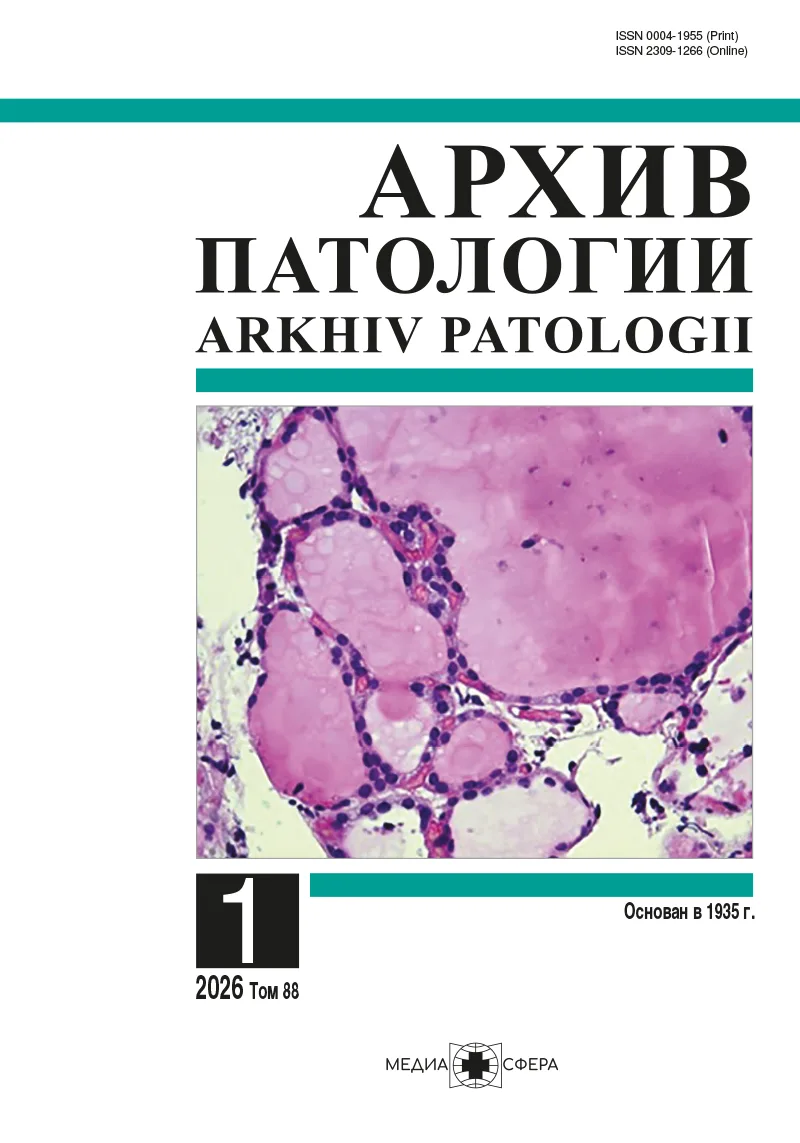
Морфологическая и иммуногистохимическая характеристика сердца пациентов с COVID-19
Резюме
ЦЕЛЬ ИССЛЕДОВАНИЯ
Проанализировать патоморфологические и иммуногистохимические характеристики сердца умерших от COVID-19.
МАТЕРИАЛ И МЕТОДЫ
Проведено комплексное патоморфологическое исследование сердца при 88 аутопсиях от тяжелого COVID-19 (42 мужчины и 46 женщин, средний возраст 71,4±12,7 года). Наличие SARS-CoV-2-инфекции во всех случаях было подтверждено положительными результатами ПЦР-тестов. С помощью иммуногистохимического исследования проанализирована экспрессия вирусного нуклеокапсидного белка (NP), CD3, CD68, CD31, CD34, фактора Виллебранда (vWF) в клеточных популяциях и структурах миокарда.
РЕЗУЛЬТАТЫ
В большинстве случаев отмечался полиморфизм структурных изменений, что выражалось в сочетании признаков хронических и острых повреждений миокарда. Многочисленные очаги интерстициального и периваскулярного фиброза и липоматоза, неравномерная гипертрофия кардиомиоцитов, отложения амилоида свидетельствовали о предшествующих сердечно-сосудистых заболеваниях. Острые и подострые патологические изменения миокарда включали расстройства кровообращения (полнокровие, внутрипросветные мегакариоциты, тромбоз микрососудов, интерстициальный отек), сосудистые повреждения, альтеративные изменения кардиомиоцитов. В 45% случаев присутствовала лимфомакрофагальная инфильтрация, которая была ассоциирована с иммуногистохимическим выявлением NP в кардиомиоцитах и клетках сосудов. Установлена слабая экспрессия CD31 и высокая экспрессия vWF в эндотелии микрососудов.
ЗАКЛЮЧЕНИЕ
Экспрессия NP в кардиомиоцитах, макрофагах и эндотелиальных клетках сосудов сердца свидетельствует об их непосредственном инфицировании вирусом SARS-CoV-2 и возможной длительной персистенции вирусной инфекции. Установлено, что при тяжелом COVID-19 в сердце выявляются CD3- и CD68-позитивные клетки; наблюдается эндотелиальная дисфункция, на что указывают пониженная экспрессия CD31 и высокая экспрессия vWF. Выявленные изменения миокарда могут влиять на развитие постковидных сердечно-сосудистых осложнений.
Ключевые слова
- сердце
- COVID-19
- патоморфология
- иммуногистохимия
Дата поступления: 28.05.2025
Дата принятия в печать: 22.10.2025
Дата публикации: 27.01.2026
- Deshmukh V, Motwani R, Kumar A, Kumari C, Raza K. Histopathological observations in COVID-19: a systematic review. J Clin Pathol. 2021;74(2):76-83. https://doi.org/10.1136/jclinpath-2020-206995
- Peiris S, Mesa H, Aysola A, Manivel J, Toledo J, Borges-Sa M, Aldighieri S, Reveiz L. Pathological findings in organs and tissues of patients with COVID-19: A systematic review. PLoS One. 2021;16(4):e0250708. https://doi.org/10.1371/journal.pone.0250708
- Mallhi TH, Safdar A, Butt MH, Salman M, Nosheen S, Mustafa ZU, Khan FU, Khan YH. Atypical Complications during the Course of COVID-19: A Comprehensive Review. Medicina (Kaunas). 2024;60(1):164. https://doi.org/10.3390/medicina60010164
- Roshdy A, Zaher S, Fayed H, Coghlan JG. COVID-19 and the Heart: A Systematic Review of Cardiac Autopsies. Front Cardiovasc Med. 2021;7:626975. https://doi.org/10.3389/fcvm.2020.626975
- Sang CJ 3rd, Burkett A, Heindl B, Litovsky SH, Prabhu SD, Benson PV, Rajapreyar I. Cardiac pathology in COVID-19: a single center autopsy experience. Cardiovasc Pathol. 2021:107370. https://doi.org/10.1016/j.carpath.2021.107370
- Dal Ferro M, Bussani R, Paldino A, Nuzzi V, Collesi C, Zentilin L, Schneider E, Correa R, Silvestri F, Zacchigna S, Giacca M, Metra M, Merlo M, Sinagra G. SARS-CoV-2, myocardial injury and inflammation: insights from a large clinical and autopsy study. Clin Res Cardiol. 2021;110(11):1822-1831. https://doi.org/10.1007/s00392-021-01910-2
- Philip B, Mukherjee P, Khare Y, Ramesh P, Zaidi S, Sabry H, Harky A. COVID-19 and its long-term impact on the cardiovascular system. Expert Rev Cardiovasc Ther. 2023;21(3):211-218. https://doi.org/10.1080/14779072.2023.2184800
- Sewanan LR, Clerkin KJ, Tucker NR, Tsai EJ. How Does COVID-19 Affect the Heart? Curr Cardiol Rep. 2023;25(3):171-184. https://doi.org/10.1007/s11886-023-01841-6
- Митрофанова Л.Б., Макаров И.А., Рунов А.Л., Вонский М.С., Данилова И.А., Сидорин В.С., Моисеева О.М., Конради А.О. Клинико-морфологическое и молекулярно-биологическое исследование миокарда у пациентов с COVID-19. Российский кардиологический журнал. 2022;27(7):4810. https://doi.org/10.15829/1560-4071-2022-4810
- Akhmerov A, Marbán E. COVID-19 and the Heart. Circ Res. 2020;126(10):1443-1455. https://doi.org/10.1161/CIRCRESAHA.120.317055
- Aleksova A, Fluca AL, Gagno G, Pierri A, Padoan L, Derin A, Moretti R, Noveska EA, Azzalini E, D’Errico S, Beltrami AP, Zumla A, Ippolito G, Sinagra G, Janjusevic M. Long-term effect of SARS-CoV-2 infection on cardiovascular outcomes and all-cause mortality. Life Sci. 2022;310:121018. https://doi.org/10.1016/j.lfs.2022.121018
- Xie Y, Xu E, Bowe B, Al-Aly Z. Long-term cardiovascular outcomes of COVID-19. Nat Med. 2022;28(3):583-590. https://doi.org/10.1038/s41591-022-01689-3
- Tobler DL, Pruzansky AJ, Naderi S, Ambrosy AP, Slade JJ. Long-Term Cardiovascular Effects of COVID-19: Emerging Data Relevant to the Cardiovascular Clinician. Curr Atheroscler Rep. 2022;24(7):563-570. https://doi.org/10.1007/s11883-022-01032-8
- Singh TK, Zidar DA, McCrae K, Highland KB, Englund K, Cameron SJ, Chung MK. A Post-Pandemic Enigma: The Cardiovascular Impact of Post-Acute Sequelae of SARS-CoV-2. Circ Res. 2023;132(10):1358-1373. https://doi.org/10.1161/CIRCRESAHA.122.322228
- Mezache L, Nuovo GJ, Suster D, Tili E, Awad H, Radwański PB, Veeraraghavan R. Histologic, viral, and molecular correlates of heart disease in fatal COVID-19. Ann Diagn Pathol. 2022;60:151983. https://doi.org/10.1016/j.anndiagpath.2022.151983
- Kern L, Mittenbühler MJ, Vesting AJ, Ostermann AL, Wunderlich CM, Wunderlich FT. Obesity-Induced TNFα and IL-6 Signaling: The Missing Link between Obesity and Inflammation-Driven Liver and Colorectal Cancers. Cancers (Basel). 2018;11(1):24. https://doi.org/10.3390/cancers11010024
- Rapkiewicz AV, Mai X, Carsons SE, Pittaluga S, Kleiner DE, Berger JS, Thomas S, Adler NM, Charytan DM, Gasmi B, Hochman JS, Reynolds HR. Megakaryocytes and platelet-fibrin thrombi characterize multi-organ thrombosis at autopsy in COVID-19: A case series. EClinicalMedicine. 2020;24:100434. https://doi.org/10.1016/j.eclinm.2020.100434
- Bois MC, Boire NA, Layman AJ, Aubry MC, Alexander MP, Roden AC, Hagen CE, Quinton RA, Larsen C, Erben Y, Majumdar R, Jenkins SM, Kipp BR, Lin PT, Maleszewski JJ. (2021). COVID-19-Associated Nonocclusive Fibrin Microthrombi in the Heart. Circulation. 2021 143(3): 230-243. https://doi.org/10.1161/CIRCULATIONAHA.120.050754
- Mikhaleva L, Gioeva Z, Varyasin V, Berezhnaja E, Vandysheva R, Gutyrchik N, Pechnikova V, Kontorshchikov A, Midiber K, Kakturskij L. Pathomorphological Features of the Novel Coronavirus Disease in Patients with Systemic Amyloidosis. Biomedicines. 2023;11(10):2811. https://doi.org/10.3390/biomedicines11102811
- Halushka MK, Vander Heide RS. Myocarditis is rare in COVID-19 autopsies: cardiovascular findings across 277 postmortem examinations. Cardiovasc Pathol. 2021;50:107300. https://doi.org/10.1016/j.carpath.2020.107300
- Oprinca GC, Muja LA. Postmortem examination of three SARS-CoV-2-positive autopsies including histopathologic and immunohistochemical analysis. Int J Legal Med. 2021;135(1):329-339. https://doi.org/10.1007/s00414-020-02406-w
- Panagiotides NG, Poledniczek M, Andreas M, Hülsmann M, Kocher AA, Kopp CW, Piechota-Polanczyk A, Weidenhammer A, Pavo N, Wadowski PP. Myocardial Oedema as a Consequence of Viral Infection and Persistence-A Narrative Review with Focus on COVID-19 and Post COVID Sequelae. Viruses. 2024;16(1):121. https://doi.org/10.3390/v16010121
- Maccio U, Zinkernagel AS, Shambat SM, Zeng X, Cathomas G, Ruschitzka F, Schuepbach RA, Moch H, Varga Z. SARS-CoV-2 leads to a small vessel endotheliitis in the heart. EBioMedicine. 2021;63:103182. https://doi.org/10.1016/j.ebiom.2020.103182
- Благова О.В., Коган Е.А., Лутохина Ю.А., Куклева А.Д., Айнетдинова Д.Х., Новосадов В.М., Рудь Р.С., Зайцев А.Ю., Зайденов В.А., Куприянова А.Г., Александрова С.А., Фомин В.В. Постковидный миоэндокардит подострого и хронического течения: клинические формы, роль персистенции коронавируса и аутоиммунных механизмов. Кардиология. 2021;61(6):11-27. https://doi.org/10.18087/cardio.2021.6.n1659
- Коган Е.А., Куклева А.Д., Березовский Ю.С., Благова О.В., Жарков Н.В., Айнетдинова Д.Х., Демяшкин Г.А. Клинико-морфологическая характеристика SARS-CoV-2-ассоциированного миокардита, подтвержденного наличием РНК и белков вируса в ткани миокарда. Архив патологии. 2021;83(4):5-13. https://doi.org/10.17116/patol2021830415
- Nappi F, Avtaar Singh SS. SARS-CoV-2-Induced Myocarditis: A State-of-the-Art Review. Viruses. 2023;15(4):916. https://doi.org/10.3390/v15040916
- Цинзерлинг В.А., Вашукова М.А., Васильева М.В., Исаков А.Н., Луговская Н.А., Наркевич Т.А., Суханова Ю.В., Семенова Н.Ю., Гусев Д.А. Вопросы патоморфогенеза новой коронавирусной инфекции (COVID-19). Журнал инфектологии. 2020;12(2):5-11. https://doi.org/10.22625/2072-6732-2020-12-2-5-11
- Lertkiatmongkol P, Liao D, Mei H, Hu Y, Newman PJ. Endothelial functions of platelet/endothelial cell adhesion molecule-1 (CD31). Curr Opin Hematol. 2016;23(3):253-9. https://doi.org/10.1097/MOH.0000000000000239
- Liao D, Mei H, Hu Y, Newman DK, Newman PJ. CRISPR-mediated deletion of the PECAM-1 cytoplasmic domain increases receptor lateral mobility and strengthens endothelial cell junctional integrity. Life Sci. 2018;193:186-193. https://doi.org/10.1016/j.lfs.2017.11.002
- Mojiri A, Alavi P, Lorenzana Carrillo MA, Nakhaei-Nejad M, Sergi CM, Thebaud B, Aird WC, Jahroudi N. Endothelial cells of different organs exhibit heterogeneity in von Willebrand factor expression in response to hypoxia. Atherosclerosis. 2019;282:1-10. https://doi.org/10.1016/j.atherosclerosis.2019.01.002


Рекомендуем статьи по данной теме:
Клинико-морфологические прогностические показатели рецидива полипозного риносинусита.Российская ринология. 2026;34(3):40-46
Молекулярные и системные механизмы когнитивных нарушений, ассоциированных с коронавирусной инфекцией.Журнал неврологии и психиатрии им. С.С. Корсакова. 2026;126(8):40-50
Влияние острой тепловой травмы на морфологические особенности сердечно-легочной системы.Судебно-медицинская экспертиза. 2026;69(4):29-33
Транзиторный констриктивный перикардит, ассоциированный с COVID-19: опыт двухлетнего наблюдения и терапии.Кардиология и сердечно-сосудистая хирургия. 2026;19(4):67-73
Муцинозная аденокарцинома червеобразного отростка, имитирующая опухоль яичника.Архив патологии. 2026;88(4):55-59
Характеристика субпопуляций лимфоцитов и клеток системы мононуклеарных фагоцитов печени в острый период и в отдаленные сроки после перенесенного заболевания COVID-19.Архив патологии. 2026;88(4):5-13
Эпидемиологические и клинические особенности опухолей околоушных слюнных желез в Республике Хакасия.Оперативная хирургия и клиническая анатомия (Пироговский научный журнал). 2026;10(2-2):73-79
Мировой опыт ведения пациентов после COVID-19.Профилактическая медицина. 2026;29(6):95-103
Случай псевдолимфомы кожи лица как реакция на профессиональное воздействие дихлорэтана.Клиническая дерматология и венерология. 2026;25(2):271-276
Постковидный синдром: организующаяся COVID-19-ассоциированная пневмония. Клинический случай.Респираторная медицина. 2025;1(1):65-72