Патогенетические аспекты влияния изменений геомагнитного поля на показатели вегетативной регуляции и риск сосудистых нарушений
Журнал: Журнал неврологии и психиатрии им. С.С. Корсакова. 2025;125(9):145-150.
DOI: 10.17116/jnevro2025125091145
Прочитано: 1747 раз
Резюме
ЦЕЛЬ ИССЛЕДОВАНИЯ
Оценить влияние магнитных бурь на вариабельность сердечного ритма (ВСР) и прогнозируемый риск инсульта у пациентов с соматоформной дисфункцией вегетативной нервной системы (СДВНС).
МАТЕРИАЛ И МЕТОДЫ
Обследован 141 пациент с СДВНС (80 — перманентная, 61 — пароксизмальная форма) и 67 здоровых лиц (контрольная группа), средний возраст 45±1,2 года. Диагноз подтвержден по МКБ-10 (F45.3). ВСР с помощью аппарата для оценки ВНС, анализировались спектральные характеристики и временные (транзиторные) показатели ВСР. Геомагнитная активность оценивалась по Kp-индексу Центра прогнозирования космической погоды NOAA, а также Геофизической службы Российской академии наук.
РЕЗУЛЬТАТЫ
У пациентов с СДВНС показатели ВСР были значительно снижены по сравнению с контролем, особенно при пароксизмальной форме. Во время магнитных бурь (Kp> 5) стандартное отклонение последовательных RR-интервалов (SDNN), среднеквадратичное отклонение разностей между соседними RR-интервалами (RMSSD), высокочастотный компонент (HF) и низкочастотный компонент (LF) дополнительно уменьшались. Риск инсульта составил 17,1% при пароксизмальной форме, 9,5% при перманентной и 7,5% в контрольной группе. Корреляционный анализ выявил отрицательную связь SDNN и RMSSD с риском инсульта (r=–0,995; r=–0,991) и положительную связь LF/HF с риском (r=0,841).
ЗАКЛЮЧЕНИЕ
Магнитные бури усиливают вегетативный дисбаланс и повышают прогнозируемый риск инсульта у пациентов с СДВНС, особенно при пароксизмальной форме. Снижение ВСР может служить надежным маркером сосудистых осложнений и обосновывает необходимость профилактического наблюдения метеочувствительных пациентов.
Ключевые слова
- вегетативная нервная система
- соматоформная дисфункция вегетативной нервной системы
- перманентная форма
- пароксизмальная форма
- вариабельность сердечного ритма
- магнитные бури
- риск развития инсульта
Дата поступления: 23.05.2025
Дата принятия в печать: 06.06.2025
Дата публикации: 06.10.2025
Хорошо известно, что колебания геомагнитного поля нашей планеты, называемые магнитными бурями, являются фактором, повышающим вероятность развития заболеваний сердца и мозга. Магнитные бури представляют особую угрозу для лиц, чья профессиональная деятельность сопряжена с продолжительным умственным напряжением и повышенным уровнем ответственности. Во время геомагнитных возмущений и резких скачков геомагнитной активности отмечается рост числа инфарктов миокарда, гипертонических кризов и инсультов [1—6].
Сердечно-сосудистая система является одним из основных органов-мишеней, подверженных влиянию геомагнитного поля Земли на человеческий организм. В периоды неблагоприятной гелиомагнитной обстановки наблюдается значительное снижение устойчивости сердца к физическим нагрузкам, нарушается внесердечная регуляция сердечной деятельности и изменяется восприимчивость к лекарственным препаратам [5, 6].
По мнению ряда исследователей, геомагнитные поля могут оказывать влияние на организм человека, изменяя работу его регуляторных систем. Эти системы обрабатывают информацию из внешней среды и, соответственно, координируют жизненные процессы. Флуктуации геомагнитного поля, подобно любому стрессовому агенту, влияют на все физиологические системы, но в особенности на нервную систему. Под воздействием стрессоров возникает функциональное напряжение в регуляторных механизмах организма [6].
Повышенная восприимчивость нейрогуморальных компонентов регуляции и коры головного мозга к непосредственным изменениям геомагнитной обстановки позволяет предполагать возможность обнаружения этих воздействий по реакции регуляторных систем. Для наиболее эффективного решения этой задачи целесообразно изучать параметры функционирования вегетативной нервной системы (ВНС), которая первой активируется в процессах адаптации к различным факторам окружающей среды [6].
Долговременное изучение вариабельности сердечного ритма (ВСР) способствовало разработке многочисленных индикаторов, которые отражают разнообразные уровни гуморального, гормонального, вегетативного и центрального коркового контроля. В то же время обширная статистическая основа и высокая степень повторяемости дают возможность получать ценные сведения для практического применения. Мониторинг геомагнитной активности играет значимую роль в предсказании состояния здоровья метеозависимых людей [7].
Вегетативные расстройства представляют собой одну из наиболее противоречивых и неоднозначных проблем в современной медицинской науке и интерпретируются различными экспертами по-разному.
Изменения в геомагнитном поле связаны с атмосферным давлением и электрическими процессами, и эти факторы воздействуют на работу сердечно-сосудистой системы. Многочисленные научные исследования подтверждают воздействие геомагнитных возмущений на ВРС. Усиление геомагнитной активности приводит к дисбалансу в работе симпатического и парасимпатического отделов ВНС, что находит отражение в характеристиках ВСР [2].
Результаты исследований демонстрируют, что в периоды геомагнитных бурь наблюдается существенное снижение показателей ВСР, что негативно сказывается на функционировании сердца и сосудов. Кроме того, влияние геомагнитных бурь может проявляться как изолированно, так и в совокупности с другими геофизическими параметрами окружающей среды [2].
В периоды интенсивных атмосферных разрядов или скачков напряжения ВСР может значительно уменьшаться, даже если организм реагирует на раздражители. Следовательно, при исследовании воздействия геомагнитных возмущений акцент делается на магнитной составляющей явления [8—11].
Исследования подтверждают, что магнитобиологическое воздействие сохраняется и при создании искусственной магнитной компоненты геомагнитной бури в лабораторной среде. Такое воздействие способно изменять различные физиологические параметры, оказывая влияние на сердечно-сосудистую систему, ВНС и общее вегетативное равновесие организма [12, 13].
Наиболее ощутимо влияние магнитных бурь на метеозависимых людей. У этой группы лиц наблюдается снижение показателей ВСР, усиление активности симпатического отдела нервной системы и ослабление парасимпатического влияния [13, 14].
Концепция вегетативной дисфункции (ВД) описывает функциональные сбои, проявляющиеся в различных органах и системах, а также механизмы развития этого состояния. Причины таких нарушений разнообразны, но ключевую роль играет дисбаланс в работе лимбико-ретикулярной системы, усугубляемый повышенной геомагнитной активностью и интенсификацией магнитных бурь [14].
Магнитные бури с интенсивностью в диапазоне (4< F<9) усугубляют дисфункцию надсегментарных структур и являются основным этиологическим фактором в развитии соматоформной дисфункции ВНС (СДВНС). Кроме того, подобные нарушения могут быть связаны с врожденной или приобретенной дисфункцией в индивидуальной структуре гипофиза, что дополнительно усугубляет патогенез СДВНС. Во время магнитных бурь ВД возникают в результате колебаний геомагнитного поля, изменения давления в атмосфере, увеличения концентрации ионов. Этот процесс приводит к развитию СДВНС и повышает уровень метеочувствительности пациентов. ВД характеризуются различными клиническими проявлениями в кардиоваскулярный, дыхательной, желудочно-кишечной и других системах. Магнитные бури оказывают особенно сильное воздействие на сердечно-сосудистую систему и считаются важным фактором риска развития СДВНС, а также инсульта [5].
СДВНС проявляется в двух основных формах — перманентной и пароксизмальной. При пароксизмальной форме возникают вегетативные кризы. В этом случае при резкой активации симпатической или парасимпатической системы возникает сильный стресс в кардиоваскулярных и вегетативных системах. С помощью аппарата для оценки ВНС выявлены изменения ВСР во время вегетативных кризов [15]. Во время магнитных бурь особенно возрастает симпатическая активность, что приводит к сильной нагрузке на сердечно-сосудистую систему и повышает риск развития инсульта.
Цель исследования — изучить влияние геомагнитных бурь на показатели ВСР у пациентов с СДВНС и оценить их прогностическое значение в отношении риска развития сердечно-сосудистых осложнений.
Материал и методы
Обследован 141 пациент с СДВНС и 67 здоровых (контрольная группа) лиц. Средний возраст обследованных составил 45±1,2 года. Группы не различались по половому составу и возрастным характеристикам в статистически значимой степени, что обеспечивало корректное сравнение полученных результатов.
Критерии включения: пациенты в возрасте от 30 до 60 лет с клинически установленным диагнозом СДВНС согласно Международной классификации болезней 10-го пересмотра — МКБ-10 (код F45.3); отсутствие в анамнезе острого нарушения мозгового кровообращения, инфаркта миокарда или других острых сосудистых событий; добровольное письменное согласие пациента на участие в исследовании; наличие полной и технически качественной регистрации показателей ВСР, проведенной с использованием аппаратно-программного комплекса для оценки ВНС; проживание пациента в пределах наблюдаемого региона не менее одного года для обеспечения корректного анализа воздействия геомагнитных факторов.
Критерии невключения: наличие органических заболеваний центральной нервной системы (включая последствия черепно-мозговой травмы, деменцию, нейродегенеративные заболевания), тяжелых декомпенсированных соматических заболеваний (таких как сердечная недостаточность III функционального класса, выраженная хроническая дыхательная недостаточность); эндокринные расстройства с нарушением вегетативной регуляции (например, декомпенсированный сахарный диабет, тиреотоксикоз); прием лекарственных препаратов, влияющих на ВСР (β-адреноблокаторы, антидепрессанты, анксиолитики); а также физиологические состояния беременности и лактации; отказ от участия в исследовании.
Все пациенты с СДВНС (n=141) были разделены на две подгруппы: с эпизодическим течением, при котором наблюдались выраженные вегетативные реакции в форме приступов (пароксизмальная форма) — 80 пациентов, и с устойчивым течением, характеризующимся постоянными, но менее выраженными симптомами (перманентная форма) — 61 пациент.
Диагноз СДВНС подтверждался на основании совокупности жалоб, характерных для дисфункции автономной регуляции (включая сердцебиение, лабильную тахикардию, чувство нехватки воздуха, абдоминальный дискомфорт без органической основы), данных анамнеза, результатов соматовегетативного осмотра и исключения структурных и органических патологий при помощи стандартных инструментальных методов обследования (электрокардиография, ультразвуковое исследование органов брюшной полости, лабораторные исследования).
Оценка функционального состояния ВНС осуществлялась путем анализа параметров ВСР и реакций сердечно-сосудистой системы на фоне изменений геомагнитной обстановки. Для этого применялся аппаратно-программный комплекс ВНС-СПЕКТР-9, обеспечивающий комплексную регистрацию показателей автономной регуляции. Метод спектрального анализа основывался на применении алгоритма быстрого преобразования Фурье (БПФ), что позволяло рассчитывать основные частотные индексы: мощность спектра в диапазоне частот ниже 0,05 Гц (очень низкочастотный компонент — VLF), мощность спектра в пределах 0,05—0,15 Гц (низкочастотный компонент — LF), а также мощность спектра в диапазоне 0,16—0,4 Гц (высокочастотный компонент — HF). Кроме того, определялось соотношение LF/HF как интегральный показатель симпатовагального баланса, отражающий соотношение активности симпатического и парасимпатического отделов ВНС.
Информация о геомагнитной обстановке, включая значения Kp-индекса, использовалась для стратификации уровней геомагнитной активности. Классификация геомагнитных изменений осуществлялась в соответствии с международной шкалой Центра прогнозирования космической погоды Национального управления океанических и атмосферных исследований США (NOAA SWPC), основанной на показателях планетарного Kp-индекса. Согласно данной классификации значения Kp от 0 до 3 отражают спокойное состояние геомагнитного поля, значение Kp, равное 4, расценивается как повышенный уровень активности, тогда как значения от 5 до 9 интерпретируются как геомагнитные бури различной интенсивности. В частности, значения Kp от 5 до 6 соответствуют слабой и умеренной буре, Kp от 7 и выше — сильным и очень сильным геомагнитным возмущениям, вплоть до экстремальных.
Официальные данные о текущем и архивном уровне геомагнитной активности получены из открытых источников: сайта Центра прогнозирования космической погоды NOAA (https://www.swpc.noaa.gov), а также Геофизической службы Российской академии наук (https://www.gcras.ru). В исследовании использовались ежедневные архивные значения Kp-индекса, соответствующие датам регистрации показателей ВСР.
Помимо спектральных характеристик анализировались временные (транзиторные) показатели ВСР, включая SDNN — стандартное отклонение последовательных RR-интервалов, RMSSD — среднеквадратичное отклонение разностей между соседними RR-интервалами, а также PNN50 — процент последовательных RR-интервалов, различающихся более чем на 50 мс. Совокупность этих параметров позволила объективно оценить реактивность и стабильность вегетативной регуляции в условиях различной геомагнитной активности. В данном исследовании анализировались не случаи инсульта, а прогностические оценки риска инсульта, рассчитанные на основании параметров ВСР. Этот риск особенно возрастает при симпатической гиперактивности, снижении парасимпатического тонуса и общем снижении вариабельности сердечного ритма.
Все участники подписали добровольное информированное согласие на участие в исследовании.
Обработка данных осуществлялась с применением программного обеспечения Microsoft Excel 2016 и пакета IBM SPSS Statistics версии 26.0. Для статистической обработки полученных данных использовались методы описательной и корреляционной статистики. Количественные показатели представлены в виде средних значений и стандартных отклонений (M±SD). Для оценки достоверности различий между группами применялся t-критерий Стьюдента для независимых выборок. Корреляционные связи между параметрами ВРС и риском инсульта определялись с использованием коэффициента линейной корреляции Пирсона (r). Статистическая значимость различий принималась при уровне p<0,05.
Результаты
Пациенты с СДВНС имеют значительно более низкие показатели ВСР по сравнению с контрольной группой. При пароксизмальной форме СДВНС ВСР еще более снижена по сравнению с перманентной формой.
В то время как парасимпатический тонус преобладает у пациентов с перманентной формой СДВНС, эпизоды симпатической активности у пациентов с пароксизмальной формой оказывают сильное влияние на показатели ВСР.
Под влиянием магнитных бурь эти показатели ухудшаются, так как магнитные бури (индекс магнитной бури выше 4 баллов) оказывают сильную стрессовую нагрузку на вегетативную систему управления сердцем. Это негативно влияет на электрофизиологическую стабильность сердца и повышает риск развития инсульта.
У пациентов с пароксизмальной формой показатели ВСР (SDNN, RMSSD, HF и LF) во время магнитных бурь значительно снижены, что обусловлено дисбалансом в системе вегетативного контроля сердца (таблица). Повышение симпатического тонуса под воздействием магнитных бурь приводит к повышению артериального давления (АД) и увеличению нагрузки на сердечно-сосудистую систему, что может спровоцировать развитие ишемического или геморрагического инсульта.
Показатели ВНС при различных формах СДВНС и прогноз риска инсульта
Показатель | КГ, n=67 | СДВНС, n=141 | СДВНС (перманентная форма), n=80 | СДВНС (пароксизмальная форма), n=61 |
SDNN, мс | 83,8±5,3 | 64,0±4,5 | 71,0±6,7 | 57,0±5,2 |
RMSSD, мс | 62,6±4,1 | 48,0±5,6 | 55,0±9,1 | 41,0±5,8 |
pNN50, % | 30,5±2,2 | 26,0±4,2 | 30,0±6,3 | 22,0±5,2 |
VLF, мс² | 4266±515 | 1993±295 | 2413±227 | 1521±225 |
LF, мс² | 2464±312 | 1446±187 | 1659±270 | 1207±246 |
HF, мс² | 2125±383 | 1110±301 | 1521±522 | 648±177 |
LF/HF | 1,6±0,1 | 2,0±0,3 | 2,0±0,5 | 2,0±0,4 |
Артериальное давление, мм рт.ст | 107,8±27 | 120,6±5,5 | 115,7±5,5 | 125,5±5,5 |
RR, мс | 962,0±26,1 | 911,0±32,2 | 876,0±45,3 | 950,0±44,6 |
Индекс напряжения | 61,4±4,6 | 58,0±3,7 | 52,0±4,0 | 64,0±5,0 |
Риск инсульта, % | 7,5 | 8,8 | 9,5 | 17,1 |
Среди показателей ВСР снижение временных показателей, таких как SDNN и RMSSD, и снижение спектральных индексов HF и LF имеют важное значение для прогнозирования риска инсульта. Риск развития инсульта значительно возрастает у пациентов с СДВНС с пароксизмальной формой, особенно в дни сильных магнитных бурь (Kp>5).
Анализ показателей ВСР, связанный с магнитными бурями, снижает ВСР у пациентов с перманентной формой, что увеличивает риск инсульта в 1,5—2 раза. Обнаружена сильная положительная корреляция (r>0,8, p<0,01) между показателями ВСР и развитием инсульта в периоды интенсивных магнитных бурь у пациентов с СДВНС (рисунок на цв. вклейке). Дисбаланс симпатического и парасимпатического тонуса, особенно у пациентов с СДВНС с пароксизмальной формой, увеличивает вероятность развития острых сосудистых событий.
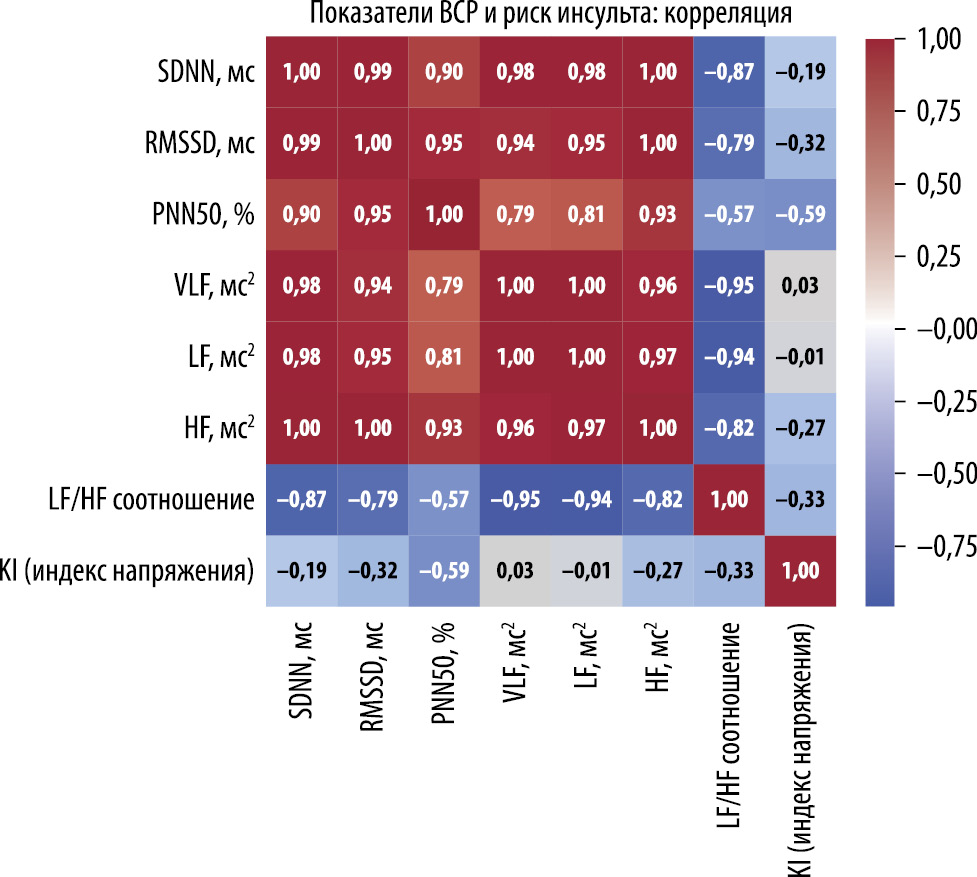
Показатели ВСР и риск инсульта (тепловая корреляционная таблица).
Связь между СДВНС и риском развития инсульта прослеживалась на основании анализа параметров ВСР. У пациентов с пароксизмальной формой СДВНС было выявлено значительное снижение спектральных показателей — VLF, LF и HF компонентов, что коррелировало с повышенным риском развития инсульта. У больных с перманентным течением СДВНС такой риск оказался относительно ниже и составил 9,5%, в то время как у пациентов с пароксизмальной формой он достигал 17,1%. Несмотря на это, даже при перманентной форме риск инсульта оставался выше, чем в контрольной группе, где он составлял 7,5%. У пациентов с СДВНС отмечался достоверно повышенный риск развития инсульта в периоды выраженной геомагнитной активности. В частности, в дни с высокой интенсивностью геомагнитных возмущений (Kp≥7) риск инсульта возрастал в 3,5 раза (p< 0,01). Наиболее выраженные изменения регистрировались у пациентов с пароксизмальной формой СДВНС, для которых было характерно существенное повышение соотношения LF/HF наряду с выраженным снижением спектральной мощности, что свидетельствовало о дисбалансе вегетативной регуляции и нарушении стабильности сердечного ритма.
Корреляционный анализ выявил сильные взаимосвязи между параметрами ВСР и предполагаемым риском инсульта. Установлена обратная корреляция между SDNN и риском инсульта (r=–0,995), что указывает на то, что чем ниже значение SDNN, тем выше вероятность развития инсульта. Аналогично между RMSSD и риском инсульта наблюдается выраженная отрицательная корреляция (r=–0,991). Спектральные показатели также демонстрировали аналогичную тенденцию: коэффициент корреляции между VLF и риском инсульта составил –0,964, а между LF и риском инсульта –0,973. Корреляция между HF и риском инсульта достигала –0,997, что подтверждает ведущую роль снижения парасимпатической активности в формировании сосудистых рисков. Напротив, соотношение LF/HF показывало прямую корреляцию с риском инсульта (r=0,841), отражающую рост симпатической активности как провоцирующего фактора.
Результаты анализа показали, что снижение временных и спектральных параметров ВСР, в частности SDNN, RMSSD и HF, достоверно связано с повышенным риском инсульта. Одновременно с этим увеличение симпатовагального соотношения (LF/HF) указывает на нарастающее преобладание симпатического отдела вегетативной нервной системы. Под действием сильных магнитных бурь (уровня G3 и выше) наблюдалось общее угнетение параметров ВСР, особенно SDNN и RMSSD, что подтверждает высокий уровень вегетативного стресса в эти периоды. У пациентов с пароксизмальной формой СДВНС такие изменения фиксировались при уровне геомагнитной активности от G1 до G3 (индекс Kp от 4 до 9). В этих условиях преобладание симпатической активности сопровождалось значительным повышением риска инсульта, достигающим 17,1%.
Обсуждение
Вариабельность сердечного риска является наиболее надежным методом оценки симпатической и парасимпатической направленности. С помощью аппарата для оценки ВНС были изучены влияние магнитных бурь на сердечно-сосудистую систему. Исследования показали значительные изменения показателей ВСР у пациентов с СДВНС и инсультом во время магнитных бурь. Согласно литературным данным у пациентов с инсультом также выявлены выраженные изменения показателей ВСР во время геомагнитных возмущений [15, 16]. Вариабельность диапазона частоты сердечных сокращений (SDNN, RMSSD, PNN50) снижается под влиянием магнитных бурь, что свидетельствует о дисбалансе вегетативного управления сердцем.
В ходе исследований в дни, когда магнитная буря была сильной (индекс Kp 5—7), показатели ВСР пациентов резко снижались, в то время как SDNN снижалась на 15—25%, что указывает на гиперактивацию симпатического компонента в вегетативном контроле. При этом снижался парасимпатический тонус (снижались показатели средней частоты сердечных сокращений), что провоцировало стресс и вегетативный дисбаланс в сердечно-сосудистой системе.
Во время магнитных бурь наблюдаются резкие изменения в функции сердечно-сосудистой системы и ЦНС. Исследования показывают, что во время магнитных бурь у пациентов с СДВНС риск инсульта увеличивается в 2,5—3 раза. Наблюдения с помощью аппарата для оценки ВНС подтвердили связь между изменениями в кардиоваскулярной системе во время магнитных бурь и развитием инсульта.
Следует отметить, что данное исследование не ставило целью регистрацию случаев инсульта. Основное внимание было сосредоточено на анализе параметров ВСР как биомаркеров вегетативного дисбаланса, возникающего при изменениях геомагнитного поля. Следовательно, обсуждение риска инсульта носит гипотетический характер, основанный на ранее установленной связи между снижением ВСР и повышенной вероятностью цереброваскулярных событий, что подтверждено литературными источниками.
Исследования показали, что во время магнитных бурь возникает дисбаланс между симпатической и парасимпатической частями сердечно-сосудистой системы, который регистрируется через ВСР. В дни, когда магнитная буря усиливается, в сердечно-сосудистой системе возникают стрессовые реакции из-за повышения симпатического тонуса, что значительно повышает риск развития инсульта.
Результаты исследования показали, что в дни, когда магнитные бури усиливались (Kp≥5—7), показатели ВСР у пациентов с СДВНС значительно снижались. Особенно при пароксизмальной форме наблюдалось повышенное соотношение LF/HF и снижение спектральной силы VLF, что подтверждает вегетативный дисбаланс и гиперчувствительность к стрессу во время магнитных бурь.
Заключение
Результаты проведенного исследования показали, что значения ВСР значительно изменяются под воздействием магнитных бурь, особенно у пациентов с СДВНС. При пароксизмальной форме заболевания выявлено более выраженное снижение временных параметров (SDNN, RMSSD) и спектральных показателей (HF, LF), что сопровождается повышением риска инсульта в периоды высокой геомагнитной активности (Kp> 5).
Корреляционный анализ установил наличие сильной взаимосвязи между снижением параметров ВСР и вероятностью развития инсульта (r>0,8; p<0,01), что подтверждает их прогностическую значимость.
Таким образом, мониторинг показателей ВСР с использованием аппаратно-программного комплекса для оценки ВНС может рассматриваться как эффективный инструмент для раннего выявления риска инсульта и разработки профилактических мероприятий у пациентов с СДВНС, особенно в периоды интенсивных магнитных бурь.
Авторы заявляют об отсутствии конфликта интересов.
- Адамбаев З.И., Киличев И.А., Худайбергенов Н.Ю. Сочетанное влияние высоких температур и магнитных бурь на развитие инсультов у мужчин в регионе Приаралья. Журнал неврологии и нейрохирургических исследований. 2025;1:38-41. https://doi.org/10.5281/zenodo.14872377
- Chai Z, Wang Y, Li YM, et al. Chen M. Correlations between geomagnetic field and global occurrence of cardiovascular diseases: evidence from 204 territories in different latitude. BMC Public Health. 2023;23(1):1771.
- Erdmann W, Kmita H, Kosicki JZ, et al. How the Geomagnetic Field Influences Life on Earth — An Integrated Approach to Geomagnetobiology. Orig Life Evol Biosph. 2021;51(3):231-257. https://doi.org/10.1007/s11084-021-09612-5
- Mayrovitz HN. Linkages Between Geomagnetic Activity and Blood Pressure. Cureus. 2023;15(9):e45637. https://doi.org/10.7759/cureus.45637
- Михайлис А.А., Микуляк Н.И., Вершинина О. Д. Влияние вспышечной активности солнца и геомагнитных бурь на цикличность проявления церебральных и коронарных сосудистых катастроф. Вестник высших учебных заведений. Медицинские науки. Патологическая физиология. 2019;2(50):152-163. https://doi.org/10.21685/2072-3032-2019-2-14
- Sarimov RM, Serov DA, Gudkov SV. Biological Effects of Magnetic Storms and ELF Magnetic Fields. Biology (Basel). 2023;12(12):1506. https://doi.org/10.3390/biology12121506
- Arakaki X, Arechavala RJ, Choy EH, et al. The connection between heart rate variability (HRV), neurological health, and cognition: A literature review. Front Neurosci. 2023;17:1055445. https://doi.org/10.3389/fnins.2023.1055445
- Hasty F, Garcia G, Davila CH, et al. Heart rate variability as a possible predictive marker for acute inflammatory response in COVID-19 patients. Mil Med. 2020;186:34-38. https://doi.org/10.1093/milmed/usaa405
- Hayano J, Kisohara M, Ueda N, et al. Impact of heart rate fragmentation on the assessment of heart rate variability. Appl Sci. 2020;10:3314. https://doi.org/10.3390/app10093314
- Imbimbo C, Spallazzi M, Ferrari-Pellegrini F, et al. Heart rate variability and cognitive performance in adults with cardiovascular risk. Cereb Circ Cogn Behav. 2022;3:100-136. https://doi.org/10.1016/j.cccb.2022.100136
- Kim HG, Cheon EJ, Bai DS, et al. Stress and heart rate variability: a meta-analysis and review of the literature. Psychiatry Investig. 2018;15:235-245. https://doi.org/10.30773/pi.2017.08.17
- Li C, Meng X, Pan Y, et al. The association between heart rate variability and 90-day prognosis in patients with transient ischemic attack and minor stroke. Front Neurol. 2021;12:636474. https://doi.org/10.3389/fneur.2021.636474
- Mantantzis K, Schlaghecken F, Maylor EA. Heart rate variability predicts older adults’ avoidance of negativity. J Gerontol B Psychol Sci Soc Sci. 2020;75:1679-1688. https://doi.org/10.1093/geronb/gby148
- Song R, Pan KY, Xu H, et al. Association of cardiovascular risk burden with risk of dementia and brain pathologies: a population-based cohort study. Alzheimers Dement. 2021;17:1914-1922. https://doi.org/10.1002/alz.12343
- Barak Oto F, Glazačev OS, Dudnik HN, et al. Peculiarities of the autonomic balance assessed through heart rate variability analysis in sportsmen and nonsportsmen. Zdravstvena zaštita. 2008;114:17-25. https://doi.org/10.2298/zmspn0814017b
- Binici Z, Mouridsen MR, Køber L, et al. Decreased nighttime heart rate variability is associated with increased stroke risk in apparently healthy subjects with no history of stroke. Stroke. 2011;42(11):3196-3201. https://doi.org/10.1161/STROKEAHA.110.607697




Рекомендуем статьи по данной теме:
Клинико-функциональные особенности болезни Паркинсона при хронической болезни почек.Журнал неврологии и психиатрии им. С.С. Корсакова. 2026;126(8):79-85
Риноманометрия в оценке вегетативной регуляции организма человека.Российская ринология. 2026;34(2):13-24
Нарушения вегетативной регуляции у больных с ортостатической гипотензией, вазовагальными обмороками и синдромом постуральной ортостатической тахикардии.Кардиологический вестник. 2026;21(2):57-64
Сосудистая жесткость и вегетативный статус у лиц молодого возраста в аспекте совершенствования их ангиологического скрининга.Профилактическая медицина. 2026;29(4):51-60
Вариабельность сердечного ритма как предиктор тяжести острого аппендицита: проспективное аналитическое исследование.Хирургия. Журнал им. Н.И. Пирогова. 2026;(3):57-62
Влияние сезонности и планетарного индекса геомагнитной активности на артериальное давление и частоту сердечных сокращений.Кардиологический вестник. 2025;20(4-2):126-134
Клинико-патогенетическое обоснование комплексного применения лечебных физических факторов у пациентов с вазомоторным ринитом при проведении холодно-плазменной вазотомии нижних носовых раковин.Восстановительные биотехнологии, профилактическая, цифровая и предиктивная медицина. 2025;2(4):5-13
Влияние функционального статуса автономной нервной системы на развитие и течение привычно-избыточного напряжения аккомодации.Вестник офтальмологии. 2025;141(6):44-51
Роль нейровоспаления в формировании судорожной активности и вегетативных расстройств при эпилепсии.Журнал неврологии и психиатрии им. С.С. Корсакова. 2025;125(8):50-58
Возможности применения кортикальной электрической стимуляции для исследования вегетативной дисфункции у пациентов с эпилепсией.Журнал неврологии и психиатрии им. С.С. Корсакова. 2025;125(8):25-34