Поиск информативных предикторов развития и прогрессирования рассеянного склероза
Журнал: Журнал неврологии и психиатрии им. С.С. Корсакова. 2025;125(9):124-130.
DOI: 10.17116/jnevro2025125091124
Прочитано: 1686 раз
Резюме
ЦЕЛЬ ИССЛЕДОВАНИЯ
Выявление информативных предикторов развития и прогрессирования рассеянного склероза (РС) на основании полигенного анализа ассоциаций полиморфных вариантов в генах IL1R1, IL10, IL12B, IL2, IL2RA и IL7R.
МАТЕРИАЛ И МЕТОДЫ
В группе исследования, состоявшей из 247 пациентов с РС и 1271 представителей группы контроля, выполнен анализ ассоциаций с развитием и прогрессированием РС полиморфных вариантов генов IL1R1, IL10, IL12B, IL2, IL2RA, IL7 и IL7R. Проведен поиск комбинаций аллельных вариантов, ассоциированных с заболеванием, с использованием программы APSampler, построены прогностические модели развития и прогрессирования РС при помощи метода многофакторной логистической регрессии с пошаговым включением переменных.
РЕЗУЛЬТАТЫ
Повышенная вероятность РС связана с полиморфными вариантами IL1R1 rs2287047 (рецессивная модель, OR=2,2, pFDR=0,022), IL7R rs1494558 (лог-аддитивная модель, OR=1,49, pDR=0,003) и генотипом IL2RA rs12722580*I/D (кодоминантная модель, OR=1,67, pFDR=0,03). Сниженный риск РС ассоциирован с вариантами IL10 rs1800872 (рецессивная модель, OR=0,38, pFDR=0,044), IL7R rs10624573 (доминантная модель, OR=0,67, pFDR=0,022), IL7R rs6897932 (рецессивная модель, OR=0,21, pFDR=0,008) и генотипом IL2RA rs12722580* D/D (кодоминантная модель, OR=0,78, pFDR=0,03). Выявлены сочетания (IL7R rs1494558*T+IL7R rs6897932*T, IL1R1 rs2287047*C+IL12B rs3212227*C и IL7R rs1494558*T/C+IL12B rs3212227*A), обладающие синергетическим эффектом, и созданы предиктивные модели риска развития и прогрессирования РС с достаточно высокой прогностической значимостью.
ЗАКЛЮЧЕНИЕ
Результаты исследования подчеркивают важность полиморфных вариантов IL7R, IL1R1, IL2RA и IL10 в формировании наследственной предрасположенности к РС. Полученные модели требуют валидации и могут быть дополнены другими предикторами для повышения точности, однако демонстрируют важные патогенетические закономерности и направления для дальнейшего изучения.
Ключевые слова
- рассеянный склероз
- интерлейкины
- генетический полиморфизм
- анализ ассоциаций
- прогностическая модель
- предиктивная медицина
Дата поступления: 13.11.2024
Дата принятия в печать: 10.01.2025
Дата публикации: 06.10.2025
Рассеянный склероз (РС) — это хроническое, прогрессирующее демиелинизирующее заболевание центральной нервной системы, основой которого является аутоиммунное воспаление. Хотя молекулярные механизмы этиопатогенеза РС еще не до конца изучены, ключевую роль в этом процессе играют аутореактивные иммунные клетки, которые посредством секреции цитокинов и активации воспалительного каскада способствуют формированию демиелинизирующих бляшек. Цитокиновый сигналинг, обеспечиваемый взаимодействием различных цитокинов, включая интерлейкины, с их рецепторами, способствует реализации основных патогенетических механизмов РС.
Исследования показали, что взаимодействие интерлейкина-7 (IL-7) с гетеродимерным рецепторным комплексом, включающим высокоаффинную цепь IL-7Rα и общую цитокиновую γc-цепь, играет значимую роль в развитии T- и B-лимфоцитов, поддержании клеток памяти (CD4+T-клеток) и апоптозе [1]. Обнаружена связь взаимодействия IL-7/IL-7Rα с РС и его экспериментальной моделью — аутоиммунным энцефаломиелитом (ЭАЭ) [2]. Другой важный сигнальный путь включает IL-2, реализующий свои эффекты через взаимодействие с рецептором IL-2R, который может существовать в трех различных формах: мономерной, состоящей из IL-2Rα; гетеромерной, включающей IL-2Rβ и γc-цепь; и тримерной, объединяющей все три цепи [3]. IL-2Rα может также отделяться от поверхности активированных иммунных клеток, образуя sIL-2R [4]. Взаимодействие IL-2/IL-2R обладает двойственным действием, с одной стороны, стимулируя иммунный ответ за счет дифференцировки и пролиферации эффекторных CD4+T-клеток, а с другой стороны, поддерживая иммунотолерантность и гомеостаз благодаря индукции и выживанию Treg, а также инициации апоптоза клеток [5]. Сигнальный путь IL-1/IL-1R1 оказывает влияние на дифференцировку IL-17-продуцирующих T-клеток (Th-17), которые участвуют в аутоиммунных реакциях [6, 7]. IL-12B (β-субъединица IL-12) играет важную роль в дифференцировке T-клеток в Th1-клетки, связанной с рецидивами РС; уровень IL-12B повышен в демиелинизирующих бляшках и цереброспинальной жидкости у пациентов с РС [8]. IL-6 — мощный индуктор острофазового ответа, секретируемый T- и B-клетками, макрофагами, микроглией, а также неиммунными клетками, такими как эндотелиальные клетки и нейроны [9]. Установлено, что в активных бляшках больных РС уровень IL-6 повышен, а у мышей с выключенным IL6 наблюдается устойчивость к ЭАЭ [9, 10]. IL-10 оказывает выраженное нейропротекторное действие при РС и ЭАЭ, модулируя аномальную нейрональную активность, связанную с воспалительными медиаторами [11, 12].
Идентифицированы ассоциации, в том числе полногеномные, между полиморфными вариантами генов IL1R1, IL10, IL12B, IL2, IL2RA, IL7 и IL7R и развитием РС, а также различными формами течения и прогрессированием заболевания [13—19]. Было показано, что эффект аллелей риска может варьировать в разных популяциях [20—22]. Современные данные указывают на системное и плейотропное действие интерлейкинов в развитии РС, поэтому анализ полиморфных вариантов генов интерлейкинов и их взаимодействий становится особенно важным направлением для прогнозирования риска заболевания.
Цель исследования — выявление информативных предикторов развития и прогрессирования РС на основании полигенного анализа ассоциаций полиморфных вариантов в генах IL1R1, IL10, IL12B, IL2, IL2RA и IL7R.
Материал и методы
Группа пациентов с РС состояла из 247 человек (114 русских, 98 татар, 35 башкир) с достоверным диагнозом РС по критериям McDonald [23], находившихся под наблюдением в Республиканском центре рассеянного склероза на базе Республиканской клинической больницы имени Г.Г. Куватова (г. Уфа) в период с 2000 по 2020 г. Средний возраст пациентов на момент включения в исследование составил 38,9±9,99 года, средний возраст манифестации заболевания 28,53±8,68 года. Соотношение женщин и мужчин среди пациентов равнялось 2,1:1 (167:80). Среди больных РС выделена группа пациентов (n=44, 16 мужчин и 28 женщин), у которых в течение периода наблюдения не отмечалось прогрессирования заболевания. Группа контроля включала 1271 практически здорового человека (448 русских, 642 татар, 181 башкир, средний возраст 38,1±10,57 года) без признаков РС и других аутоиммунных или нейродегенеративных заболеваний.
Методики выделения ДНК и генотипирования для исследуемых полиморфизмов описаны ранее [24—26]. Проверку распределения частот генотипов и аллелей проводили по закону Харди—Вайнберга. Для оценки ассоциации полиморфизмов с заболеванием использовали показатель отношения шансов (OR, odds ratio). Ассоциации оценивали в среде R с помощью пакета SNPassoc (версия 2.1-0) используя доминантную, кодоминантную, сверхдоминантную, рецессивную и лог-аддитивную модели наследования [27]. В доминантной модели гомозиготы по референсному аллелю сравнивали с гетерозиготами и гомозиготами по вариантному аллелю, в рецессивной — гомозиготы по вариантному аллелю с остальными. Сверхдоминантная модель включала сравнение гетерозигот с обоими гомозиготами, а кодоминантная — сравнение всех типов. Лог-аддитивная модель учитывала эффекты одного и двух вариантных аллелей.
Для идентификации сочетаний аллелей, связанных с заболеванием, использовался APSampler (версия 3.6.0) (https://apsampler.sourceforge.net/) [28]. Для корректировки на множественные сравнения и уменьшения вероятности ошибки первого рода применяли метод Бенджамини-Хохберга для контроля уровня FDR (False Discovery Rate) [29]. Оценку возможного нелинейного взаимодействия между двумя элементами сочетаний проводили при помощи фактора синергии SF [30]. Прогностические модели строились с использованием многофакторной логистической регрессии с пошаговым включением переменных, в качестве которых выступали отдельные полиморфные варианты в оптимальной модели, а также парные сочетания со значимым показателем SF.
Работа проводилась в соответствии с этическими принципами исследований, включающих участие человека в качестве субъекта. Все участники дали добровольное письменное информированное согласие на участие в исследовании.
Результаты
Согласно результатам анализа ассоциаций с риском развития РС, повышенная вероятность заболевания связана с полиморфными вариантами IL1R1 rs2287047 (рецессивная модель, OR=2,2; pFDR=0,022), IL7R rs1494558 (лог-аддитивная модель, OR=1,49; pFDR=0,003) и генотипом IL2RA rs12722580*I/D (кодоминантная модель, OR=1,67; pFDR=0,03). Напротив, сниженный риск ассоциирован с вариантами IL10 rs1800872 (рецессивная модель, OR=0,38; pFDR=0,044), IL7R rs10624573 (доминантная модель, OR=0,67; pFDR=0,022), IL7R rs6897932 (рецессивная модель, OR=0,21; pFDR=0,008) и генотипом IL2RA rs12722580* D/D (кодоминантная модель, OR=0,78; pFDR=0,03) (табл. 1).
Таблица 1. Результаты анализа ассоциаций исследуемых полиморфных вариантов с РС
Ген SNP | Генотип | Контроль, % | РС, % | pHWE | Модель | OR 95%CIOR | p | pFDR |
IL10 rs1800872 | C/C | 52,7 | 60,3 | Рецессивная (C/C-C/A vs. A/A) | 0,38 0,15—0,95 | 0,026 | 0,044 | |
C/A | 37,6 | 35,8 | ||||||
A/A | 9,8 | 4 | ||||||
IL1R1 rs2287047 | C/C | 43,3 | 33,3 | Рецессивная (C/C-T/C vs. T/T) | 2,2 1,22—3,94 | 0,009 | 0,022 | |
T/C | 47,6 | 48,7 | ||||||
T/T | 9,1 | 18 | ||||||
IL2 rs2069772 | T/T | 40,2 | 39,1 | Лог-аддитивная (0,1,2) | 1,04 0,83—1,31 | 0,733 | 0,733 | |
T/G | 49,2 | 49,6 | ||||||
G/G | 10,7 | 11,3 | ||||||
IL7R rs10624573 | D/D | 39,6 | 49,6 | Доминантная (D/D vs. I/D-I/I) | 0,67 0,5—0,89 | 0,007 | 0,022 | |
I/D | 44,3 | 38,3 | ||||||
I/I | 16,1 | 12,1 | ||||||
IL7R rs1494558 | C/C | 39,3 | 29,2 | Лог-аддитивная (0,1,2) | 1,49 1,2—1,86 | 2,97·10–4 | 0,003 | |
C/T | 45,6 | 45,1 | ||||||
T/T | 15,1 | 25,8 | ||||||
IL7R rs6897932 | C/C | 57,8 | 55,8 | Рецессивная (C/C-C/T vs. T/T) | 0,21 0,07—0,7 | 0,002 | 0,008 | |
C/T | 36,1 | 42,9 | ||||||
T/T | 6,2 | 1,4 | ||||||
IL12B rs3212227 | A/A | 63,7 | 60 | Лог-аддитивная (0,1,2) | 1,16 0,83—1,62 | 0,392 | 0,436 | |
A/C | 31,7 | 33,8 | ||||||
C/C | 4,7 | 6,2 | ||||||
IL6 rs1800796 | G/G | 80,9 | 78,1 | Сверхдоминантная (G/G-C/C vs. G/C) | 1,24 0,78—1,96 | 0,369 | 0,436 | |
G/C | 17,4 | 20,6 | ||||||
C/C | 1,7 | 1,2 | ||||||
IL2RA rs1570538 | C/C | 26,6 | 25,2 | Сверхдоминантная (C/C-T/T vs. T/C) | 1,31 0,97—1,76 | 0,076 | 0,108 | |
T/C | 49,4 | 56,1 | ||||||
T/T | 24 | 18,7 | ||||||
IL2RA rs12722580 | I/I | 48,3 | 50,8 | Кодоминантная (I/D vs. I/I и D/D vs. I/I) | 0,015 | 0,030 | ||
I/D | 44,4 | 36,4 | 0,78 0,5—1,07 | |||||
D/D | 7,3 | 12,8 | 1,67 1,01—2,78 |
Примечание. pHWE — уровень значимости для точного теста на соответствие равновесию Харди–Вайнберга для контрольной группы; OR – отношение шансов; 95% CIOR — 95% доверительный интервал для показателя отношения шансов; p — уровень значимости, pFDR — уровень значимости с поправкой Бенджамини—Хохберга на множественность сравнений; модель отбиралась на основании информационного критерия Акаике.
С помощью программы APSampler, использующей метод Монте-Карло на основе марковских цепей, проведен анализ возможных комбинаций генетических вариантов, ассоциированных с риском РС. В составах комбинаций, связанных с высоким риском РС, чаще всего встречались генотипы и аллели IL12B rs3212227, IL7R rs6897932, IL7R rs1494558, IL2RA rs1570538, IL2 rs2069772, IL10 rs1800872, IL6 rs1800796 и IL1R1 rs2287047 (табл. 2). Наибольший риск развития РС выявлен у носителей комбинаций IL7RA rs6897932*Т, IL7R rs1494558*Т, IL2RA rs1570538*Т и IL1R1 rs2287047*Т (OR=7,73; pFDR=0,041) и IL7RA rs6897932*Т, IL7R rs1494558*Т/Т и IL6 rs1800796*G (OR=7,48; pFDR=0,020) (см. табл. 2). Важно отметить, что величина риска и эффект аллелей зависели от других компонентов в паттерне. В результате анализа нелинейных взаимодействий в выявленных сочетаниях наиболее значимый синергетический эффект был обнаружен для пар IL7R rs1494558*T+IL7R rs6897932*T (SF=4,62; 95% CISF 2,12—10,04, Z=3,87, p=1,1·10–4) и IL1R1 rs2287047*C+IL12B rs3212227*C (SF=3,72; 95% CISF 1,02—13,63, Z=–1,98, p=0,047).
Таблица 2. Сочетания аллелей и генотипов исследуемых полиморфных локусов, ассоциированные с повышенным риском и прогрессированием РС
IL1R1 rs2287047 | IL2 rs2069772 | IL2RA rs1570538 | IL2RA rs12722580 | IL6 rs1800796 | IL7R rs1494558 | IL7R rs6897932 | IL12B rs3212227 | Контроль, % | Опыт, % | OR 95% CIOR | p | pFDR |
Сочетания, ассоциированные с РС: | ||||||||||||
— | — | T | — | — | — | T | C | 3,91 | 17,80 | 5,33 1,94—14,64 | 3,30·10—4 | 0,026 |
C | G | T | — | — | — | — | C | 3,88 | 16,81 | 5,01 1,82—13,82 | 6,14·10–4 | 0,034 |
— | — | — | — | G | T/T | T | — | 0,00 | 9,77 | 7,48 2,45—22,81 | 1,57·10–4 | 0,020 |
T | — | T | — | — | T | T | — | 3,74 | 23,08 | 7,73 2,60—22,92 | 1,45·10–5 | 0,041 |
Сочетания, ассоциированные с прогрессированием РС: | ||||||||||||
— | — | — | — | G | T/C | — | A | 9,52 | 44,14 | 7,51 1,67—33,80 | 0,002 | 1 |
— | T | — | — | — | T/C | — | A | 9,52 | 42,72 | 7,08 1,57—32,02 | 0,003 | 1 |
C/C | G | — | D | — | — | C | — | 33,33 | 9,38 | 0,21 0,07—0,65 | 0,009 | 1 |
На основании полученных данных методом многофакторной логистической регрессии с пошаговым включением наиболее значимых предикторов, в качестве которых выступали ассоциированные с РС полиморфные варианты в оптимальной модели (см. табл. 2), а также выявленные парные сочетания со значимыми показателями SF, была построена прогностическая модель (табл. 3), которая, по данным ROC-анализа, продемонстрировала достаточно высокую прогностическую эффективность (AUC=0,7, χ2=24,35, p=6,8·10–5) (рис. 1, а).
Таблица 3. Коэффициенты уравнения логистической регрессии для многофакторных моделей расчета генетического риска развития и прогрессирования РС
Предиктор | Beta | p | OR | 95% CIOR |
Модель повышенного риска развития РС | ||||
IL10 rs1800872*A/A | –0,97 | 0,049 | 0,38 | 0,12—0,99 |
IL1R1 rs2287047*T/T | 0,91 | 0,047 | 2,47 | 1,03—6,85 |
IL2RA rs1570538*T/C | 0,73 | 0,023 | 2,09 | 1,11—3,92 |
IL7R rs1494558*T+IL7R rs6897932*T | 1,26 | 0,002 | 3,54 | 1,6—7,83 |
Константа | –0,35 | 0,147 | 0,70 | |
Модель повышенного риска прогрессирования РС | ||||
IL1R1 rs2287047*C/C+IL2RA rs12722580*D | –1,484 | 0,017 | 0,227 | 0,07—0,77 |
IL7R rs1494558*C/T+IL12B rs3212227*A | 1,808 | 0,023 | 6,101 | 1,29—28,88 |
Константа | 1,359 | 0,000 | 3,893 | |
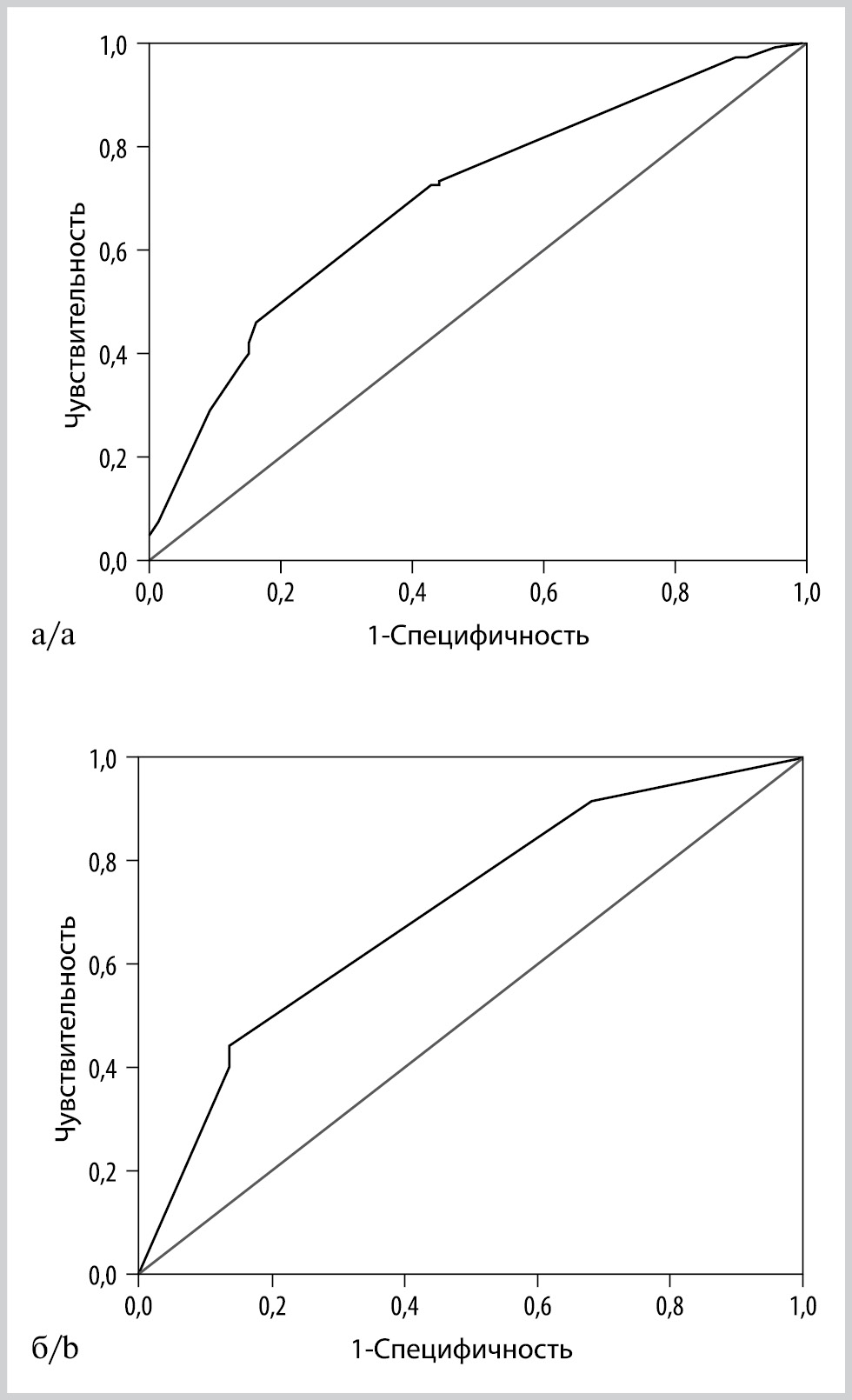
ROC-анализ эффективности моделей, построенной на основе генетических маркеров индивидуального риска развития (а) и прогрессирования (б) РС.
При дальнейшем анализе были выявлены сочетания генетических вариантов, ассоциированных с прогрессированием заболевания, среди которых наиболее часто были представлены варианты IL12B rs3212227 и IL7R rs1494558, хотя статистическая значимость обнаруженных ассоциаций терялась при корректировке на множественные сравнения (см. табл. 2). Наиболее значимые синергетические эффекты были установлены для взаимодействий IL12B rs3212227*A и IL7R rs1494558*T/C (SF=36,05, 95% CISF 1,09—1190,14, Z=2,01, p=0,045), а также, на уровне тенденции, для взаимодействий IL1R1 rs2287047*C/C и IL2RA rs12722580*D (SF=0,17, 95% CISF 0,02—1,34, Z=–1,68, p=0,092). Была построена прогностическая модель прогрессирования РС (см. табл. 3), продемонстрировавшая достаточно высокую эффективность (AUC=0,7, p=0,001) (рис. 1, б).
Обсуждение
Выявлены ассоциации полиморфных вариантов генов IL7R (rs1494558, rs10624573 и rs6897932), IL1R1 (rs2287047), IL2RA (rs12722580) и IL10 (rs1800872) с риском развития РС. Также обнаружены сочетания (IL7R rs1494558*T+IL7R rs6897932*T, IL1R1 rs2287047*C+IL12B rs3212227*C и IL7R rs1494558*T/C+IL12B rs3212227*A), обладающие синергетическим эффектом, и созданы предиктивные модели риска развития и прогрессирования РС с высокой прогностической значимостью.
Согласно нашим данным, значимый вклад в предрасположенность к РС вносят полиморфные варианты гена альфа-цепи рецептора IL-7 (IL7R). IL-7 играет ключевую роль в развитии и поддержании гомеостаза T-клеток, взаимодействуя с рецептором, включающим альфа-цепь (IL-7Rα), кодируемую геном IL7R, и γc-цепь, общую для IL-2, IL-4, IL-9, IL-15 и IL-21 [31]. Полиморфизм rs6897932C>T, приводящий к замене Thr244Ile в экзоне 6, влияет на пропуск экзона, снижая образование растворимого рецептора sIL-7Rα [13, 32]. Аллель C и генотип C/C полиморфного варианта IL7R rs6897932 ассоциированы с риском РС у европейцев, но не у азиатских популяций [33—35]. Вариант rs6897932 сцеплен с rs1494558C>T (Thr66Ile) в экзоне 2 гена IL7R (r²=0,161, C=T, T=C), и установлено, что аллель rs1494558*T связан с повышением уровней mIL-7Rα и sIL-7Rα, а также с повышенным риском РС [36].
Другой ассоциированный с РС полиморфизм, rs2287047C>T, находится в интроне 1 гена IL1R1, который кодирует рецептор, связывающийся с IL-1α или IL-1β и активирующий сигнальные пути NF-κB и MAPK, что приводит к усилению экспрессии провоспалительных цитокинов и хемокинов. Сообщается, что аллель rs2287047*T связан с уменьшенной экспрессией IL1R1 [37].
Несмотря на то, что мы не обнаружили индивидуальных ассоциаций полиморфного варианта IL12B rs3212227 с РС, аллель C данного локуса представлен в сочетаниях, ассоциированных с развитием заболевания, а аллель A — в сочетаниях, связанных с его прогрессированием. Полиморфизм rs3212227A>C находится в 3′ нетранслируемой области гена IL12B; показано, что у здоровых людей с генотипом rs3212227*C/C уровень IL-12 в плазме значительно выше, чем у гетерозигот и гомозигот по аллелю A [38]. Генотип IL12B rs3212227*C/C ассоциирован с РС у жителей Ирана [39] и связан с прогрессированием РС в чешской популяции [40]. В исследовании, выполненном в болгарской популяции, получены данные о том, что эффект полиморфизма IL12B rs3212227 может зависеть от пола [41]. Проведенный метаанализ подтвердил связь данного варианта с РС, не зависящую от этнического происхождения (европеоидного или азиатского) [42].
Заключение
Данное исследование было сосредоточено на одном из ключевых аспектов молекулярной патогенеза РС — цитокиновом сигнальном пути, в то время как другие значимые факторы, такие как гены HLA, остались за рамками анализа. Тем не менее, даже при таком ограничении, наши результаты позволяют предполагать, что полиморфные варианты генов IL7R (rs1494558, rs10624573 и rs6897932), IL1R1 (rs2287047), IL2RA (rs12722580) и IL10 (rs1800872) вносят значимый вклад в наследственную предрасположенность к развитию РС. Полученные нами прогностические модели развития и прогрессирования РС обладают умеренной предсказательной способностью и требуют проверки на независимых выборках. Их точность, вероятно, можно повысить за счет включения дополнительных предикторов, что станет задачей для дальнейших исследований. Тем не менее, полученные модели демонстрируют важные закономерности. В частности, обнаруженные синергетические взаимодействия между генотипами и аллелями в комбинациях IL7R rs1494558T и IL7R rs6897932T, IL1R1 rs2287047C и IL12B rs3212227C, а также IL7R rs1494558T/C и IL12B rs3212227A могут значительно усиливать прогностическую силу модели. Детальное изучение природы этих взаимодействий и их влияния на риск развития и прогрессирование РС является перспективным направлением для дальнейших исследований.
Авторы заявляют об отсутствии конфликта интересов.
- Azizi G, Van den Broek B, Ishikawa LLW, et al. IL-7Rα on CD4(+) T cells is required for their survival and the pathogenesis of experimental autoimmune encephalomyelitis. J Neuroinflammation. 2024;21(1):253. https://doi.org/10.1186/s12974-024-03224-2
- Arbelaez CA, Glatigny S, Duhen R, et al. IL-7/IL-7 Receptor Signaling Differentially Affects Effector CD4+ T Cell Subsets Involved in Experimental Autoimmune Encephalomyelitis. J Immunol. 2015;195(5):1974-1983. https://doi.org/10.4049/jimmunol.1403135
- Peerlings D, Mimpen M, Damoiseaux J. The IL-2 — IL-2 receptor pathway: Key to understanding multiple sclerosis. J Transl Autoimmun. 2021;4:100123. https://doi.org/10.1016/j.jtauto.2021.100123
- Lin M, Park S, Hayden A, et al. Clinical utility of soluble interleukin-2 receptor in hemophagocytic syndromes: a systematic scoping review. Ann Hematol. 2017;96(8):1241-1251. https://doi.org/10.1007/s00277-017-2993-y
- Klatzmann D, Abbas AK. The promise of low-dose interleukin-2 therapy for autoimmune and inflammatory diseases. Nat Rev Immunol. 2015;15(5):283-294. https://doi.org/10.1038/nri3823
- Luís JP, Simões CJV, Brito RMM. The Therapeutic Prospects of Targeting IL-1R1 for the Modulation of Neuroinflammation in Central Nervous System Disorders. Int J Mol Sci. 2022;23(3):1731. https://doi.org/10.3390/ijms23031731
- Lee Y, Awasthi A, Yosef N, et al. Induction and molecular signature of pathogenic TH17 cells. Nat Immunol. 2012;13(10):991-999. https://doi.org/10.1038/ni.2416
- Burman J, Zjukovskaja C, Svenningsson A, et al. Cerebrospinal fluid cytokines after autologous haematopoietic stem cell transplantation and intrathecal rituximab treatment for multiple sclerosis. Brain Communications. 2023;5(1):fcad011. https://doi.org/10.1093/braincomms/fcad011
- Göbel K, Ruck T, Meuth SG. Cytokine signaling in multiple sclerosis: Lost in translation. Mult Scler. 2018;24(4):432-439. https://doi.org/10.1177/1352458518763094
- Kleiter I, Ayzenberg I, Araki M, et al. Tocilizumab, MS, and NMOSD. Mult Scler. 2016;22(14):1891-1892. https://doi.org/10.1177/1352458516643395
- Gilio L, Buttari F, Pavone L, et al. Fatigue in Multiple Sclerosis Is Associated with Reduced Expression of Interleukin-10 and Worse Prospective Disease Activity. Biomedicines. 2022;10(9):2058. https://doi.org/10.3390/biomedicines10092058
- Mandolesi G, Centonze D, Furlan R, et al. Interleukin-10 contrasts inflammatory synaptopathy and central neurodegenerative damage in multiple sclerosis. Front Mol Neurosci. 2024;17. https://doi.org/10.3389/fnmol.2024.1430080
- Gregory SG, Schmidt S, Seth P, et al. Interleukin 7 receptor alpha chain (IL7R) shows allelic and functional association with multiple sclerosis. Nat Genet. 2007;39(9):1083-1091. https://doi.org/10.1038/ng2103
- Beecham AH, Patsopoulos NA, Xifara DK, et al. Analysis of immune-related loci identifies 48 new susceptibility variants for multiple sclerosis. Nat Genet. 2013;45(11):1353-1360. https://doi.org/10.1038/ng.2770
- Hafler DA, Compston A, Sawcer S, et al. Risk Alleles for Multiple Sclerosis Identified by a Genomewide Study. New England Journal of Medicine. 2007;357(9):851-862. https://doi.org/10.1056/NEJMoa073493
- Sawcer S, Hellenthal G, Pirinen M, et al. Genetic risk and a primary role for cell-mediated immune mechanisms in multiple sclerosis. Nature. 2011;476(7359):214-219. https://doi.org/10.1038/nature10251
- De Jager PL, Jia X, Wang J, et al. Meta-analysis of genome scans and replication identify CD6, IRF8 and TNFRSF1A as new multiple sclerosis susceptibility loci. Nat Genet. 2009;41(7):776-782. https://doi.org/10.1038/ng.401
- Patsopoulos NA, Baranzini SE, Santaniello A, et al. Multiple sclerosis genomic map implicates peripheral immune cells and microglia in susceptibility. Science. 2019;365(6460):eaav7188. https://doi.org/10.1126/science.aav7188
- Bashinskaya VV, Kulakova OG, Kiselev IS, et al. GWAS-identified multiple sclerosis risk loci involved in immune response: validation In Russians. J Neuroimmunol. 2015;282:85-91. https://doi.org/10.1016/j.jneuroim.2015.03.015
- Matesanz F, Fedetz M, Collado-Romero M, et al. Allelic expression and interleukin-2 polymorphisms in multiple sclerosis. J Neuroimmunol. 2001;119(1):101-105. https://doi.org/10.1016/S0165-5728(01)00354-X
- Al-Naseri MAS, Ad’hiah AH, Salman ED. The association between multiple sclerosis and genetic variations of TGFβ1 and IL2 genes in Iraqi patients. Meta Gene. 2019;19:253-257. https://doi.org/10.1016/j.mgene.2019.01.001
- Martinelli-Boneschi F, Esposito F, Brambilla P, et al. A genome-wide association study in progressive multiple sclerosis. Mult Scler. 2012;18(10):1384-1394. https://doi.org/10.1177/1352458512439118
- Thompson AJ, Banwell BL, Barkhof F, et al. Diagnosis of multiple sclerosis: 2017 revisions of the McDonald criteria. Lancet Neurol. 2018;17(2):162-173. https://doi.org/10.1016/S1474-4422(17)30470-2
- Timasheva Y, Zaplakhova O, Nasibullin T, et al. Association between allelic variants of IL2, IL2RA, and IL7R genes and multiple sclerosis. Russ J Genet. 2019;55:487-494. https://doi.org/10.1134/S1022795419030153
- Timasheva YR, Balkhiyarova ZR, Nasibullin TR, et al. Multilocus associations of inflammatory genes with the risk of type 1 diabetes. Gene. 2019;707:1-8. https://doi.org/10.1016/j.gene.2019.04.085
- Timasheva Y, Nasibullin TR, Tuktarova IA, et al. Multilocus evaluation of genetic predictors of multiple sclerosis. Gene. 2022;809:146008. https://doi.org/10.1016/j.gene.2021.146008
- González JR, Armengol L, Solé X, et al. SNPassoc: an R package to perform whole genome association studies. Bioinformatics. 2007;23(5):654-655. https://doi.org/10.1093/bioinformatics/btm025
- Favorov AV, Andreewski TV, Sudomoina MA, et al. A Markov chain Monte Carlo technique for identification of combinations of allelic variants underlying complex diseases in humans. Genetics. 2005;171(4):2113-2121. https://doi.org/10.1534/genetics.105.048090
- Benjamini Y, Hochberg Y. Controlling the false discovery rate: a practical and powerful approach to multiple testing. J R Stat Soc Ser B Stat Method. 1995;57:289-300. https://doi.org/10.1111/j.2517-6161.1995.tb02031.x
- Cortina-Borja M, Smith AD, Combarros O, Lehmann DJ. The synergy factor: a statistic to measure interactions in complex diseases. BMC Res Notes. 2009;2:105. https://doi.org/10.1186/1756-0500-2-105
- Winer H, Rodrigues GOL, Hixon JA, et al. IL-7: Comprehensive review. Cytokine. 2022;160:156049. https://doi.org/10.1016/j.cyto.2022.156049
- Lundström W, Highfill S, Walsh STR, et al. Soluble IL7Rα potentiates IL-7 bioactivity and promotes autoimmunity. PNAS. 2013;110(19):E1761-E1770. https://doi.org/10.1073/pnas.1222303110
- Kiselev I, Bashinskaya V, Baulina N, et al. Genetic differences between primary progressive and relapsing-remitting multiple sclerosis: The impact of immune-related genes variability. Mult Scler Relat Disord. 2019;29:130-136. https://doi.org/10.1016/j.msard.2019.01.033
- Zhang R, Duan L, Jiang Y, et al. Association between the IL7R T244I polymorphism and multiple sclerosis: a meta-analysis. Mol Biol Rep. 2011;38(8):5079-5084. https://doi.org/10.1007/s11033-010-0654-5
- Wu S, Liu Q, Zhu JM, et al. Association between the IL7R T244I polymorphism and multiple sclerosis risk: a meta analysis. Neurol Sci. 2016;37(9):1467-1474. https://doi.org/10.1007/s10072-016-2608-8
- Lundtoft C, Seyfarth J, Jacobsen M. IL7RA genetic variants differentially affect IL-7Rα expression and alternative splicing: a role in autoimmune and infectious diseases? Genes Immun. 2020;21(2):83-90. https://doi.org/10.1038/s41435-019-0091-y
- Pietzner M, Wheeler E, Carrasco-Zanini J, et al. Mapping the proteo-genomic convergence of human diseases. Science. 2021;374(6569):eabj1541. https://doi.org/10.1126/science.abj1541
- Yılmaz V, Yentür SP, Saruhan-Direskeneli G. IL-12 and IL-10 polymorphisms and their effects on cytokine production. Cytokine. 2005;30(4):188-194. https://doi.org/10.1016/j.cyto.2005.01.006
- Nemati M, Ebrahimi H, Hajghani H, et al. Association of Interleukin-12B Gene Polymorphism With Multiple Sclerosis in Patients From Southeast of Iran. Arch Neurosci. 2018;5(2):e63360. https://doi.org/10.5812/archneurosci.63360
- Benešová Y, Vašků A, Bienertová-Vašků J. Association of interleukin 6, interleukin 7 receptor alpha, and interleukin 12B gene polymorphisms with multiple sclerosis. Acta Neurol Belg. 2018;118(3):493-501. https://doi.org/10.1007/s13760-018-0994-9
- Miteva L, Trenova A, Slavov G, Stanilova S. IL12B gene polymorphisms have sex-specific effects in relapsing–remitting multiple sclerosis. Acta Neurol Belg. 2019;119(1):83-93. https://doi.org/10.1007/s13760-018-01066-3
- Huang J, Yang Y, Zhou F, et al. Meta-analysis of the IL23R and IL12B polymorphisms in multiple sclerosis. Int J Neurosci. 2016;126(3):205-212. https://doi.org/10.3109/00207454.2015.1007508




Рекомендуем статьи по данной теме:
Хронические болевые синдромы у пациентов с демиелинизирующими заболеваниями центральной нервной системы.Российский журнал боли. 2026;24(3):54-65
Применение генно-инженерной биологической терапии у пациента с T2-индуцированным полипозным риносинуситом, отягощенным рассеянным склерозом.Российская ринология. 2026;34(3):73-80
Тенденции общей заболеваемости рассеянным склерозом взрослого населения субъектов Российской Федерации за 2013—2024 гг.Профилактическая медицина. 2026;29(8):44-49
Распространенность рассеянного склероза в Республике Дагестан.Журнал неврологии и психиатрии им. С.С. Корсакова. 2026;126(8):66-70
Оптимизация дозирования системного изотретиноина у пациентов с акне с высокой вероятностью рецидива.Клиническая дерматология и венерология. 2026;25(4):576-582
Эффективность многофакторной регрессионной модели и клинических шкал в прогнозировании летального исхода на этапе поступления в отделение реанимации и интенсивной терапии у пациентов с инфарктом головного мозга.Анестезиология и реаниматология. 2026;(4):45-53
Итоги научно-практической конференции с международным участием «Неврология XXI века: актуальные вопросы, достижения и инновации». 26—27 марта 2026 года, Санкт-Петербург.Журнал неврологии и психиатрии им. С.С. Корсакова. 2026;126(7):133-137
Продленный сброс воздуха после лобэктомии и его влияние на 30- и 90-дневную летальность: ретроспективное многоцентровое исследование.Хирургия. Журнал им. Н.И. Пирогова. 2026;(7):87-94
Оптимизация тактики ведения пациентов с изолированной травматической перфорацией барабанной перепонки.Вестник оториноларингологии. 2026;91(3):34-39
Разработка инструмента прогнозирования хронической послеоперационной боли в кардиохирургии.Российский журнал боли. 2026;24(2):62-67