Анализ причин поздней диагностики сосудистой миелопатии
Журнал: Журнал неврологии и психиатрии им. С.С. Корсакова. 2025;125(9):117-123.
DOI: 10.17116/jnevro2025125091117
Прочитано: 1457 раз
Резюме
ЦЕЛЬ ИССЛЕДОВАНИЯ
Определить и детализировать основные причины поздней диагностики сосудистой миелопатии.
МАТЕРИАЛ И МЕТОДЫ
Проведено ретроспективное и проспективное исследование 77 пациентов с диагнозом «G95.1 Сосудистая миелопатия», наблюдавшихся в ПСПбГМУ им. И.П. Павлова в 2020—2024 гг. Постановка диагноза осуществлялась после комплексного обследования и исключения других, компрессионных и некомпрессионных причин миелопатии. После верификации диагноза пациенты были разделены на две группы: группу 1 (n=21, 27,3%) составили пациенты, поступившие с уже установленной сосудистой миелопатией, в группу 2 (n=56, 72,7%) были включены пациенты, поступившие с другим, некорректным, диагнозом.
РЕЗУЛЬТАТЫ
Выявлено, что 27 пациентов (48,2%) группы 2 и 1 пациент (4,8%) группы 1 (p=0,0004, ОШ=18,62, 95% ДИ 2,34—148,4) не были госпитализированы в первые трое суток от дебюта заболевания в стационар, оснащенный необходимым лабораторным и инструментальным оборудованием для уточнения причины миелопатии. У 30 (53,6%) пациентов группы 2 были выявлены существенные отклонения в первичной интерпретации данных анамнеза и клинической картины заболевания, при этом в группе 1 такие отклонения выявлены у 1 (4,8%) пациента (p<0,0001, ОШ=23,1, 95% ДИ 2,89—183,9). МРТ не было выполнено в первые трое суток после поступления в стационар у 47 (90,4%) пациентов группы 2, в группе 1 таких пациентов было 9 (45,0%) (p<0,000, ОШ=11,5, 95% ДИ 3,21—41,12). Пациенты с некорректным диагнозом имели значительно более высокую степень инвалидизации (p<0,001), при этом пациенты с корректным диагнозом демонстрировали лучшую функциональную независимость (p<0,001).
ЗАКЛЮЧЕНИЕ
Было выделено три группы причин поздней диагностики сосудистой миелопатии, связанные с задержкой сроков оказания медицинской помощи и маршрутизацией пациентов; некорректной интерпретацией анамнеза и клинической картины заболевания и поздним проведением нейровизуализационного обследования. Для улучшения качества оказания помощи необходимо повышение информированности о клинических проявлениях и современных методах диагностики инфаркта спинного мозга, обеспечение доступности необходимых диагностических исследований, совершенствование маршрутизации пациентов.
Ключевые слова
- спинной мозг
- ишемия
- сосудистая миелопатия
- причины
- диагностика
Дата поступления: 18.03.2025
Дата принятия в печать: 27.04.2025
Дата публикации: 06.10.2025
Разнородность причин и неспецифичность клинических проявлений сосудистой миелопатии, а также отсутствие диагностических стандартов и протоколов обследования определяют высокий уровень поздней диагностики и, в целом, гиподиагностики этого состояния [1]. При этом раннее выявление ишемического поражения спинного мозга, его причин, исключение других видов некомпрессионных миелопатий играет ключевую роль в своевременном начале адекватных терапевтических и реабилитационных программ [2, 3].
В связи с этим изучение потенциальных причин, способствующих позднему выявлению сосудистой миелопатии, представляет большую актуальность.
Цель исследования — определение и детализация основных причин поздней диагностики сосудистой миелопатии.
Материал и методы
Был проведен ретроспективный и проспективный анализ медицинских данных пациентов с клиническим диагнозом — сосудистая миелопатия, наблюдавшихся в ПСПбГМУ им. И.П. Павлова с 2020 по 2024 гг.
Критерии включения: пациенты мужского и женского пола в возрасте от 18 лет; наличие клинического синдрома острой миелопатии с длительностью симптомов не более 3 мес. на момент включения в исследование; подтвержденный клинический диагноз: «Сосудистая миелопатия».
Критерии невключения: наличие в анамнезе перенесенного инсульта, транзиторной ишемической атаки, опухоли головного и спинного мозга или других заболеваний центральной нервной системы; подозрение на неишемический характер патологического процесса по данным МРТ спинного мозга.
Всего в исследование было включено 77 пациентов (40 женщин и 33 мужчины, средний возраст 58,4±12,4 года) с верифицированным в результате комплексного обследования диагнозом «G95.1 Сосудистая миелопатия». Из них артериальный инфаркт спинного мозга был подтвержден у 64 человек (83,1%), венозный инфаркт спинного мозга — у 13 человек (16,9%).
После верификации диагноза пациенты были разделены на две группы: в группу 1 (n=21, 27,3%) вошли пациенты с уже установленным до поступления в ПСПбГМУ им. И.П. Павлова клиническим диагнозом «Сосудистые миелопатии»; в группу 2 (n=56, 72,7%) были включены пациенты, поступившие с другим направительным диагнозом.
Всем пациентам проводилось комплексное лечение с применением антиагрегантов/антикоагулянтов для улучшения микроциркуляции и перфузии спинного мозга, а также статинов для коррекции липидного профиля. В случае артериовенозных фистул основными методами лечения являлись клипирование фистулы или эндоваскулярная эмболизация, направленные на закрытие патологического сообщения; при диско-радикулярно-сосудистом конфликте проводилась хирургическая декомпрессия. Всем пациентам была составлена индивидуальная реабилитационная программа. Функциональный исход оценивался по Модифицированной шкале Рэнкина (Modified Rankin Scale, mRS) и индексу Бартел (Barthel Index, BI).
Протокол исследования был одобрен Локальным этическим комитетом ПСПбГМУ им. И.П. Павлова. Установление окончательного диагноза «Сосудистая миелопатия» осуществлялось после комплексного клинического, лабораторного, в том числе ликворологического, нейро-, ангиовизуализационного обследования пациентов и исключения других, компрессионных и некомпрессионных причин миелопатии. Пациенты, включенные в настоящее исследование, не имели клинических и визуализационных признаков паренхиматозного кровоизлияния в спинной мозг (гематомиелия).
Статистическая обработка данных осуществлялась с использованием программного обеспечения IBM SPSS Statistics 21. Для описания разных значений категориальных данных вычислялись абсолютные частоты и проценты от общего количества наблюдений. Обработка категориальных данных проводилась с использованием таблиц частот, таблиц сопряженности, критерия χ2 или точного критерия Фишера (в случае малого числа наблюдений). При выполнении множественных сравнений учитывалась поправка Холма—Бонферрони. Проводился расчет отношения шансов (ОШ) и доверительного интервала (95% ДИ). Тестирование всех статистических гипотез проводилось на уровне значимости 0,05.
Результаты
Сердечно-сосудистые заболевания были одной из основных причин артериальной миелоишемии, в частности, патология аорты была выявлена у 39 человек (50,6%), из них: атеросклероз аорты — у 32 пациентов, аневризма брюшного отдела аорты — у 4 пациентов, расслоение аорты — у 2 пациентов, тяжелый аортальный стеноз — у 1 пациента. В 15 случаях (19,5%) развитие артериального инфаркта было ассоциировано с тромбозами артерий спинного мозга или магистральных стволов, в 5 случаях (6,5%) — с компрессией радикуломедуллярных артерий, грыжей межпозвонкового диска. У 14 пациентов (18,2%) признаки спинального инсульта возникли после проведения хирургических вмешательств на позвоночнике, сердце или аорте.
Развитие венозного инфаркта спинного мозга в 4 случаях (5,2%) было связано с наличием спинальной дуральной артериовенозной фистулы, в 3 случаях (3,9%) — с артерио-венозными мальформациями других типов, в 2 случаях (2,6%) — со спондилогенными причинами, в 4 случаях достоверную причину венозного инфаркта выявить не удалось.
Изолированное ишемическое поражение шейного отдела спинного мозга выявлено у 23 пациентов (29,9%), грудного — у 26 пациентов (33,7%), пояснично-крестцового — у 15 пациентов (19,5%). Сочетанная ишемия шейного и грудного отделов спинного мозга подтверждена в 5 случаях (6,5%), грудного и поясничного отделов — в 8 случаях (10,4%). На момент поступления пациентов в ПСПбГМУ им. И.П. Павлова средняя продолжительность заболевания составила 32 дня, у 44 человек (57,1%) срок установки правильного диагноза превысил 2 недели от клинического дебюта.
Большинство пациентов группы 2 поступило с направительным диагнозом болезни спинного мозга неуточненной (n=18, 32,1%), вертеброгенной комрессионной миелопатии (n=11, 19,6%), острого поперечного миелита (n=8, 14,3%) и острых воспалительных полинейропатий (n=7, 12,5%). Единичные случаи были представлены демиелинизирующими заболеваниями ЦНС (заболевания спектра оптиконевромиелита n=2, 3,6%, рассеянный склероз n=1, 1,8%), новообразованиями спинного мозга (n=2, 3,6%), а также патологией головного мозга (инфаркт головного мозга n=4, 7,1%, энцефалопатия неуточненная n=3, 5,4%).
Анализ медицинской документации пациентов и результатов проведенных методов обследования позволил выделить несколько групп причин, определяющих позднюю диагностику сосудистой миелопатии. Среди них были причины, связанные: с задержкой сроков оказания медицинской помощи и маршрутизацией пациентов, с некорректной интерпретацией анамнеза и клинической картины заболевания, с поздним проведением нейровизуализационного обследования.
Задержка сроков оказания медицинской помощи и маршрутизации пациентов
С учетом важности своевременного начала терапевтических и реабилитационных мероприятий у пациентов с сосудистой миелопатией ранняя госпитализация является одним из главных условий, определяющих точность диагностики заболевания. Несмотря на острое и подострое развитие клинических признаков миелопатии, 28 пациентов (n=1 (4,8%) в группе 1, n=27 пациентов (48,2 %) в группе 2, p=0,0004, ОШ=18,62 (95% ДИ 2,34—148,4)) не были госпитализированы в первые 3 суток от дебюта заболевания в специализированный или многопрофильный медицинский центр, оснащенный необходимым лабораторным и инструментальным оборудованием для уточнения причины миелопатии (рисунок). Среди причин несвоевременной госпитализации пациентов были отмечены как эпизоды необращения за медицинской помощью со стороны самих пациентов (12%), так и эпизоды некорректной маршрутизации пациентов со стороны медицинских специалистов (19,5%).
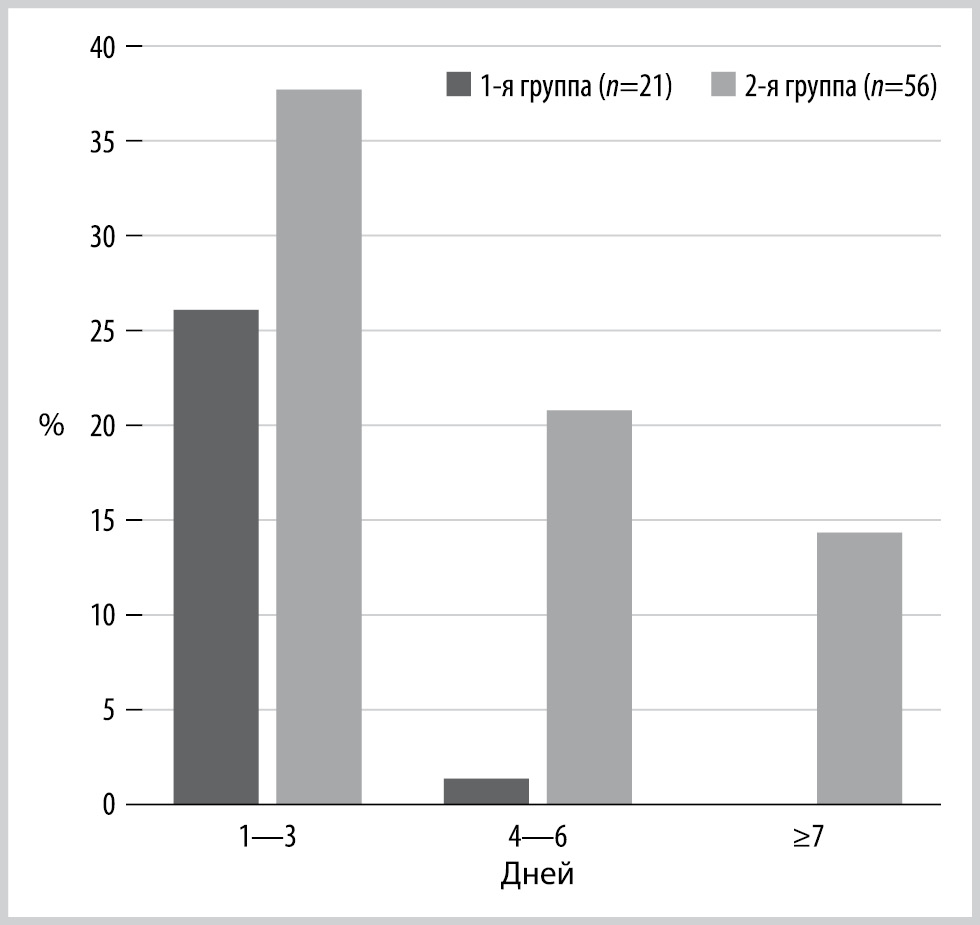
Распределение пациентов по срокам госпитализации в специализированный стационар.
Некорректная интерпретация анамнеза и клинической картины заболевания
Этап неврологического осмотра пациентов с детальным изучением анамнеза заболевания является значимой критической точкой в диагностике миелопатий и определении дальнейшей тактики обследования. В настоящем исследовании у 40,3% пациентов были выявлены существенные отклонения в первичной интерпретации данных анамнеза и клинической картины заболевания. При этом в группе 1 такие отклонения выявлены у 1 (4,8%) пациента, в группе 2 — у 30 (53,6%) пациентов (p<0,0001, ОШ=23,1 (95% ДИ 2,89—183,9).
Согласно диагностическим критериям, предложенным N.L. Zalewski (2019, 2021), артериальный инфаркт спинного мозга протекает как острая, нетравматическая миелопатия, развивающаяся в течение 12 часов, без предшествующих эпизодов хронической прогрессирующей симптоматики [4, 5]. В нашем исследовании внезапное развитие заболевания с нарастанием неврологического дефицита в течение 12 часов зафиксировано у 54 пациентов. Такой темп развития клинической картины, свидетельствующий с большой вероятностью в пользу сосудистого механизма заболевания, не был учтен более, чем у половины пациентов (55,5%).
Болевой синдром в зоне ишемического поражения спинного мозга, предшествовавший развитию двигательных и чувствительных расстройств, был частым клиническим признаком, который также не учитывался неврологами при первичном осмотре пациентов. Подобную нейропатическую боль в дебюте заболевания отмечали 43 пациента (55,8%), из них — 18 пациентов группы 2, однако она ошибочно расценивалась как скелетно-мышечная боль ввиду дегенеративно-дистрофических процессов в позвоночнике.
Объективная оценка факторов риска сердечно-сосудистых заболеваний: атеросклероз, артериальная гипертензия, нарушения сердечного ритма, патология аорты) на этапе сбора анамнеза не была проведена у 75% пациентов. В последствии комплексное обследование подтвердило наличие выраженной сердечно-сосудистой патологии у этих пациентов. При этом отмечено, что наличие болевого синдрома в дебюте заболевания было значимо связано с наличием в анамнезе сердечно-сосудистых заболеваний, сопровождающихся развитием сердечной недостаточности (χ2df=1=3,847 p=0,0498).
Позднее проведение нейровизуализационного обследования
Магнитно-резонансная томография (МРТ) является основным параклиническим методом диагностики и дифференциальной диагностики ишемии спинного мозга, позволяя с достаточной степенью чувствительности исключать другие, компрессионные и некомпрессионные причины миелопатий. Поэтому оценка МР-картины очага миелопатии, методологической полноты ее описания и сроков проведения нейровизуализации стало одним из ключевых этапов данного исследования.
В настоящем исследовании технические и организационные причины привели к невыполнению МРТ позвоночника и спинного мозга на момент первичного обследования у 5 (6,5%) пациентов: n=1 (4,8%) в группе 1, n=4 (7,1%) в группе 2 (p=0,556). Из оставшихся 72 пациентов, которым было проведено МРТ на данном этапе, 56 пациентам (77,8%) исследование не было выполнено в первые трое суток после поступления в стационар. В группе 1 таких пациентов было 9 (45,0%), в группе 2 — 47 (90,4%) пациентов, p<0,0001, ОШ=11,5 (95% ДИ 3,21—41,12). Последовательность диффузионно-взвешенного изображения (ДВИ) с построением карт измеряемого коэффициента диффузии (ИКД), позволяющая подтвердить ишемический характер заболевания, была выполнена только 3 пациентам (4,2 %) из группы 1. Только у 15 (21%) пациентов заключение первично выполненного МРТ было представлено в достаточном объеме с указанием размеров очага поражения, его локализации по поперечнику спинного мозга, описанием перифокальной неповрежденной зоны и прилегающих сосудов, что позволило избежать повторных исследований и уточнить диагноз в более короткие сроки. В среднем каждому пациенту проводилось по два МР-обследования с целью уточнения деталей поражения спинного мозга, максимально одному пациенту было выполнено 8 обследований. Внутривенное контрастирование не было проведено 20 пациентам (28%).
Кроме того, 18 пациентам (23,4%) вместо МРТ в первые трое суток госпитализации была выполнена КТ позвоночника, что также отразилось в более позднем установлении корректного диагноза. В группе 1 было 5 (23,8%) таких пациентов, в группе 2 — 13 (23,2%) пациентов.
Таким образом, проведенное нами исследование выявило, что поздняя госпитализация в специализированное медицинское учреждение, некорректный или неполный анализ данных на этапе неврологического осмотра и невыполнение МРТ в первые сутки после госпитализации являются значимыми факторами, связанными с постановкой неверного диагноза и, как следствие, задержкой в выявлении сосудистой миелопатии (табл. 1).
Таблица 1. Основные причины позднего выявления сосудистой миелопатии в исследуемых группах (точный двусторонний критерий Фишера, p<0,05)
Причины поздней диагностики | Группа 1 | Группа 2 | p | ОШ (95% ДИ) | ||
n | % | n | % | |||
Поздняя госпитализация в профильный стационар | 1 | 4,8 | 27 | 48,2 | 0,0004 | 18,62 (2,34—148,4) |
Некорректная интерпретация анамнеза и клинической картины | 1 | 4,8 | 30 | 53,6 | <0,0001 | 23,1 (2,89—183,9) |
Невыполнение МРТ в первые сутки госпитализации | 9 | 45* | 47 | 90,4* | <0,0001 | 11,5 (3,21—41,12) |
Выполнение КТ позвоночника вместо МРТ | 5 | 23,8 | 13 | 23,2 | 1,0 | — |
Примечание. * — от общего количества пациентов в группе, которым было проведено МРТ при первичном обследовании.
Функциональный исход
Оценка функционального исхода в исследуемых группах позволила сравнить эффективность медицинской помощи в условиях ранней и поздней диагностики, а также выявить зависимость между своевременностью диагностики и отдаленными результатами лечения. В настоящем исследовании пациенты группы 2 имели значительно более высокую степень инвалидизации, в то время как пациенты группы 1 демонстрировали лучшую функциональную независимость (табл. 2).
Таблица 2. Сравнительный анализ функциональных исходов в исследуемых группах (t-критерий, U-критерий Манна—Уитни, p<0,05)
Параметр | Группа 1 | Группа 2 | p |
Модифицированная шкала Рэнкина, баллов | 2,8±1,1 | 4,3±0,9 | <0,001 |
Индекс Бартел, баллов | 62,5±18,3 | 31,2±12,7 | <0,001 |
Обсуждение
Сосудистая миелопатия — это тяжелое поражение спинного мозга, связанное с нарушением локального артериального или венозного кровообращения. Поздняя диагностика этого заболевания и, соответственно, позднее начало адекватной терапии и реабилитации может привести к драматическим последствиям, включая развитие кардиореспираторных осложнений и летальный исход [6]. Поэтому изучение потенциальных причин, способствующих позднему выявлению сосудистой миелопатии, представляет большую актуальность.
Теме ошибочной диагностики миелопатий посвящен ряд исследований. При этом исследований, посвященных ошибочной диагностике именно сосудистой миелопатии, нами обнаружено не было. В ретроспективном исследовании N.L. Zalewski и соавт., охватившем 226 пациентов с подозрением на идиопатический поперечный миелит, лишь у 41 пациента (18,1%) был подтвержден первоначальный диагноз. У 158 пациентов (69,9%) диагноз был пересмотрен в пользу другого заболевания, из них сосудистая миелопатия была подтверждена также у 41 пациента (18,1%) [7].
В похожем ретроспективном исследовании P. Barreras и соавт. только у 247 из 457 пациентов (54%) был подтвержден воспалительный характер поражения спинного мозга, у остальных 46% пациентов была диагностирована сосудистая (20%), спондилотическая (8%) или другая миелопатия (18%). В прогностическую модель, оптимизирующую дифференциальную диагностику миелопатий, авторы включили время развития клинических признаков, изначальный двигательный дефицит, распространение очагов поражения при МР-обследовании [8].
В проведенных исследованиях показано, что методы лечения, используемые при воспалительных заболеваниях, в частности применение высокодозной терапии глюкокортикостероидами, потенциально могут усугубить клинические проявления и исходы сосудистой миелопатии [7—9]. Этот факт подтверждает важность своевременной диагностики и дифференциальной диагностики миелопатий.
В проведенном нами исследовании лишь у 27,3% пациентов ишемический характер миелопатии был верифицирован изначально верно. Большинство пациентов поступало с другими уточненными или неуточненными миелопатиями, а также вариантами острого поражения головного мозга и периферической нервной системы, что в целом не способствовало раннему установлению корректного диагноза и началу адекватных лечебных и реабилитационных программ.
Относительно низкая распространенность сосудистой миелопатии (1,6—7,2 на 100 тыс. человек, по данным A.I. Qureshi и соавт. [10]) и отсутствие утвержденных диагностических критериев проявляется в недостаточной информированности врачей об особенностях дебюта, клинических проявлениях, методах диагностики этого заболевания и необходимости применения дополнительных нейровизуализационных последовательностей [4, 11, 12]. Это приводит к некорректной маршрутизации пациентов и задержке в оказании специализированной медицинской помощи. В настоящем исследовании более трети пациентов (36,4%) не были госпитализированы в профильные медицинские центры в течение трех суток от дебюта заболевания, что закономерно и значимо снижало шансы на раннее выявление заболевания.
В данном контексте не следует упускать из виду и психологический фактор со стороны пациентов, который может препятствовать своевременному обращению за медицинской помощью. Согласно нашим наблюдениям, сроки обращаемости пациентов за помощью, как и в случае церебрального инсульта, зависят от двух факторов: тяжести состояния пациентов (скорость развития клинических признаков, выраженность парапареза, наличие нарушений функций тазовых органов) и степени осведомленности о важности незамедлительного обращения за медицинской помощью [13].
Неспецифичность клинической картины является одним из основных факторов, затрудняющих раннюю дифференциальную диагностику миелопатий. Поэтому клиницисты должны иметь повышенный уровень настороженности в отношении возможного ишемического механизма поражения спинного мозга, во многом опираясь на анамнестические данные о развитии заболевания [14, 15]. В настоящем исследовании у 40,3% пациентов были выявлены существенные отклонения в первичной интерпретации анамнеза и клинической картины заболевания. Показано, что подобная некорректная интерпретация клинических данных снижает шансы на своевременную постановку правильного диагноза.
Считается, что инфаркт спинного мозга сопровождается развитием острейшего неврологического дефицита с клиническим синдромом, обусловленным вовлечением определенного сосудистого бассейна (синдром передней спинномозговой артерии, задних спинномозговых артерий, сулько-комиссуральной артерии) или зоны кровоснабжения (центромедуллярный синдром, синдром «человек в бочке») [11, 16]. Согласно предложенным диагностическим критериям, артериальный инфаркт спинного мозга рассматривается как остро возникшая миелопатия, развивающаяся в течение 12 часов. При этом авторы критериев отмечают, что у 25% пациентов развитие клинической картины может продолжаться и после указанного срока [4, 5]. В нашем исследовании острое развитие неврологического дефицита в течение 12 часов было отмечено у 54 пациентов (70%), однако у 55,5% из них данный факт не был первично интерпретирован как признак инфаркта спинного мозга, что соответственно привело к более позднему установлению правильного диагноза.
Венозный инфаркт спинного мозга, напротив, может развиваться подостро, что затрудняет его своевременное выявление и зачастую не вызывает серьезных опасений у самих пациентов [17, 18]. В настоящем исследовании венозный инфаркт спинного мозга был выявлен у 13 пациентов (16,9%), каждый из которых вошел в группу 2 с первично некорректным диагнозом.
Важным клиническим признаком, который зачастую упускается в диагностическом поиске, является болевой синдром в зоне инфаркта спинного мозга. Об острой боли в спине, возникающей одновременно с развитием неврологического дефицита или до его появления, сообщают примерно 70% пациентов со спонтанным инфарктом спинного мозга [19, 20]. Важно заметить, что такой болевой синдром является нетипичным для острого миелита [21]. В нашем исследовании боль в дебюте заболевания отмечали 43 пациента (55,8%), что близко к показателям, описываемым в литературе, однако такой болевой синдром не ассоциировался с развитием ишемии спинного мозга.
Другим важным аспектом раннего диагностического поиска является определение у пациента факторов риска сердечно-сосудистых заболеваний. Сопутствующие заболевания, такие как сахарный диабет, ишемическая болезнь сердца, артериальная гипертензия и другие, могут быть непосредственно связаны с развитием инфаркта спинного мозга. При этом атеросклеротическое поражение аорты и артерий спинного мозга считается одной из основных причин миелоишемии [11, 12]. Возрастные пациенты с факторами риска сердечно-сосудистых заболеваний составляют существенную часть пострадавших с сосудистой миелопатией, однако встречаются и более редкие причины спонтанного инфаркта спинного мозга сосудистого происхождения, такие как диссекция позвоночной артерии и фиброзно-хрящевая эмболия, характерные преимущественно для лиц молодого возраста [19, 22]. В нашем исследовании анамнестическая, лабораторная или инструментальная оценка наличия факторов риска сердечно-сосудистых заболеваний не была проведена при первичном обследовании у 75% пациентов, что потребовало дополнительного обследования и привело к поздней постановке правильного диагноза.
Наконец, для своевременного и точного определения сосудистой миелопатии требуется обязательное проведение МРТ [11, 12, 23]. Однако не все медицинские учреждения, куда первично поступают пациенты, имеют необходимое нейровизуализационное оборудование и квалифицированных специалистов. При некорректной интерпретации анамнеза и неврологического статуса МРТ может не проводиться в первые дни госпитализации даже при доступности необходимого оборудования [4, 5]. В настоящем исследовании было продемонстрировано, что невыполнение МРТ в первые сутки после поступления значимо связано с постановкой некорректного первичного диагноза.
В связи с тем, что базовые последовательности МРТ (T2-ВИ, T2-FLAIR) низкоспецифичны в отношении некоторых миелопатий, а также ввиду потенциального не выявления на них очага ишемии в первые 8—12 часов от дебюта заболевания из-за нарастающего отека спинного мозга [2, 24], протокол обследования рекомендуется дополнять последовательностью ДВИ с построением карт ИКД [14, 25, 26]. Наше исследование показало крайне низкую частоту использования ДВИ для выявления сосудистой миелопатии в острейшем и остром периодах заболевания, что может быть обусловлено техническими ограничениями и неосведомленностью специалистов о выполнении этой последовательности. В дальнейшем протокол обследования может быть дополнен аксиальным T2*GRE, 3D-динамической трехфазной контрастной спинальной МР-ангиографией и постконтрастным сагиттальным спин-эхо-T1-ВИ [27].
В некоторых случаях МРТ может быть трудно выполнимой по техническим или медицинским причинам, что также затрудняет раннюю диагностику. В условиях отсутствия абсолютных и относительных противопоказаний к МРТ некорректным диагностическим решением является проведение в первые сутки заболевания КТ позвоночника вместо МРТ. В нашем исследовании суммарно было 18 подобных случаев, в 13 из которых это привело к постановке неверного диагноза. При этом КТ-диагностика может служить значимым дополнительным инструментом в выявлении причин гипоперфузии спинного мозга. Например, КТ-ангиография аорты и ее ветвей позволяет визуализировать атеросклеротическое поражение сосудистой стенки, наличие локальных сужений и расслоений, препятствующих кровоснабжению спинного мозга [27, 28].
В 2024 году были опубликованы два систематизированных обзора, данные которых коррелируют с результатами настоящего исследования в отношении причин, диагностики и исходов сосудистой миелопатии. В обзоре и метаанализе, опубликованном YCH. Dokponou и соавт. [29], и включившим данные 876 пациентов из 117 исследований, выявлено, что задержка диагностики сосудистой миелопатии превышает 14 дней дольше, чем в 50% случаев, достигая 6 мес. в 12,4% случаев, что напрямую связано с ухудшением функциональных исходов — увеличением балла по шкале Рэнкина [29]. Эти данные согласуются с нашими наблюдениями, где группа пациентов с некорректным первичным диагнозом демонстрировала статистически значимое ухудшение показателей по сравнению с группой ранней диагностики: mRS 4,3 против 2,8 (p<0,001) и BI 31,2 против 62,5 (p<0,001).
В обзоре, опубликованном M. Gharios и соавт. [30], включившим данные 440 пациентов из 33 исследований, особо подчеркивается роль сосудистых факторов риска в развитии ишемического спинального инсульта и важность их своевременного выявления на ранних этапах комплексной диагностики. Оба обзора единогласно указывают на критическую важность ранней нейровизуализации. Показано, что проведение МРТ с ДВИ увеличивает вероятность своевременного выявления ишемии спинного мозга [29, 30]. Это актуализирует обозначенную в нашем исследовании проблему отсутствия рутинного применения последовательности ДВИ в первичном МРТ пациентов с признаками сосудистой миелопатии.
Заключение
Поздняя диагностика сосудистой миелопатии является серьезной и пока не решенной проблемой. Для повышения качества оказания помощи необходим комплекс мер, включающий, в том числе, проведение образовательных мероприятий для повышения информированности пациентов и врачей о симптомах и современных методах диагностики заболевания, обеспечение доступности необходимых диагностических исследований, совершенствование маршрутизации пациентов в диагностических и лечебных целях. Кроме того, необходимо разработать алгоритм действий врача при подозрении на сосудистую миелопатию, чтобы минимизировать время постановки точного диагноза и начала терапии, предотвратить назначение неадекватных методов диагностики и лечения.
Среди потенциальных практических рекомендаций можно выделить включение последовательности ДВИ в протоколы МРТ, а также обязательную оценку факторов риска сердечно-сосудистых заболеваний у всех пациентов с подозрением на сосудистое поражение спинного мозга.
Авторы заявляют об отсутствии конфликта интересов.
- Caton MT, Huff JS. Spinal Cord Ischemia. In: StatPearls. Treasure Island (FL): StatPearls Publishing; 2023. Accessed March 7, 2025. https://www.ncbi.nlm.nih.gov/books/NBK539870/
- Kim BR, Park KS, Kim HJ, et al. Features of non-traumatic spinal cord infarction on MRI: Changes over time. PLoS One. 2022;17(9):e0274821. https://doi.org/10.1371/journal.pone.0274821
- Pichiorri F, Masciullo M, Foti C, et al. Cocaine-related cervical spinal cord infarction: a case report and review of the literature. J Med Case Rep. 2022;16(1):59. https://doi.org/10.1186/s13256-021-03223-4
- Zalewski NL, Rabinstein AA, Krecke KN, et al. Characteristics of Spontaneous Spinal Cord Infarction and Proposed Diagnostic Criteria. JAMA Neurol. 2019;76(1):56-63. https://doi.org/10.1001/jamaneurol.2018.2734
- Zalewski NL. Vascular Myelopathies. Continuum (Minneap Minn). 2021;27(1):30-61. https://doi.org/10.1212/CON.0000000000000905
- Da Ros V, Picchi E, Ferrazzoli V, et al. Spinal vascular lesions: anatomy, imaging techniques and treatment. Eur J Radiol Open. 2021;8:100369. https://doi.org/10.1016/j.ejro.2021.100369
- Zalewski NL, Flanagan EP, Keegan BM. Evaluation of idiopathic transverse myelitis revealing specific myelopathy diagnoses. Neurology 2018;90(2):e96-e102. https://doi.org/10.1212/WNL.0000000000004796
- Barreras P, Fitzgerald KC, Mealy MA, et al. Clinical biomarkers differentiate myelitis from vascular and other causes of myelopathy. Neurology. 2018;90(1):e12-e21. https://doi.org/10.1212/WNL.0000000000004765
- Nasr DM, Brinjikji W, Rabinstein AA, Lanzino G. Clinical outcomes following corticosteroid administration in patients with delayed diagnosis of spinal arteriovenous fistulas. J Neurointerv Surg. 2017;9(6):607-610. https://doi.org/10.1136/neurintsurg-2016-012430
- Qureshi AI, Afzal MR, Suri MFK. A Population-Based Study of the Incidence of Acute Spinal Cord Infarction. J Vasc Interv Neurol. 2017;9(4):44-48
- Weidauer S, Nichtweiß M, Hattingen E, et al. Spinal cord ischemia: aetiology, clinical syndromes and imaging features. Neuroradiology. 2015;57(3):241-257. https://doi.org/10.1007/s00234-014-1464-6
- Vargas MI, Gariani J, Sztajzel R, et al. Spinal cord ischemia: practical imaging tips, pearls, and pitfalls. AJNR Am J Neuroradiol. 2015;36(5):825-830. https://doi.org/10.3174/ajnr.A4118
- Стаховская Л.В., Шеховцова К.В., Рожкова Т.И., и др. Сравнительный анализ качества медицинской помощи больным с инсультом на догоспитальном этапе в разных городах Российской Федерации. Журнал неврологии и психиатрии им. С.С. Корсакова. Спецвыпуски. 2010;110(9-2):36-41.
- Weidauer S, Wagner M, Nichtweiß M. Magnetic Resonance Imaging and Clinical Features in Acute and Subacute Myelopathies. Clin Neuroradiol. 2017;27(4):417-433. https://doi.org/10.1007/s00062-017-0604-x
- Kranz PG, Amrhein TJ. Imaging Approach to Myelopathy: Acute, Subacute, and Chronic. Radiol Clin North Am. 2019;57(2):257-279. https://doi.org/10.1016/j.rcl.2018.09.006
- Sandoval JI, De Jesus O. Anterior Spinal Artery Syndrome. In: StatPearls. Treasure Island (FL): StatPearls Publishing; 2024. Accessed March 7, 2025. https://www.ncbi.nlm.nih.gov/books/NBK560731/
- Vuong SM, Jeong WJ, Morales H, et al. Vascular Diseases of the Spinal Cord: Infarction, Hemorrhage, and Venous Congestive Myelopathy. Semin Ultrasound CT MR. 2016;37(5):466-481. https://doi.org/10.1053/j.sult.2016.05.008
- Zalewski NL, Rabinstein AA, Brinjikji W, et al. Unique Gadolinium Enhancement Pattern in Spinal Dural Arteriovenous Fistulas. JAMA Neurol. 2018;75(12):1542-1545. https://doi.org/10.1001/jamaneurol.2018.2605
- Richard S, Abdallah C, Chanson A, et al. Unilateral posterior cervical spinal cord infarction due to spontaneous vertebral artery dissection. J Spinal Cord Med. 2014;37(2):233-236. https://doi.org/10.1179/2045772313Y.0000000125
- Lee DW, Choi YH. Spinal cord infarction mimicking ischemic heart disease. Clin Exp Emerg Med. 2017;4(2):109-112. https://doi.org/10.15441/ceem.16.121
- Zalewski NL, Rabinstein AA, Krecke KN, et al. Spinal cord infarction: Clinical and imaging insights from the periprocedural setting. J Neurol Sci. 2018;388:162-167. https://doi.org/10.1016/j.jns.2018.03.029
- Draganich C, Wenzel LR. Fibrocartilagenous embolism case series: is it a zebra? Spinal Cord Ser Cases. 2021;7(1):28. https://doi.org/10.1038/s41394-021-00395-5
- Yasuda N, Kuroda Y, Ito T, et al. Postoperative spinal cord ischaemia: magnetic resonance imaging and clinical features. Eur J Cardiothorac Surg. 2021;60(1):164-174. https://doi.org/10.1093/ejcts/ezaa476
- Thurnher MM, Bammer R. Diffusion-weighted MR imaging (DWI) in spinal cord ischemia. Neuroradiology. 2006;48(11):795-801. https://doi.org/10.1007/s00234-006-0130-z
- Vargas MI, Boto J, Meling TR. Imaging of the spine and spinal cord: An overview of magnetic resonance imaging (MRI) techniques. Rev Neurol (Paris). 2021;177(5):451-458. https://doi.org/10.1016/j.neurol.2020.07.005
- Costamagna G, Meneri M, Abati E, et al. Hyperacute extensive spinal cord infarction and negative spine magnetic resonance imaging: a case report and review of the literature. Medicine (Baltimore). 2020;99(43):e22900. https://doi.org/10.1097/MD.0000000000022900
- Пономарев Г.В., Агафонов А.О., Бариляк Н.Л., и др. МРТ-диагностика сосудистых миелопатий: от базовых последовательностей к перспективным протоколам исследования. Анналы клинической и экспериментальной неврологии. 2024;18(3): 81-90. https://doi.org/10.17816/ACEN.1065
- Vargas MI, Barnaure I, Gariani J, et al. Vascular Imaging Techniques of the Spinal Cord. Semin Ultrasound CT MR. 2017;38(2):143-152. https://doi.org/10.1053/j.sult.2016.07.004
- Dokponou YCH, Ontsi Obame FL, Takoutsing B, et al. Spinal cord infarction: A systematic review and meta-analysis of patient’s characteristics, diagnosis accuracy, management, and outcome. Surg Neurol Int. 2024;15:325. https://doi.org/10.25259/SNI_477_2024
- Gharios M, Stenimahitis V, El-Hajj VG, et al. Spontaneous spinal cord infarction: a systematic review. BMJ Neurol Open. 2024;6(1):e000754. https://doi.org/10.1136/bmjno-2024-000754





Рекомендуем статьи по данной теме:
Возможности и ограничения искусственного интеллекта во флебологии: результаты систематического обзора литературы с метаанализом.Флебология. 2026;20(3):220-248
Совершенствование методов объективной диагностики острого риносинусита.Вестник оториноларингологии. 2026;91(4):88-91
Клинико-диагностические аспекты глаукоматозной кератопатии при врожденной глаукоме.Вестник офтальмологии. 2026;142(4):37-45
Осведомленность врачей первичного звена Челябинской области о диагностике и лечении ревматоидного артрита.Профилактическая медицина. 2026;29(7):25-30
Тактика хирурга при мукоцеле червеобразного отростка.Оперативная хирургия и клиническая анатомия (Пироговский научный журнал). 2026;10(2-2):103-108
Клинический случай диагностики и лечения экстраносоглоточной ангиофибромы.Вестник оториноларингологии. 2026;91(3):111-114
Инфекционный уретрит у мужчин: этиология, эпидемиология, диагностика и лечение (аналитический обзор).Клиническая дерматология и венерология. 2026;25(3):464-472
Проблемы диагностики и лечения грибовидного микоза у детей.Клиническая дерматология и венерология. 2026;25(3):450-457
Эктопическая беременность в интерстициальном отделе маточной трубы.Российский вестник акушера-гинеколога. 2026;26(3):55-59
Врожденная внутригрудная добавочная селезенка: редкое клиническое наблюдение.Хирургия. Журнал им. Н.И. Пирогова. 2026;(6):108-112