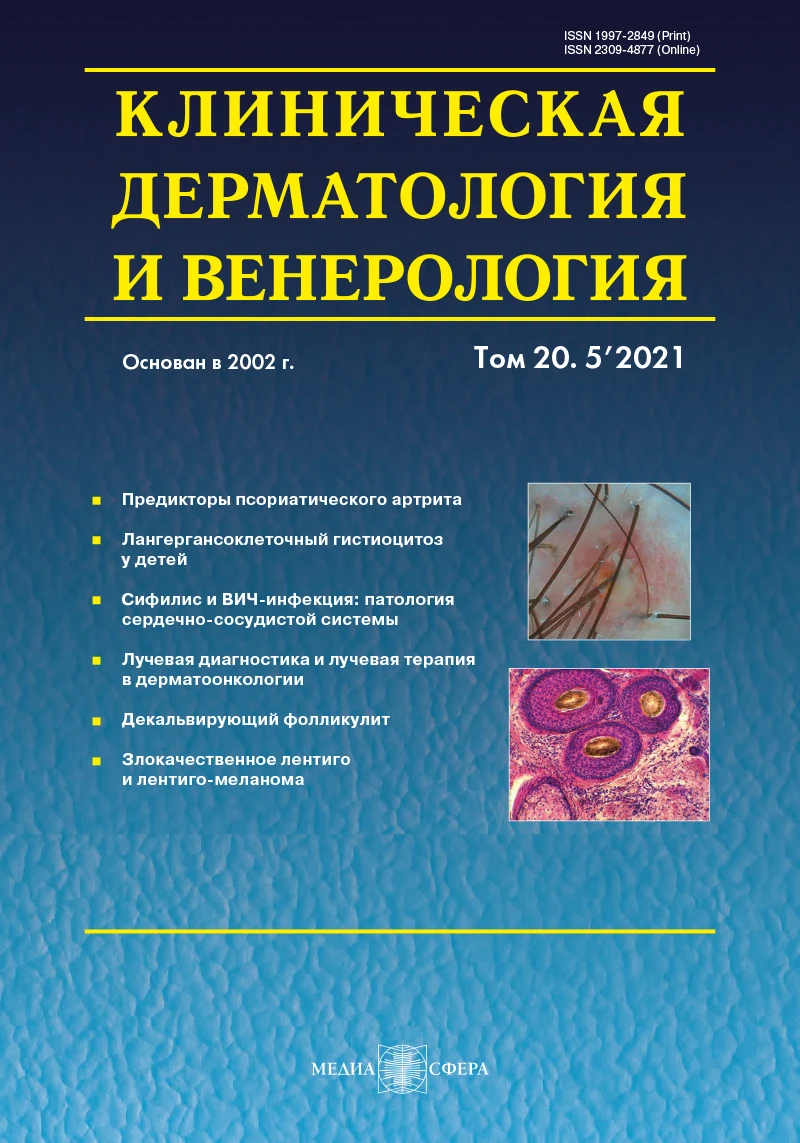
Декальвирующий фолликулит: обзор литературы и описание клинического случая
Журнал: Клиническая дерматология и венерология. 2021;20(5):83-88.
DOI: 10.17116/klinderma20212005183
Прочитано: 9524 раза
Резюме
Декальвирующий фолликулит — редкий дерматоз с преимущественным поражением волосистой части головы, характеризуемый гнойным воспалением волосяных фолликулов, хроническим рецидивирующим течением и прогрессирующим стойким выпадением волос. Клиническая и патогистологическая картина декальвирующего фолликулита часто носит неспецифичный характер, что обусловливает возникающие диагностические трудности. Приводим обзор литературы с освещением вопросов этиопатогенеза, клинических и дерматоскопических проявлений заболевания, особенностей патогистологической картины, а также описание клинического случая декальвирующего фолликулита. Клиническая картина характеризовалась фолликулярными папулами и пустулами, пучковыми волосами, очагами рубцовой алопеции; дерматоскопически выявлены фолликулярные пустулы, признак «взрыв звезды», пучковые волосы, трубчатое шелушение, концентрически расположенные вокруг волосяных фолликулов петли сосудов; при бактериологическом исследовании содержимого пустул выделен Staphylococcus aureus. При патогистологическом исследовании выявлены гиперкератоз, акантоз, вакуолярная дистрофия клеток шиповидного слоя, расширенные волосяные воронки, заполненные роговыми массами. В дерме наблюдалась перифолликулярная и периваскулярная инфильтрация лимфоцитами, нейтрофилами, макрофагами, единичными плазмоцитами. Выявлены крупные очаги гранулематозного воспаления. В центре этих очагов видны стержни волос, лишенные эпителиальных влагалищ, окруженные полуразрушенными волосяными сумками и значительной лимфогистиоцитарной инфильтрацией с единичными гигантскими клетками. Вокруг этих очагов выраженный фиброз. Патоморфологическая картина позволила отнести заболевание к рубцовым алопециям нейтрофильного типа. На клиническом примере показано, что при диагностике декальвирующего фолликулита необходимо сопоставление клинико-анамнестических, лабораторных и патогистологических данных.
Ключевые слова
- декальвирующий фолликулит
- рубцовая алопеция
- диагностика
- дерматоскопия
- патогистология
Дата поступления: 17.01.2020
Дата принятия в печать: 15.07.2021
Дата публикации: 01.11.2021
Декальвирующий фолликулит — редкий дерматоз с преимущественным поражением волосистой части головы, характеризуемый гнойным воспалением волосяных фолликулов, хроническим рецидивирующим течением и прогрессирующим стойким выпадением волос [1–3]. Впервые описан E. Quinquad (1888), названиие «декальвирующий фолликулит» введено L. Brocq (1905) [4]. Заболевание относится к нейтрофильной группе первичных рубцовых алопеций, его клинико-гистологическими вариантами считаются пучковый фолликулит Смита и Сандерсона и рубцующая себорейная экзема Лаймона [5].
В структуре первичных рубцовых алопеций удельный вес декальвирующего фолликулита составляет 11,0% [6]. Дебют заболевания приходится на молодой и средний возраст, мужчины и женщины болеют одинаково часто [6], согласно другим данным, среди заболевших преобладают мужчины [7–9].
Патогенез декальвирующего фолликулита неясен. Предполагается генетически детерминированный специфический иммунодефицит с высоким риском фолликулярной инфекции [10]. Согласно наиболее распространенной теории, декальвирующий фолликулит является результатом аберрантного иммунного ответа на антигены Staphylococcus aureus. Инфицирование волосяных фолликулов Staphylococcus aureus вызывает интенсивную миграцию нейтрофилов в перифолликулярную и внутрифолликулярную дерму. Приток нейтрофилов опосредован механизмами врожденного иммунитета, прежде всего, хемоаттрактантом интерлейкином-8, экспрессируемым при декальвирующем фолликулите в фолликулярном эпителии и перифолликулярной дерме. Нейтрофилы повреждают фолликулярный эпителий, проникают в фолликулы, где фагоцитируют Staphylococcus aureus. Значимая роль придается суперантигенам Staphylococcus aureus, способным взаимодействовать с молекулами главного комплекса гистосовместимости II класса антигенпрезентирующих клеток и Vβ-доменом T-клеточного рецептора, экспрессированного на мембране T-лимфоцитов. Результатом этого взаимодействия является высвобождение провоспалительных (интерферон-γ, фактор некроза опухоли-α) и профибротических (фактор роста фибробластов-β, трансформирующий фактор роста-β, IL-1, IL-4) медиаторов. Интенсивное гранулоцитарное воспаление разрушает волосяные фолликулы и кожу волосистой части головы, активированные фибробласты перепроизводят внеклеточный матрикс, что приводит к фиброзу [10–12]. Согласно другой гипотезе, патогенез декальвирующего фолликулита связан с существованием бактериальных биопленок, состоящих из Propionibacterium acnes, колонизирующих анаэробную инфраинфундибулярную часть волосяного фолликула. При смещении экосистемы волосяного фолликула в силу пока не установленных причин комменсальные биопленки становятся патогенными, что приводит к клиническим проявлениям декальвирующего фолликулита. Staphylococcus aureus, наиболее часто выявляемый при культуральном исследовании содержимого пустул, рассматривается в данном случае в качестве условно-патогенного микроорганизма [9].
Патоморфологическая картина декальвирующего фолликулита неспецифична и зависит от активности заболевания. Биоптаты ранних активных очагов поражения характеризуются агрегацией кератина в расширенных воронках волосяных фолликулов, внутри- и перифолликулярным нейтрофильным инфильтратом в верхней и средней части волосяного фолликула. Вокруг разрушающихся фолликулов формируется смешанный инфильтрат из лимфоцитов, гистиоцитов, плазматических клеток, отмечаются нейтрофильные абсцессы, гранулемы стержней волос. Прогрессирование заболевания связано с распространением инфильтрата, состоящего из лимфоцитов, плазматических клеток и немногочисленных гранулоцитов, в адвентициальную дерму [4, 13]. Обращают на себя внимание свободно расположенные стержни волос, лишенные окружающего фолликулярного эпителия [14]. Среди патогистологических признаков, обнаруживаемых в межфолликулярном эпителии, отмечаются эпидермальная атрофия, вакуолярная дегенерация базальных кератиноцитов [15]. В поздней стадии патогистологическая картина характеризуется заменой волосяных фолликулов фиброзными тяжами, грубым межфолликулярным фиброзом с плазматическими клетками и концентрическим перифолликулярным фиброзом с лимфоцитами. Сальные железы сохраняются вокруг отдельных волосяных фолликулов, но отсутствуют в областях, где есть выраженный перифолликулярный фиброз, отмечается слияние воронок нескольких волосяных фолликулов [4, 13].
Патологический процесс при декальвирующем фолликулите локализуется преимущественно на коже теменной и затылочной областей, помимо этого, может поражаться кожа бороды, аксиллярных впадин, лобка, голеней, медиальной поверхности бедер [10, 13]. Клиническая картина представлена диффузными или очаговыми перифолликулярно расположенными папуло-пустулезными высыпаниями, эрозиями, гнойно-геморрагическими корками с исходом в рубцовую атрофию. Очаги поражения характеризуются медленным центробежным распространением, слиянием в более крупные очаги рубцовой алопеции, по периферии которых в активную стадию заболевания наблюдаются фолликулярные папулы и пустулы. Наличие пустул считается маркером тяжести и активности декальвирующего фолликулита. В очагах поражения могут быть пучковые волосы, являющиеся результатом кластеризации рядом расположенных и вовлеченных в патологический процесс волосяных фолликулов. Субъективно отмечаются зуд, жжение, болезненность в очагах поражения [4, 10, 16].
Дерматоскопическая картина декальвирующего фолликулита включает фолликулярные пустулы желтого цвета, перифолликулярную эритему, концентрически расположенные вокруг волосяных фолликулов сосуды в виде петель, перифолликулярную эпидермальную гиперплазию в виде признака «взрыв звезды», трубчатое шелушение вокруг волос, области цвета слоновой кости или молочно-красного цвета без фолликулярного рисунка, пучковый фолликулит, представленный 5 волосами и более, объединенными общим фолликулярным отверстием [16–18].
При диагностике декальвирующего фолликулита учитывают клинико-анамнестические данные, свидетельствующие о хроническом гнойном фолликулите, приводящем к стойкому выпадению волос и рубцовой атрофии; дерматоскопические признаки; результаты патогистологического исследования, подтверждающего нейтрофильный характер рубцовой алопеции; данные культурального исследования содержимого пустул с определением чувствительности к антибиотикам [4, 10, 13, 16].
При дифференциальной диагностике следует учитывать эрозивный пустулез волосистой части головы, абсцедирующий и подрывающий фолликулит и перифолликулит Гоффмана, хроническую красную волчанку волосистой части головы, келлоидные акне задней поверхности шеи, фолликулярный плоский лишай, микозы [5, 8, 19].
Декальвирующий фолликулит устойчив к проводимой терапии, целью лечения является купирование воспаления и дальнейшего разрушения волосяных фолликулов [3]. Основным методом лечения является длительная системная антибиотикотерапия, в ходе которой отмечается улучшение течения дерматоза [10]. Сведения об эффективности изотретиноина [20, 21], фузидиевой кислоты [3], дапсона, препаратов цинка [8, 19], биологических агентов (инфликсимаб и адалимумаб) [22] фотодинамической терапии [23] спорные.
Приводим результаты наблюдения.
Пациент Е., 1987 года рождения, направлен на консультативный прием кафедры дерматовенерологии ОрГМУ (зав. кафедрой — д.м.н. проф. Л.Г. Воронина) 12.10.17 с диагностической целью. Пациент предъявлял жалобы на высыпания на волосистой части головы, сопровождающиеся незначительными болезненностью и зудом, отсутствием роста волос. Согласно анамнестическим данным и сведениям амбулаторной карты, пациент с 5-летнего возраста страдал атопическим дерматитом, в 2005 г. был диагностирован себорейный дерматит. С 2007 г. на коже волосистой части головы стали появляться немногочисленные пустулезные элементы, что первоначально расценено как себорейный дерматит, осложненный пиодермией. Однако заболевание медленно, непрерывно рецидивировало, назначаемое наружное лечение антибактериальными и комбинированными препаратами, а также общее лечение гипосенсибилизирующими, антигистаминными препаратами и антибиотиками приносило кратковременный эффект, стали заметны очаги стойкой алопеции. С 2013 по 2017 г. в качестве причин рубцовой алопеции рассматривались красная волчанка волосистой части головы и подрывающий и абсцедирующий фолликулит и перифолликулит Гоффмана.
Локальный статус. Кожный патологический процесс преимущественно локализован в макушечной и теменной областях, где отмечены группирующиеся фолликулярные воспалительные папулы, окруженные эритематозным венчиком, очаги рубцовой алопеции цвета слоновой кости, гладкие и мягкие при пальпации. По периферии очагов алопеции и на их фоне рост пучковых волос, застойная перифолликулярная эритема, единичные фолликулярные пустулы, пронизанные волосом, эрозии (рис. 1).

Рис. 1. Декальвирующий фолликулит.
Единичные фолликулярные пустулы, пучковые волосы, перифолликулярная эритема, сливающиеся очаги рубцовой алопеции.
Дерматоскопически выявлены единичные фолликулярные пустулы, пронизанные стержнем волоса; молочно-красные области с отсутствием устьев сально-волосяных фолликулов; признак «взрыв звезды», соответствующий эпидермальной гиперплазии вокруг пучков волос; трубчатое шелушение, концентрически расположенные вокруг фолликулов удлиненные петли сосудов (рис. 2).

Рис. 2. Дерматоскопическая картина (камера Aramo SG).
а — признак «взрыв звезды» (×60); б — фолликулярная пустула (×60); в — тубулярное шелушение, перифолликулярно расположенные удлиненные петлеобразные сосуды (×200); г — области цвета слоновой кости и молочно-красного цвета, лишенные фолликулярного рисунка (×60).
Пациент предоставил результаты лабораторных и клинических исследований.
Бактериологическое исследование содержимого пустул: выделенный микроорганизм Staphylococcus aureus (ПМО>105 КОЕ/мл), чувствительный к цефтриаксону, имипенему, фузидину, рифампицину, цефазолину, доксициклину, ципрофлоксацину, клиндамицину, умеренно чувствительный к азитромицину, устойчивый к оксациллину.
Иммунологическое исследование: иммунограмма нейтрофильного типа с нейтрофилезом, увеличением количества/уровней ЦИК, Ig A, E, G, НСТ-тест спонтанный с уменьшением количества/уровней лейкоцитов, CD3 (абсолютные), CD4, IgM с лимфопенией.
ФГДС: явления хронического гастрита, гиперацидное состояние базальной секреции тела желудка с субкомпенсированной ощелачивающей функцией. Тест на Helicobacter pylory +++.
Ультразвуковое исследование внутренних органов: небольшое количество гиперэхогенной взвеси в желчном пузыре.
Заключение эндокринолога: гипергликемия натощак, гипокальциемический синдром, гипохлоремия.
Заключение окулиста: миопия слабой степени.
Патоморфологическое исследование биоптата кожи из очага поражения: выявлен хронический неспецифический дерматит с очаговой лимфоклеточной инфильтрацией преимущественно вокруг волосяных фолликулов и сосудов с очаговыми кровоизлияниями, реактивным акантозом эпидермального эпителия.
С учетом неспецифичности описанных в патогистологическом заключении данных и их несоответствия клинической картине болезни проведен консультативный пересмотр готовых микропрепаратов. В эпидермисе исследуемых образцов выявлены умеренный гиперкератоз, акантоз и расслоение рогового слоя. В клетках базального слоя и нижних слоев шиповатого видны признаки вакуолярной дистрофии. Базальная мембрана утолщена. Волосяные воронки расширены, заполнены роговыми чешуйками.
На протяжении всего корня волоса и в зоне волосяной луковицы, вокруг волосяных фолликулов обнаружена перифолликулярная и периваскулярная инфильтрация (рис. 3, а). Она носила полиморфный характер и состояла из лимфоцитов, нейтрофилов, макрофагов, единичных плазмоцитов и эозинофилов.

Рис. 3. Патогистологическая картина.
а — периваскулярная и перифолликулярная лейкоцитарная инфильтрация в нижней трети корня волоса; б — периваскулярная и перифолликулярная лейкоцитарная инфильтрация; в — лейкоцитарная инфильтрация вокруг сосудов и потовых желез; г — очаг гранулематозного воспаления. В центре стержень волоса, окруженный полуразрушенной волосяной сумкой, вокруг инфильтрация нейтрофилами, лимфоцитами, макрофагами и гигантскими клетками инородного тела. Окраска гематоксилином и эозином (×150).
В средних слоях дермы волосяные фолликулы значительно сближены, возможно, из-за возникающего рядом фиброза. Вокруг волосяных фолликулов и вокруг сосудов умеренная инфильтрация преимущественно лимфоцитами и полиморфно-ядерными лейкоцитами. В этих зонах отмечены отдельные сохранившиеся сальные железы (см. рис. 3, б). Вокруг сохранившихся в глубоких слоях дермы потовых желез также наблюдали лимфомакрофагальную и нейтрофильную инфильтрацию (см. рис. 3, в).
В средних слоях дермы выявлены крупные очаги гранулематозного воспаления. В центре этих очагов видны стержни волос, лишенные эпителиальных влагалищ, окруженные полуразрушенными волосяными сумками и значительной лимфогистиоцитарной инфильтрацией с единичными гигантскими клетками (см. рис. 3, г). Вокруг этих очагов выраженный фиброз.
На большом протяжении в дерме обнаружены множественные очаги инфильтрации, не содержащие фолликулов волос и состоящие из лимфоцитов, нейтрофилов, макрофагов, единичных гигантских клеток. Вокруг этих очагов выраженный фиброз.
Заключение: патогистологическая картина соответствует рубцовой алопеции нейтрофильного типа.
На основании совокупности клинических и дерматоскопических признаков, результатов бактериологического исследования и патогистологических данных выставлен диагноз: декальвирующий фолликулит Кэнко.
Описанный клинический случай — пример редко встречающейся формы первичной рубцовой алопеции нейтрофильного типа. Клиническая и патогистологическая картина декальвирующего фолликулита Кэнко часто носит неспецифичный характер, что объясняет диагностические трудности. Сопоставление клинических и дерматоскопических признаков заболевания, лабораторных данных и результатов патогистологического исследования позволит избежать диагностической ошибки.
Авторы заявляют об отсутствии конфликта интересов.
The authors declare no conflict of interest.
- Bolduc C, Sperling LC, Shapiro J. Primary cicatricial alopecia: Other lymphocytic primary cicatricial alopecias and neutrophilic and mixed primary cicatricial alopecias. J Am Acad Dermatol. 2016;75(6):1101-1117. https://doi.org/10.1016/j.jaad.2015.01.056
- Otberg N, Shapiro J. Hair Growth Disorders. In: Goldsmith LA, Katz SI, Gilchrest BA, Paller AS, Leffell DJ, Wolff K. eds. Fitzpatrick’s Dermatology in General Medicine, 8e New York, NY: McGraw-Hill; 2012.
- Pimenta R, Borges-Costa J. Successful Treatment with Fusidic Acid in a Patient with Folliculitis Decalvans. Acta Dermatovenerol Croat. 2019;27(1):49-50.
- Fabris MR, Melo CP, Melo DF. Folliculitis decalvans: the use of dermatoscopy as an auxiliary tool in clinical diagnosis. An Bras Dermatol. 2013;88(5): 814-816. https://doi.org/10.1590/abd1806-4841.20132129
- Trüeb, RM. The Difficult Hair Loss Patient: Guide to Successful Management of Alopecia and Related Conditions, Springer; 2015.
- Price V, Mirmirani P. Cicatricial Alopecia: An Approach to Diagnosis and Management. Springer New York Dordrecht Heidelberg London. 2011.
- Sillani C, Bin Z, Ying Z, et al. Effective treatment of folliculitis decalvans using selected antimicrobial agents. Int J Trichology. 2010;2(1):20-23. https://doi.org/10.4103/0974-7753.66908
- Lugović-Mihić L, Barisić F, Bulat V, et al. Differential diagnosis of the scalp hair folliculitis. Acta Clin Croat. 2011;50(3):395-402.
- Matard B, Meylheuc T, Briandet R, et al. First evidence of bacterial biofilms in the anaerobe part of scalp hair follicles: a pilot comparative study in folliculitis decalvans. J Eur Acad Dermatol Venereol. 2013;27(7):853-860. https://doi.org/10.1111/j.1468-3083.2012.04591.x
- Rigopoulos D, Stamatios G, Ioannides D. Primary scarring alopecias. Curr Probl Dermatol. 2015;47:76-86. https://doi.org/10.1159/000369407
- Chiarini C, Torchia D, Bianchi B, et al. Immunopathogenesis of folliculitis decalvans: clues in early lesions. Am J Clin Pathol. 2008;130(4):526-534. https://doi.org/10.1309/NG60Y7V0WNUFH4LA
- Schwartz JR, Henry JP, Kerr KM, et al. Incubatory environment of the scalp impacts pre-emergent hair to affect post-emergent hair cuticle integrity. J Cosmet Dermatol. 2018;17(1):105-111. https://doi.org/10.1111/jocd.12355
- Yang A, Hannaford R, Kossard S. Folliculitis decalvans-like pustular plaques on the limbs sparing the scalp. Australas J Dermatol. 2020;61(1):54-56. https://doi.org/10.1111/ajd.13178
- Doytcheva K, Tan T, Guitart J, et al. Naked Hair Shafts as a Marker of Cicatricial Alopecia. Am J Dermatopathol. 2018;40(7):498-501. https://doi.org/10.1097/DAD.0000000000001075
- Kumar UM, Yelikar BR. The spectrum of histopathological lesions in scarring alopecia: a prospective study. J Clin Diagn Res. 2013;7(7):1372-1376. https://doi.org/10.7860/JCDR/2013/5138.3131
- Fernández-Crehuet P, Vañó-Galván S, Molina-Ruiz AM, et al. Trichoscopic Features of Folliculitis Decalvans: Results in 58 Patients. Int J Trichology. 2017;9(3):140-141. https://doi.org/10.4103/ijt.ijt_85_16
- Errichetti E, Stinco G. Dermoscopy in General Dermatology: A Practical Overview. Dermatol Ther (Heidelb). 2016;6(4):471-507. https://doi.org/10.1007/s13555-016-0141-6
- Rudnicka L, Olszewska M, Rakowska A, editors. Atlas of trichoscopy dermoscopy in hair and scalp disease. London; 2012.
- Акимов В.Г., Соркина И.Л. Декальвирующий фолликулит Кинко. Современные проблемы дерматовенерологии, иммунологии и врачебной косметологии. 2010;3:61-65.
- Tietze JK, Heppt MV, von Preußen A, et al. Oral isotretinoin as the most effective treatment in folliculitis decalvans: a retrospective comparison of different treatment regimens in 28 patients. J Eur Acad Dermatol Venereol. 2015;29(9):1816-1821. https://doi.org/10.1111/jdv.13052
- Охлопков В.А., Зубарева Е.Ю., Радул Е.В. Декальвирующий фолликулит Кэнко: клиническое наблюдение. Клиническая дерматология и венерология. 2018;17(1):30-31. https://doi.org/10.17116/klinderma201817130-33
- Mihaljević N, von den Driesch P. Successful use of infliximab in a patient with recalcitrant folliculitis decalvans. J Dtsch Dermatol Ges. 2012;10(8):589-590. https://doi.org/10.1111/j.1610-0387.2012.07972.x
- Miguel-Gomez L, Vano-Galvan S, Perez-Garcia B, et al. Treatment of folliculitis decalvans with photodynamic therapy: Results in 10 patients. J Am Acad Dermatol. 2015;72(6):1085-1087. https://doi.org/10.1016/j.jaad.2015.02.1120



Рекомендуем статьи по данной теме:
Возможности и ограничения искусственного интеллекта во флебологии: результаты систематического обзора литературы с метаанализом.Флебология. 2026;20(3):220-248
Совершенствование методов объективной диагностики острого риносинусита.Вестник оториноларингологии. 2026;91(4):88-91
Клинико-диагностические аспекты глаукоматозной кератопатии при врожденной глаукоме.Вестник офтальмологии. 2026;142(4):37-45
Осведомленность врачей первичного звена Челябинской области о диагностике и лечении ревматоидного артрита.Профилактическая медицина. 2026;29(7):25-30
Тактика хирурга при мукоцеле червеобразного отростка.Оперативная хирургия и клиническая анатомия (Пироговский научный журнал). 2026;10(2-2):103-108
Клинический случай диагностики и лечения экстраносоглоточной ангиофибромы.Вестник оториноларингологии. 2026;91(3):111-114
Инфекционный уретрит у мужчин: этиология, эпидемиология, диагностика и лечение (аналитический обзор).Клиническая дерматология и венерология. 2026;25(3):464-472
Проблемы диагностики и лечения грибовидного микоза у детей.Клиническая дерматология и венерология. 2026;25(3):450-457
Гипопигментация кожи: современные подходы к классификации, патогенезу и дифференциальной диагностике.Клиническая дерматология и венерология. 2026;25(3):347-354
Эктопическая беременность в интерстициальном отделе маточной трубы.Российский вестник акушера-гинеколога. 2026;26(3):55-59