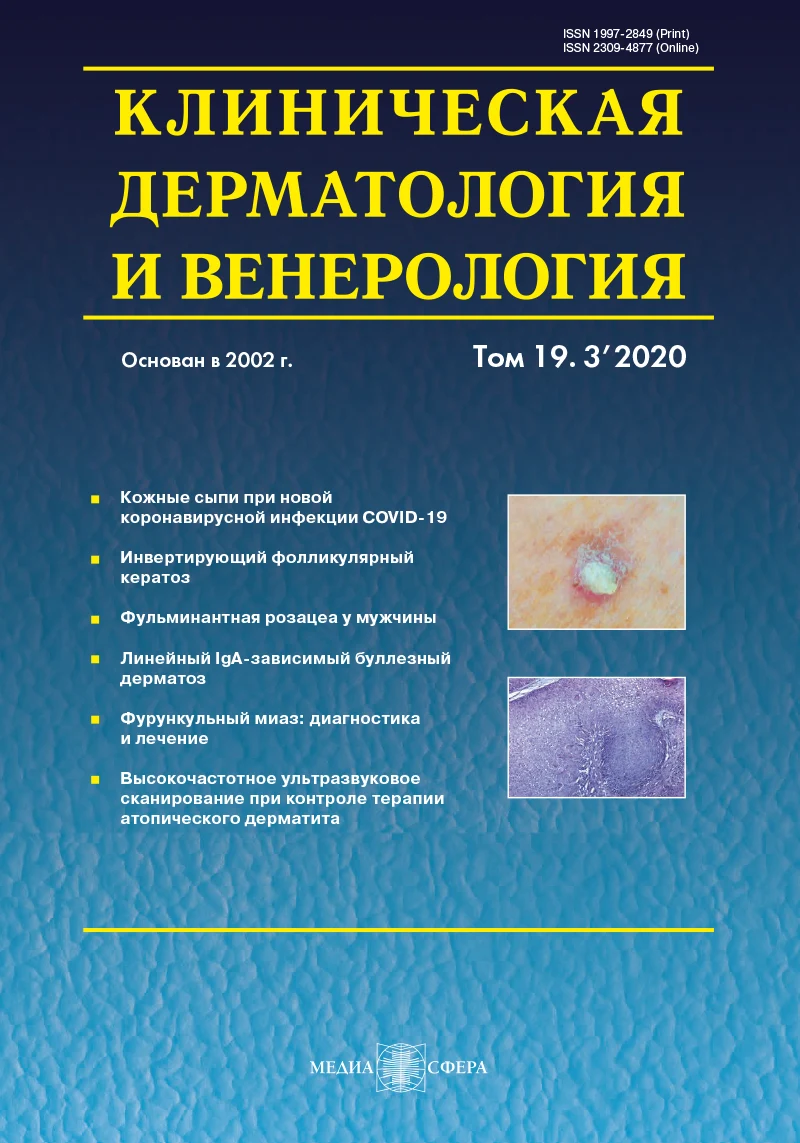
Клинический случай линейного IgA-зависимого буллезного дерматоза
Журнал: Клиническая дерматология и венерология. 2020;19(3):326-330.
DOI: 10.17116/klinderma202019031326
Прочитано: 8587 раз
Резюме
Линейный IgA-зависимый буллезный дерматоз — редкое иммуноопосредованное пузырное кожное заболевание, поражает кожу и слизистые оболочки, характеризуется появлением субэпидермальных пузырей, индуцированных аутоантителами, которые направлены против нескольких аутоантигенов с разной молекулярной массой, расположенных в зоне базальной мембраны многослойного плоского эпителия кожи и слизистых оболочек. Различают 2 формы заболевания — детскую и взрослую, однако их клиническое различие незначительно. У детей линейный IgA-зависимый буллезный дерматоз ранее называли «хронический буллезный дерматоз детского возраста». Взрослая форма обычно наблюдается у женщин после 60 лет, нередко у больных лимфомой, злокачественными неоплазиями внутренних органов, а также после приема некоторых лекарственных препаратов. Отмечается ассоциация дерматоза с HLA-В8 практически у всех больных, как детей, так и взрослых. Первоначально линейный IgA-зависимый дерматоз считался одной из разновидностей герпетиформного дерматита, однако в настоящее время эти заболевания четко разграничиваются на основании иммунопатологических и иммуногенетических признаков, а также в связи с отсутствием устойчивой ассоциации линейного дерматоза с глютенсенситивной энтеропатией. Наблюдается выраженная схожесть клинических и морфологических проявлений с другими буллезными дерматозами (герпетиформный дерматит Дюринга, приобретенный буллезный эпидермолиз, буллезный пемфигоид Левера, буллезная форма красного плоского лишая, рубцующий пемфигоид), вследствие чего нередко возникают диагностические ошибки. Таким образом, основополагающим при постановке диагноза является характерная иммунопатологическая картина заболевания — линейная полоса IgA в зоне дермально-эпидермальной базальной мембраны. Приведено описание клинического наблюдения редкого дерматоза у женщины в возрасте 82 лет. Особый интерес представляет идентичность клинической и морфологической картины в данном случае с герпетиформным дерматитом Дюринга. Подчеркивается важность применения иммунофлюоресцентного метода диагностики для своевременной верификации диагноза линейного IgA-дерматоза. Осведомленность практикующих дерматологов об этом заболевании способствует ранней диагностике, соответствующему лечению и более благоприятному прогнозу.
Ключевые слова
- IgA-линейный дерматоз
- Ig-линейный дерматит
- клинический случай
- диагностика буллезных дерматозов
Дата поступления: 14.10.2019
Дата принятия в печать: 24.03.2020
Дата публикации: 11.11.2020
Введение
Линейный IgА-зависимый буллезный дерматоз — редкое иммуноопосредованное пузырное заболевание кожи, характеризуется наличием гомогенного линейного отложения IgA на базальной клеточной мембране. Первоначально дерматоз рассматривали как разновидность герпетиформного дерматита Дюринга [1], однако в настоящее время эти заболевания четко разграничены на основании иммунопатологических и иммуногенетических признаков, а также в связи с отсутствием устойчивой ассоциации линейного IgA-дерматоза с глютенчувствительной энтеропатией.
По данным англоязычной литературы [2], частота встречаемости заболевания в европейской популяции варьирует от 0,2 до 1 случая на 1 млн населения в год. Различают детскую и взрослую формы заболевания, в детском возрасте линейный IgA-зависимый дерматоз манифестирует в первые месяцы жизни, нередко после перенесенных инфекционных заболеваний. Как правило, взрослую форму наблюдают преимущественно у лиц зрелого возраста, чаще заболевание возникает у женщин после 60 лет, нередко — у больных лимфомой, злокачественными неоплазмами внутренних органов [3]. Отмечается ассоциация дерматоза с HLA-В8 практически у всех больных [1, 2].
Клиническая картина может имитировать герпетиформный дерматит, буллезный пемфигоид и рубцующий пемфигоид [4]. Характер кожных проявлений чрезвычайно полиморфный. Патологический процесс представлен везикулами и пузырями с напряженной покрышкой, прозрачным или геморрагическим содержимым, с тенденцией к группировке, а также к образованию гирляндоподобной формы, в ряде случаев кольцевидных очертаний; высыпания располагаются на видимо неизмененном или гиперемированном участке кожи. Наряду с везикулезно-буллезными элементами наблюдают единичные уртикарные и папулезные высыпания, эрозии и геморрагические корочки. В основном высыпания локализуются на разгибательных поверхностях конечностей, туловище, ягодицах и лице (чаще в периоральной области). Больных беспокоит интенсивный зуд в местах высыпаний [1, 2]. Возможно также вовлечение в патологический процесс слизистых оболочек любой локализации (наиболее часто поражаются глаза и полость рта) [5]. Поражение слизистой оболочки ротовой полости обычно представлено болезненными эрозиями, образующимися после вскрытия пузырей. Помимо глаз и полости рта, могут поражаться слизистые оболочки других органов — гортани, глотки, трахеи, пищевода, бронхов, влагалища [1, 3].
В большинстве случаев причину развития заболевания выявить не удается, однако развитие могут провоцировать инфекционные заболевания, злокачественные опухоли, системные заболевания, прием лекарственных средств [6], интенсивная инсоляция, термические ожоги [2]. Чаще всего наблюдается ассоциация со злокачественными новообразованиями (неходжкинская лимфома с последующим хроническим лимфоцитарным лейкозом, почечно-клеточная карцинома и рак мочевого пузыря), воспалительными заболеваниями кишечника (неспецифический язвенный колит и болезнь Крона), системной красной волчанкой [2, 7].
Гистопатологическое исследование биоптата кожи у пациентов с линейным IgA-зависимым буллезным дерматозом выявляет субэпидермальный пузырь со скоплением нейтрофилов в верхних слоях дермы (микроабсцессы сосочкового слоя), также возможно присутствие мононуклеаров и эозинофилов [1]. Однако бывает трудно дифференцировать линейный IgA-дерматоз от других аутоиммунных субэпидермальных буллезных дерматозов только по клиническим и гистологическим признакам. В связи с этим рекомендовано проведение прямой (ПИФ) [8] и непрямой иммунофлюоресценции необработанной и/или расщепленной солевым раствором кожи либо иммуноэлектронной микроскопии (ИЭМ). При ПИФ обычно наблюдают линейное отложение IgA вдоль зоны базальной мембраны, реже выявляют сочетанное присутствие IgG, IgM или C3-комплемента [3, 5, 8]. Таким образом, выделяют классические случаи с преобладанием фиксации IgA (линейный IgA-дерматоз), а также смешанные формы аутоиммунных буллезных заболеваний (линейный IgG/IgA-дерматоз или линейный IgA/IgG-дерматоз). РНИФ используют для обнаружения циркулирующих IgA-аутоантител, положительный результат регистрируют у 30–50% пациентов с линейным IgA-буллезным дерматозом. ИЭМ позволяет определить точное расположение иммунных депозитов в lamina lucida или в lamina/sublamina densa [2].
Лечение линейного IgA-буллезного дерматоза проводят в зависимости от тяжести течения заболевания. При легкой форме достаточно эффективно применение топических кортикостероидных средств в качестве монотерапии. Системным препаратом терапии первой линии при более тяжелом течении является дапсон [1, 3]. При наличии противопоказаний к его применению используют сульфаниламидные препараты. При отсутствии эффективности от проводимой терапии возможно назначение системных кортикостероидных препаратов [9]. Терапия резерва включает плазмаферез и системное введение иммуноглобулинов. Лечение проводят до достижения клинической ремиссии [2, 10].
Клиническое наблюдение
Пациентка Ф., 1937 года рождения, поступила в Клинику им. В.Г. Короленко с жалобами на высыпания на коже волосистой части головы, туловища, верхних и нижних конечностей, сопровождаемые постоянным интенсивным зудом в местах высыпаний. Считает себя больной с 2007 г., когда впервые появились высыпания на коже спины на фоне погрешности в диете, в связи с чем обратилась к дерматологу по месту жительства, диагноз и проводимое лечение уточнить затрудняется. Отмечен положительный эффект после проведенного лечения. В 2009 г. высыпания распространились на кожу туловища, верхних и нижних конечностей, в связи с чем госпитализирована в дерматологический стационар (выписной эпикриз не предоставлен), где клинически, со слов, диагностирован герпетиформный дерматит Дюринга. В объеме проводимой терапии получала дапсон (дозу и кратность приема препарата уточнить затрудняется) с временным положительным эффектом. Рекомендован дальнейший прием препарата дапсон амбулаторно, который пациентка самостоятельно отменила после выписки из стационара. В дальнейшем отмечала периоды обострений кожного патологического процесса, которые самостоятельно купировала эпизодическим приемом препарата дапсон с временным положительным эффектом. Неоднократно лечилась амбулаторно и стационарно (последняя госпитализация в 2016 г. в условиях дневного стационара по месту жительства. Терапия включала преднизолон таблетированный (кратность и дозу препарата уточнить затрудняется), наружно бетаметазона дипропионат мазь) с временным положительным эффектом; рекомендован дальнейший прием преднизолона амбулаторно под контролем дерматолога по месту жительства (последний прием преднизолона в 2016 г.). В сентябре 2018 г. на фоне погрешности в диете появились высыпания на коже волосистой части головы, туловища, верхних конечностей, поэтому самостоятельно принимала дапсон по 1 таблетке 2 раза в день в течение 4 дней, с последующей отменой из-за отсутствия препарата. На фоне лечения отметила ухудшение кожного процесса в виде распространения высыпаний, усиления интенсивности зуда в местах высыпаний. Обратилась к дерматологу по месту жительства и направлена на стационарное лечение в Клинику им. В.Г. Короленко.
Локальный статус при поступлении: патологический процесс на коже носит распространенный, островоспалительный характер. На коже волосистой части головы, туловища, верхних и нижних конечностей на умеренно отечном эритематозном фоне везикуло-буллезные элементы диаметром до 1 см, полусферической формы, с плотной покрышкой, заполненные серозным прозрачным содержимым, преимущественно на коже боковых поверхностей туловища, с тенденцией к группировке, на поверхности эритематозных очагов фестончатых очертаний эрозивные дефекты с серозно-геморрагическими корочками на поверхности (рис. 1). Симптомы Никольского, Асбо-Ханзена отрицательные. Слизистые оболочки свободны от высыпаний.

Рис. 1. Очаги поражения на боковой поверхности туловища.
Fig. 1. Lesions on the lateral surface of the trunk.
В условиях стационара с целью дообследования исследован цитоз пузырной жидкости, акантолитические клетки не обнаружены, э. 4%. Клинический анализ крови: умеренная эозинофилия до 7% (норма до 5%), остальные показатели в пределах референсных значений. Биохимический анализ крови: повышение уровня глюкозы до 6,7 ммоль/л (норма до 6,1 ммоль/л). Гликемический профиль: уровень гликемии натощак 6,9 ммоль/л, после нагрузки 9,9 ммоль/л. Проведен бактериологический посев отделяемого с элемента на коже туловища, выявлены рост Staphylococcus Cohnii (–), чувствительность к амоксиклаву, цефазолину, цефуроксиму, цефтриаксону, фузидиевой кислоте.
Консультирована терапевтом, неврологом, эндокринологом, выявлены сопутствующие заболевания: артериальная гипертензия II стадии, 2-й cтепени, риск ССО 4. ЦВБ. ХИГМ сложного генеза. Сахарный диабет II типа, компенсация.
Целевой уровень HbA1c<7%.
На основании данных анамнеза и клинической картины заболевания выставлен предварительный диагноз: герпетиформный дерматит Дюринга. Проведена терапия дапсоном в дозе 50 мг по 1 таблетке 2 раза в день, 6 дней с однодневным перерывом, десенсибилизирующими, антибактериальными, антигистаминными препаратами, наружное использование растворов анилиновых красителей, топических глюкокортикостероидных средств.
С целью верификации диагноза выполнены патоморфологическое и иммунофлюоресцентное исследования. Диагностическая биопсия кожи: в биоптате мультилокулярный субэпидермальный пузырь с нечетким дном, заполненный фибрином и нейтрофилами. В дерме периваскулярные лимфогистиоцитарные с примесью эозинофилов и нейтрофилов инфильтраты, в отдельных дермальных сосочках микроабсцессы из нейтрофилов. При проведении реакции прямой иммунофлюоресценции с мечеными FITC антителами к IgA, c3c, IgM, IgG на замороженных срезах определяется линейное свечение IgA вдоль базальной мембраны; отсутствие свечения с3с вдоль базальной мембраны; отсутствие свечения IgM вдоль базальной мембраны; отсутствие свечения IgG. Заключение: совокупность данных гистологической и иммуноморфологической картин более всего соответствует линейному IgA-дерматозу (рис. 2).

Рис. 2. IgA-линейное отложение.
Fig. 2. IgA linear deposition.
С учетом анамнеза заболевания, клинической картины, лабораторных методов исследования, данных гистологического и иммунофлюоресцентного методов исследования диагностирован линейный IgA-дерматоз.
На фоне проведенной терапии большинство высыпаний на коже волосистой части головы, туловища, верхних и нижних конечностей регрессировало до поствоспалительных пятен застойно-розового цвета. Отмечены единичные, сухие, серозно-геморрагические корочки на коже спины в стадии отторжения. Свежих высыпаний не зарегистрировано.
Пациентка выписана с рекомендациями продолжить прием препарата дапсон 50 мг по 1 таблетке 2 раза в день по следующей схеме: 6 дней с однодневным перерывом и дальнейшей коррекцией дозы под строгим контролем дерматолога по месту жительства, с учетом динамики кожного процесса, контроля клинического анализа крови.
Обсуждение
Данное клиническое наблюдение представляет особый интерес в связи с редкой встречаемостью линейного IgА-дерматоза. Клиническая картина заболевания (наличие буллезных элементов на умеренно отечном эритематозном фоне, сгруппированность пузырных элементов, присутствие интенсивного зуда) имитировала герпетиформный дерматит Дюринга, с которым пациентку наблюдали на протяжении длительного периода. Соблюдение определенного алгоритма диагностических критериев позволяет своевременно выставить диагноз. При гистологическом исследовании в сосочках дермы определены нейтрофильные микроабсцессы, что характерно и для герпетиформного дерматита Дюринга. Полученные данные подтверждают сложность дифференциальной диагностики этих дерматозов без использования иммунофлюоресцентного метода исследования. Только проведение ПИФ позволило достоверно диагностировать линейный IgA-зависимый дерматоз.
Заключение
Линейный IgA-зависимый буллезный дерматоз является гетерогенной группой везикуло-буллезных заболеваний кожи и слизистых оболочек. Диагноз в настоящее время возможно установить только на основании иммунофлюоресцентного метода. Приведенный случай представляет интерес в связи с редкостью патологии в клинической практике, тяжестью течения заболевания (большой площадью кожного патологического процесса, интенсивным зудом в местах высыпаний), сложностью дифференциально-диагностического поиска, что требует дальнейшего обобщения опыта для своевременной постановки диагноза.
Авторы заявляют об отсутствии конфликта интересов.
The authors declare no conflict of interest.
<- Fortuna G, Marinkovich MP. Linear immunoglobulin A bullous dermatosis. Clin Dermatol. 2012;30:38-50. PubMed PMID: 22137225. https://doi.org/10.1016/j.clindermatol.2011.03.008
- Kridin K. Subepidermal autoimmune bullous diseases: overview, epidemiology, and associations. Immunol Res. 2018 Feb;66(1):6-17. Review PubMed PMID: 29159697. https://doi.org/10.1007/s12026-017-8975-2
- Machado TYS, Enokihara MMSES, Iida TM, Porro AM. Adult linear IgA bullous dermatosis: report of three cases. An Bras Dermatol. 2018;93(3):435-437. PubMed PMID: 29924252; PubMed Central PMCID: PMC6001096. https://doi.org/10.1590/abd1806-4841.20187304
- Koga H, Ishii N, Hashimoto T, Nakama T. Case of shift from linear immunoglobulin A bullous dermatosis to pemphigus herpetiformis for a short period of time. J Dermatol. 2017;44(2):189-193. Epub 2016 Nov 5. PubMed PMID: 28497856. https://doi.org/10.1111/1346-8138.13677
- Garel B, Ingen-Housz-Oro S, Afriat D, Prost-Squarcioni C, Tétart F, Bensaid B, Bara Passot C, Beylot-Barry M, Descamps V, Duvert-Lehembre S, Grootenboer-Mignot S, Jeudy G, Soria A, Valnet-Rabier MB, Barbaud A, Caux F, Lebrun-Vignes B.Drug-induced linear immunoglobulin A bullous dermatosis: A French retrospective pharmacovigilance study of 69 cases. Br J Clin Pharmacol. 2019;85(3):570-579. Epub 2019 Jan 4. PubMed PMID: 30511379; PubMed Central PMCID: PMC6379232. https://doi.org/10.1111/bcp.13827
- Garel B, Ingen-Housz-Oro S, Afriat D, Prost-Squarcioni C, Tétart F, Bensaid B, Bara Passot C, Beylot-Barry M, Descamps V, Duvert-Lehembre S, Grootenboer-Mignot S, Jeudy G, Soria A, Valnet-Rabier MB, Barbaud A, Caux F, Lebrun-Vignes B. Drug-induced linear immunoglobulin A bullous dermatosis: A French retrospective pharmacovigilance study of 69 cases. Br J Clin Pharmacol. 2019;85(3):570-579. https://doi.org/10.1111/bcp.13827
- Kartan S, Shi VY, Clark AK, Chan LS. Paraneoplastic Pemphigus and Autoimmune Blistering Diseases Associated with Neoplasm Characteristics, Diagnosis,Associated Neoplasms, Proposed Pathogenesis, Treatment. Am J Clin Dermatol. 2017;18(1):105-126. Review. PubMed PMID: 27878477. https://doi.org/10.1007/s40257-016-0235-z
- Faria PCP, Cruz CC, Abulafia LA, Maceira JMP, Cassia FF, Medeiros PM. The importance of direct immunofluorescence in pemphigus herpetiformis diagnosis. An Bras Dermatol. 2017;92(5 suppl 1):145-147. PubMed PMID: 29267475; PubMed Central PMCID: PMC5726706. https://doi.org/10.1590/abd1806-4841.20174510
- Gouveia AI, Teixeira A, Freitas JP, Soares-de-Almeida L, Filipe P, Sacramento-Marques M. Linear Immunoglobulin A Bullous Dermatosis. J Pediatr. 2016;170:338-e1. Epub 2015 Dec 28. PubMed PMID: 26732409. https://doi.org/10.1016/j.jpeds.2015.11.078
- Ishii N. Prognostic factors of patients with linear IgA bullous dermatosis. Br J Dermatol. 2017;177(1):16-17. PubMed PMID: 28731254. https://doi.org/10.1111/bjd.15603