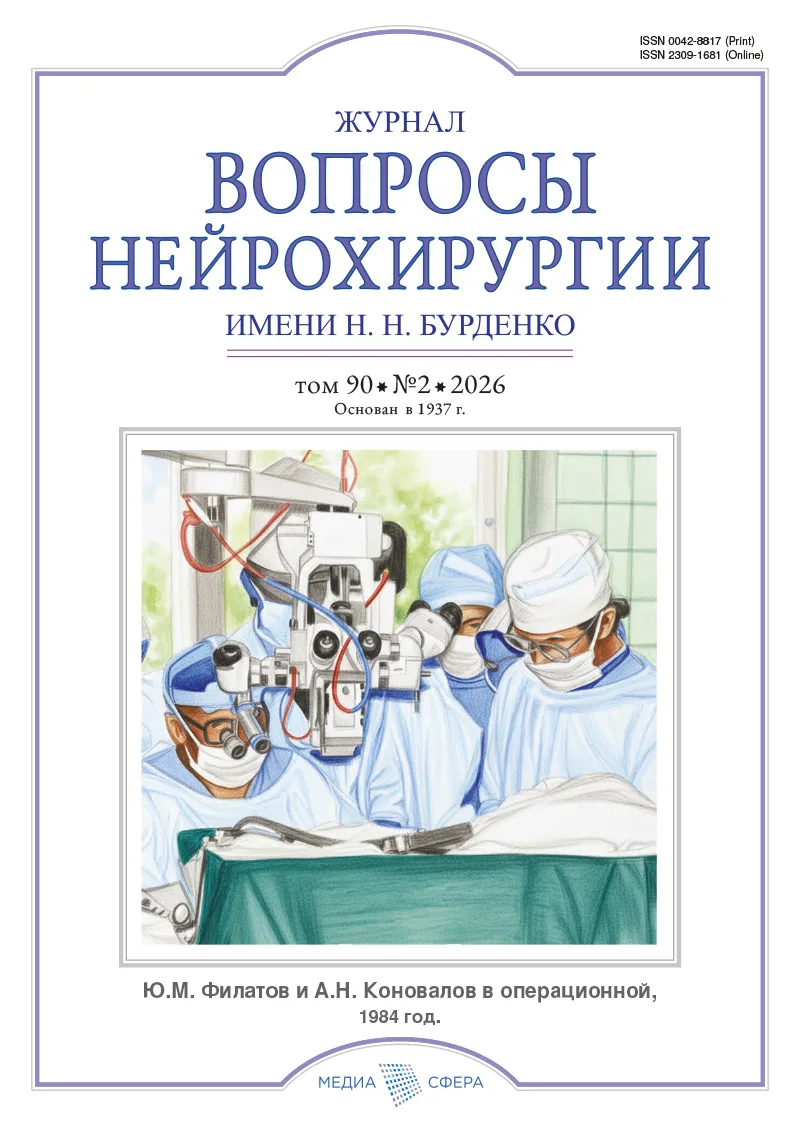
Роль биопсии в лечении детей с диффузными опухолями ствола головного мозга
Журнал: Вопросы нейрохирургии имени Н.Н. Бурденко. 2026;90(2):29-36.
DOI: 10.17116/neiro20269002129
Прочитано: 1753 раза
Резюме
Диффузные опухоли ствола головного мозга составляют 10–20% всех новообразований головного мозга у детей, являясь основной причиной смерти в детской нейроонкологии. Эффективных способов лечения заболевания не существует. Общая выживаемость редко превышает 1,5—2 года.
ЦЕЛЬ ИССЛЕДОВАНИЯ
Биопсия диффузных опухолей ствола головного мозга для определения их гистологического варианта и молекулярно–генетических маркеров, поиска возможных мишеней для таргетной терапии.
МАТЕРИАЛ И МЕТОДЫ
С 2021 по 2025 г. в Морозовской детской клинической больнице г. Москвы прооперировано 26 больных с диффузными опухолями ствола головного мозга в возрасте от 1,5 до 17 лет с длительностью анамнеза от 1 нед до 13 мес. В 96% случаев опухоль была первичной. Предварительный диагноз выставлен по данным клинической картины и МРТ. Стереотаксическая биопсия с использованием нейронавигатора Brainlab (Германия) трансцеребеллярным доступом выполнена у 24 пациентов, открытая биопсия — у 2.
РЕЗУЛЬТАТЫ
Опухоль верифицирована у 24 (92%) больных. У 2 больных получена мозговая ткань. По результатам морфологического исследования у 80% пациентов диагностирована диффузная срединная глиома. В 1 случае выявлена ганглиоглиома, в 1 — глиома высокой степени злокачественности и в 1 — глиома низкой степени злокачественности. Всем больным произведено иммуногистохимическое исследование биоптата. 58% обследовано по программе Next Generation Sequencing. Мутация H3K27M выявлена в 71%. Мутации BRAF-V600E обнаружены у 2 больных, мутация в гене FGFR2 — у 1 больного. По результатам выявленных мутаций назначалась таргетная терапия. Общая 2–летняя выживаемость составила 20%, бессобытийная 2–летняя выживаемость — 0%. Бессобытийная выживаемость больного с мутацией BRAF-V600E, получившего таргетную терапию, составила 21 мес.
ВЫВОДЫ
Стереотаксическая биопсия диффузных опухолей ствола головного мозга может быть выполнена безопасно. Выявление мишеней для персонифицированной терапии может стать ключом к излечению больных.
Ключевые слова
- опухоли головного мозга у детей
- опухоль ствола головного мозга
- DIPG
- СТБ
- таргетная терапия
Дата поступления: 01.07.2025
Дата принятия в печать: 30.01.2026
Дата публикации: 03.04.2026
- Озеров С.С., Рыжова М.В., Кумирова Э.В. Диффузные опухоли ствола головного мозга у детей. Биология опухоли и надежда на лучший исход. Современное состояние проблемы. Вопросы нейрохирургии им. Н.Н. Бурденко. 2021;85(4):77-86. https://doi.org/10.17116/neiro20218504177
- Dmetrichuk JM, Pendleton C, Jallo GI, Quiñones-Hinojosa A. Father of neurosurgery: Harvey Cushing’s early experience with a pediatric brainstem glioma at the Johns Hopkins Hospital. Journal of Neurosurgery: Pediatrics. 2011;8(4):337-341. https://doi.org/10.3171/2011.7.PEDS11101
- Tosi U, Souweidane M. Fifty years of DIPG: looking at the future with hope. Child’s Nervous System. 2023;39(10):2675-2686. https://doi.org/10.1007/s00381-023-06037-5
- Vanan MI, Eisenstat DD. DIPG in Children — What Can We Learn from the Past? Frontiers in Oncology. 2015;5:237. https://doi.org/10.3389/fonc.2015.00237
- Hersh DS, Kumar R, Moore KA, Smith LGF, Tinkle CL, Chiang J, Patay Z, Gajjar A, Choudhri AF, Lee-Diaz JA, Vaughn B, Klimo P. Safety and efficacy of brainstem biopsy in children and young adults. Journal of Neurosurgery: Pediatrics. 2020;26(5):552-562. https://doi.org/10.3171/2020.4.PEDS2092
- Albright AL, Packer RJ, Zimmerman R, Rorke LB, Boyett J, Hammond GD. Magnetic resonance scans should replace biopsies for the diagnosis of diffuse brain stem gliomas: a report from the Children’s Cancer Group. Neurosurgery. 1993;33(6):1026-1029; discussion 1029-1030. https://doi.org/10.1227/00006123-199312000-00010
- Di Ruscio V, Del Baldo G, Fabozzi F, Vinci M, Cacchione A, de Billy E, Megaro G, Carai A, Mastronuzzi A. Pediatric Diffuse Midline Gliomas: An Unfinished Puzzle. Diagnostics. 2022;12(9):2064. https://doi.org/10.3390/diagnostics12092064
- Sheikh SR, Patel NJ, Recinos VMR. Safety and Technical Efficacy of Pediatric Brainstem Biopsies: An Updated Meta-Analysis of 1000+ Children. World Neurosurgery. 2024;189:428-438.e2. https://doi.org/10.1016/j.wneu.2024.06.163
- Tosi U, Souweidane M. Diffuse Midline Gliomas: Challenges and New Strategies in a Changing Clinical Landscape. Cancers. 2024;16(1):219. https://doi.org/10.3390/cancers16010219
- Sheikh SR, Recinos VMR, Thompson EM, Mangum R, Wright-Nadkarni M, Gampel B, Patel NJ. The role of brainstem biopsy and targeted therapies in pediatric diffuse midline glioma/diffuse intrinsic pontine glioma. Frontiers in Oncology. 2024;14:1504440. https://doi.org/10.3389/fonc.2024.1504440
- Lo Greco MC, Marano G, La Rocca M, Acquaviva G, Milazzotto R, Liardo RLE, Basile A, Foti PV, Palmucci S, David E, Parisi S, Pontoriero A, Pergolizzi S, Spatola C. Latest Advancements in the Management of H3K27M-Mutant Diffuse Intrinsic Pontine Glioma: A Narrative Review. Cancers. 2025;17(3):420. https://doi.org/10.3390/cancers17030420
- Del Baldo G, Carai A, Abbas R, Cacchione A, Vinci M, Di Ruscio V, Colafati GS, Rossi S, Diomedi Camassei F, Maestro N, Temelso S, Pericoli G, De Billy E, Giovannoni I, Carboni A, Rinelli M, Agolini E, Mackay A, Jones C, Chiesa S, Balducci M, Locatelli F, Mastronuzzi A. Targeted therapy for pediatric diffuse intrinsic pontine glioma: a single-center experience. Therapeutic Advances in Medical Oncology. 2022;14:17588359221113693. https://doi.org/10.1177/17588359221113693
- Puget S, Beccaria K, Blauwblomme T, Roujeau T, James S, Grill J, Zerah M, Varlet P, Sainte-Rose C. Biopsy in a series of 130 pediatric diffuse intrinsic Pontine gliomas. Child’s Nervous System. 2015;31(10):1773-1780. https://doi.org/10.1007/s00381-015-2832-1
- Pfaff E, El Damaty A, Balasubramanian GP, Blattner-Johnson M, Worst BC, Stark S, Witt H, Pajtler KW, van Tilburg CM, Witt R, Milde T, Jakobs M, Fiesel P, Frühwald MC, Hernáiz Driever P, Thomale UW, Schuhmann MU, Metzler M, Bochennek K, Simon T, Dürken M, Karremann M, Knirsch S, Ebinger M, von Bueren AO, Pietsch T, Herold-Mende C, Reuss DE, Kiening K, Lichter P, Eggert A, Kramm CM, Pfister SM, Jones DTW, Bächli H, Witt O. Brainstem biopsy in pediatric diffuse intrinsic pontine glioma in the era of precision medicine: the INFORM study experience. The European Journal of Cancer. 2019;114:27-35. https://doi.org/10.1016/j.ejca.2019.03.019
- Wang M, Zhang Y, Shi W, Zhu R, Li H, Zhao R. Frameless robot-assisted stereotactic biopsy: an effective and minimally invasive technique for pediatric diffuse intrinsic pontine gliomas. Journal of Neuro-Oncology. 2022;160(1):107-114. https://doi.org/10.1007/s11060-022-04122-4
- Früh A, Schaumann A, Cohrs G, Pennacchietti V, Schulz M, Hernáiz Driever P, Koch A, Thomale UW. Biopsies of Caudal Brainstem Tumors in Pediatric Patients-A Single-Center Retrospective Case Series. World Neurosurgery. 2023;177: e84-e93. https://doi.org/10.1016/j.wneu.2023.05.108
- Gojo J, Pavelka Z, Zapletalova D, Schmook MT, Mayr L, Madlener S, Kyr M, Vejmelkova K, Smrcka M, Czech T, Dorfer C, Skotakova J, Azizi BAA, Chocholous M, Reisinger D, Lastovicka D, Valik D, Haberler C, Peyrl A, Noskova H, Pál K, Jezova M, Veselska R, Kozakova S, Slaby O, Slavc I, Sterba J. Personalized Treatment of H3K27M-Mutant Pediatric Diffuse Gliomas Provides Improved Therapeutic Opportunities. Frontiers in Oncology. 2020;9:1436. https://doi.org/10.3389/fonc.2019.01436
- Grill J, Le Teuff G, Varlet P, Hargrave DR, Nysom K, Blomgrenn K, McCowage GB, Bautista F, Van Vuurden D, Debily MA, Kergrohen T, Puget S, Bolle S, Abbou S, Leblond P, Boddaert N, Vassal G, Le Deley MC. Biological medicines for diffuse intrinsic pontine glioma (DIPG) eradication (BIOMEDE): Final results of an international randomized phase II platform trial comparing 3 targeted therapies in combination with radiotherapy from ITCC, SIOPE-Brain and ANZCHOG. Journal of Clinical Oncology. 2023;41(16_suppl):10003-10003. https://doi.org/10.1200/JCO.2023.41.16_suppl.10003
- Hajikarimloo B, Tos SM, Alvani MS, Kooshki A, Hasanzade A, Zare AH, Zare AH, Najari D, Habibi MA. Efficacy and safety of dabrafenib plus trametinib in pediatric versus adult gliomas: a systematic review and meta-analysis. Child’s Nervous System. 2025;41(1):104. https://doi.org/10.1007/s00381-025-06760-1
- Cacciotti C, Tabori U, Hawkins C, Bennett J. Targeting the RAS/MAPK pathway in children with glioma. Journal of Neuro-Oncology. 2025;171(2):265-277. https://doi.org/10.1007/s11060-024-04857-2
- Abu Laban D, Alsharif A, Al-Hussaini M, Obeidat M, Maraqa B, Alzoubi Q, Musharbash A, Jaddoua S, Ramlawi R, Khaleifeh K, Ibrahimi AK, Sarhan N, Bouffet E, Amayiri N. BRAF/MEK inhibitors use for pediatric gliomas; real world experience from a resource-limited country. Frontiers in Oncology. 2024;14:1417484. https://doi.org/10.3389/fonc.2024.1417484
- Deland L, Keane S, Olsson Bontell T, Sjöberg Bexelius T, Gudinaviciene I, De La Cuesta E, De Luca F, Nilsson JA, Carén H, Mörse H, Abel F. A pilocytic astrocytoma with novel ATG16L1:: NTRK2 fusion responsive to larotrectinib: a case report with genomic and functional analysis. Oncologist. 2025;30(3): oyae254. https://doi.org/10.1093/oncolo/oyae254
- Christian EA, Rutka JT. Emerging frontiers in diffuse intrinsic pontine glioma treatment: A new hope. Neuro-Oncology. 2025:27(8):2127-2128. https://doi.org/10.1093/neuonc/noaf117
- Cacciotti C, Wright KD. Advances in Treatment of Diffuse Midline Gliomas. Current Neurology and Neuroscience Reports. 2023;23(12):849-856. https://doi.org/10.1007/s11910-023-01317-8


Рекомендуем статьи по данной теме:
Клинический случай применения таргетной терапии у пациента с муковисцидозом и декомпенсированным циррозом печени.Респираторная медицина. 2026;2(2):66-71
Путь к инновациям: терапия метастатического колоректального рака сегодня и завтра (по материалам XII Конференции RUSSCO «Опухоли желудочно-кишечного тракта»).Онкология. Журнал им. П.А. Герцена. 2026;15(3):112-117
Перспективы терапии шизофрении с использованием ретроэлементов в качестве мишеней.Журнал неврологии и психиатрии им. С.С. Корсакова. 2026;126(4):22-27
Мигрень и депрессия: важные взаимоотношения.Журнал неврологии и психиатрии им. С.С. Корсакова. 2026;126(4):15-21
Обоснование персонализированного подхода в терапии пациентов с рецидивирующим полипозным риносинуситом на основании изучения особенностей цитокининдуцированного Th2-воспаления (интерлейкин-4, интерлейкин-13).Вестник оториноларингологии. 2026;91(2):43-49
Опухолеассоциированные фибробласты и их особенности как компонента опухолевой стромы при раке мочевого пузыря.Архив патологии. 2026;88(2):87-93
Связь между кишечной микробиотой и патогенезом псориаза.Клиническая дерматология и венерология. 2026;25(1):15-22
Классификация немелкоклеточного рака легкого по версии ВОЗ, 2021: от морфологии к персонализированной терапии.Архив патологии. 2026;88(1):60-67
Прогностически неблагоприятные типы рака молочной железы.Онкология. Журнал им. П.А. Герцена. 2025;14(6):78-82
Предикторы аритмий и неблагоприятных исходов у пациентов онкологического профиля на фоне противоопухолевого лечения.Профилактическая медицина. 2025;28(11):86-93