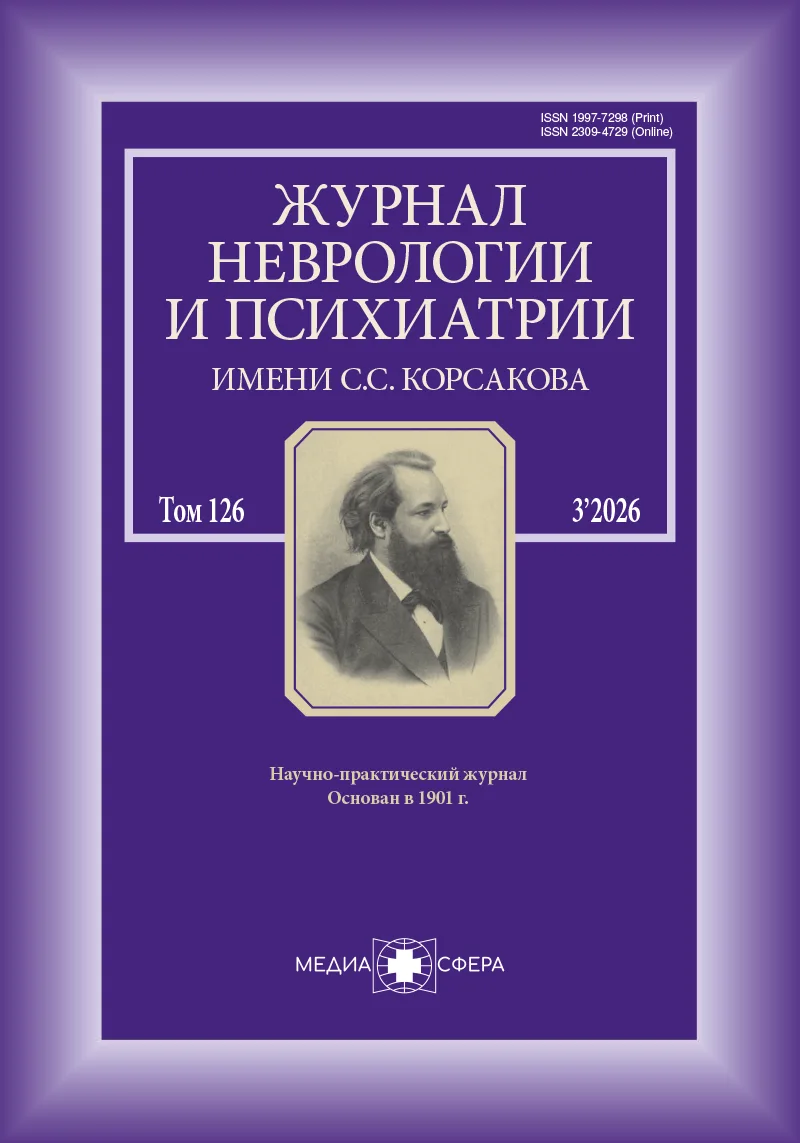
Drug-drug interactions with Mexidol in patients with ischemic stroke: Analysis of data from randomized clinical trials
Журнал: Журнал неврологии и психиатрии им. С.С. Корсакова. 2026;126(3):141-154.
DOI: 10.17116/jnevro2026126031141
Read: 2556 раз
Abstract
OBJECTIVE
Identification of drug-drug interaction of Mexidol when used in patients with ischemic stroke.
MATERIAL AND METHODS
The data from randomized controlled clinical trials (RCTs) of the efficacy and safety of Mexidol, EPICA and MIR, in patients with ischemic stroke were analyzed.
RESULTS
The analysis included data from 304 participants of RCT MIR and 150 participants of RCT EPICA. In both studies, antihypertensive drugs were most often used as concomitant therapy (94.1% of participants in the MIR RCT and 98.0% of EPIC RCT). In patients receiving Mexidol, antihypertensive drugs with INN were more often prescribed: enalapril (24.0%), bisoprolol (16.7%), amlodipine (11.8%), lisinopril (8.4%), indapamide (7.9%). In addition to antihypertensive drugs, almost all participants in RCTS MIR and EPIC received antiplatelet drugs (90.1% and 94.0% respectively), lipid-lowering drugs (78.0% and 78.7% respectively) and electrolyte solutions (77.3% and 75.3% respectively). Anticoagulants were prescribed in 24.0% of participants in the MIR RCT and in 34.0% of participants in the EPIC RCT. Analysis of drug interaction models, taking into account the total number of adverse events and the systemic organ class to which they belong, did not reveal a statistically significant change in the frequency of adverse events in patients receiving concomitant therapy along with Mexidol (p>0.05 in all comparison pairs).
CONCLUSION
The analysis did not reveal drug interactions when using Mexidol and all types of concomitant therapy in patients with ischemic stroke. This study confirmed the high safety and good tolerability when using Mexidol in patients receiving multiple medications at the same time.
Keywords
- stroke
- cerebrovascular accident
- ethylmethylhydroxypyridine succinate
- Mexidol
- drug interaction
Дата поступления: 16.02.2026
Дата принятия в печать: 04.03.2026
Дата публикации: 15.04.2026
- GBD 2019 Stroke Collaborators. Global, regional, and national burden of stroke and its risk factors, 1990-2019: a systematic analysis for the Global Burden of Disease Study 2019. Lancet Neurol. 2021;20(10):795-820. https://doi.org/10.1016/S1474-4422(21)00252-0
- Ignatyeva VI, Voznyuk IA, Shamalov NA, et al. Social and economic burden of stroke In Russian Federation. S.S. Korsakov Journal of Neurology and Psychiatry. 2023;123(8-2):5-15. (In Russ.). https://doi.org/10.17116/jnevro20231230825
- Global Burden of Cardiovascular Diseases and Risks 2023 Collaborators. Global, Regional, and National Burden of Cardiovascular Diseases and Risk Factors in 204 Countries and Territories, 1990-2023. J Am Coll Cardiol. 2025;86(22):2167-2243. https://doi.org/10.1016/j.jacc.2025.08.015
- Samorodskaya IV. Variability and changes in regional mortality rates from acute cerebrovascular accidents. Vrach. 2023;34 (10):12-17. (In Russ.). https://doi.org/10.29296/25877305-2023-10-02
- Yuan K, Chen J, Xu P, et al. A Nomogram for Predicting Stroke Recurrence Among Young Adults. Stroke. 2020;51(6):1865-1867. https://doi.org/10.1161/STROKEAHA.120.029740
- Divišová P, Šaňák D, Král M, et al. Young cryptogenic ischemic stroke: A descriptive analysis of clinical and laboratory characteristics, outcomes and stroke recurrence. J Stroke Cerebrovasc Dis. 2020;29(9): 23-29. https://doi.org/10.1016/j.jstrokecerebrovasdis.2020.105046
- M’barek L, Sakka S, Megdiche F, et al. Traditional risk factors and combined genetic markers of recurrent ischemic stroke in adults. J Thromb Haemost. 2021;19(10):2596-2604. https://doi.org/10.1111/jth.15448
- Tolpygina SN, Zagrebelny AV, Chernysheva MI, et al. Comorbidity and long-term survival of patients suffered from acute cerebrovascular accident based on the REGION-M registry. Russian Journal of Preventive Medicine. 2023;26(11):64-68. https://doi.org/10.17116/profmed20232611164
- Sun J, Qiao Y, Zhao M, et al. Global, regional, and national burden of cardiovascular diseases in youths and young adults aged 15-39 years in 204 countries/territories, 1990-2019: a systematic analysis of Global Burden of Disease Study 2019. BMC Med. 2023;21(1):222-227. https://doi.org/10.1186/s12916-023-02925-4
- Penina GO, Ponomareva GM. Analysis of the Stroke Register in the Komi Republic for fifteen years. Vestnik Syktyvkarskogo universiteta. Seriya 2. Biologiya. Geologiya. Khimiya. Ekologiya. 2023;3(27):39-42. (In Russ.).
- Wang L, Han Y, Cao C, et al. The non-linear link between non-high-density lipoprotein to high-density lipoprotein ratio and the risk of stroke in middle-aged and older adults in Chinese: a prospective cohort study from the China health and retirement longitudinal study. Front Endocrinol. 2024; 14:1303336. https://doi.org/10.3389/fendo.2023.1303336
- Klinicheskie rekomendatsii Ministerstva zdravookhraneniya Rossijskoj Federacii. Narusheniya lipidnogo obmena. 2023. (In Russ.). Accessed December 16, 2025. https://cr.minzdrav.gov.ru/preview-cr/752_1
- Klinicheskie rekomendatsii Ministerstva zdravookhraneniya Rossijskoj Federacii. Ishemicheskij insul’t i tranzitornaya ishemicheskaya ataka. 2024. (In Russ.). Accessed December 16, 2025. https://cr.minzdrav.gov.ru/preview-cr/814_1
- Medication safety in polypharmacy: technical report. Accessed December 19, 2025. https://www.who.int/publications/i/item/WHO-UHC-SDS-2019.11
- Zheng WY, Richardson LC, Li L, et al. Drug-drug interactions and their harmful effects in hospitalised patients: a systematic review and meta-analysis. Eur J Clin Pharmacol. 2018;74(1):15-27. https://doi.org/10.1007/s00228-017-2357-5
- Aksoy N, Ozturk N. A meta-analysis assessing the prevalence of drug–drug interactions among hospitalized patients. Pharmacoepidemiol Drug Saf. 2023;32(12):1319-1330. https://doi.org/10.1002/pds.5691
- Gonzaga de Andrade Santos TN, Mendonça da Cruz Macieira G, Cardoso Sodré Alves BM, et al. Prevalence of clinically manifested drug interactions in hospitalized patients: A systematic review and meta-analysis. PLoS One. 2020;15(7):e0235353. https://doi.org/10.1371/journal.pone.0235353
- Ibysheva AT, Muldaeva GM, Arystan LI, et al. The multimorbidity and polypharmacy in the older people in the primary care. International Journal of Applied and Fundamental Research. 2021;5:18-24. (In Russ.).
- Arora S, Shemisa K, Vaduganathan M, et al. Premature Ticagrelor Discontinuation in Secondary Prevention of Atherosclerotic CVD: JACC Review Topic of the Week. J Am Coll Cardiol. 2019;73(19):2454-2464. https://doi.org/10.1016/j.jacc.2019.03.470
- Vol’skaya EA. Pacientskij komplaens. Obzor tendencij v issledovaniyax. Remedium. 2013;(11):6-15. (In Russ.).
- Martynov MU, Zhuravleva MV, Vasyukova NS, et al. Oxidative stress in the pathogenesis of stroke and its correction. S.S. Korsakov Journal of Neurology and Psychiatry. 2023;123(1):16-27. (In Russ.). https://doi.org/10.17116/jnevro202312301116
- Kulesh AA. Neuroprotective therapy in acute ischemic stroke. Neurology, Neuropsychiatry, Psychosomatics. 2021;13(4):94-102. (In Russ.). https://doi.org/10.14412/2074-2711-2021-4-94-102
- Shchukin IA, Koltsov IA, Fidler MS, Glukhareva AP. Neurocytoprotection advances in reperfusion therapy. S.S. Korsakov Journal of Neurology and Psychiatry. 2024;124(12-2):75-88. (In Russ.). https://doi.org/10.17116/jnevro202412412275
- Voronina TA, Litvinova SA, Gladysheva NA, et al. The known and new ideas about the mechanism of action and the spectrum of effects of Mexidol. S.S. Korsakov Journal of Neurology and Psychiatry. 2025;125(5):22-33. (In Russ.). https://doi.org/10.17116/jnevro202512505122
- Klinicheskie rekomendatsii Ministerstva zdravookhraneniya Rossijskoj federatsii. Kognitivnye rasstrojstva u lits pozhilogo i starcheskogo vozrasta. 2024. (In Russ.). Accessed December 16, 2025. https://cr.minzdrav.gov.ru/preview-cr/617_5?ysclid=mj8xim4mj932144279
- Klinicheskie rekomendatsii Ministerstva zdravookhraneniya Rossijskoj federatsii. Gemorragicheskij insul’t. 2025. (In Russ.). Accessed December 16, 2025. https://cr.minzdrav.gov.ru/preview-cr/523_3
- Shamalov NA, Fedin AI, Rakhimbaeva GS. Results of the international multicenter randomized, double-blind, placebo-controlled clinical trial for the evaluation of the efficacy and safety of the sequential therapy with ethylmethylhydroxypyridine succinate in patients in the acute and early recovery periods of ischemic stroke (MIR). S.S. Korsakov Journal of Neurology and Psychiatry. 2025;125(8-2):40-53. (In Russ.). https://doi.org/10.17116/jnevro202512508240
- Stakhovskaya LV, Shamalov NA, Khasanova DR, et al. Results of a randomized double blind multicenter placebo-controlled, in parallel groups trial of the efficacy and safety of prolonged sequential therapy with mexidol in the acute and early recovery stages of hemispheric ischemic stroke (EPICA). S.S. Korsakov Journal of Neurology and Psychiatry. 2017;117(3-2):55-65. (In Russ.). https://doi.org/10.17116/jnevro20171173255-65
- Shchulkin AV, Chernykh IV, Abalenikhina YV, et al. Study of drug-drug interactions between Mexidol and thrombolytic drugs. S.S. Korsakov Journal of Neurology and Psychiatry. 2025;125(9):139-144. (In Russ.). https://doi.org/10.17116/jnevro2025125091139
- Gonzaga TN, Mendonça da Cruz MG, Cardoso BM, et al. Prevalence of clinically manifested drug interactions in hospitalized patients: A systematic review and meta-analysis. PloS One. 2020;15(7):e0235353. https://doi.org/10.1371/journal.pone.0235353
- Rasool MF, Rehman AU, Khan I, et al. Assessment of risk factors associated with potential drug-drug interactions among patients suffering from chronic disorders. PloS One. 2023;18(1):e0276277. https://doi.org/10.1371/journal.pone.0276277
- Ayenew W, Asmamaw G, Issa A. Prevalence of potential drug-drug interactions and associated factors among outpatients and inpatients in Ethiopian hospitals: a systematic review and meta-analysis of observational studies. BMC Pharmacol Toxicol. 2020;21(1):63. https://doi.org/10.1186/s40360-020-00441-2
- Alemayehu TT, Geremew GW, Tegegne AA, et al. Drug-drug interaction among elderly patients in Africa: a systematic review and meta-analysis. BMC Pharmacol Toxicol. 2025;26(1):92. https://doi.org/10.1186/s40360-025-00926-y
- Gewandter JS, Smith SM, McKeown A, et al. Reporting of primary analyses and multiplicity adjustment in recent analgesic clinical trials: ACTTION systematic review and recommendations. Pain. 2014;155(3):461-466. https://doi.org/10.1016/j.pain.2013.11.009
- Ludbrook J. On making multiple comparisons in clinical and experimental pharmacology and physiology. Clin Exp Pharmacol Physiol. 1991;18(6): 379-392. https://doi.org/10.1111/j.1440-1681.1991.tb01468.x
- Protokol tromboliticheskoj terapii ishemicheskogo insul’ta. Saint Petersburg; 2023. (In Russ.). Accessed December 16, 2025. https://nsnch.org/wp-content/uploads/2021/12/A5_27_01_23_all.pdf
- Sehweil SM, Goncharova ZA. Thrombolytic therapy of cerebral infarction caused by an occlusion in the proximal segment of the middle cerebral artery. Russian Neurological Journal. 2024;29(3):41-48. (In Russ.). https://doi.org/10.30629/2658-7947-2024-29-3-41-48


Recommended articles:
Enhancing medical rehabilitation outcomes for patients following ischemic stroke.S.S. Korsakov Journal of Neurology and Psychiatry. 2026;126(8-2):60-74
Dynamics of emergency medical service calls for acute cerebrovascular incidents: a 15-year analysis of age, gender, and temporal patterns.Russian Journal of Preventive Medicine. 2026;29(7):17-24
Systemic inflammation in spastic forms of cerebral palsy: pathogenetic role and modulation possibilities using Mexidol in motor rehabilitation of pediatric patients.S.S. Korsakov Journal of Neurology and Psychiatry. 2026;126(5):74-82
The cerebroprotective effects of Mexidol in patients with hypertension.S.S. Korsakov Journal of Neurology and Psychiatry. 2026;126(4):113-118
Multimodal antioxidant therapy in ischemic stroke: from MIR trial to bedside.S.S. Korsakov Journal of Neurology and Psychiatry. 2025;125(12-2):64-71
Distal protection in transcatheter aortic valve implantation: pros and cons. Choice of the patient or preferences of the clinic and surgeon?Pirogov Russian Journal of Surgery. 2025;(11-2):12-19
Study of drug-drug interactions between Mexidol and thrombolytic drugs.S.S. Korsakov Journal of Neurology and Psychiatry. 2025;125(9):139-144
Results of the international multicenter randomized, double-blind, placebo-controlled clinical trial for the evaluation of the efficacy and safety of the sequential therapy with ethylmethylhydroxypyridine succinate in patients in the acute and early recovery periods of ischemic stroke (MIR).S.S. Korsakov Journal of Neurology and Psychiatry. 2025;125(8-2):40-53
The known and new ideas about the mechanism of action and the spectrum of effects of Mexidol.S.S. Korsakov Journal of Neurology and Psychiatry. 2025;125(5):22-33
The main mechanisms of development of cognitive impairment.S.S. Korsakov Journal of Neurology and Psychiatry. 2025;125(4-2):13-18