
Клинический опыт применения 0,01% атропина для контроля близорукости у детей в Азербайджане
Журнал: Вестник офтальмологии. 2025;141(4):29-33.
DOI: 10.17116/oftalma202514104129
Прочитано: 2260 раз
Резюме
ЦЕЛЬ ИССЛЕДОВАНИЯ
Изучить изменение глазных параметров у пациентов с прогрессирующей близорукостью, получавших 0,01% атропин.
МАТЕРИАЛ И МЕТОДЫ
В исследовании были задействованы 35 детей (18 (51,4%) девочек, 17 (48,6%) мальчиков) в возрасте 4—15 лет. Среди них у 20 (57,2%) один родитель, а у 2 (5,7%) оба родителя были близорукими. Работа проводилась в 4 этапа: 1-й этап — первичное обследование; 2-й этап — через 8 мес без лечения; 3-й этап — через 12 мес после лечения; 4-й этап — через 6 мес после прекращения лечения. Атропин 0,01% закапывали ежедневно перед сном, продолжительность каждого курса — 1,5 мес, всего 4 курса со сроком наблюдения 12 мес. Больные были с астигматическим компонентом.
РЕЗУЛЬТАТЫ
На 2-м этапе практически у всех установлено прогрессирование миопии, наблюдался статистически достоверный рост сферического эквивалента у 63 (90%) глаз — в среднем на 0,70 дптр (p=0,000, p<0,001). Такая же динамика наблюдалась в показателе передне-задней оси (ПЗО) глазного яблока — 0,35±0,09 мм (p=0,000, p<0,001). На 3-м этапе отмечалась стабилизация показателей как сферического эквивалента, так и ПЗО. В среднем разница между 2-м и 3-м этапами по сферическому эквиваленту незначительна (–0,08 дптр) и недостоверна (p=0,127, p<0,050). Стабилизация также наблюдалась по показателю ПЗО (0,04 мм) (p=0,034, p<0,050). Различия между 3-м и 4-м этапами по сферическому эквиваленту были незначительны и недостоверны (–0,01 дптр) (p=0,012).
ЗАКЛЮЧЕНИЕ
Применение 0,01% атропина в течение 1 года четырьмя курсами по 1,5 мес каждый стабилизирует миопический процесс у детей с прогрессирующей миопией. Данный способ является эффективным и приемлемым методом контроля миопии у детей дошкольного и школьного возраста.
Ключевые слова
- атропин 0
- 01%
- длина оси глаза
- миопия
- сферический эквивалент
Дата поступления: 11.09.2024
Дата принятия в печать: 25.09.2024
Дата публикации: 08.09.2025
Введение
В современном мире стал естественным образ человека в медицинских очках. Если еще в прошлом столетии ношение очков больше ассоциировалось с возрастом, то в наше время оптическими очками все чаще пользуются дети и молодые люди. Основной причиной является близорукость. Так, по статистике Всемирной организации здравоохранения (ВОЗ), в 2010 г. только в Китае насчитывалось около 75 млн пациентов с нарушениями зрения, первопричиной которых является нескорректированная близорукость [1]. В городах распространенность миопии среди учащихся средних школ составляет более 70%, а среди выпускников средней школы — 80—90%, из них миопия высокой степени — 10—20% [2]. Миопия выше 6,0 дптр определяется как близорукость высокой степени, способная вызвать такие осложнения, как дегенерация желтого пятна и отслойка сетчатки. Серьезно ухудшается качество жизни больных с миопией высокой степени, нередко приводящей к полной потере зрения [3]. Обеспокоенность вызывает тот факт, что тенденция к увеличению числа молодых людей с миопией высокой степени неуклонно растет. По данным I. Morgan и соавторов, риск осложнений, таких как задняя склеральная стафилома, хориоидальная неоваскуляризация, дистрофия сетчатки и атрофия хориоидеи, которые могут привести к слепоте, резко увеличился, особенно в Азии, за последние 100 лет [4]. Поэтому ВОЗ рассматривает профилактику и лечение миопии как часть глобального плана профилактики слепоты, особенно в Восточной Азии [5]. Следует отметить, что развитие миопии высокой степени до патологической миопии, окончательного возникновения слепоты, нарушения зрения — это длительный процесс. Обычно близорукость возникает в раннем детском возрасте (возраст начальной миопии часто приходится на дошкольный возраст) и часто превышает степень миопии 6,0 дптр уже в возрасте 15 лет. Степень близорукости и длина передне-задней оси (ПЗО) глазного яблока продолжают прогрессировать и во взрослом возрасте. По мере удлинения ПЗО глаза задняя сосудистая оболочка и склера продолжают развиваться и истончаются. Когда возникают патологические изменения, такие как хориоретинальная атрофия и хориоидальная неоваскуляризация, пациенты, как правило, достигают возраста старше 50 лет.
Во избежание слепоты и нарушений зрения, вызванных осложнениями миопии высокой степени, необходимо начинать скрининг и вмешательство по поводу близорукости с детского и подросткового возраста [7].
В этом направлении перспективны исследования по применению атропина для контроля прогрессирования миопии. Атропин, антагонист М-рецепторов, показал свою эффективность в борьбе с близорукостью во многих экспериментальных и клинических испытаниях последних лет [8]. В исследовании ATOM2 в Сингапуре было проведено рандомизированное контролируемое клиническое исследование. Через 2 года после применения глазных капель с 1% атропином миопия у детей уменьшилась на 0,92 дптр и увеличилась длина ПЗО глаза на 0,40 мм по сравнению с контрольным этапом. Через 2 года лечения атропином 0,05%, 0,1% и 0,01% близорукость у детей увеличилась на 0,30 дптр, 0,38 дптр и 0,49 дптр соответственно, что было достоверно ниже, чем у лиц контрольной группы (1,20 дптр) [9]. Несмотря на то что 1% глазные капли атропина обладают миопическим рикошетным эффектом после прекращения приема, данный эффект исчезает при снижении концентрации атропина до 0,1% и 0,01% [10].
В исследовании LAMP в Гонконге после 1 года лечения атропином 0,05%, 0,025% и 0,01% миопия у детей увеличилась на 0,27 дптр, 0,46 дптр и 0,59 дптр соответственно, что было значительно ниже, чем на контрольном этапе (0,81 дптр), а длина ПЗО глаза увеличилась на 0,20 мм, 0,29 мм и 0,36 мм соответственно, что было ниже, чем у детей контрольной группы (0,41 мм) [11]. Аналогичные исследования в стране и за рубежом также подтвердили, что использование низкоконцентрированного атропина хорошо влияет на контроль близорукости. В настоящее время на Тайване, в Гонконге, Сингапуре и некоторых районах Китая чаще стали лечить детей с высоким риском миопии и быстрым ростом близорукости глазными каплями атропина с низкой концентрацией [12].
Механизм контроля миопии атропином до конца не выяснен. Ранние исследования показали, что атропин может контролировать близорукость посредством регулирующего механизма. Однако известно, что атропин все еще может контролировать развитие близорукости после отключения регулирующего пути в экспериментах на животных. На сегодняшний день общепринятая точка зрения механизма положительного действия на торможение развития близорукости состоит в том, что он контролирует близорукость по нерегулирующему механизму, связанному с антагонизмом сигнальных путей М-рецепторов на сетчатке или поверхности склеры [13].
В Азербайджане число детей с миопией, как и во всем мире, неуклонно растет. Близорукость является ведущей (73,1%) патологией органа зрения среди подростков в республике; общая заболеваемость близорукостью у данной возрастной категории с 2001 по 2010 г. характеризовалась ростом на 40% [14]. Резюмируя вышеизложенное, была поставлена цель — исследовать эффективность применения 0,01% атропина в течение 1,5 лет (с условием увеличения этого срока) для раннего контроля близорукости и поздней консолидации, а также для выявления побочных эффектов.
Материал и методы
В исследованиях участвовали 35 пациентов (70 глаз), 17 мальчиков и 18 девочек, средний возраст составил: М±m=10,5±0,4 года при min=4 года, max=15 лет. Обследование пациентов проводили в 4 этапа:
1-й этап — первичное обследование (исходное состояние);
2-й этап — обследование через 8 мес; этап сравнения без лечения;
3-й этап — обследование через 12 мес с начала лечения;
4-й этап — обследование через 6 мес после прекращения лечения.
Лечение: пациентам 3-го этапа инстиллировали 0,01% глазные капли атропина сульфата каждую ночь перед сном в течение 12 мес в оба глаза. Были назначены 4 курса, каждый по 1,5 мес, с интервалами в 1,5—2 мес.
Определяемые показатели: Sph — сферический компонент, Cyl — цилиндрический компонент, AL — аксиальная длина ПЗО глаза.
Осмотры пациентов включали осмотр переднего отрезка глаза с помощью щелевой лампы, визометрию, субъективную оптометрию и фундоскопию (осмотр заднего сегмента проводился методом биомикроскопии в прямом фокальном освещении с использованием бесконтактных линз 90 дптр).
Выявляли побочное действие атропина на глаз: при циклоплегии наблюдалось затруднение при чтении на следующий день, преходящая светобоязнь, которая проходила через некоторое время [6].
Измерение рефракционного состояния (статуса) и радиуса кривизны роговицы проводили с помощью автоматизированного компьютерного рефрактокератометра (KR-800, Topcon, Япония), остроту зрения и коррекцию — на фороптере (IS-600, Topcon, Япония), осевое измерение выполняли с помощью IOL Master (Zeiss IOL Master 700, Германия) и на ультразвуковом аппарате USG Eye Cubed (Ellex, Австралия).
Методика циклоплегии: в конъюнктивальный мешок каждого глаза закапывали по 1 капле 1% циклопентолата с интервалом в 5 мин по 3 раза, через 30—35 мин повторяли рефракцию.
От родителей всех пациентов было получено информированное согласие на участие в эксперименте. Проведение эксперимента разрешено решением биоэтического комитета Азербайджанского медицинского университета.
Критерии включения пациентов в эксперимент: возраст до 16 лет, миопия не менее 1,0 дптр и не более 6,0 дптр, наличие астигматического компонента, прогрессирующая миопия.
Для статистической обработки полученных данных были использованы программы MS Excel и S-PLUS. Цифровые данные обрабатывались в статистическом пакете SPSS Statistics v. 26 методами вариационной статистики. Вариационные ряды представлены средними (среднее арифметическое — М, минимальные — min, максимальные — max) и среднеструктурными (медиана — Me, квартили — Q1, Q3) показателями. Статистическую значимость внутригрупповой изменчивости оценивали непараметрическим ранговым W-критерием Wilcoxon, нулевую гипотезу отвергали при p<0,05.
Результаты и обсуждение
Результаты, полученные в ходе исследования, представлены в таблице, из которой видно, что на 2-м этапе, когда пациенты наблюдались в течении 8 мес без лечения, происходило прогрессирование миопии. Так, в этой группе по сравнению с результатами первичного обследования детей, включенных в данное исследование (1-й этап), сферический компонент в средней значимости достиг –3,39 дптр от –2,69 дптр, цилиндрический компонент составил –1,31 дптр от –1,05 дптр, аксиальная длина ПЗО глаза незначительно увеличилась — до 24,40±0,09 мм от 24,00 мм. Все изменения статистически достоверны (p<0,001) (см.таблицу).
Результаты определения сферического и цилиндрического компонентов аксиальной длины ПЗО глаза до и после инстилляции 0,01% раствора атропина сульфата
Этап | Valid N | Mean | Std. Error | Min | Max | Median | Percentile 25; 75 | р-value | |
1-й | Sph | 70 | –2,69 | 0,75 | –7,0 | –2,50 | –4,00; –0,75 | ||
Cyl | 70 | –1,05 | 0 | –3,75 | –0,88 | –1,50; –0,25 | |||
AL | 70 | 24,0 | 0,09 | 22,78 | 25,92 | 23,9 | 23,6; 24,4 | ||
2-й | Sph2 | 70 | –3,39 | 0,50 | –8,25 | –3,50 | –5,00; –1,00 | 0,000 | |
Cyl2 | 70 | –1,31 | 0 | –4,50 | –1,00 | –1,75; –0,50 | 0,000 | ||
AL2 | 70 | 24,4 | 0,11 | 22,92 | 26,83 | 24,3 | 23,7; 24,9 | 0,000 | |
3-й | Sph3 | 70 | –3,47 | 1,25 | –9,0 | –3,25 | –5,00; –1,25 | 0,000 | |
Cyl3 | 70 | –1,39 | –0,25 | –4,50 | –1,25 | –1,75; –0,50 | 0,000 | ||
AL3 | 70 | 24,4 | 0,11 | 23,09 | 26,79 | 24,3 | 23,7; 24,9 | 0,000 | |
4-й | Sph4 | 70 | –3,48 | 1 | –8,75 | –3,50 | –4,75; –1,25 | 0,000 | |
Cyl4 | 70 | –1,35 | 0,75 | –4,5 | –1,25 | –2,00; –0,50 | 0,000 |
Примечание. Sph — сферический компонент; Cyl — цилиндрический компонент; AL — аксиальная длина переднезадней оси глаза.
Анализ полученных результатов показал, что на 3-м этапе наблюдался статистически достоверный рост сферического эквивалента у 63 (90%) глаз — в среднем на 0,70 дптр (p=0,000), (p<0,001). Такая же динамика наблюдалась в показателе длины ПЗО глаза — 0,35±0,09 мм (p=0,000, p<0,001).
На 3-м этапе у пациентов после инстилляции 0,01% атропина сульфата в течение 12 мес мы наблюдали следующую картину: по сравнению с результатами 2-го этапа сферический и цилиндрический компоненты незначительно изменились; аксиальная длина ПЗО глаза оставалась без изменений на уровне 24,4±0,11 мм. Как видно из результатов, на 3-м этапе в динамике отмечалась стабилизация показателей как сферического эквивалента, так и ПЗО. В среднем разница между 2-м и 3-м этапами по сферическому эквиваленту незначительна (–0,08 дптр) и недостоверна (p=0,127, p<0,050). Стабилизация также наблюдалась по показателю длины ПЗО глаза (0,04 мм) (p=0,034, p<0,050).
Результаты обследований на 4-м этапе, через 6 мес после прекращения лечения 0,01% атропином, показали, что по сферическому эквиваленту достигнутая стабилизация сохранялась. Различия между 3-м и 4-м этапами по сферическому эквиваленту были незначительны и недостоверны (–0,01 дптр) (p=0,012).
Динамику изменений показывает график, на котором наглядно видно, что без лечения у детей при миопии с астигматическим компонентом за 8 мес происходит значительное ухудшение зрения с предыдущей коррекцией: сферический компонент увеличивался на 26% (p<0,001), цилиндрический компонент — на 24,8% (p<0,001), аксиальная длина ПЗО глаза — на 1,7% (p<0,001). После лечения в течение 12 мес 0,01% раствором атропина сульфата эти показатели по сравнению с исходными данными увеличивались на 29% (p<0,001), 32,4% (p<0,001) и 1,7% (p<0,001) соответственно. Как видно из приведенных данных, разница показателей между группой наблюдения и группой лечения по сферическому компоненту — 3% (p=0,127), по цилиндрическому компоненту — 7,6% (p=0,115). Показатель длины ПЗО глаза не изменялся. По истечении 6 мес после окончания лечения мы наблюдали незначительное повышение сферического компонента — на 0,4% (p=0,112), а цилиндрический компонент снижался на 0,4% (p=0,201) (см. рисунок).
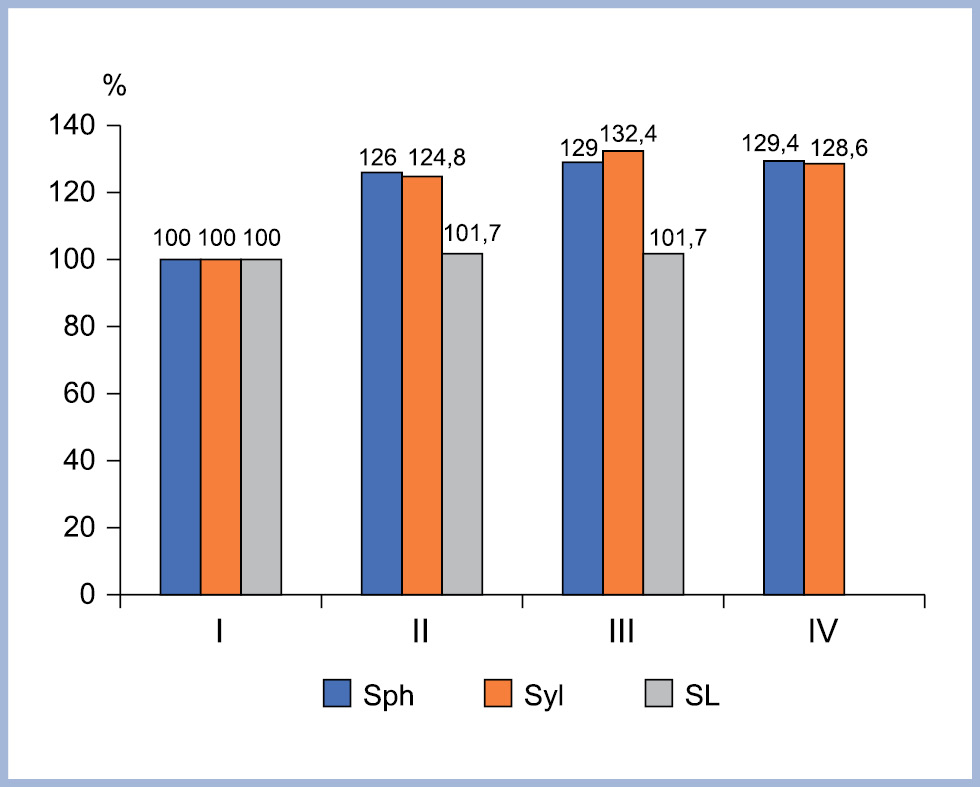
Динамика изменений у детей при миопии с астигматическим компонентом с указанием стандартной погрешности.
I — первичное обследование; II — обследование через 8 мес без лечения; III — обследование через 12 мес с начала лечения; IV — обследование через 6 мес после прекращения лечения (показатели первичного обследования приняты за 100%). Sph — сферический компонент; Cyl — цилиндрический компонент; AL — аксиальная длина переднезадней оси глаза.
Таким образом, по результатам исследования можно констатировать, что лечение в течение года 0,01% раствором атропина сульфата замедляет прогрессирование миопии и стабилизирует процесс ее развития в течение 6 мес по окончании лечения у детей при миопии с астигматическим компонентом.
Заключение
Применение 0,01% атропина в течение 1 года 4 курсами по 1,5 мес стабилизирует миопический процесс у детей с прогрессирующей миопией. Данный способ лечения является эффективным и приемлемым методом контроля миопии у детей дошкольного и школьного возраста.
Автор заявляет об отсутствии конфликта интересов.
- Holden BA, Fricke TR, Wilson DA, Jong M, Naidoo KS, Sankaridurg P, Wong TY, Naduvilath TJ, Resnikoff S. Global Prevalence of Myopia and High Myopia and Temporal Trends from 2000 through 2050. Ophthalmology. 2016;123(5):1036-1042. https://doi.org/10.1016/j.ophtha.2016.01.006
- Вержанская Т.Ю. Применение атропина для лечения прогрессирующей миопии у детей и подростков. Вестник офтальмологии. 2017;3:89-98. https://doi.org/10.17116/oftalma2017133389-98
- Sankaridurg P, Tahhan N, Kandel H, Naduvilath T, Zou H, Frick KD, Marmamula S, Friedman DS, Lamoureux E, Keeffe J, Walline JJ, Fricke TR, Kovai V, Resnikoff S. IMI Impact of Myopia. Investigative Ophthalmology & Visual Science. 2021;62(5):28. https://doi.org/10.1167/iovs.62.5.2
- Morgan IG, He M. An Important Step Forward in Myopia Prevention: Low-Dose Atropine. Ophthalmology. 2016;123(2):232-233. https://doi.org/10.1016/j.ophtha.2015.10.012
- Chia A, Ngo C, Choudry N, Yamakawa Y, Tan D. Atropine Ophthalmic Solution to Reduce Myopia Progression in Pediatric Subjects: The Randomized, Double-Blind Multicenter Phase II APPLE Study. Asia-Pacific Journal of Ophthalmology. 2023;12(4):370-376. https://doi.org/10.1097/APO.0000000000000609
- Chiang MF, Kouzis A, Pointer RW, Repka MX. Treatment of childhood myopia with atropine eyedrops and bifocal spectacles. Binocular vision and strabismus quarterly. 2001;21(3):209-216.
- Mccrann S, Loughman J, Butler JS, Paudel N, Flitcroft DI. Smartphone use as a possible risk factor for myopia. Clinical and Experimental Optometry. 2021;104(1):35-41. https://doi.org/10.1111/cxo.13092
- Bullimore M, Berntsen D. Low-dose atropine for myopia control: considering all the data. JAMA Ophthalmology. 2018;136:303.
- Gong Q, Janowski M, Luo M, Wei H, Chen B, Yang G, Liu L. Efficacy and adverse effects of atropine in childhood myopia: a meta-analysis. JAMA Ophthalmology. 2017;135(6):624-630. https://doi.org/10.1001/jamaophthalmol.2017.1091
- Yam JC, Jiang Y, Tang SM, Law AKP, Chan JJ, Wong E, Ko ST, Young AL, Tham CC, Chen LJ, Pang CP. Low-Concentration Atropine for Myopia Progression (LAMP) Study: a randomized, double-blinded, placebo-controlled trial of 0.05%, 0.025%, and 0.01% atropine eye drops in myopia control. Ophthalmology. 2019;126:113-124. https://doi.org/10.1016/j.ophtha.2018.05.029
- Zhang Ju, Li Z, Cheng Z, Wang T, Shi W. Comparison of the clinical efficacy of orthokeratology and 0.01% atropine for retardation of myopia progression in myopic children. Contact Lens and Anterior Eye. 2024;47(1): 102094. https://doi.org/10.1016/j.clae.2023.102094
- Zhang M, Qiu W, An M, Sun Y, Zhang Z, Yu C. Analysis of the reports of low-concentration atropine in controlling myopia in children. Journal Français d’Ophtalmologie. 2023 Mar;46(3):239-248. https://doi.org/10.1016/j.jfo.2022.09.024
- Long H, Shi MH, Li X. Efficacy and safety of atropine in myopic children: A meta-analysis of randomized controlled trials. Journal Français d’Ophtalmologie. 2023;46(8):929-940. https://doi.org/10.1016/j.jfo.2023.01.030
- Агаева Р.Б. Исследование близорукости на фоне общей заболеваемости болезней глаза и его придаточного аппарата у подростков в возрасте от 14 до 17 лет в Азербайджанской республике. Офтальмология. 2013;2(12):18-21.


Рекомендуем статьи по данной теме:
Выбор метода докоррекции после ранее выполненной фемтолазерной лентикулярной коррекции миопии и миопического астигматизма по технологии CLEAR.Вестник офтальмологии. 2026;142(4):92-98
Рефракционная экстракция хрусталика с имплантацией трифокальной интраокулярной линзы при высокой миопии и миопическом астигматизме.Вестник офтальмологии. 2026;142(3):45-49
Исследование биомеханических свойств роговичной лентикулы при миопии и миопическом астигматизме после фемтолазерной коррекции по технологии CLEAR.Вестник офтальмологии. 2025;141(6):145-152
Биомеханические свойства стромы роговицы, удаленной в результате технологии SMILE, при миопии и различной величине переднезадней оси.Вестник офтальмологии. 2025;141(6):135-144
Роль ранних изменений толщины хориоидеи на фоне ношения очков с линзами HAL в прогнозе эффективности оптической терапии прогрессирующей близорукости у детей.Вестник офтальмологии. 2025;141(6):69-74
Результаты конфокальной микроскопии роговицы при кавитационных осложнениях фемто-ЛАСИК.Вестник офтальмологии. 2025;141(6):63-68
Определение возраста формирования миопии у школьников по данным медицинских осмотров.Вестник офтальмологии. 2025;141(5):46-52
Показатели компьютерной аккомодографии как предикторы развития миопической рефракции.Вестник офтальмологии. 2025;141(4):41-48
Микробиота глазной поверхности у детей с миопией.Вестник офтальмологии. 2025;141(3):5-12
Функциональные результаты и состояние роговицы при кавитационных осложнениях фемто-ЛАЗИК.Вестник офтальмологии. 2024;140(5):78-86