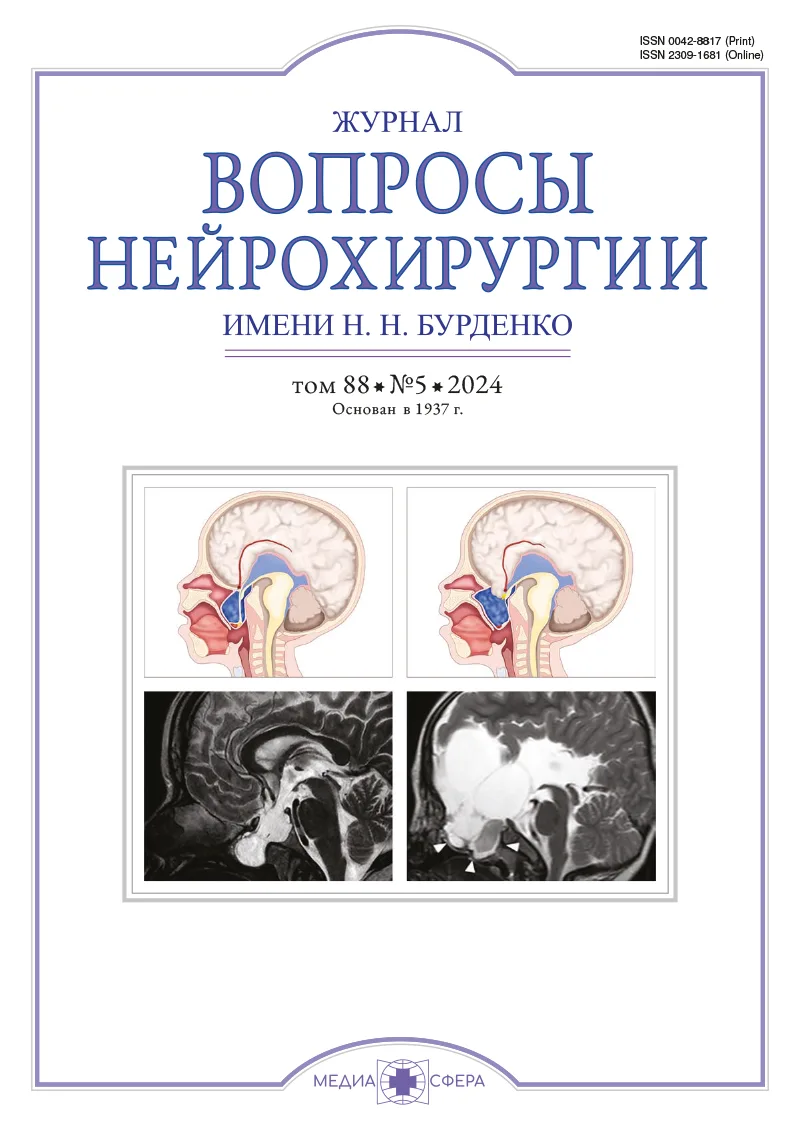
Современные представления о топографо-анатомической классификации краниофарингиом: обзор литературы
Журнал: Вопросы нейрохирургии имени Н.Н. Бурденко. 2024;88(5):110-117.
DOI: 10.17116/neiro202488051110
Прочитано: 3167 раз
Резюме
Краниофарингиомы (КФ) — доброкачественные опухоли хиазмально-селлярной области у детей и взрослых. Хирургическое удаление является в настоящее время основным методом лечения КФ и во многом зависит от топографо-анатомического расположения опухоли.
ЦЕЛЬ ИССЛЕДОВАНИЯ
Анализ и описание найденных в мировой литературе топографо-анатомических классификаций КФ.
МАТЕРИАЛ И МЕТОДЫ
Осуществлен поиск опубликованных классификаций КФ с 1960 по 2023 г. с помощью доступных баз данных медицинской литературы — PubMed, eLibrary, КиберЛенинка. При поиске были использованы ключевые слова «Craniopharyngioma», «third ventricle», «endoscopic transnasal surgery for craniopharyngiomas», «краниофарингиома», «нейрохирургия», «гипоталамус».
РЕЗУЛЬТАТЫ
Найдена 21 публикация с классификациями КФ, соответствующая условиям поиска. Подавляющее количество работ распределено относительно топографо-анатомического расположения КФ в собственных сериях: исходный рост вдоль гипоталамо-гипофизарной оси (4 классификации), отношение к структурам III желудочка (5 классификаций), отношение к стеблю гипофиза (2 классификации), отношение к зрительным нервам (2 классификации), отношение к оболочкам (3 классификации), классификация папилломатозных КФ (1 публикация), классификация адамантиномоподобных КФ (1 публикация), функциональные классификации поражения гипоталамуса КФ (3 публикации).
ЗАКЛЮЧЕНИЕ
Приведенные в литературе топографические классификации КФ отражают их отношение к наиболее важным базальным структурам мозга: гипофизу, гипоталамусу, зрительным путям, сосудам виллизиева круга. Кроме того, существуют единичные топографо-анатомические классификации с акцентированием морфологической составляющей КФ. Установление точного анатомо-топографического варианта КФ часто имеет решающее значение для выбора оптимального хирургического доступа и определения возможности и целесообразности радикального удаления опухоли. Дальнейшее уточнение отношения КФ к структурам диэнцефальной области связано с совершенствованием диагностических методов, в частности с использованием магнитно-резонансной томографии с высоким пространственным разрешением (7 Тл) и магнитно-резонансной трактографии.
Ключевые слова
- краниофарингиома
- III желудочек
- хиазмально-селлярная область
- нейрохирургия
- гипоталамус
Дата поступления: 04.06.2024
Дата принятия в печать: 21.06.2024
Дата публикации: 18.10.2024
Список сокращений
АКФ — адамантиномоподобная краниофарингиома
КТ — компьютерная томография
КФ — краниофарингиома
МРТ — магнитно-резонансная томография
ПКФ — папилломатозная краниофарингиома
ХСО — хиазмально-селлярная область
Введение
Краниофарингиомы (КФ) — доброкачественные опухоли хиазмально-селлярной области у детей и взрослых. Согласно классификации Всемирной организации здравоохранения (2021), КФ относятся к доброкачественным новообразованиям, однако они склонны к инвазивному росту в окружающие структуры, а также характеризуются высоким риском (30—59%) развития рецидива заболевания после хирургического лечения [1, 2]. КФ выявляются в 2—5% случаев всех интракраниальных опухолей у взрослых и в 6—13% случаев у детей [3]. Следует подчеркнуть, что в настоящее время выделяют два вида КФ, различных по происхождению, гистологическому строению и генетическим особенностям: адамантиномоподобные КФ (АКФ) и папилломатозные КФ (ПКФ).
Источником формирования АКФ, составляющих основную массу КФ (до 85%), являются персистирующие эмбриональные эпителиальные клетки кармана Ратке, располагающиеся в разных отделах гипоталамо-гипофизарной области. Согласно молекулярно-генетическим исследованиям, развитие АКФ связано с наличием мутации в гене CTNNB1, который кодирует белок бета-катетин [4]. Для АКФ характерно смешанное строение (солидная часть, кисты, петрификаты), гистологический полиморфизм и локальный инфильтративный рост.
ПКФ составляют около 15% всех КФ и в подавляющем большинстве случаев выявляются у взрослых (с пиком формирования в возрасте 45—70 лет) [5]. Их развитие связано с мутацией в гене BRAF V600E [6]. Считается, что ПКФ возникают вследствие мутации гипофизарного эпителия [7]. ПКФ, как правило, имеет вид солидной или солидно-кистозной опухоли. Солидный компонент внешне напоминает тутовую ягоду или фрагмент цветной капусты. Для ПКФ не характерно наличие петрификатов и множественных кист [8]. До 60% ПКФ располагается строго в пределах полости III желудочка [9].
Хирургическое удаление в настоящее время считается основным методом лечения КФ с применением как транскраниальных, так и эндоскопических, трансназальных доступов [10]. В настоящее время основная концепция хирургического удаления КФ заключается в попытке радикального удаления опухоли с оставлением ее участков в зоне выраженной инфильтрации мозга, прежде всего в зоне гипоталамуса, с последующим стереотаксическим облучением неудаленных фрагментов.
Топография КФ и их отношение к наиболее значимым структурам мозга, таким как гипоталамус, зрительные пути, базальные сосуды, имеет первостепенное значение для выбора хирургического доступа и возможности радикального удаления опухоли.
В мировой литературе имеются многочисленные топографо-анатомические классификации КФ. Авторы разделяют КФ, исходя из их расположения, отношения к окружающим анатомическим структурам. Нами был осуществлен поиск опубликованных классификаций КФ с 1960 по 2023 г. с помощью доступных баз данных медицинской литературы: PubMed, CyberLeninka, eLibrary. В перечне ключевых слов для поиска классификаций КФ были использованы термины: «краниофарингиома», «III желудочек», «нейрохирургия», «классификация», «гипоталамус». При поиске найдена 21 классификация КФ, каждая из которых имеют свои особенности. При этом большое число работ посвящено оценке взаимоотношения КФ со структурами диэнцефальной области (III желудочек, его дно, стебель гипофиза, сосцевидные тела, супраоптическое углубление, хиазма зрительных нервов, окружающие сосуды и нервы).
Обзор классификаций
Впервые подробное описание КФ представил Эрдгейм, опубликовав в 1904 г. свою работу «Об опухолях гипофизарного хода» [11]. Вслед за Эрдгеймом ряд других авторов [12] описали скопления эмбриональных эпителиальных клеток на разных уровнях гипоталамо-гипофизарной оси, что впоследствии стало основой выделения топографических вариантов КФ. Первые данные о строении, гистологических особенностях и топографии КФ основывались на изучении секционных наблюдений, позднее на результатах компьютерной томографии и магнитно-резонансной томографии (МРТ) обследований больных с КФ. Одним из первых термин «краниофарингиома» стал использовать Харви Кушинг. По мере накопления информации стало ясно, что КФ — это неоднородная группа опухолей. Основную часть (85%) составляют опухоли, развивающиеся из остатков эпителия кармана Ратке. Они стали обозначаться как АКФ. Позже стали выделять группу КФ (15%), характерных для пациентов взрослого возраста и возникающих путем метаплазии гипофизарного эпителия [8]. За этими опухолями, состоящими из многослойного эпителия, закрепилось название «папилломатозные КФ». АКФ и ПКФ существенно различаются по происхождению, локализации, инвазивности и прогнозу лечения. Поэтому стоит раздельно рассматривать проблему классификации этих двух групп КФ. В большинстве публикаций, за исключением работы R. Prieto и соавт. [9], авторы не обращают внимание на эти различия и в основном описывают особенности топографии АКФ.
Классификации адамантиномоподобных краниофарингиом в зависимости от исходного роста вдоль гипоталамо-гипофизарной оси
Учитывая результаты, полученные Эрдгеймом и его последователями, одну из первых подробных классификаций АКФ в зависимости от места исходного роста, основанную на анализе большой серии патолого-анатомических исследований, в 1965 г. предложил В.В. Грехов (Институт нейрохирургии им. Н.Н. Бурденко, ныне НМИЦН им. Н.Н. Бурденко). Он выделил четыре основных топографических варианта КФ: субселлярные, эндосупраселлярные, стебельные, инфундибулярные. В дальнейшем классификация В.В. Грехова была детализирована J. Steno [13].
В 1990 г. M.G. Yaşargil и соавт. опубликовали свой более чем 40-летний опыт хирургического лечения КФ. Они использовал топографо-анатомическую классификацию КФ, близкую к той, что предложил В.В. Грехов, но более детализированную, выделив шесть вариантов КФ, расположенных вдоль вертикальной оси (интраселлярные-инфрадиафрагмальные, интра- и супраселлярные, супрадиафрагмальные экстравентрикулярные, интра- и экстравентрикулярные, паравентрикулярные, внутрижелудочковые) [14].
M. Samii и M. Tatagiba [15] в своем исследовании (1997) также предложили классификацию КФ по анатомической локализации вдоль гипоталамо-гипофизарной оси, схожую с приведенными выше работами (интраселлярные, инфундибуло-туберальные, внутрижелудочковые, гантелевидные).
Классификации краниофарингиом по отношению к структурам III желудочка
В мировой литературе представлены работы, детально описывающие топографическое отношение КФ ко дну III желудочка и прилегающим к нему анатомическим структурам. A.B. Kassam и соавт. изучали взаимоотношение КФ и дна III желудочка, подразделяя опухоли на три типа в зависимости их положения по отношению к инфундибулярному углублению (преинфундибулярный, трансинфундибулярный, ретроинфундибулярный типы) [16].
R. Prieto и соавт. в своем исследовании изучали дооперационные МРТ-данные 200 пациентов и выделили пять типов топографического отношения КФ ко дну III желудочка (эндосупраселлярные, супраселлярно-псведовнутрижелудочковые, вторично внутрижелудочковые, инфундибуло-туберальные, строго внутрижелудочковые) [17, 18]. Кроме того, дополнительно, на основании полученных данных о КФ в мировой литературе (аутопсийные исследования, интраоперационные находки), авторам в 87% случаев удалось определить степень спаянности КФ с окружающими структурами и выделить пять основных подтипов адгезии опухоли с мозгом: легкая, умеренная, выраженная, тяжелая, критическая. Особый интерес представляет работа J.M. Pascual и соавт. [19], в которой приводится оригинальный метод уточнения отношения КФ к структурам III желудочка по характеру смещения опухолью мамиллярных тел. Авторы выделяют четыре типа КФ (строго внутрижелудочковые, инфундибулотуберальные, вторично внутрижелудочковые, псевдоинтравентрикулярные). Авторы в своей работе предложили определять отношение КФ к III желудочку по степени смещения мамиллярных тел путем определения угла, образованного условной дорсальной плоскостью мамиллярных тел и плоскостью, параллельной дну IV желудочка. Так, для супраселлярных КФ, смещающих вверх дно III желудочка, характерен тупой угол (больше 90°) (рис. 1а). Для КФ, расположенных в полости III желудочка, характерен острый мамиллярный угол (меньше 60°) ввиду смещения опухолью мамиллярных тел к стволу головного мозга (рис. 1б, 1в).

Рис. 1. Варианты смещения сосцевидных тел краниофарингиомой (примеры из собственных наблюдений).
а — тупой мамиллярный угол (желтая линия), опухоль смещает мамиллярные тела вместе с дном III желудочка кверху без проникновения в его полость; б — интактные мамиллярные тела (эндосупраселлярная краниофарингиома); в — острый мамиллярный угол (перфорация дна III желудочка опухолью, смещение мамиллярных тел к стволу мозга, при краниофарингиомах преимущественно интравентрикулярного расположения). Зеленой стрелкой отмечены мамиллярные тела. Все углы образованы пересечением линии, параллельной дну IV желудочка, с линией, условно проходящей через дорсальную плоскость мамиллярных тел.
T. Yu и соавт. проанализировали редкую группу КФ, расположенных полностью в III желудочке [20]. Авторы определяли объем и локализацию опухоли по степени смещения терминальной пластинки на МРТ:
— степень I — структуры III желудочка четко различимы, терминальная пластинка не выбухает;
— степень II — структуры III желудочка определяются, терминальная пластинка выбухает;
— степень III — структуры III желудочка не определяются, терминальная пластинка сильно деформирована.
T. Watanabe и соавт. в серии из 26 наблюдений определяли отношение КФ, распространяющейся в III желудочек, по степени деформации супраоптического углубления опухолью [21]. Авторы выделяют три типа смещения/сдавления супраоптического углубления:
1) верхний тип (КФ смещает супраоптическое углубление вверх);
2) передний тип (КФ смещает супраоптическое углубление кпереди);
3) вовлеченный тип (супраоптическое углубление вовлечено в КФ).
Авторы также резюмируют, что наиболее подходящим доступом при верхнем и переднем типах является передний расширенный трансназальный доступ, а для удаления КФ, вовлекающихся в супраоптическое углубление, наиболее оптимальным является срединный межполушарный транскаллезный доступ.
Классификации краниофарингиом по отношению к стеблю гипофиза
H. Morisako и соавт. предложили классификацию с исходным ростом КФ из стебля гипофиза. Авторы выделили четыре группы КФ:
1) интраселлярный тип — КФ возникает из интраселлярной части стебля;
2) прехиазмальный тип — КФ возникает из передней поверхности стебля;
3) ретрохиазмальный тип — КФ возникает из задней поверхности стебля;
4) внутрижелудочковый тип — КФ возникает из дна III желудочка [22].
Для каждой из групп был предложен хирургический доступ. B. Tang и соавт. [23] на основании проведенных эндоскопических трансназальных вмешательств предлагают свою классификацию КФ по отношению к стеблю гипофиза:
— центральный тип (из тканевого центра стебля гипофиза, рост внутри и вдоль стебля гипофиза);
— периферический тип, подразделяется на:
а) гипоталамический,
б) супраселлярный,
в) интраселлярный.
Классификации краниофарингиом по отношению к зрительным путям
На особенности нарушения зрения при КФ впервые обратил внимание H.J. Hoffman [24], определив отношение КФ к хиазме зрительных нервов на основе оценки нейровизуализационных данных. Автор разделял КФ на селлярные, прехиазмальные, ретрохиазмальные и гигантские опухоли. R. Prieto и соавт. [25] представили свою классификацию отношения КФ к хиазме зрительных нервов на основании анализа МРТ-данных. Авторы определили шесть типов смещения хиазмы зрительных нервов опухолью:
— тип А (нормальное положение хиазмы);
— тип B (опухоль смещает хиазму вниз);
— тип C (смещение хиазмы вперед);
— тип D (сдавление хиазмы со смещением вперед);
— тип E (сдавление хиазмы опухолью и смещение вверх);
— тип F (сдавление и смещение хиазмы кзади опухолью, распространяющейся кпереди от зрительного перекреста).
Согласно описанным данным, наиболее выраженное снижение зрения авторы обнаружили при сдавлении хиазмы и смещении кпереди и вверх передним фрагментом опухоли.
Классификации краниофарингиом по отношению к оболочкам
В мировой литературе имеются работы, описывающие взаимоотношение стенок (капсулы) КФ с пиальной и арахноидальной оболочками. I.S. Ciric и J.W. Cozzens [26] одними из первых выделили группу КФ, располагающихся экстрапиально в субарахноидальном пространстве, связывая это со временем формирования pia mater. В.В. Грехов в своей работе также акцентировал внимание на взаимоотношении КФ с окружающими оболочками. S. Qi и соавт. разработали классификацию супраселлярных краниофарингиом QST, основываясь на определении взаимоотношения арахноидальной и пиальной оболочек с КФ, развивающимися в седле на уровне стебля гипофиза и гипоталамуса [27]:
— тип Q — инфрадиафрагмальные КФ;
— тип S (Subarachnoidal) — супраселлярные субарахноидальные. Возникают из среднего или нижнего сегмента ножки гипофиза и обычно распространяются среди субарахноидальных цистерн;
— тип T (Tuber) — супраселлярные субпиальные вентрикулярные. Возникают в верхних отделах ножки и туберальной части, распространяются преимущественно вверх и занимают пространство III желудочка.
Авторы отмечают возможность прогнозировать направление роста КФ в определенной зоне в зависимости от границ арахноидальных мембран. Существует также патолого-анатомическое исследование А.Е. Коршунова (1987), в котором автор детально описал взаиморасположение КФ и артерий виллизиева круга по степени выраженности их вовлечения в стенку опухоли, выделив четыре типа:
1) легкая степень спаек с сосудами (стенка артерии плотно прилежит к поверхности опухоли, легко отделяется, оставляя на капсуле неглубокие борозды);
2) средняя степень (стенка артерии прикрепляется к капсуле опухоли с помощью большого количества соединительнотканных спаек, после рассечения которых магистральный сосуд легко отделяется от поверхности опухоли);
3) тяжелая степень (стенка артерии плотно фиксирована к капсуле опухоли за счет мелких артериальных ветвей, уходящих в толщу капсулы; отделение только после пересечения коллатералей);
4) критическая степень (отдельные сегменты магистральных артерий основания полностью включены в толщу капсулы опухоли).
Классификация папилломатозных краниофарингиом
В настоящее время существует крайне мало работ, посвященных топографии ПКФ. R. Prieto и соавт. [9] была предложена классификация, основанная на анализе данных литературы за период более 100 лет. Исходя из полученных данных авторы выделяют два основных варианта ПКФ:
1) строго внутрижелудочковые КФ, располагающиеся только в пределах III желудочка (60% наблюдений);
2) нестрого внутрижелудочковые/интраэкстравентрикулярные КФ (30% наблюдений).
На рис. 2 представлены структуры мозга, по отношению к которым предлагалась топографическая классификация КФ, и авторы этих классификаций.

Рис. 2. Схема, иллюстрирующая основные анатомические структуры, вовлекающиеся в патологический процесс при поражении краниофарингиомой, а также авторы классификаций, описавшие их.
а — сагиттальный рисунок диэнцефальной области (гипофиз, стебель, дно III желудочка); б — коронарный рисунок области на уровне III желудочка.
Обсуждение
Основываясь на описанных особенностях топографической классификации и на многолетнем собственном опыте хирургического лечения КФ, мы считаем возможным сделать следующие пояснения и замечания. В отношении классификации АКФ наиболее важно подчеркнуть, что этот тип опухоли, по теории, высказанной Эрдгеймом, развивается из остатков эмбрионального эпителия на разных уровнях гипоталамо-гипофизарной оси, следовательно, может располагаться в седле, стебле гипофиза и гипоталамической области. Подобной группировки АКФ придерживаются большинство авторов.
Такая классификация была предложена в НМИЦ нейрохирургии Н.Н. Бурденко в 1965 г. В.В. Греховым, позднее дополнена J. Steno и применяется нами с некоторыми уточнениями на протяжении десятилетий, а также проверена опытом лечения более 3000 больных с АКФ. Эта классификация близка к большей части приведенных в литературе классификаций и не противоречит им. Мы считаем важным привести ее, подчеркнув, что она касается в основном АКФ (рис. 3):

Рис. 3. Основные топографические варианты адамантиномоподобной краниофарингиомы. В центре — локализация исходного места роста опухоли.
1 — эндосупраселлярные краниофарингиомы. В большинстве случаев в момент диагностики опухоли достигают больших размеров и выходят за пределы седла. От мозговых структур опухоль отделена диафрагмой седла, арахноидальной и пиальной оболочками. Достигая большого размера, опухоли могут вызывать грубые сдавления III желудочка, зрительных путей и других базальных структур; 2 — стебельные краниофарингиомы. Опухоли, развивающиеся из эпителиальных зачатков в стебле гипофиза, преимущественно в его нижних и средних отделах. Отделены от дна III желудочка арахноидальной и пиальной оболочками. В большинстве случаев смещают вверх дно III желудочка и сдавливают зрительные пути; 3 — интраэкстравентрикулярные краниофарингиомы. Адамантиномоподобные краниофарингиомы, развивающиеся в верхних отделах стебля и воронке III желудочка, распространяются в полость III желудочка и в базальные цистерны. Соотношение интравентрикулярных и экстравентрикулярных фрагментов может существенно варьировать: краниофарингиома может как частично врастать в просвет желудочка, так и полностью занимать его и даже распространяться через резко расширенные межжелудочковые отверстия в боковые желудочки; 4 — экстрааксиальные гигантские кистозные краниофарингиомы. Эти опухоли развиваются из эмбрионального эпителия, расположенного на уровне ножки гипофиза экстрапиально, в связи с чем краниофарингиома, формируя гигантские кисты, распространяется в базальном субарахноидальном пространстве, резко смещая мозг; встречаются преимущественно у детей младшего возраста [28].
1) эндоселлярные и эндосупраселлярные КФ, исходный рост опухоли из эмбрионального эпителия области турецкого седла;
2) стебельные КФ, развиваются на уровне нижних и средних отделов стебля гипофиза;
3) интраэкстравентрикулярные (по отношению к III желудочку) КФ, развиваются из верхних отделов стебля на уровне воронки гипофиза и распространяются как в полость III желудочка, так и экстравентрикулярно с ростом в хиазмальную и межножковую цистерны. Чистое интравентрикулярное расположение АКФ — большая редкость;
4) экстрааксиальные гигантские кистозные КФ, развивающиеся из эмбрионального эпителия экстрапиально на уровне стебля гипофиза.
Одна из наиболее сложных и важных проблем — определение отношения КФ к III желудочку и его основным образованиям. Однако следует подчеркнуть, что топография КФ, в том числе ее распространение в III желудочек, не позволяет определить степень поражения опухолью гипоталамуса и других структур. В таких случаях крайне важна клиническая оценка состояния больного. Нами было найдено всего несколько работ, посвященных оценке функционального состояния гипоталамуса до и после удаления КФ. К ним относятся исследования S. Puget и соавт. [29], L. Yang и соавт. [30], C.J. de Vile и соавт. [31].
Следует подчеркнуть определенную условность и ограниченность всех представленных классификаций. Так, в большинстве анализируемых работ не делается различий между основными гистологическими вариантами КФ: между АКФ и значительно более редко встречающимися ПКФ. А различия между ними весьма существенны, в связи с чем эти варианты КФ целесообразно рассматривать отдельно.
В целом приведенные классификации прежде всего помогают определить расположение опухоли, но часто не позволяют установить степень поражения тех или иных структур. Лишь тщательный клинический анализ (оценка эндокринного статуса, водно-электролитных нарушений, зрительных функций, эмоционально-мнестических нарушений и ряда других клинических симптомов) позволяет составить более и менее полное представление о поражении структур диэнцефальной области, расположенных рядом с опухолью.
Классификация, как правило, это схема, из которой всегда возможны определенные исключения. Так, КФ, возникающая в турецком седле, инфильтрируя стебель гипофиза, может распространяться не только супраселлярно, но и в III желудочек. Возможен и мультицентричный рост опухоли. Кроме того, при использовании классификаций важно иметь в виду, что отношение КФ к гипоталамусу более или менее точно можно установить при опухолях сравнительно небольшого размера. К сожалению, в большинстве случаев больные обращаются к врачу, когда опухоль достигает больших размеров и дальнейшее определение ее положения относительно гипоталамуса крайне затруднительно. К примеру, предложенный J.M. Pascual и соавт. вариант определять степень проникновения в III желудочек по смещению мамиллярных тел в ряде случаев малоинформативен, например в случае интраэкстравентрикулярных КФ, когда мамиллярные тела вообще неразличимы или остаются в «нейтральном» положении при КФ, располагающихся и в III желудочке, и в базальных цистернах.
Следует подчеркнуть, что определение точного топографо-анатомического варианта КФ часто имеет решающее значение для выбора оптимального хирургического доступа и установления возможности и целесообразности радикального удаления опухоли. Дальнейшее уточнение отношения КФ к структурам диэнцефальной области связано с совершенствованием диагностических методов, в частности с использованием МРТ с высоким пространственным разрешением (7 Тл) и МР-трактографии.
Заключение
Приведенные в литературе топографические классификации КФ отражают их отношение к наиболее важным базальным структурам мозга: гипофизу, гипоталамусу, зрительным путям, сосудам виллизиева круга. Необходимо различать два вида КФ — наиболее часто встречаемые АКФ (85%) и редкие ПКФ (15%).
Основой топографических классификаций АКФ является место исходного роста опухоли из остатков эмбрионального эпителия вдоль гипоталамо-гипофизарной оси. В связи с этим целесообразно выделять следующие формы АКФ: эндосупраселлярные, стебельные и КФ, распространяющиеся в III желудочек — интраэкстравентрикулярные, а также гигантские кистозные экстрааксиальные КФ. Большая часть ПКФ располагаются в III желудочке и делятся на строго и не строго внутрижелудочковые формы.
Участие авторов:
Концепция и дизайн исследования — Коновалов А.Н., Иванов В.В., Кутин М.А., Клочкова И.С.
Сбор и обработка материала — Иванов В.В.
Статистическая обработка данных — Иванов В.В., Коновалов А.Н., Кутин М.А.
Написание текста — Иванов В.В.
Редактирование — Коновалов А.Н., Кутин М.А., Клочкова И.С., Пронин И.Н., Калинин П.Л., Семенова Ж.Б.
Авторы заявляют об отсутствии конфликта интересов.
- Коновалов А.Н., Кутин М.А., Кадашев Б.А., Калинин П.Л., Фомичев Д.В., Астафьева Л.И., Голанов А.В., Трунин Ю.Ю. Современные принципы лечения краниофарингиом. Опухоли головы и шеи. 2012;3:7-16. https://doi.org/10.17650/2222-1468-2012-0-3-7-16
- Калинин П.Л., Кутин М.А., Фомичев Д.В., Кадашев Б.А. Общие принципы диагностики и выбора вариантов хирургического лечения новообразований хиазмально-селлярной области (аденом гипофиза, краниофарингиом, менингиом и других). Нейрохирургия. 2016;4:23-30.
- Momin AA, Recinos MA, Cioffi G, Patil N, Soni P, Almeida JP, Kruchko C, Barnholtz-Sloan JS, Recinos PF, Kshettry VR. Descriptive epidemiology of craniopharyngiomas in the United States. Pituitary. 2021;24(4):517-522. PMID: 33506438. https://doi.org/10.1007/s11102-021-01127-6
- Sekine S, Shibata T, Kokubu A, Morishita Y, Noguchi M, Nakanishi Y, Sakamoto M, Hirohashi S. Craniopharyngiomas of adamantinomatous type harbor beta-catenin gene mutations. The American Journal of Pathology. 2002 Dec;161(6):1997-2001. PMID: 12466115; PMCID: PMC1850925. https://doi.org/10.1016/s0002-9440(10)64477-x
- Кутин М.А., Сиднева Ю.Г., Коновалов А.Н., Пронин И.Н., Кадашев Б.А., Калинин П.Л., Шкарубо А.Н., Семенова Ж.Б., Фомичев Д.В., Шарипов О., Шульц Е.И., Лубнин А.Ю., Попугаев К.А., Савин И.А., Астафьева Л.И., Клочкова И.С., Шишкина Л.В., Добровольский Г.Ф., Ротин Д.Л., Саватеев А.Н. Гипоталамус. современные представления о пространственной и функциональной организации (Обзор литературы). Вестник неврологии, психиатрии и нейрохирургии. 2016;2:55-65.
- Brastianos PK, Taylor-Weiner A, Manley PE, Jones RT, Dias-Santagata D, Thorner AR, Lawrence MS, Rodriguez FJ, Bernardo LA, Schubert L, Sunkavalli A, Shillingford N, Calicchio ML, Lidov HG, Taha H, Martinez-Lage M, Santi M, Storm PB, Lee JY, Palmer JN, Adappa ND, Scott RM, Dunn IF, Laws ER Jr, Stewart C, Ligon KL, Hoang MP, Van Hummelen P, Hahn WC, Louis DN, Resnick AC, Kieran MW, Getz G, Santagata S. Exome sequencing identifies BRAF mutations in papillary craniopharyngiomas. Nature Genetics. 2014;46(2):161-165. https://doi.org/10.1038/ng.2868
- Саватеев А.Н., Трунин Ю.Ю., Мазеркина Н.А. Лучевая терапия и радиохирургия в лечении краниофарингиом. Вопросы нейрохирургии имени Н.Н. Бурденко. 2017;81(3):94-106. https://doi.org/10.17116/neiro201781394-106
- Crotty TB, Scheithauer BW, Young WF Jr, Davis DH, Shaw EG, Miller GM, Burger PC. Papillary craniopharyngioma: a clinicopathological study of 48 cases. Journal of Neurosurgery. 1995;83(2):206-214. https://doi.org/10.3171/jns.1995.83.2.0206
- Prieto R, Barrios L, Pascual JM. Papillary Craniopharyngioma: A Type of Tumor Primarily Impairing the Hypothalamus — A Comprehensive Anatomo-Clinical Characterization of 350 Well-Described Cases. Neuroendocrinology. 2022;112(10):941-965. https://doi.org/10.1159/000521652
- Кутин М.А., Калинин П.Л., Кадашев Б.А., Фомичев Д.В., Шарипов О.И., Голанов А.В., Трунин Ю.Ю., Астафьева Л.И., Мазеркина Н.А., Клочкова И.С., Сиднева Ю.Г., Семенова Ж.Б., Саватеев А.Н., Струнина Ю.В., Сидорук Е.В. Краниофарингиомы. Общие сведения и основные направления лечения (обзорная лекция). Вестник неврологии, психиатрии и нейрохирургии. 2016;5.
- Yaşargil MG, Curcic M, Kis M, Siegenthaler G, Teddy PJ, Roth P. Total removal of craniopharyngiomas. Approaches and long-term results in 144 patients. Journal of Neurosurgery. 1990;73(1):3-11. https://doi.org/10.3171/jns.1990.73.1.0003
- Lobos EI, Freed CG, Ashe SM. An intrinsic tumor of the third ventricle. Journal of Neuropathology and Experimental Neurology. 1953;12(3):232-243. https://doi.org/10.1097/00005072-195307000-00003
- Steno J. Microsurgical topography of craniopharyngiomas. Acta Neurochirurgica Supplement. 1985;35:94-100.
- Yaşargil MG, Curcic M, Kis M, Siegenthaler G, Teddy PJ, Roth P. Total removal of craniopharyngiomas. Approaches and long-term results in 144 patients. Journal of Neurosurgery. 1990;73(1):3-11. https://doi.org/10.3171/jns.1990.73.1.0003
- Samii M, Tatagiba M. Surgical management of craniopharyngiomas: a review. Neurologia Medico-Chirurgica. 1997;37(2):141-149. https://doi.org/10.2176/nmc.37.141
- Kassam AB, Gardner PA, Snyderman CH, Carrau RL, Mintz AH, Prevedello DM. Expanded endonasal approach, a fully endoscopic transnasal approach for the resection of midline suprasellar craniopharyngiomas: a new classification based on the infundibulum. Journal of Neurosurgery. 2008;108(4):715-728. https://doi.org/10.3171/JNS/2008/108/4/0715
- Prieto R, Pascual JM, Barrios L. Topographic Diagnosis of Craniopharyngiomas: The Accuracy of MRI Findings Observed on Conventional T1 and T2 Images. American Journal of Neuroradiology. 2017;38(11):2073-2080. https://doi.org/10.3174/ajnr.A5361
- Prieto R, Pascual JM, Rosdolsky M, Castro-Dufourny I, Carrasco R, Strauss S, Barrios L. Craniopharyngioma adherence: a comprehensive topographical categorization and outcome-related risk stratification model based on the methodical examination of 500 tumors. Neurosurgical Focus. 2016;41(6):E13. https://doi.org/10.3171/2016.9.FOCUS16304
- Pascual JM, Prieto R, Carrasco R, Barrios L. Displacement of mammillary bodies by craniopharyngiomas involving the third ventricle: surgical-MRI correlation and use in topographical diagnosis. Journal of Neurosurgery. 2013;119(2):381-405. https://doi.org/10.3171/2013.1.JNS111722
- Yu T, Sun X, Ren X, Cui X, Wang J, Lin S. Intraventricular craniopharyngiomas: surgical management and outcome analyses in 24 cases. World Neurosurgery. 2014;82(6):1209-1215. https://doi.org/10.1016/j.wneu.2014.06.015
- Watanabe T, Uehara H, Takeishi G, Chuman H, Azuma M, Yokogami K, Takeshima H. Proposed System for Selection of Surgical Approaches for Craniopharyngiomas Based on the Optic Recess Displacement Pattern. World Neurosurgery. 2023;170:e817-e826. https://doi.org/10.1016/j.wneu.2022.11.138
- Morisako H, Goto T, Goto H, Bohoun CA, Tamrakar S, Ohata K. Aggressive surgery based on an anatomical subclassification of craniopharyngiomas. Neurosurgical Focus. 2016;41(6):E10. https://doi.org/10.3171/2016.9.FOCUS16211
- Tang B, Xie SH, Xiao LM, Huang GL, Wang ZG, Yang L, Yang XY, Xu S, Chen YY, Ji YQ, Zeng EM, Hong T. A novel endoscopic classification for craniopharyngioma based on its origin. Scientific Reports. 2018;8(1):10215. https://doi.org/10.1038/s41598-018-28282-4
- Hoffman HJ. Surgical management of craniopharyngioma. Pediatric Neurosurgery. 1994;21(Suppl 1):44-49. https://doi.org/10.1159/000120861
- Prieto R, Pascual JM, Barrios L. Optic chiasm distortions caused by craniopharyngiomas: clinical and magnetic resonance imaging correlation and influence on visual outcome. World Neurosurgery. 2015;83(4):500-529. https://doi.org/10.1016/j.wneu.2014.10.002
- Ciric IS, Cozzens JW. Craniopharyngiomas: transsphenoidal method of approach — for the virtuoso only? Clinical Neurosurgery. 1980;27:169-187.
- Qi S, Lu Y, Pan J, Zhang X, Long H, Fan J. Anatomic relations of the arachnoidea around the pituitary stalk: relevance for surgical removal of craniopharyngiomas. Acta Neurochirurgica. 2011;153(4):785-796. https://doi.org/10.1007/s00701-010-0940-y
- Konovalov AN. Third ventricle craniopharyngiomas. World Neurosurgery. 2014;82(6):1023-1025. https://doi.org/10.1016/j.wneu.2014.08.017
- Puget S, Garnett M, Wray A, Grill J, Habrand JL, Bodaert N, Zerah M, Bezerra M, Renier D, Pierre-Kahn A, Sainte-Rose C. Pediatric craniopharyngiomas: classification and treatment according to the degree of hypothalamic involvement. Journal of Neurosurgery. 2007;106(1 Suppl):3-12. https://doi.org/10.3171/ped.2007.106.1.3
- Yang L, Xie S, Tang B, Wu X, Tong Z, Fang C, Ding H, Bao Y, Zheng S, Hong T. Hypothalamic injury patterns after resection of craniopharyngiomas and correlation to tumor origin: A study based on endoscopic observation. Cancer Medicine. 2020;9(23):8950-8961. https://doi.org/10.1002/cam4.3589
- de Vile CJ, Grant DB, Hayward RD, Kendall BE, Neville BG, Stanhope R. Obesity in childhood craniopharyngioma: relation to post-operative hypothalamic damage shown by magnetic resonance imaging. The Journal of Clinical Endocrinology and Metabolism. 1996;81(7):2734-2737. https://doi.org/10.1210/jcem.81.7.8675604


Рекомендуем статьи по данной теме:
Плазменный скальпель Береснева в лечении фантомного болевого синдрома.Российский журнал боли. 2026;24(3):27-30
Гипоталамическое ожирение при краниофарингиомах у взрослых: распространенность и факторы риска до и после нейрохирургического лечения.Вопросы нейрохирургии имени Н.Н. Бурденко. 2026;90(2):77-84
Первое клиническое применение аутологичного фибринового клея Vivostat в нейрохирургии Казахстана и Центральной Азии.Вопросы нейрохирургии имени Н.Н. Бурденко. 2026;90(2):70-76
Опыт применения системного тромболизиса у пациентов с массивной тромбоэмболией легочной артерии после нейрохирургической операции (серия клинических наблюдений и обзор литературы).Анестезиология и реаниматология. 2026;(1):84-91
Радиохирургическое лечение нейрохирургических пациентов (к 20-летию нейрорадиохирургии в России).Вопросы нейрохирургии имени Н.Н. Бурденко. 2025;89(6):7-15
Патоморфология рецидивирующих менингиом.Архив патологии. 2025;87(5):28-35
Анатомические варианты папилломатозных краниофарингиом: анализ хирургической серии.Вопросы нейрохирургии имени Н.Н. Бурденко. 2025;89(4):18-29
Коллизионные опухоли хиазмально-селлярной области: сложности предоперационной нейровизуализации и выбора хирургического доступа (клинические случаи и обзор литературы).Вопросы нейрохирургии имени Н.Н. Бурденко. 2025;89(3):75-82
Возможности HARDI-CSD-трактографии в определении структуры проводящих путей диэнцефальной области при краниофарингиомах.Вопросы нейрохирургии имени Н.Н. Бурденко. 2025;89(1):30-36
Показатели безрецидивной выживаемости при хирургическом и комбинированном лечении краниофарингиом, впервые выявленных у взрослых пациентов.Вопросы нейрохирургии имени Н.Н. Бурденко. 2024;88(5):54-59