
Антиоксидантная терапия для коррекции нитрозативного стресса при воспалительных заболеваниях полости носа
Журнал: Российская ринология. 2025;33(3):191-196.
DOI: 10.17116/rosrino202533031191
Прочитано: 1414 раз
Резюме
Нитрозативный стресс играет важную роль при воспалительных заболеваниях полости носа, в связи с чем исследование проявлений стресса и возможности его фармакологической коррекции остаются актуальными.
ЦЕЛЬ ИССЛЕДОВАНИЯ
Оценить состояние нитрозативного стресса и эффективность антиоксидантной терапии у пациентов с воспалительными заболеваниями полости носа.
ПАЦИЕНТЫ И МЕТОДЫ
Было обследовано 156 пациентов с воспалением полости носа, распределенных на 4 группы по фактору, вызвавшему воспаление, и методам лечения. В 1-ю и 2-ю группы вошло по 36 пациентов с острым риносинуситом, в 3-ю (44 пациента) и 4-ю (40 пациентов) группы — больные после септопластики и вазотомии. Больным 2-й и 4-й групп кроме стандартного лечения и местного введения в полость носа репаранта дополнительно был назначен антиоксидант — 15% раствор диметилового эфира 1,1-диметил-3-оксобутилфосфоновой кислоты. У пациентов определяли концентрацию нитратов и нитритов в носовом секрете при обращении, на 5, 10, 21-е сутки.
РЕЗУЛЬТАТЫ
При воспалении на ранних сроках наблюдения отмечался рост концентрации метаболитов оксида азота с последующим истощением нитросидергической системы и постепенным снижением их концентрации ниже контрольных значений. На 5-е сутки между 1-й и 2-й (p1—2=0,0001), 3-й и 4-й (p3—4=0,009) группами отмечалась статистически значимая разница. Во 2-й и 4-й группах концентрация метаболитов оксида азота не превышала контрольных значений.
ВЫВОДЫ
У больных с воспалительными заболеваниями полости носа назначение антиоксидантной терапии в раннем периоде снижало проявления нитрозативного стресса. Для избежания выраженного и длительного угнетения выработки оксида азота после приема антиоксидантной терапии, которое может оказывать негативное влияние на регенерацию эпителия, необходим динамический контроль концентрации метаболитов оксида азота в носовом секрете.
Ключевые слова
- оксид азота
- воспаление
- слизистая оболочка
- антиоксидант
- нитрозативный стресс
Дата поступления: 07.10.2024
Дата принятия в печать: 18.03.2025
Дата публикации: 30.09.2025
Введение
Развивающийся при воспалительных заболеваниях полости носа нитрозативный стресс реализуется за счет высокореактивных метаболитов оксида азота (NO), повышенная концентрация которых существенно влияет на секрецию и пролиферацию клеток эпителия, механизмы апоптоза и мукоцилиарного клиренса [1—3]. По данным авторов, умеренное повышение концентрации NO стимулирует секрецию слизи и активирует движения ресничек мерцательного эпителия (МЭ), что способствует мукоцилиарному клиренсу, элиминации патогенов [1, 4, 5]. Кроме того, активные радикалы азота участвуют во всех фазах воспалительного процесса: индуцируют нейтрофильный и макрофагальный фагоцитоз бактерий и некротического детрита, влияют на продукцию факторов ангиогенеза, усиливают секрецию цитокинов, стимулирующих рост фибробластов [6—9].
Радикалы азота могут оказывать как защитное, так и повреждающее действие на клетки. Значительное и длительное повышение содержания метаболитов NO нарушает репаративные процессы при воспалении за счет токсического повреждения эпителия. В результате разрушаются межклеточные связи, усиливается отек из-за пареза сосудов и увеличения их проницаемости [3, 10]. При недостатке метаболитов NO снижается синтез коллагена в ране, уменьшается прочность рубца, что также приводит к извращению нормального хода репаративной регенерации [7, 8].
Известно, что антиоксиданты снижают концентрацию активных радикалов азота, тем самым открывают возможность регуляции биоактивности NO [11—13].
Таким образом, динамическое исследование концентрации метаболитов NO в носовом секрете (НС) является важным показателем активности воспаления, эффективности антиоксидантной терапии.
Цель исследования — оценить состояние нитрозативного стресса и эффективность антиоксидантной терапии у больных с воспалительными заболеваниями полости носа.
Пациенты и методы
После получения информированного согласия в исследование были включены 72 пациента с острым риносинуситом (ОРС) средней степени тяжести и 84 пациента после септопластики с вазотомией нижних носовых раковин в возрасте 18—50 лет как мужского, так и женского пола. Больные были распределены на 4 группы по фактору, вызвавшему воспаление (инфекция, травма), и методу лечения (рисунок).
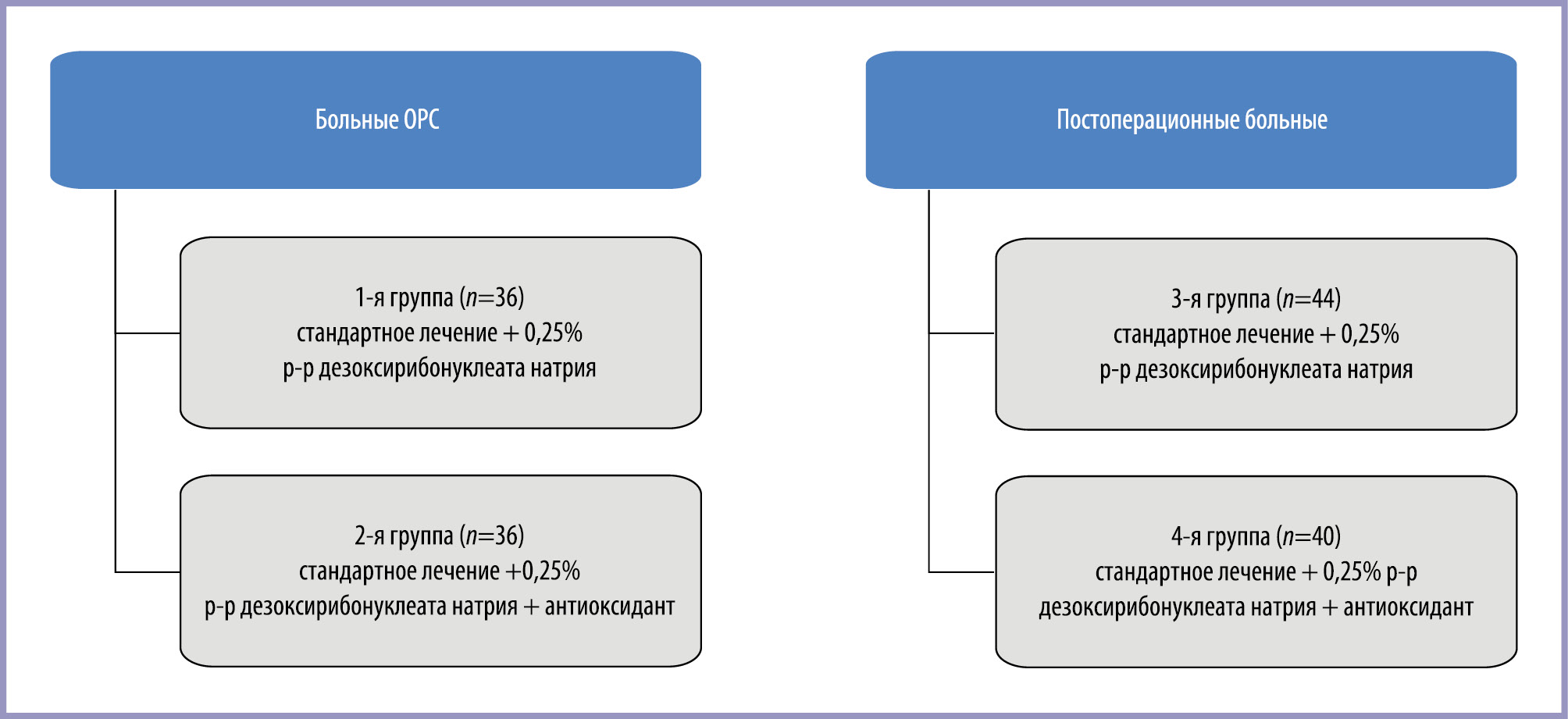
Клинические группы включенных в исследование пациентов.
Стандартное лечение ОРС и постоперационный уход осуществляли согласно утвержденным клиническим рекомендациям. Также для улучшения репарации слизистой оболочки (СО) полости носа всем больным местно был добавлен репарант — 0,25% р-р дезоксирибонуклеата натрия — Деринат (ООО «ФЗ Иммунолекс», Россия). В качестве препарата с антиоксидантными свойствами для больных 2-й и 4-й групп был выбран 15% раствор диметилового эфира 1,1-диметил-3-оксобутилфосфоновой кислоты — Димефосфон (ОАО «Татхимпрепараты», Россия) в связи с возможностью его топического применения: применяли на турундах в полость носа дважды в день по 15 мин в течение 5 сут. В контрольную группу включили 33 практически здоровых лица в возрасте 18—50 лет.
Соблюдение биоэтических норм в ходе клинического исследования, соответствие этическим стандартам Хельсинкской декларации 1975 г. и ее пересмотренным вариантам (2000 г., 2008 г., 2013 г.) подтверждено заключением комиссии (протокол №3 от 09.06.2021, ГУ ЛНР «Луганский государственный медицинский университет имени Святителя Луки» ЛНР).
В НС при первичном осмотре, затем на 5, 10, 21-е сутки определяли общую концентрацию нитратов, восстановленных до нитритов цинковой пылью и сернокислым марганцем, и нитритов путем диазотирования с добавлением реактива Грисса фотометрическим методом.
Статистический анализ полученных данных проводили с помощью программы Statistica 8.0 (StatSoft, Inc., США). Гипотезу нормальности распределения в выборках проверяли с помощью критерия W Шапиро—Уилка. Непараметрические количественные данные описаны медианой (Me) и интерквартильным размахом [Q1; Q3]. При сравнении двух независимых групп использовали непараметрический критерий Манна—Уитни, зависимых групп — критерий Вилкоксона (p≤0,05).
Результаты
Установлено, что в НС практически здоровых людей суммарная концентрация метаболитов NO составляла 1056,7 [984,4; 1132,1] мкМ. У больных ОРС обеих групп значения статистически значимо (p1,2=0,001) превышали контрольные показатели без статистически значимых отличий между группами (таблица).
Динамика изменений концентрации метаболитов оксида азота в носовом секрете больных, Me [Q1; Q3], мкМ
Срок наблюдения | Группа | ||||
1-я, n=36 | 2-я, n=36 | 3-я, n=44 | 4-я, n=40 | p | |
При обращении | 1362,1 [1251,9; 1460,8] | 1345,1 [1167,6; 1466,6] | 874,8 [764,5; 967,5] | 874,9 [743,9; 987,4] | — |
p* | 0,0001 | 0,0001 | 0,0001 | 0,0001 | — |
5-е сутки | 1267,6 [1171,9; 1362,1] | 1041,2 [1020,5; 1104,4] | 1148,7 [1025,5; 1274,3] | 1061,5 [974,6; 1124,6] | р1—2=0,0001 р3—4=0,009 |
p* | 0,0001 | 0,78 | 0,02 | 0,85 | — |
10-е сутки | 1099,0 [1045,8; 1232,2] | 1035,6 [1005,3; 1066,9] | 1071,2 [974,0; 1253,6] | 1034,7 [974,6; 1116,1] | р1—2=0,0002 |
p* | 0,03 | 0,38 | 0,56 | 0,45 | — |
21-е сутки | 992,9 [886,5; 1046,9] | 1031,4 [986,1; 1045,7] | 974,0 [943,9; 1066,6] | 1025,5 [974,6; 1087,6] | р3—4=0,02 |
p* | 0,002 | 0,06 | 0,005 | 0,23 | — |
Примечание. * — для сравнения между исследуемой и контрольной группами.
На 5-е сутки наблюдения концентрации метаболитов NO в НС у больных ОРС статистически значимо (p1=0,005; p2<0,001) снизились в обеих группах, причем во 2-й группе до контрольных значений (p=0,78). Между группами отмечалась статистически значимая (p1—2=0,0001) разница (см. таблицу).
На 10-е сутки наблюдения концентрация метаболитов NO в НС больных ОРС статистически значимо (p=0,03) оставалась в 1-й группе выше контроля и значений во 2-й группе (p1—2=0,0002). Следует обратить внимание, что на 21-е сутки наблюдения в 1-й группе без коррекции нитрозативного стресса после повышения на ранних сроках отмечалось снижение концентрации нитратов и нитритов: регистрировалась статистически значимая разница с контрольной группой (p=0,002).
В НС больных 3-й и 4-й групп до операции установлено, что концентрация метаболитов NO достоверно (p3,4=0,0001) была меньше контрольных значений без статистически значимых отличий между группами (p3—4=0,95). На 5-е сутки после операции отмечалось достоверное (p3,4=0,0001) повышение концентрации метаболитов NO в НС в обеих группах. Наименьшие проявления нитрозолирующего стресса регистрировались в 4-й группе, где концентрация метаболитов NO не превышала контрольных значений (p=0,85) и отмечалась статистически достоверная (p3—4=0,009) разница с 3-й группой (см. таблицу).
К 10-м суткам постоперационного периода отмечалось достоверное (p=0,005) снижение концентрации метаболитов NO в НС в 3-й группе до контрольных значений (p=0,56), в 4-й группе концентрация оставалась стабильной, на уровне контрольных значений. В 4-й группе на 21-е сутки постоперационного периода, как и в 1-й группе пациентов с ОРС было зарегистрировано достоверное (p=0,005) снижение концентрации метаболитов NO в НС до значений ниже контрольных.
Обсуждение
Подводя итог, отмечаем, что в 1-й и 3-й группах, где больным не был назначен антиоксидант, на 5-е сутки отмечалась повышенная концентрация метаболитов NO в НС. На поздних сроках (21-е сутки) нитросидергическая система истощалась после активации, что проявлялось снижением концентрации нитратов и нитритов ниже контрольных значений. По данным литературы, длительное ухудшение метаболизма NO предрасполагает к хронизации воспалительного процесса, замедляет репаративную регенерацию [7, 13—15]. Во 2-й и 4-й группах, где проводилась медикаментозная коррекция нитрозативного стресса, у больных уже на 5-е сутки отмечалась нормализация концентрации активных радикалов без угнетения нитросидергической системы на поздних сроках.
У больных хроническим ринитом до операции было выявлено снижение концентрации метаболитов NO в НС, что говорит о нарушении гомеостаза СО носа, т.к. NO необходим для продукции эпителиальной слизи, ускорения движения ресничек эпителия, осуществления полноценного мукоцилиарного клиренса [3, 16]. По данным литературы, снижение содержания NO в выдыхаемом воздухе также отмечается при других заболеваниях, сопровождающихся резким угнетением мукоцилиарного клиренса (цилиарная дискинезия, муковисцидоз, дефицит α1-антитрипсина) [17—19]. На 5-е сутки после операции у пациентов отмечалось повышение концентрации метаболитов NO, что, по данным других авторов, приводит к вторичному повреждению эпителия, способствует сосудистым расстройствам в зоне альтерации, вызывает тканевую гипоксию, отек, усиливает метаболические сдвиги [3, 4]. Назначение антиоксиданта после операции в 4-й группе позволило уменьшить проявления нитрозативного стресса в раннем послеоперационном периоде. Антиоксидантная терапия должна быть назначена как можно раньше после воздействия повреждающего фактора, но длительность назначения необходимо контролировать исследованием метаболитов NO в динамике, поскольку значительное и длительное угнетение выработки NO может ухудшать регенерацию СО. Подобный подавляющий эффект антиоксидантной терапии был выявлен в эксперименте [20]. Зависимость эффективности назначения ингибиторов синтазы NO от стадии воспаления отмечена и другими авторами [11, 15, 21, 22].
Выводы
1. У пациентов с ОРС и постоперационных больных на ранних сроках наблюдения отмечался рост концентрации метаболитов NO с последующим постепенным истощением нитросидергической системы.
2. Назначение антиоксидантной терапии в раннем периоде воспалительной реакции позволило уменьшить проявления нитрозативного стресса.
3. Динамическое исследование концентрации метаболитов NO в НС необходимо для коррекции длительности антиоксидантной терапии с целью избегания резкого и длительного угнетения выработки NO и ухудшения регенерации СО.
Участие авторов:
Концепция и дизайн исследования — Берест И.Е., Селезнёв К.Г., Тананакина Т.П.
Сбор и обработка материала — Берест И.Е., Решетникова О.С.
Статистическая обработка данных — Берест И.Е., Тананакина Т.П.
Написание текста — Берест И.Е.
Редактирование — Берест И.Е., Решетникова О.С., Селезнёв К.Г., Тананакина Т.П.
Авторы заявляют об отсутствии конфликта интересов.
- Soodaeva S, Klimanov I, Kubysheva N, Popova N, Batyrshin I. The state of the nitric oxide cycle in respiratory tract diseases. Oxidative Medicine and Cellular Longevity. 2020;4:1-9. https://doi.org/10.1155/2020/4859260
- Титов В.Ю., Вертипрахов В.Г., Долгорукова А.М., Осипов А.Н. Синтез и метаболизм оксида азота в физиологических процессах и при воспалении. Биорадикалы и антиоксиданты. 2018;5(3):243-246.
- Черных Н.М., Носуля Е.В., Ким И.А., Гуманова Н.Г. Влияние содержания метаболитов оксида азота на мукоцилиарный транспорт слизистой оболочки полости носа у пациентов с дисфункцией щитовидной железы. Сибирский медицинский журнал. 2015;8(139):18-21.
- Дадали В.А. Патогенез нитрозативного стресса и подходы к модуляции уровней NO в органах и тканях. Терапевт. 2023;4:52-58. https://doi.org/10.33920/MED-12-2304-06
- Кузнецова В.Л., Соловьева А.Г. Оксид азота: свойства, биологическая роль, механизмы действия. Сетевое издание. Современные проблемы науки и образования. 2015;4. Ссылка активна на 06.09.2024. https://science-education.ru/ru/article/view?id=21037
- Чернышева М.М., Егоров В.И., Голубовский Г.А. Перспективы применения экзогенного оксида азота в комплексном лечении пациентов, перенесших риносептопластику. Российская оториноларингология. 2018;5(96):122-129. https://doi.org/10.18692/1810-4800-2018-5-122-129
- Abd El-Aleem SA, Mohammed HH, Saber EA, Embaby AS, Djouhri L. Mutual inter-regulation between iNOS and TGF-β1: Possible molecular and cellular mechanisms of iNOS in wound healing. Biochimica et biophysica acta. Molecular basis of disease. 2020;1866(10):165850. https://doi.org/10.1016/j.bbadis.2020.165850
- Едранов С.С. Клеточно-молекулярные аспекты посттравматической регенерации слизистой оболочки околоносовых пазух. Тихоокеанский медицинский журнал. 2016;(2):67-71. Ссылка активна на 06.09.2024. https://www.tmj-vgmu.ru/jour/article/view/40/40
- Ким И.А., Носуля Е.В., Орехова К.К. Патогенетическое значение оксида азота при аллергическом рините (обзор литературы). Российская ринология. 2015;23(2):68-71. https://doi.org/10.17116/rosrino201523268-71
- Wu M, Lu Z, Wu K, Nam C, Zhang L, Guo J. Recent advances in the development of nitric oxide-releasing biomaterials and their application potentials in chronic wound healing. Journal of materials chemistry B. 2021;9(35):1-12. https://doi.org/10.1039/d1tb00847a
- Zamora R, Vodovotz Y, Billiar TR. Inducible nitric oxide synthase and inflammatory diseases. Molecular Medicine. 2000;6:347-373. https://doi.org/10.1007/BF03401781
- Мотов В.С., Быков В.В., Быкова А.В., Венгеровский А.И. Противовоспалительное и анальгетическое действие ингибитора индуцируемой синтазы оксида азота в эксперименте. Journal of Siberian Medical Sciences. 2022;6(1):106-115. https://doi.org/10.31549/2542-1174-2022-6-1-106-115
- Башкатова В. Г., Алексеева Е. В., Назарова Г. А., Судаков С. К. Влияние ингибитора синтазы оксида азота на процессы обучения и памяти крыс, подвергнутых длительному перинатальному воздействию кофеина. Бюллетень экспериментальной биологии и медицины. 2022;1:29-32. https://doi.org/10.47056/0365-9615-2021-173-1-29-32
- Волкова А.Г., Шарапов М.Г., Равин В.К., Гордеева А.В., Карадулева Е.В., Мубаракшина Э.К., Темнов А.А., Фесенко Е.Е., Новоселов В.И. Эффект различных ферментов-антиоксидантов на регенеративные процессы в эпителии трахеи после химического ожога. Пульмонология. 2014;2:84-90. Ссылка активна на 06.09.2024. https://journal.pulmonology.ru/pulm/article/view/248/247
- Куркин Д.В., Бакулин Д.А., Кляусов А.С., Абросимова Е.Е., Ковалев Н.С., Пустынников В.Э., Фомичев Е.А. Система оксида азота и течение раневого процесса при сахарном диабете. Лекарственный вестник. 2022;1(23):3-11. Ссылка активна на 06.09.2024. https://www.volgmed.ru/uploads/journals/articles/1648556343-drugs-bulletin-2022-1-4082.pdf?ysclid=m0rshqoaz8123128206
- Абатуров А.Е. Роль монооксида азота в неспецифической защите респираторного тракта. Здоровье ребёнка. 2009;1(16). Ссылка активна на 06.09.2024. https://pediatric.mif-ua.com/archive/article/7981
- Бочарова Н.В., Новгородцева Т.П. Уровень метаболитов оксида азота в крови пациентов с хроническими заболеваниями органов дыхания. Здоровье. Медицинская экология. Наука. 2017;4(71):27-31. Ссылка активна на 06.09.2024. https://doi.org/10.5281/zenodo.835308
- Ricciardolo FL, Sterk PJ, Gaston B, Folkerts G. Nitric Oxide in health and disease of the respiratory system. Physiological Reviews. 2004;84(3):731-765. https://doi.org/10.1152/physrev.00034.2003
- Русецкий Ю.Ю., Симонова О.И., Полунина Т.А., Малявина У.С., Латышева Е.Н. Современные взгляды на хронический риносинусит у пациентов с муковисцидозом. Российская ринология. 2016;24(4):47-54. https://doi.org/10.17116/rosrino201624447-54
- Берест И.Е. Коррекция нитрозативного стресса при репаративной регенерации слизистой оболочки полости носа в эксперименте. Уральский медицинский журнал. 2024;23(2):98-105. https://doi.org/10.52420/umj.23.2.98
- Архипова Л.Т., Архипова М.М., Леванова О.Г. О роли оксида азота в патогенезе раннего послеоперационного внутриглазного воспаления при экспериментальной хирургической травме обоих глаз. Российский офтальмологический журнал. 2012;3:75-80. Ссылка активна на 06.09.2024. https://roj.igb.ru/jour/manager/files/archive/%D0%A0%D0%9E%D0%962012_3.pdf
- Попович О., Страту Е., Корецкий Я., Гикавый В. Эффективность ингибиторов NO-синтаз при воспалении. Вестник современной науки. 2016;10:104-108.


Рекомендуем статьи по данной теме:
Связь между клинической активностью и воспалительной реакцией при одонтогенных кератокистах. Ретроспективное исследование.Российская стоматология. 2026;19(3):13-17
Эндометриоз как фиброзно-воспалительное заболевание: место ферментной терапии в стратегии комплексного лечения эндометриоз-ассоциированных состояний. Резолюция Совета экспертов.Проблемы репродукции. 2026;32(4):18-31
Микропластик и нанопластик как новые модифицируемые факторы сердечно-сосудистого риска.Профилактическая медицина. 2026;29(8):113-117
Совершенствование методов объективной диагностики острого риносинусита.Вестник оториноларингологии. 2026;91(4):88-91
Топографо-анатомическое обоснование безопасных зон для местной анестезии на основе изучения сосудов малого и мелкого калибра, микроциркуляторного русла и типа черепа.Оперативная хирургия и клиническая анатомия (Пироговский научный журнал). 2026;10(2-2):88-95
Значение протеолитических систем в диагностике и прогнозе течения нейродегенеративных заболеваний, связанных с нарушением структуры деградации белков.Лабораторная служба. 2026;15(2):31-36
Ассоциация однонуклеотидных вариантов генов ABCG2 и ABCB1 с клинико-лабораторными показателями при терапии клозапином.Журнал неврологии и психиатрии им. С.С. Корсакова. 2026;126(4):77-80
L-аргинин как новый инструмент в интенсивной терапии сердечно-сосудистых расстройств: систематический обзор литературы.Кардиология и сердечно-сосудистая хирургия. 2026;19(2):75-85
Маркеры нарушения созревания ооцитов при «бедном» ответе яичников на контролируемую овариальную стимуляцию.Проблемы репродукции. 2026;32(1):44-56
Нарушения репаративной регенерации при остром аппендиците у пациентов разного возраста.Хирургия. Журнал им. Н.И. Пирогова. 2026;(2):73-84