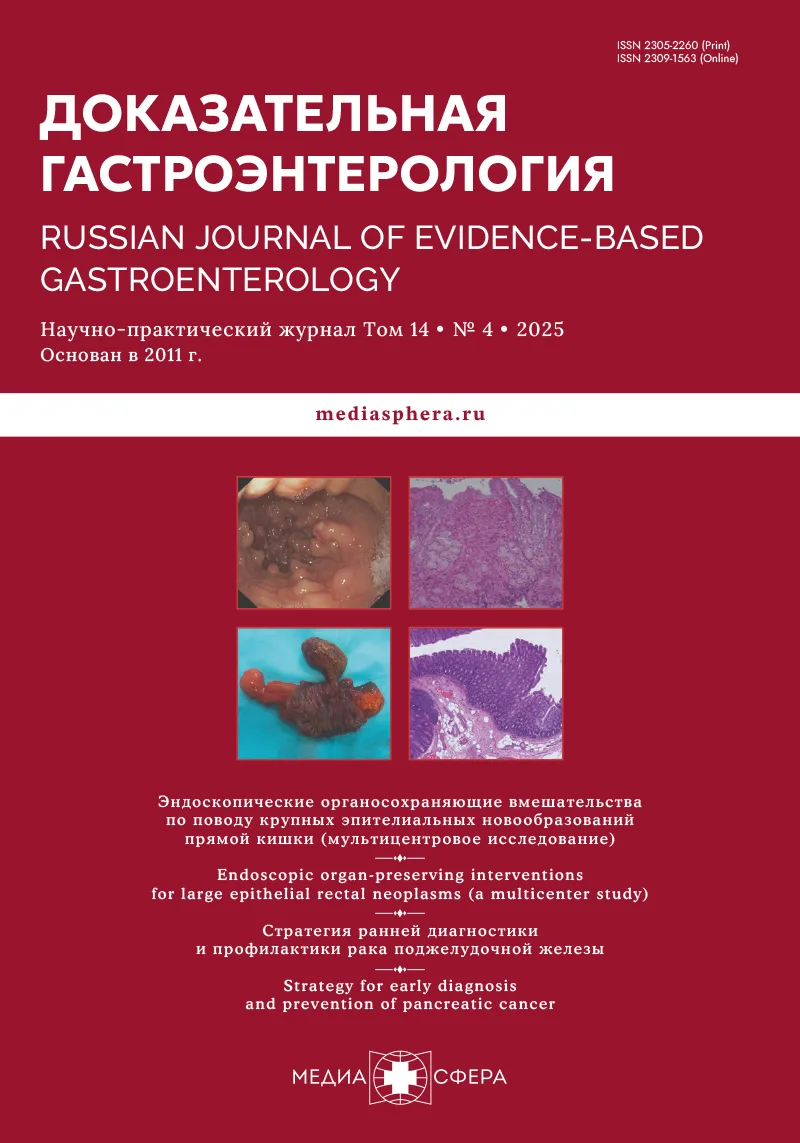
Эндоскопические органосохраняющие вмешательства по поводу крупных эпителиальных новообразований прямой кишки (мультицентровое исследование)
Журнал: Доказательная гастроэнтерология. 2025;14(4):21-26.
DOI: 10.17116/dokgastro20251404121
Прочитано: 1499 раз
Резюме
Крупные доброкачественные новообразования прямой кишки являются сложной клинической проблемой, поскольку традиционные хирургические вмешательства нередко приводят к инвалидизирующим последствиям и существенному снижению качества жизни. Эндоскопическая подслизистая диссекция (ESD) представляет собой органосохраняющий метод, однако данные о ее применении при крупных и субциркулярных поражениях прямой кишки ограниченны.
ЦЕЛЬ ИССЛЕДОВАНИЯ
Оценить эффективность и безопасность эндоскопического удаления крупных новообразований прямой кишки (площадью >20 см²) методом диссекции в подслизистом слое.
МАТЕРИАЛ И МЕТОДЫ
В исследование включены 80 пациентов (37 мужчин и 43 женщины, средний возраст 80 (38—90) лет), получавших лечение в 2018—2024 гг. в трех специализированных центрах. Все пациенты имели доброкачественные аденомы прямой кишки площадью >20 см². Оценивали техническую успешность, частоту осложнений и результаты последующего наблюдения.
РЕЗУЛЬТАТЫ
Единым блоком удалены новообразования у 76 (95%) пациентов; в 4 (5%) случаях выполнена гибридная техника с использованием эндоскопической петли. Послеоперационные кровотечения возникли у 6 (7,5%) пациентов и были купированы эндоскопически. Поверхностные повреждения мышечного слоя отмечены у 27 (33,7%) пациентов и не требовали вмешательства. У 2 (2,5%) пациентов выявлены полнослойные дефекты, устраненные OTSC-клипсой или стандартными клипсами. Через 3 мес у 68 (85%) пациентов с поражением 1/3—2/3 окружности обнаружены клинически незначимые рубцовые изменения без стеноза; у 5 (6,25%) пациентов с циркулярным поражением — умеренное сужение просвета без функциональных нарушений.
ЗАКЛЮЧЕНИЕ
ESD является эффективным и безопасным методом удаления крупных доброкачественных новообразований прямой кишки, включая образования, расположенные вблизи анального канала. Методика позволяет избежать радикальных операций с формированием колостомы и минимизировать риск поздних рубцовых стриктур при соблюдении протокола послеоперационного ведения.
Ключевые слова
- эндоскопическая подслизистая диссекция
- новообразования прямой кишки
- эндоскопия
- аденокарцинома
- послеоперационные осложнения
Дата поступления: 18.04.2025
Дата принятия в печать: 21.08.2025
Дата публикации: 12.01.2026
Введение
Колоректальный рак занимает третье место в структуре летальности от онкологических заболеваний и составляет 1,9 млн (9,6%) случаев во всем мире в год. При этом прямая кишка является наиболее распространенной локализацией злокачественных опухолей в толстой кишке [1]. Внедрение скрининговых программ позволяет чаще выявлять ранние стадии опухолевого поражения и доброкачественные новообразования, в том числе значительных размеров. Это дает возможность применять при лечении органосохраняющие минимально инвазивные методики вместо резекционных вмешательств, которые могут завершаться формированием временной или постоянной стомы, что принципиально сказывается на качестве жизни пациентов [2, 3].
Среди минимально инвазивных методик выделяют эндоскопическую резекцию слизистой оболочки (endoscopic mucosal resection — EMR), эндоскопическую подслизистую диссекцию (endoscopic submucosal dissection — ESD) и трансанальные эндоскопические операции (ТЭО). EMR является технически наиболее простой методикой среди всех эндоскопических вмешательств. Однако размеры новообразований, позволяющие выполнить безопасную и радикальную моноблочную петлевую резекцию слизистой оболочки, не превышают 15—20 мм [4—7].
ESD представляет собой эндоскопическое вмешательство, позволяющее удалять доброкачественные новообразования единым блоком с использованием методики диссекции в подслизистом слое с помощью специальных ножей [8]. Впервые методика ESD была реализована при удалении новообразований в желудке [9], а в настоящее время с успехом применяется и в толстой кишке [10—12]. Моноблочное удаление новообразований позволяет оценить радикальность проведенного вмешательства при последующем морфологическом исследовании. Это особенно актуально при окончательном выявлении злокачественной трансформации опухоли. Морфологическое изучение полностью удаленного препарата позволяет определить глубину распространения опухолевого поражения, наличие лимфоваскулярной инвазии, а также оценить края резекции для определения дальнейшей тактики лечения [13]. ESD обеспечивает радикальность резекции при удалении новообразований толстой кишки в 90% наблюдений [13]. Однако при больших размерах новообразования, диаметром >30 см, уровень R0-резекции может снижаться до 74%. По всей вероятности, это связано с техническими трудностями визуализации подслизистого слоя при крупных опухолях, что в ряде случаев может привести к их нерадикальному удалению.
В течение последних 30 лет для удаления крупных эпителиальных новообразований прямой кишки приоритетными являлись ТЭО. Они имеют более низкое количество осложнений и короткий восстановительный период по сравнению с традиционными хирургическими методиками: 4 и 7% соответственно [5, 6]. При ТЭО выполняется полнослойное удаление новообразований, располагающихся ниже тазовой брюшины, с частью прилегающей мезоректальной клетчатки [6]. Технические особенности проведения ТЭО, связанные с фиксацией тубуса ректоскопа в анальном канале, ограничивают применение методики при локализации опухоли вблизи анального канала. Кроме того, недоступными для применения ТЭО являются крупные новообразования, распространяющиеся на 2/3 окружности кишки и более, а также опухоли, расположенные на расстоянии проксимальнее 15 см от анального канала [7]. Альтернативой ТЭО для вышеописанных новообразований является выполнение традиционного хирургического вмешательства — резекция или экстирпация прямой кишки с формированием стомы. Учитывая совершенно иное качество жизни у этих пациентов и высокий риск осложнений, при наличии доброкачественного поражения прямой кишки методика ESD представляется приоритетной.
Материал и методы
В исследование были включены 80 пациентов (37 мужчин и 43 женщины, средний возраст 80 (38—90) лет) с крупными новообразованиями прямой кишки, находившихся на лечении с 2018 по 2024 г. в трех лечебных учреждениях: ГБУЗ «Московский клинический научно-практический центр им. А.С. Логинова ДЗМ», Клиника высоких медицинских технологий им. Н.И. Пирогова СПбГУ, ФГАОУ ВО «Первый МГМУ им. И.М. Сеченова» Минздрава России.
Критерием включения в исследование являлось наличие доброкачественного новообразования прямой кишки. Осмотр новообразования выполняли в белом спектре света, а затем в узкоспектральном режиме. Размер новообразований составлял >5 см по наибольшему измерению. Принимая во внимание, что новообразования имели неправильную форму с различными параметрами ширины и длины, мы считали целесообразным оценивать площадь удаленного новообразования, используя формулу S=a·b, в которой значение «a» является наибольшей длиной удаленного фрагмента, значение «b» — наибольшей шириной. Таким образом, площадь наименьшего фрагмента составила 20 см2, наибольшего — 208 см2.
Подготовка толстой кишки к оперативному вмешательству проводилась по двухэтапной схеме с использованием специализированных слабительных препаратов. За 3 дня до операции пациенту рекомендовалась диета с низким содержанием растительной клетчатки.
У 24 (30%) пациентов новообразования локализовались в непосредственной близости от анального канала (<1 см) или с переходом на зубчатую линию. В подобных ситуациях только эндоскопическое удаление новообразования позволяло сохранить анальный сфинктер, что обусловливало приоритет выбора методики операции. Наибольшее расстояние нижнего края опухоли от анального канала составило 15 см.
Циркулярное поражение наблюдали у 6 (7,5%) пациентов, у 4 из которых новообразование начиналось от анального канала. Поражение с распространением на 2/3 окружности было у 38 (47,5%) пациентов, у 11 (13,75%) из которых имелось вовлечение анального канала. Поражение на 1/3 окружности выявлено у 36 (45%) пациентов; у 9 (11,25%) из них — с распространением на анальный канал.
Большинство операций — 51 (63,75%) — проходило под внутривенной анестезией с сохранением самостоятельного дыхания, 24 (30%) пациентам выполняли эндотрахеальный наркоз, 5 (6,25%) — проводили спинальную анестезию.
Оперативное вмешательство выполняли на видеосистемах Olympus EVIS EXERA III эндоскопами 180-й или 190-й серии, FujifilmVP-7000 эндоскопами 760-й серии. Для удобства работы в прямой кишке использовали операционные гастроскопы, оснащенные каналом для подачи воды. Вмешательства выполняли в условиях инсуффляции CO2 с использованием ирригационной помпы Endomate (Endo Stars LCC) и дистального диссекционного прозрачного колпачка. Использовали также электрохирургический блок ERBE VIO 200D или ERBE 3; все эндоскопы были оснащены дополнительным каналом для подачи воды.
В 74 (92,5%) наблюдениях для удаления новообразования использовали нож I-типа, в 6 (7,5%) — диссекцию выполняли ножом Q-типа. Для основного этапа операции выбирали режимы endocut I или endocut Q с эффектом резки 2-3 в зависимости от выбранного типа ножа.
Характер эпителиальных новообразований, по данным предоперационного гистологического исследования, был представлен тубулярной аденомой низкой степени дисплазии, low-grade (49—61,25%), тяжелой степени дисплазии, high-grade (15—18,75%). В 16 (20%) наблюдениях биопсия не проводилась с целью профилактики развития фиброза в подслизистом слое. Оценку инвазивного роста проводили по визуальной картине структуры ямочного эпителия и микрососудистого рисунка.
Результаты
Время оперативного вмешательства варьировало от 60 до 780 мин (медиана составила 207,5 мин). Большинство новообразований — 76 (95%) — удалось удалить единым блоком. В 4 (5%) наблюдениях потребовалось выполнение гибридной методики с применением эндоскопической петли. При этом удаление опухоли было выполнено фрагментарно, что связано с выраженным фиброзом в подслизистом слое, выявленном в процессе выполнения оперативного вмешательства. Применение тракции петлей использовали в 5 (6,25%) наблюдениях.
У 71 (88,75%) пациента объем кровопотери составил <50 мл, у 4 (5%) — <100 мл и у 5 (6,25%) — >100 мл. При этом интраоперационные кровотечения значительно удлиняли время оперативного вмешательства, что связано с необходимостью смены инструментов и затруднением визуализации. Кровотечения были остановлены эндоскопическими методами с использованием щипцов для горячей биопсии в режиме SOFT коагуляции, эффект 5.
Послеоперационные кровотечения выявлены в 6 (7,5%) наблюдениях: в 5 — в 1-е сутки, в 1 — на 3-и. Кровотечения остановлены эндоскопическими методами при помощи гемостатических клипс. Все кровотечения были гемодинамически незначимыми; ни в одном случае не потребовалось переливания компонентов крови.
Поверхностные повреждения мышечного слоя отмечены в 27 (33,74%) наблюдениях. Повреждения мышечного слоя были обусловлены выраженным фиброзом подслизистого слоя, что нарушало визуализацию анатомических структур, а также повреждениями, возникающими в процессе выполнения гемостаза. Поверхностные повреждения мышечного слоя не требовали клипирования. В данном случае проводили однократное введение антибактериальных препаратов с профилактической целью. Последующее введение антибактериальных препаратов не потребовалось.
В 2 (2,5%) наблюдениях в процессе удаления опухоли выявлено два полнослойных повреждения стенки прямой кишки размерами 15 и 5 мм, которые потребовали закрытия. С этой целью в одном наблюдении использовали клипсу OTSC (OVESCO), в другом — стандартные гемостатические клипсы.
По данным гистологического исследования удаленных препаратов, у 38 (47,5%) пациентов выявлены тубулярные аденомы низкой степени дисплазии, low-grade, у 22 (27,5%) — тяжелая степень дисплазии, high-grade. Вертикальный и латеральный края резекции во всех наблюдениях без признаков поражения — R0, без признаков сосудистой (Lv0) и периневральной (Pn0) инвазии. При фрагментарном удалении оценка латерального края резекции не выполнялась.
Аденокарцинома выявлена у 20 (25%) пациентов. При выявлении злокачественного процесса всех пациентов направляли к онкологу для проведения онкоконсилиума с целью определения дальнейшей тактики лечения. Из них у 15 (18,75%) пациентов выявления аденокарцином вертикальный и латеральный края резекции в пределах здоровых тканей — R0, без признаков сосудистой (Lv0) и периневральной (Pn0) инвазии. В этом случае онкологический прогноз расценивали как благоприятный, пациентам назначали контрольную ректоскопию через 3, 6 и 12 мес после операции (см. таблицу). В 5 (6,25%) случаях верифицированных аденокарцином выявлены положительные края резекции, в 2 из которых — с инвазией в подслизистую основу (pT1), но без лимфоваскулярной инвазии (LV–). В этих случаях, согласно решению онкологического консилиума, была выполнена низкая передняя резекция прямой кишки. Дополнительно выполнялись МРТ малого таза и спиральная КТ органов грудной и брюшной полости с болюсным контрастным усилением неионными йодсодержащими препаратами для определения возможного регионарного и отдаленного метастазирования.
Морфологические исследование новообразований в прямой кишке
Гистологическое исследование | До операции, n (%) | После операции, n (%) |
Тубулярная аденома low grade | 49 (61,25) | 38 (47,5) |
Тубулярная аденома high grade | 15 (18,75) | 22 (27,5) |
Не проводилось | 16 (20) | — |
Аденокарцинома | — | 20 (25) |
Ввиду повышенного риска развития стеноза в послеоперационном периоде пациентам с циркулярным поражением кишки и оперативным вмешательством в области анального канала уделяли особое внимание. Всем пациентам этой группы дополнительно назначали свечи салофальк 500 мг 2 раза в день до полной эпителизации пострезекционного дефекта. При удалении новообразований циркулярного и субциркулярного характера обязательное контрольное исследование выполняли через 2 нед, что расценивали в качестве элемента раннего бужирования. При подтверждении воспалительно-грануляционных изменений без признаков перфорации пациентов с пострезекционным дефектом на расстоянии до 8—10 см от анального канала переводили на самостоятельное ежедневное бужирование бужами диаметром до 2 см. Пациентам с высоким расположением субциркулярного дефекта слизистой оболочки эндоскопическое исследование с аппаратным бужированием проводили амбулаторно еженедельно в течение 1-го месяца и далее 1 раз в 2 нед до полной эпителизации.
При контрольном обследовании через 3 мес у 68 (85%) пациентов с первичным поражением кишки 2/3 и 1/3 выявлены клинически незначимые рубцовые изменения, не суживающие просвет прямой кишки. У 5 (6,25%) пациентов с циркулярным поражением определяли циркулярные рубцовые изменения, умеренно суживающие просвет кишки не менее чем на 20 мм, что не имело функционального значения и клинических проявлений. При выполнении оперативного вмешательства с поражением на 2/3 и 1/3 окружности прямой кишки мы всегда старались оставлять «здоровую» полоску слизистой оболочки, избегая циркулярной резекции слизистой оболочки, для профилактики развития стриктуры в послеоперационном периоде.
Обсуждение
Выбор способа хирургического лечения пациентов с крупными аденомами прямой кишки до сих пор остается дискутабельным вопросом. Достаточно долгое время традиционные хирургические методы лечения в объеме резекции или экстирпации прямой кишки являлись практически единственным подходом. Такие оперативные вмешательства приводят к трудно переживаемому ухудшению качества жизни пациентов и инвалидизации.
В настоящее время в качестве альтернативных методик удаления доброкачественных новообразований прямой кишки развиваются эндоскопические минимально инвазивные технологии: ТЭО с использованием ригидных эндоскопов или ESD с использованием гибких эндоскопов. Технические особенности проведения ТЭО, связанные с фиксацией тубуса в анальном канале, ограничивают использование методики при локализации опухоли вблизи анального канала. Недоступными для проведения ТЭО являются крупные новообразования, распространяющиеся на 2/3 окружности кишки и более, а также опухоли, расположенные на расстоянии проксимальнее 15 см от анального канала. Методом выбора для этой группы пациентов является выполнение методики ESD, которая позволяет удалять доброкачественные новообразования любого размера единым блоком с сохранением функции анального канала.
В нашем исследовании мы обсудили результаты лечения 80 пациентов, у которых наблюдались крупные новообразования прямой кишки, чья площадь составляла от 20 см2. У 60 пациентов выявлены доброкачественные аденомы прямой кишки. Аденокарцинома обнаружена у 20 (25%) пациентов. Из них в 15 (18,75%) случаях выявления аденокарцином вертикальный и латеральный края резекции в пределах здоровых тканей — R0, без признаков сосудистой (Lv0) и периневральной (Pn0) инвазии. В 5 (6,25%) случаях верифицированных аденокарцином выявлены положительные края резекции, в 2 из которых — с инвазией в подслизистую основу (pT1), но без лимфоваскулярной инвазии (LV–). Во всех случаях нерадикального удаления, согласно решению онкологического консилиума, была выполнена низкая передняя резекция прямой кишки.
При наблюдении 72 (90%) пациентов в течение 1 года после проведенного оперативного вмешательства признаков рецидива не выявлено, также отсутствовали признаки рубцовых стенозов и недержания стула. Таким образом, методику ESD можно рассматривать в качестве эффективного и безопасного варианта лечения крупных доброкачественных аденом прямой кишки.
Заключение
Современные методики диссекции в подслизистом слое обладают широкими возможностями удаления доброкачественных новообразований толстой кишки. При отсутствии признаков инвазивного роста опухоли возможно удаление новообразований большого размера, в том числе с циркулярным и субциркулярным характером роста и расположением в непосредственной близости от анального канала, что позволяет избежать инвалидизирующих операций с формированием колостомы. Соблюдение протокола послеоперационного ведения таких пациентов позволяет избежать отсроченных рубцовых изменений и нарушения проходимости толстой кишки.
Участие авторов:
Концепция и дизайн исследования — Шишин К.В., Недолужко И.Ю., Цвиркун В.В., Данилов М.А.
Сбор и обработка материала — Гришина Е.А., Мальков В.А., Павлов П.В., Чернокозинская С.В.
Authors contribution:
Study design and concept — Shishin K.V., Nedoluzhko I.Yu., Tsvirkun V.V., Danilov M.A.
Data collection and processing — Grishina E.A., Malkov V.A., Pavlov P.V., Chernokozinskaya S.V.
Статистический анализ данных — Гришина Е.А., Мальков В.А., Павлов П.В., Чернокозинская С.В.
Написание текста — Гришина Е.А., Мальков В.А., Павлов П.В., Чернокозинская С.В.
Редактирование — Шишин К.В., Недолужко И.Ю., Цвиркун В.В., Данилов М.А.
Авторы заявляют об отсутствии конфликта интересов.
Statistical analysis — Grishina E.A., Malkov V.A., Pavlov P.V., Chernokozinskaya S.V.
Text writing — Grishina E.A., Malkov V.A., Pavlov P.V., Chernokozinskaya S.V.
Editing — Shishin K.V., Nedoluzhko I.Yu., Tsvirkun V.V., Danilov M.A.
- Repici A, Hassan C, De Paula Pessoa D, Pagano N, Arezzo A, Zullo A, Lorenzetti R, Marmo R. Repici A, Hassan C, De Paula Pessoa D, Pagano N, Arezzo A, Zullo A, Lorenzetti R, Marmo R. Efficacy and safety of endoscopic submucosal dissection for colorectal neoplasia: A systematic review. Endoscopy. 2012;44:137-150. https://doi.org/10.1055/s-0031-1291448
- Cronin O, Sidhu M, Shahidi N, Gupta S, O’Sullivan T, Whitfield A, Wang H, Kumar P, Hourigan LF, Byth K, Burgess NG, Bourke MJ. Comparison of the morphology and histopathology of large nonpedunculated colorectal polyps in the rectum and colon: implications for endoscopic treatment. Gastrointestinal Endoscopy. 2022;96:118-124. https://doi.org/10.1016/j.gie.2022.02.022
- D’Amico F, Amato A, Iannone A, Trovato C, Romana C, Angeletti S, Maselli R, Radaelli F, Fiori G, Viale E, Di Giulio E, Soriani P, Manno M, Rondonotti E, Galtieri PA, Anderloni A, Fugazza A, Ferrara EC, Carrara S, Di Leo M, Pellegatta G, Spadaccini M, Lamonaca L, Craviotto V, Belletrutti PJ, Hassan C, Repici A; Bowell Group. Risk of covert submucosal cancer in patients with granular mixed laterally spreading tumors. Clinical Gastroenterology and Hepatology. 2021;19:1395-1401. https://doi.org/10.1016/j.cgh.2020.07.024
- Ahmed Y, Othman M. EMR/ESD: Techniques, Complications, and Evidence. Current Gastroenterology Reports. 2020;22(8):39. https://doi.org/10.1007/s11894-020-00777-z
- Léonard D, Colin J-F, Remue C, Jamart J, Kartheuser A. Transanal endoscopic microsurgery: Long-term experience, indication expansion, and technical improvements. Surgical Endoscopy. 2012;26:312-322. https://doi.org/10.1007/s00464-011-1869-9
- Arezzo A, Passera R, Saito Y, Sakamoto T, Kobayashi N, Sakamoto N, Yoshida N, Naito Y, Fujishiro M, Niimi K, Ohya T, Ohata K, Okamura S, Iizuka S, Takeuchi Y, Uedo N, Fusaroli P, Bonino MA, Verra M, Morino M. Arezzo A, Passera R, Saito Y, Sakamoto T, Kobayashi N, Sakamoto N, Yoshida N, Naito Y, Fujishiro M, Niimi K, Ohya T, Ohata K, Okamura S, Iizuka S, Takeuchi Y, Uedo N, Fusaroli P, Bonino MA, Verra M, Morino M. Systematic review and meta-analysis of endoscopic submucosal dissection versus transanal endoscopic microsurgery for large noninvasive rectal lesions. Surgical Endoscopy. 2014;28:427-438. https://doi.org/10.1007/s00464-013-3238-3
- Saito Y, Yamada M, So E, Abe S, Sakamoto T, Nakajima T, Otake Y, Ono A, Matsuda T. Colorectal endoscopic submucosal dissection: Technical advantages compared to endoscopic mucosal resection and minimally invasive surgery. Digestive Endoscopy. 2014;26(Suppl 1):52-61. https://doi.org/10.1111/den.12196
- Yamamoto H, Kawata H, Sunada K, Sasaki A, Nakazawa K, Miyata T, Sekine Y, Yano T, Satoh K, Ido K, Sugano K. Successful en bloc resection of large superficial tumors in the stomach and colon using sodium hyaluronate and small-caliber-tip transparent hood. Endoscopy. 2003;35(8):690-694. https://doi.org/10.1055/s-2003-41516
- Ликутов А.А., Мтвралашвили Д.А., Нагудов М.А., Югай О.М., Ваганов Ю.Е., Чернышов С.В., Майновская О.А. Факторы, лимитирующие выполнение подслизистой диссекции в толстой кишке. Колопроктология. 2021;20(2):50-56. https://doi.org/10.33878/2073-7556-2021-20-2-50-56
- Мтвралашвили Д.А., Ликутов А.А., Веселов В.В., Майновская О.А., Кашников В.Н., Хомяков Е.А., Чернышов С.В. Влияет ли локализация опухоли в различных отделах толстой кишки на результаты эндоскопической диссекции в подслизистом слое? Колопроктология. 2019;18(2(68)):33-48. https://doi.org/10.33878/2073-7556-2019-18-2-33-41
- Хомяков Е.А., Мтвралашвили Д.А., Ваганов Ю.Е., Чернышов С.В., Югай О.М., Качанова Т.В. Эффективность и факторы риска эндоскопической диссекции в подслизистом слое при опухолях правых отделов толстой кишки. Вестник хирургии имени И.И. Грекова. 2020;179(4):29-35. https://doi.org/10.24884/0042-4625-2020-179-4-29-35
- Tanaka S, Kashida H, Saito Y, Yahagi N, Yamano H, Saito S, Hisabe T, Yao T, Watanabe M, Yoshida M, Kudo SE, Tsuruta O, Sugihara KI, Watanabe T, Saitoh Y, Igarashi M, Toyonaga T, Ajioka Y, Ichinose M, Matsui T, Sugita A, Sugano K, Fujimoto K, Tajiri H. JGES guidelines for colorectal endoscopic submucosal dissection/endoscopic mucosal resection. Digestive Endoscopy. 2015;27:417-434. https://doi.org/10.1111/den.12456
- Guerrieri M, Baldarelli M, de Sanctis A, Campagnacci R, Rimini M, Lezoche E. Treatment of rectal adenomas by transanal endoscopic microsurgery: 15 years’ experience. Surgical Endoscopy. 2010;24(2):445-449. https://doi.org/10.1007/s00464-009-0585-1



Рекомендуем статьи по данной теме:
Морфометрические изменения зоны внутреннего носового клапана после ревизионной риносептопластики с применением алгоритма стабилизации латеральной стенки.Пластическая хирургия и эстетическая медицина. 2026;(3):62-67
Результаты хирургического лечения больных раком правой половины ободочной кишки с применением интракорпоральных анастомозов в период пандемии COVID-19. (Ретроспективное когортное исследование).Оперативная хирургия и клиническая анатомия (Пироговский научный журнал). 2026;10(3):12-19
Факторы риска послеоперационных осложнений после резекций легкого: ретроспективное многоцентровое исследование.Хирургия. Журнал им. Н.И. Пирогова. 2026;(9-2):61-69
Результаты многоцентрового проспективного исследования ESOSTAT: анализ 90-дневных послеоперационных осложнений и летальности после радикальных операций при раке пищевода и пищеводно-желудочного перехода.Хирургия. Журнал им. Н.И. Пирогова. 2026;(9-2):50-60
Ожирение и эндоскопические методы лечения в бариатрической хирургии.Хирургия. Журнал им. Н.И. Пирогова. 2026;(8):81-88
Хирургическое лечение первично-множественного рака легкого у лиц пожилого и старческого возраста.Хирургия. Журнал им. Н.И. Пирогова. 2026;(8):23-32
Клиническая эффективность комбинированного дренирования подпеченочного пространства при лапароскопической холецистэктомии у пациентов с гангренозным холециститом.Эндоскопическая хирургия. 2026;32(4):46-53
Эндопротезирование при доброкачественных стенозах трахеи.Эндоскопическая хирургия. 2026;32(4):15-22
Внутрипросветная эндоскопическая хирургия в лечении больных ранним кардиоэзофагеальным раком: сравнительный анализ с хирургическим лечением.Онкология. Журнал им. П.А. Герцена. 2026;15(4):7-14
Ревизионные операции после лапароскопической продольной резекции желудка.Эндоскопическая хирургия. 2026;32(3):59-72