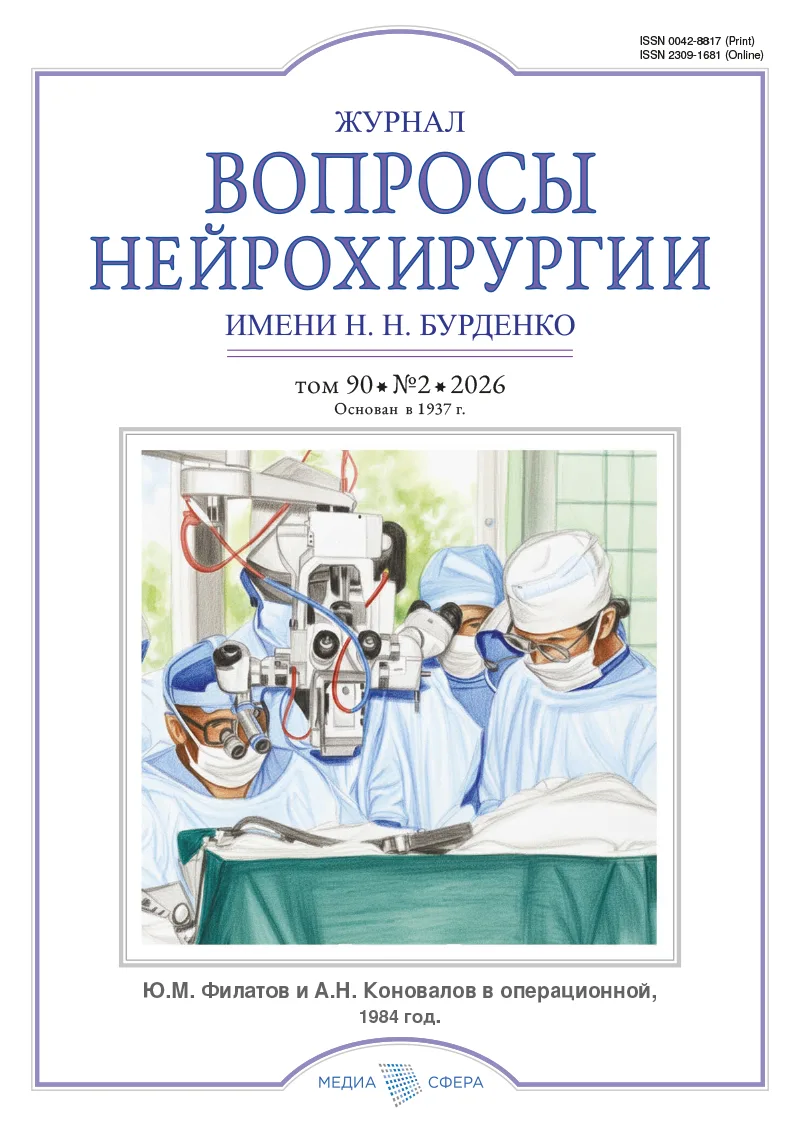
Microsurgical treatment of cerebral arteriovenous malformations: a 20-year experience of the Burdenko Neurosurgical Center
Журнал: Вопросы нейрохирургии имени Н.Н. Бурденко. 2026;90(2):6-14.
Read: 2221 раз
Abstract
OBJECTIVE
To evaluate the results of microsurgical treatment of cerebral arteriovenous malformations (AVMs) over a 20-year period and their dynamics taking into account clinical and morphological characteristics of malformations, baseline functional status of patients and clinically relevant outcome measures.
MATERIAL AND METHODS
A single-center retrospective cohort study included 1.273 cases of microsurgical treatment of cerebral AVMs between 2006 and 2025. Demographic data, AVM morphology, Spetzler-Martin grading, hemorrhage and seizures before surgery, preoperative embolization, early postoperative complications, and mRS scores before surgery and at discharge were assessed. A favorable outcome implied improvement or no deterioration compared to preoperative status. Clinically significant deterioration («new disability») was defined as deterioration compared to baseline status with mRS ≥3. Visual field defects were analyzed separately and not included in morbidity.
RESULTS
In-hospital mortality was 0.6%. Favorable outcomes were observed in 1.165 out of 1.271 patients (91.7%). Clinically significant deterioration («new disability») was observed in 8.3% of patients. The incidence of complications and adverse outcomes increased along with higher Spetzler-Martin grades. Patients with previous hemorrhage were more likely to have baseline neurological deficit, but the incidence of «new disability» in this group was no different from that in patients without hemorrhage. Preoperative embolization was more common in patients with more difficult AVMs.
CONCLUSION
Microsurgical treatment of cerebral AVMs at a specialized center is characterized by low in-hospital mortality and high proportion of favorable functional outcomes.
Keywords
- arteriovenous malformation
- microsurgery
- Spetzler– Martin
- functional outcome
- new disability
- preoperative embolization
Дата поступления: 15.01.2026
Дата принятия в печать: 30.01.2026
Дата публикации: 03.04.2026
- Dicpinigaitis A.J., Ogulnick J.V., Mayer S.A., Gandhi C.D., Al-Mufti F. Increase in ruptured cerebral arteriovenous malformations and mortality in the United States: unintended consequences of the ARUBA trial? Stroke: Vascular and Interventional Neurology. 2023;3:e000442. https://doi.org/10.1161/SVIN.122.000442.
- Luther E., Chen S.H., McCarthy D.J., Sur S., Ding D., Starke R.M., Crowley R.W., Liu K.C., Chalouhi N., Jabbour P.M. National reduction in cerebral arteriovenous malformation treatment correlated with increased rupture incidence. Journal of NeuroInterventional Surgery. 2023;15(8):735-740. https://doi.org/10.1136/jnis-2022-019110.
- Derdeyn C.P., Zipfel G.J., Albuquerque F.C., Cooke D.L., Feldmann E., Sheehan J.P., Torner J.C. Management of brain arteriovenous malformations: a scientific statement from the American Heart Association/American Stroke Association. Stroke. 2017;48(8):e200-e224. https://doi.org/10.1161/STR.0000000000000134.
- Sattari S.A., Shahbandi A., Yang W., Xu R., Yu J., Starke R.M., Jabbour P.M., Ding D. Microsurgery versus microsurgery with preoperative embolization for brain AVM treatment: a systematic review and meta-analysis. Neurosurgery. 2023;92(1):27-41. https://doi.org/10.1227/neu.0000000000002171.
- Potts M.B., Lau D., Abla A.A., Kim H., Young W.L., Lawton M.T. Current surgical results with low-grade brain AVMs. Journal of Neurosurgery. 2015;122(4):912-920. https://doi.org/10.3171/2014.12.JNS14938.
- Schramm J., Schaller K., Esche J., Boström A. Microsurgery for cerebral AVMs: subgroup outcomes in a consecutive series of 288 cases. Journal of Neurosurgery. 2017;126(4):1056-1063. https://doi.org/10.3171/2016.4.JNS153017.
- Ren Q., He M., Zeng Y., Zhao Y., Chen J., Li Y., Liu A. Microsurgery for intracranial AVM: long-term outcomes in 445 patients. PLoS One. 2017;12(3):e0174325. https://doi.org/10.1371/journal.pone.0174325.
- Inoa V., Goyal N., Arthur A.S., Rai A.T., Elijovich L., Hoit D.A., Spiotta A.M., Turk A.S., Frei D., Mocco J., Jadhav A.P. Is the modified Rankin Scale still the right endpoint for neurointerventional trials? Journal of NeuroInterventional Surgery. 2025;17(12):1267-1269. https://doi.org/10.1136/jnis-2025-024605.
- Spetzler R.F., Martin N.A. A proposed grading system for arteriovenous malformations. Journal of Neurosurgery. 1986;65(4):476-483. https://doi.org/10.3171/jns.1986.65.4.0476.
- Éliava ShSh, Filatov IuM, Pilipenko IuV, et al. Microsurgical treatment of cerebral arteriovenous malformations in Burdenko Neurosurgical Institute (recent experience). Burdenko’s Journal of Neurosurgery. 2012;76(3):34-44. (In Russ.)
- Park M.T., Essibayi M.A., Srinivasan V.M., Daniels D.J., Lanzino G., Brinjikji W. Surgical management outcomes after preoperative embolization: a systematic review and meta-analysis. Neurosurgical Review. 2022;45(6):3499-3510. https://doi.org/10.1007/s10143-022-01860-x.
- Dmitriev A.V., Eliava Sh.Sh., Yakovlev S.B., Pilipenko Yu.V., Gorozhanin V.A., Belousova O.B. Complications and functional outcomes of microsurgical resection of arteriovenous malformations following preoperative endovascular embolization. Bulletin of Neurology, Psychiatry and Neurosurgery. 2023;(6). https://doi.org/10.33920/med-01-2306-03.
- Gorozhanin VA, Pilipenko IuV, Belousova OB, Éliava ShSh. Microsurgical treatment of non-bleeding cerebral arteriovenous malformations. Burdenko’s Journal of Neurosurgery. 2018;82(5):119-124. (In Russ., In Engl.) https://doi.org/10.17116/neiro201882051119
- Gorozhanin VA, Éliava ShSh, Pilipenko IuV, Shekhtman OD, Sazonova OB. Immediate outcomes of microsurgical treatment of cerebral arteriovenous malformations in non-hemorrhagic patients. Burdenko’s Journal of Neurosurgery. 2018;82(6):30-37. (In Russ., In Engl.) https://doi.org/10.17116/neiro20188206130
- Éliava ShSh, Pilipenko IuV, Yakovlev SB, Golanov AV, Mariashev SA, Grebenev FV. Arteriovenous malformations of the brain in children: treatment results for 376 patients. Burdenko’s Journal of Neurosurgery. 2020;84(2):22-34. (In Russ., In Engl.) https://doi.org/10.17116/neiro20208402122
- Lawton M.T., Kim H., McCulloch C.E., Mikhak B., Young W.L. A supplementary grading scale for selecting patients with brain arteriovenous malformations for surgery. Neurosurgery. 2010;66(4):702-713. https://doi.org/10.1227/01.NEU.0000367555.16733.E1.
- Mohr J.P., Parides M.K., Stapf C., Moquete E., Moy C.S., Overbey J.R., Al-Shahi Salman R., Vicaut E., Young W.L., Houdart E., Cordonnier C., Stefani M.A., Hartmann A., von Kummer R., Mast H., Stapf C. Medical management with or without interventional therapy for unruptured AVMs (ARUBA). Lancet. 2014;383(9917):614-621. https://doi.org/10.1016/S0140-6736(13)62302-8.
Recommended articles:
Modern surgical approaches to prevention of upper limb lymphedema after treatment of breast cancer.Plastic Surgery and Aesthetic Medicine. 2026;(3):43-49
Off-pump coronary artery bypass grafting using microvascular technique and surgical microscope. (Immediate results).Russian Journal of Cardiology and Cardiovascular Surgery. 2026;19(3):13-20
Diagnosis and surgical treatment of vascular anomalies in children: a case report.Pirogov Russian Journal of Surgery. 2026;(5):110-114
Effects of immunological and metabolic parameters on the patient’s functional outcome in the acute period of ischemic stroke.S.S. Korsakov Journal of Neurology and Psychiatry. 2026;126(3-2):28-34
Effectiveness of revascularization and immediate outcomes after off-pump coronary artery bypass surgery using microvascular techniques and surgical microscope. (Propensity score matching).Russian Cardiology Bulletin. 2026;21(1):49-59
Effect of perioperative norepinephrine infusion on the outcomes after microsurgical free tissue grafting: a systematic review.Russian Journal of Anesthesiology and Reanimatology. 2025;(5):98-107
Microsurgical treatment of 723 cerebral aneurysms: a single-center prospective study.Burdenko's Journal of Neurosurgery. 2025;89(3):60-67
Mandible reconstruction using the Autoplan software.Plastic Surgery and Aesthetic Medicine. 2024;(4-2):58-65