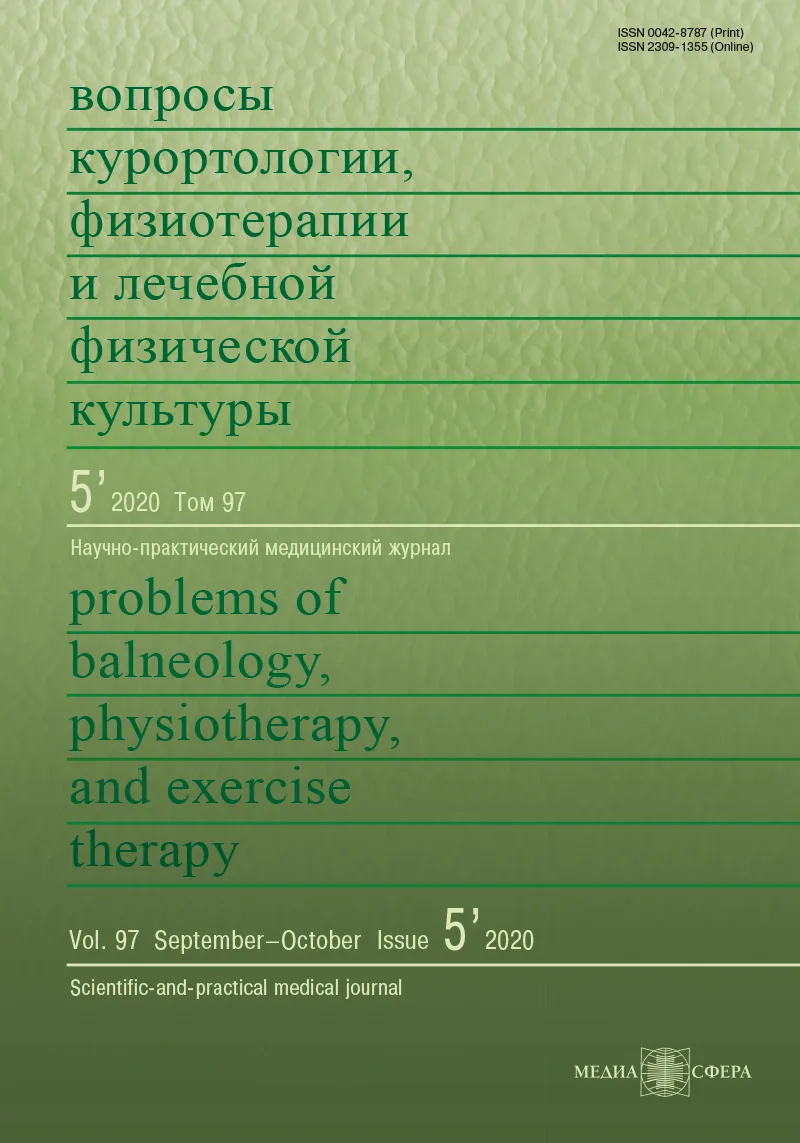
Effects of application of transcranial electrical stimulation in the training process at elite athletes of various sports
Журнал: Вопросы курортологии, физиотерапии и лечебной физической культуры. 2020;97(5):70-79.
DOI: 10.17116/kurort20209705170
Read: 5701 раз
Abstract
Restoring and optimizing the psychofunctional state of the athlete’s body is an important area of sports medicine. Methods that allow you to quickly level psychoemotional and physical stress by influencing regulatory systems are interesting. Transcranial Direct Current Stimulation (tDCS) refers to such methods. Its use in sports requires testing and scientific justification.
PURPOSE OF THE STUDY
To study the tDCS influence, used in the training process, on the psychofunctional state of highly qualified athletes of various sports.
MATERIAL AND METHODS
86 athletes aged 16 to 30 years old were examined. Their qualifications ranged from candidate master of sports to international master of sports of cyclic (track and field — 7 athletes, triathlon — 12), acyclic (weightlifting — 18) and opponent (karate — 22, rugby — 27) sports. The EEG study of electroencephalogram, heart rate variability and psychophysiological testing, ergospirometric stress testing on a treadmill were carried out to substantiate the tDCS effects.
RESULTS
The positive effect of the tDCS use is shown, which is substantiated by a significant change in physiological and psychophysiological parameters. An increase in the heart work economization, adaptive and mobilization body reserves, psychophysiological indicators was noted in triathletes after a course of 7 tDCS procedures. One tDCS in track and field athletes (according to stress testing data) helped to optimize the performance and increase the functional capabilities of the myocardium, reduce energy consumption during work. During the period of urgent recovery, tDCS contributed to the heart rate restoring acceleration, increase of the bringing in oxygen and flushing out carbon dioxide rate, and hemodynamics. The use of one procedure among acyclic sports athletes was effective for optimizing the psycho-functional state, reducing the tension of regulatory processes. After maximum muscle-strengthening exercises, the recovery processes accelerated and the CNS performance increased. In athletes of opponent sports (rugby, karate), the tDCS use helped to reduce the time of sensorimotor reactions and increase mental stability, optimize the brain functional state, and economize the heart work.
CONCLUSION
The positive effect of tDCS is expressed in improving the psycho-functional state and working capacity, accelerating the recovery processes of athletes after physical exertion. In this connection, this method can be widely recommended for use as a regenerating and stimulating effect in medical and biological support in elite sports.
Keywords
- athletes
- transcranial direct current stimulation
- recovery
- physiotherapy
- functional state
- psychophysiological state
- capacity
Дата поступления: 21.01.2020
Дата принятия в печать: 22.05.2020
Дата публикации: 10.11.2020
- Malygin AV, Lebedev VP, Pakharkov GN. Application of evidence-based medicine rules in the development of biotechnological systems of transcranial electrical stimulation. Izvestiya SPbGETU «LETI». 2004;43. (In Russ.).
- Lebedev VP, Sergienko VI. Development and justification of the therapeutic use of transcranial electrical stimulation of the brain’s defense mechanisms using the principles of evidence-based medicine. Transcranial electrical stimulation. Experimental and clinical research: a collection of articles. 2005;2:11-68. (In Russ.).
- Sein OB, Ivanov VA, Milostnoj YP. Correction of hemodynamics and emotional state in judokas after exercise using transcranial electrical stimulation. Actual problems of TES-therapy. International conference on the method of thermal power plants. 2008;103-105. (In Russ.).
- Guvakova IV, Kuznetsova LA. Violations of the vegetative status in athletes of acyclic sports and their correction by means of game biofeedback technology and transcranial stimulation. Byulleten’ sibirskoj mediciny. 2010;9(2):68-72. (In Russ.).
- Drobyshev VA, Guvakova IV, Kuznetsova LA. The use of transcranial electrical stimulation and game biofeedback in the correction of autonomic changes in athletes of cyclic sports. Sibirskoe medicinskoe obozrenie. 2010;64(4):73-77. (In Russ.).
- Vinogradova OL, Tarasova OS, Netreba AI. Using the method of transcranial electrical stimulation to correct the psychophysiological status of athletes. Transcranial electrical stimulation. Experimental and clinical research. 2009;3:256-273. (In Russ.).
- Koryagina YuV, Roguleva LG, Zamchiy TP. Transcranial electrical stimulation as a means of optimizing the psychophysiological functions of martial artists and power sports athletes. Teoriya i Praktika Fizicheskoy Kultury. 2015;3:11-13.
- Koryagina YuV, Ter-Akopov GN, Nopin SV, Roguleva LG, Kostyuk EV. The use of transcranial electrical stimulation, endomassage and magnetic field for urgent recovery and post-traumatic rehabilitation of athletes. Teoriya i Praktika Fizicheskoy Kultury. 2019;1:20-22.
- Angius L, Pascual-Leone A, Santarnecchi E. Brain stimulation and physical performance. Progress in brain research. 2018;240:317-339. https://doi.org/10.1016/bs.pbr.2018.07.010
- Moscatelli F, Valenzano A, Monda V, Ruberto M, Monda G, Triggiani A, Roccella M. Transcranial magnetic stimulation (tms) application in sport medicine: a brief. Acta Medica. 2017;33:423. https://doi.org/10.19193/0393-6384_2017_3_062
- Goodall S, Howatson G, Romer L, Ross E. Transcranial magnetic stimulation in sport science: a commentary. European journal of sport science. 2014;14:332-340. https://doi.org/10.1080/17461391.2012.704079
- Bestmann S, Walsh V. Transcranial electrical stimulation. Current Biology. 2017;27(23):1258-1262. https://doi.org/10.1016/j.cub.2017.11.001
- Koryagina YuV, Nopin SV. Hardware-software complex «Sports psychophysiologist». Computer Programs. Database. Topologies of integrated circuits. 2011;1:308. (In Russ.).
- Vehrs PR, George JD, Fellingham GW, Plowman SA, Dustman-Allen K. Submaximal treadmill exercise test to predict VO2max in fit adults. Measurement in Physical Education and Exercise Science. 2007;11(2):61-72. https://doi.org/10.1080/10913670701294047
- Shlyk N. Heart rate and type of regulation in children, adolescents and athletes. Izhevsk: Publishing House Udmurt University; 2009. (In Russ.).
- Pitkevich YuE. Heart rate variability in athletes. Gomel State Journal honey. un-that. Health and environmental issues. 2010;26(4):101-106. (In Russ.).
- Gavrilova EA. Sport, stress, variability: a monograph. M.: Sport; 2015. (In Russ.).


Recommended articles:
Effect of a combined physiotherapeutic approach on changes in functional parameters after endovitreal surgery of rhegmatogenous retinal detachment with a favorable anatomical outcome.Russian Annals of Ophthalmology. 2026;142(3):29-37
Transcranial electrotherapy in the treatment of mental diseases.Problems of Balneology, Physiotherapy and Exercise Therapy. 2025;102(6):32-39
Possibilities of combined physiotherapy treatment of allergic rhinitis.Russian Bulletin of Otorhinolaryngology. 2025;90(6):72-76
Comparative analysis of the effectiveness of outpatient rehabilitation algorithms for patients with back pain.Problems of Balneology, Physiotherapy and Exercise Therapy. 2025;102(5-2):72-80
Current possibilities of physiotherapy rehabilitation programs in the treatment of postoperative pain after surgical treatment of complex anal fistulas.Problems of Balneology, Physiotherapy and Exercise Therapy. 2025;102(5-2):28-34
The role of capillaroscopy in assessing the effectiveness of non-medicamental treatment methods. (Literature review).Problems of Balneology, Physiotherapy and Exercise Therapy. 2025;102(5):63-66
Normoxic barotherapy and enhanced external counterpulsation in the recovery of athletes with cardiac disorders.Problems of Balneology, Physiotherapy and Exercise Therapy. 2025;102(5):20-27
Personalized control of distraction rate in mandibular distraction osteogenesis: influence of mechanical and physical factors on bone regenerate maturation.Stomatology. 2025;104(5):84-91
Experience with meglumine sodium succinate for the treatment of cardiac strain in athletes.Russian Journal of Preventive Medicine. 2025;28(6):99-105
Comparative characteristics of swimmers, athletes who are non swimmers, and people not involved in sports respiratory function.Russian Journal of Preventive Medicine. 2025;28(4):117-122