Характеристика иммунного микроокружения рака эндометрия в зависимости от MMR-статуса опухоли
Резюме
ЦЕЛЬ ИССЛЕДОВАНИЯ
Изучить особенности микроокружения MMR-профицитного (pMMR) и MMR-дефицитного (dMMR) рака эндометрия.
МЕТОДЫ
В исследование было включено 34 пациентки с pMMR-раком эндометрия и 10 с dMMR-раком эндометрия. С помощью метода мультиплексной TSA-ассоциированной (tyramide signal amplification) иммунофлюоресценции проведено фенотипирование опухолевого микроокружения с оценкой стромальной и внутриопухолевой локализации клеток и экспрессии PD-1.
РЕЗУЛЬТАТЫ
В pMMR-опухолях эндометрия преобладающей клеточной популяцией являлись макрофаги CD163+, а в опухолях с dMMR макрофаги CD163+ обнаруживались в равной степени с CD8+ T-лимфоцитами и CD20+ B-лимфоцитами. В dMMR-опухолях количество CD8+ T-лимфоцитов и CD20+ B-лимфоцитов (а также CD20+ B-лимфоцитов, экспрессирующих PD-1) выше по сравнению с pMMR-опухолями, в то время как уровень FoxP3+ T-лимфоцитов был достоверно ниже. Количество макрофагов CD163+ не различалось в зависимости от MMR-статуса, при этом содержание макрофагов CD163+ выше в строме в сравнении с таковым данных клеток, расположенных интраэпителиально. У пациенток с dMMR- опухолями количество CD8+ T-лимфоцитов было выше в строме, а в pMMR-опухолях не различалось.
ЗАКЛЮЧЕНИЕ
В данном исследовании установлено, что dMMR-опухоли эндометрия характеризуются увеличением доли CD8+ T-лимфоцитов и CD20+ B-лимфоцитов, что может быть связано с лучшим ответом на иммунотерапию. Выявленные различия в пространственном распределении CD8+ T-лимфоцитов и макрофагов CD163+ подтверждают значимость локализации иммунных клеток для прогноза и эффективности лечения. Эти результаты подчеркивают необходимость дальнейшего изучения микроокружения рака эндометрия с целью персонализации терапии.
Ключевые слова
- рак эндометрия
- микросателлитная нестабильность
- опухолевое микроокружение
- лимфоциты
- макрофаги
Дата поступления: 21.01.2025
Дата принятия в печать: 25.06.2025
Дата публикации: 27.10.2025
Рак эндометрия является распространенным злокачественным новообразованием женской репродуктивной системы, поражающим женщин во всем мире. При определении прогноза заболевания и выборе тактики лечения важную роль играет молекулярная характеристика опухоли, в том числе оценка статуса системы репарации неспаренных нуклеотидов (Mismatch Repair, MMR). Система репарации неспаренных нуклеотидов представляет собой ключевой механизм поддержания геномной стабильности. Нарушение ее работы приводит к накоплению мутаций, в том числе в микросателлитных повторах, что обусловливает феномен микросателлитной нестабильности (MSI). MMR-дефицит (dMMR) ассоциирован с высокой мутационной нагрузкой, выраженным противоопухолевым иммунным ответом, инфильтрацией опухоли T-клетками, а также экспрессией иммунных контрольных белков. Эти особенности объясняют повышенную чувствительность dMMR-опухолей к терапии ингибиторами иммунных контрольных точек [1].
В последние годы все больше внимания уделяется роли микроокружения в прогрессировании рака эндометрия. Относительно связи опухолеинфильтрирующих лимфоцитов (ОИЛ) и прогноза рака эндометрия существуют неоднозначные данные. В исследовании C.-T. Fan и соавт. [2] не было обнаружено связи ОИЛ с выживаемостью без прогрессии у пациенток с MMR-профицитным и MMR-дефицитным раком эндометрия. В исследовании T. Kono-Sato и соавт. [3] демонстрируется, что прогностическая значимость ОИЛ зависела от локализации лимфоцитов. Так, низкий уровень лимфоцитов, расположенных внутри опухолевых гнезд, но не на инвазивном крае, коррелирует с худшим прогнозом у пациенток с раком эндометрия. При рассмотрении прогностической значимости отдельных типов иммунных клеток получены более однозначные данные. N. Horeweg и соавт. [4] обнаружили, что наличие большого количества CD8+ TILs является независимым предиктором улучшения общей выживаемости. Количество CD8+ лимфоцитов было значительно ниже в MSI-опухолях. Пациентки, имеющие опухоли с высоким уровнем внутриопухолевых CD8+ TIL, имели лучший прогноз общей выживаемости, в то же время стромальные CD8+ TIL не показали значительной прогностической ценности [5]. Эти данные подчеркивают важность оценки пространственного расположения иммунных клеток.
В другом исследовании [6] была подтверждена значимость соотношения CD8+ и FoxP3+ T-клеток для бессобытийной выживаемости при раке эндометрия. Существуют данные об отсутствии связи CD68+ или CD163+ опухолеинфильтрирующих макрофагов с прогнозом [3].
Особенности микроокружения рака эндометрия неизбежно сопряжены с молекулярным подтипом, базирующимся на анализе базы TCGA и включенным в рекомендации NCCN. Недавно в ряде других исследований также показано увеличение количества ОИЛ в опухолях POLE и MSI по сравнению с опухолями MSS в раке эндометрия. В 2017 г. J.B. Pakish и соавт. [7] сравнили опухолевое микроокружение рака эндометрия между группой MSI и группой MSS (исключались случаи с POLE-мутантами и POLE-неизвестными) и сообщили, что в строме MSI по сравнению с MSS присутствует больше иммунных клеток, включая клетки с гранзимом B+ и активированные цитотоксические T-лимфоциты (CTLs, CD8+granzyme B+). При TP53-мутантном подтипе плотность PD-L1+ макрофагов (p=0,047) и PD-1+ T-клеток (p=0,034) в паренхиме опухоли была самой высокой среди всех четырех подтипов [8]. Несмотря на довольно большое количество информации об особенностях клеточного состава опухолевого микроокружения в MMR-профицитном и MMR-дефицитном раке эндометрия, сведения являются разрозненными, кроме того, практически не изучены паттерны экспресии иммунных контрольных точек, что имеет прямую практическую значимость. Понимание особенностей микроокружения при раке эндометрия может дать ценные сведения для оптимизации таргетных терапевтических стратегий.
Цель данной работы — изучить особенности микроокружения MMR-профицитного и MMR-дефицитного рака эндометрия.
Пациенты и методы
В исследование было включено 44 пациентки с раком эндометрия, которые составили 2 группы: pMMR (n=34) и dMMR (n=10). Все пациентки проходили лечение в Научно-исследовательском институте онкологии ФГБНУ «Томский национальный исследовательский медицинский центр РАН» в соответствии с клиническими рекомендациями. Все пациентки подписали добровольное информированное согласие на участие в исследовании, которое было одобрено локальным этическим комитетом НИИ онкологии (протокол №18 от 25 августа 2023 г.). Гистологический тип опухоли определялся на основании морфологического изучения препаратов, окрашенных гематоксилином и эозином, в соответствии с действующей классификацией ВОЗ (5-е издание, 2020 г.). Карциносаркомы включены в исследование как смешанные мезодермальные опухоли, отличающиеся от классических форм рака эндометрия, но локализующиеся в этом органе и имеющие в своем составе эпителиальный компонент. Определение гистологического подтипа опухоли проводилось двумя независимыми патологами с целью минимизации межэкспертной вариабельности. Клинико-патологические параметры пациенток, вошедших в исследование, представлены в таблице.
Клинико-патологические параметры пациенток с раком эндометрия
Показатель | Параметр, абс(%) | p | |
pMMR(n=34) | dMMR(n=10) | ||
Возраст, годы | 58,0±7,5 | 60,0±9,0 | 0,49 |
FIGO | 0,95 | ||
IA | 4 (11,8) | 1 (10,0) | |
IB | 7 (20,6) | 3 (30,0) | |
II | 7 (20,6) | 1 (10,0) | |
IIIA | 6 (17,6) | 2 (20,0) | |
IIIC | 5 (14,7) | 2 (20,0) | |
IVB | 5 (14,7) | 1 (10,0) | |
Гистологический тип карциномы | 0,52 | ||
эндометриоидная | 30 (88,2) | 10 (100,0) | |
серозная | 2 (5,9) | 0 (0,0) | |
карциносаркома | 2 (5,9) | 0 (0,0) | |
Степень злокачественности | 0,80 | ||
I | 7 (20,6) | 3 (30,0) | |
II | 18 (52,9) | 4 (40,0) | |
III | 8 (23,5) | 3 (30,0) | |
нет данных | 1 (2,9) | 0 (0,0) | |
Глубина инвазии миометрия | 0,85 | ||
нет | 1 (2,9) | 0 (0,0) | |
менее 50% | 13 (38,2) | 4 (40,0) | |
более 50% | 20 (58,8) | 6 (60,0) | |
Лимфоваскулярная инвазия | 0,99 | ||
нет | 25 (73,5) | 7 (70,0) | |
есть | 9 (26,5) | 3 (30,0) | |
Висцеральные метастазы | 0,99 | ||
нет | 29 (85,3) | 9 (90,0) | |
есть | 5 (14,7) | 1 (10,0) | |
ИГХ-оценка MMR-статуса
ИГХ-исследование экспрессии белков системы репарации неспаренных нуклеотидов проводилось на автоматическом иммуногистостейнере Ventana BenchMark ULTRA (Roche Diagnostics, США) с использованием следующих первичных моноклональных антител производства Roche: MLH1 (клон M1, RTU) , PMS2 (клон EPR3947, RTU), MSH2 (клон G219-1129, RTU), MSH6 (клон SP93, RTU). Срезы депарафинировали и регидратировали по стандартному протоколу. Демаскировку антигенов проводили в буфере Cell Conditioning 1 (CC1) при pH 8,5 (Ventana Medical Systems) и температуре 95 °C в течение 64 мин. Инкубацию с первичными антителами проводили при температуре 37 °C в течение 32 мин. Для визуализации ИГХ-реакции использовали систему детекции OptiView DAB IHC Detection Kit (Ventana Medical Systems) согласно протоколу производителя. Докрашивание ядер осуществляли готовым раствором гематоксилина. Экспрессию белков MMR оценивали в опухоли. В качестве внутреннего положительного контроля учитывали ядра нормальных эпителиальных клеток, лимфоцитов и стромальных клеток. В случаях наличия ядерной экспрессии всех 4 белков системы репарации (MLH1, PMS2, MSH2 и MSH6) опухоли расценивали как MMR-proficient (pMMR). При полной потере ядерной экспрессии одного или нескольких белков системы репарации, при наличии адекватного внутреннего положительного контроля статус опухоли определяли как MMR-deficient (dMMR). Результат считали недействительным при отсутствии адекватного внутреннего позитивного контроля или наличии неспецифического окрашивания.
Мультиплексная иммунофлюоресценция
Мультиплексная TSA-ассоциированная (tyramide signal amplification) иммунофлюоресценция (рис. 1) была проведена с применением автоматического иммуногистостейнера BOND RXm (Leica, Германия). Использовали первичные антитела к CD8 (Ventana, clone SP57, 1:10), PD-1 (ABclonal, clone AMC0439, 1:500), CD20 (Leica Biosystems, clone L26, 1:600), CD163 (Diagnostic Biosystems, clone 10D6, 1:150), FoxP3 (Invitrogen, clone 236A/E7, 1:800), система детекции EnVision FLEX / HRP (Dako) и набор тирамидов, конъюгированных с флюоресцентными метками Opal 7-color Fluorophore Kit (Akoya Biosciences). Демаскировка антигенов была проведена в буфере Epitope Retrieval Solution 2 (Leica Biosystems) в течение 20 мин при температуре 98,5 °C. Каждый цикл окрашивания включал нанесение на срез опухолевой ткани EnVision FLEX Peroxidase-blocking reagent (Dako) (инкубация в течение 10 мин), Novocastra Protein block (Leica Biosystems) (10 мин), первичного антитела (30 мин), EnVision FLEX / HRP (30 мин), Opal (20 мин) и завершался демаскировкой в буфере Epitope Retrieval Solution 2. Окрашивание каждого среза включало 5 циклов и было проведено с соблюдением установленного соответствия первичное антитело — Opal и установленного порядка циклов: CD8 — Opal520, PD-1 — Opal540, CD20 — Opal570, CD163 — Opal620, FoxP3 — Opal690. Окрашивание ядер проводили с помощью Fluoroshield with DAPI (Sigma-Aldrich, США). Визуализацию окрашивания и получение изображений осуществляли с помощью Vectra 3.0 (Akoya Biosciences, США). Идентификацию, классификацию и подсчет клеток выполняли с использованием программного обеспечения inForm (Akoya Biosciences, США) в 7 репрезентативных областях среза ткани.
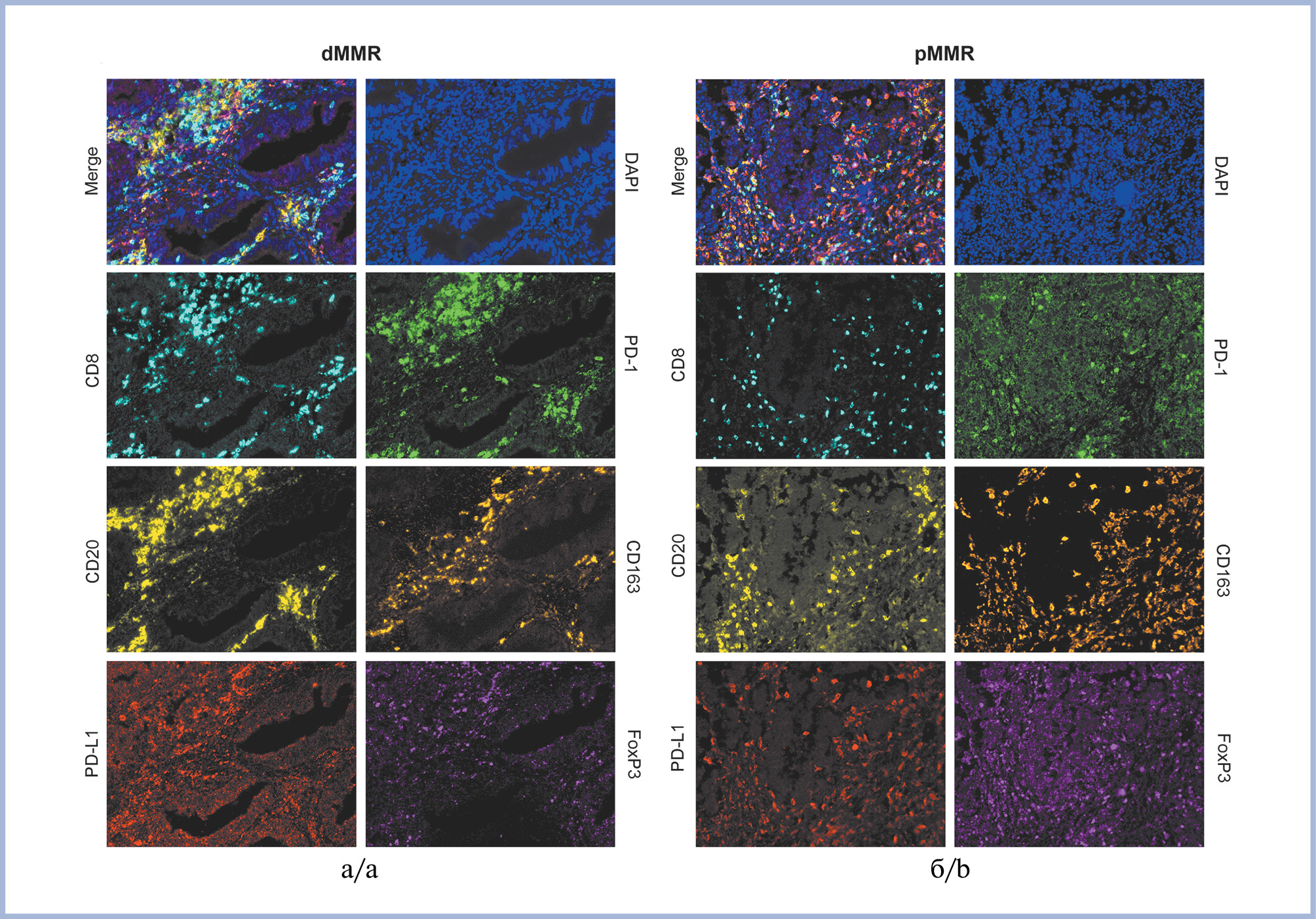
Рис. 1. Мультиплексное TSA-ассоциированное окрашивание ткани dMMR (а) и pMMR (б) рака эндометрия, ув. ×200.
В группах пациенток с pMMR- и dMMR-раком эндометрия было подсчитано количество ОИЛ в строме опухоли, а также содержание CD8+ цитотоксических лимфоцитов, CD20+ B-лимфоцитов, макрофагов CD163+ и FoxP3+ T-регуляторных лимфоцитов, расположенных в строме опухоли, а также CD8+ цитотоксических лимфоцитов и макрофагов CD163+ интраэпителиально. Кроме того, исследовано количество CD8+ T-лимфоцитов, CD20+ B-лимфоцитов, макрофагов CD163+ и FoxP3+ T-лимфоцитов, экспрессирующих PD-1. Результаты представлены в виде процента занимаемой площади стромы или процента от клеток, расположенных интраэпителиально.
Статистический анализ
Статистический анализ проводили с использованием программного обеспечения Prism 10 (GraphPad, США). Достоверность различий количественных признаков оценивали с помощью критериев Манна—Уитни и Краскела—Уоллиса. Сравнение категориальных переменных выполняли, применяя точный критерий Фишера. Различия считали достоверными при значении p<0,05.
Результаты
Уровень ОИЛ не различался в опухолях pMMR и dMMR у больных раком эндометрия (9,23(6,77—18,00)% против 10,63(8,80—14,24)%; p=0,1541) (рис. 2).
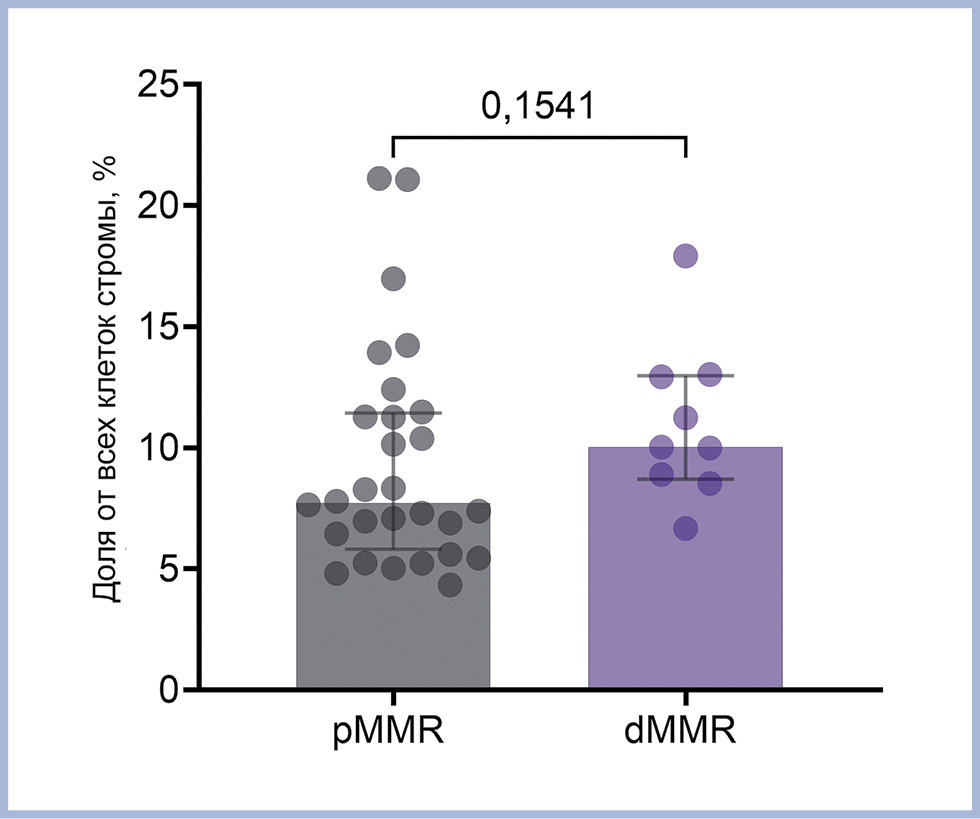
Рис. 2. Уровень опухолеинфильтрирующих лимфоцитов в строме у пациенток с раком эндометрия в зависимости от статуса системы мисматч-репарации.
Дальнейшее изучение клеточного состава опухолевого микроокружения позволило обнаружить преобладающие клеточные типы в каждой из групп опухолей (рис. 3).
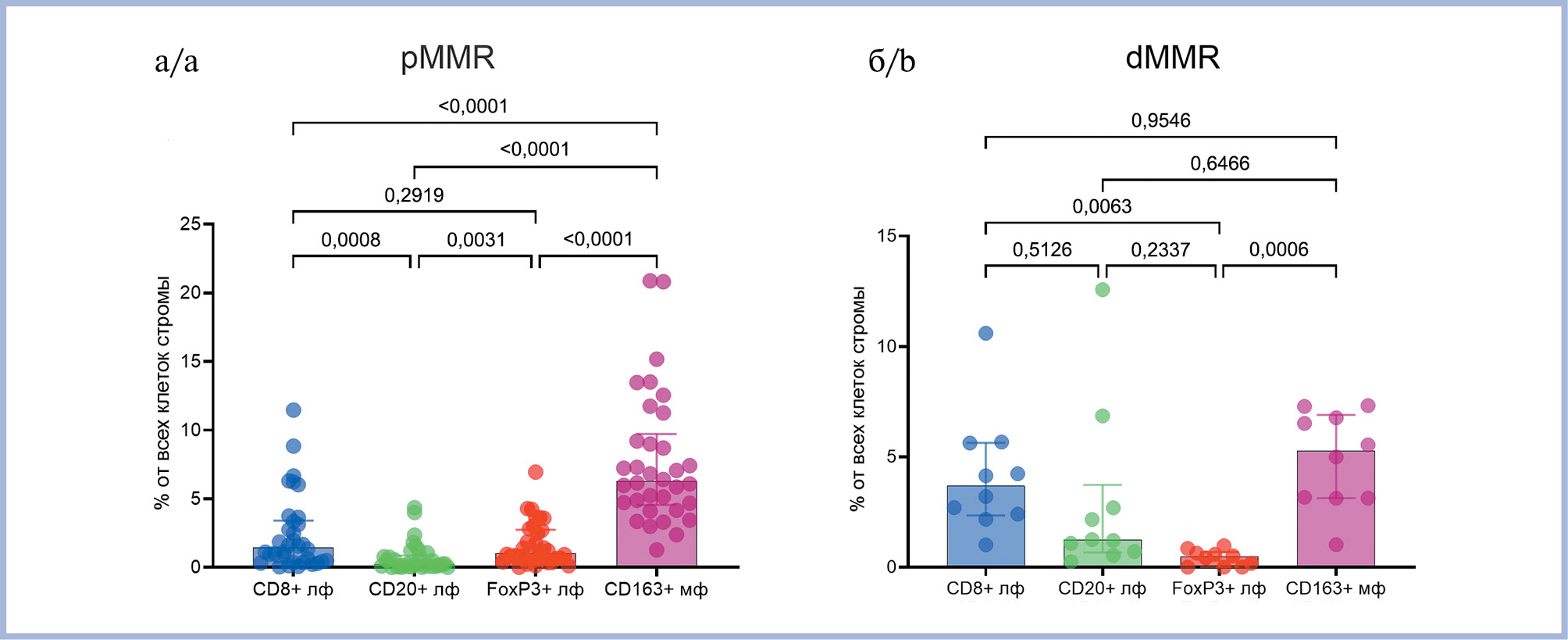
Рис. 3. Количество CD8+ T-лимфоцитов, CD20+ B-лимфоцитов, FoxP3+ T-лимфоцитов и макрофагов CD163+ в опухолевом микроокружении в pMMR (а) и dMMR опухолях (б) у пациенток с раком эндометрия (лф — лимфоциты, мф — макрофаги).
В pMMR-опухолях преобладающая клеточная популяция макрофаги CD163+ (6,27(4,54—9,71)%), далее в порядке убывания следуют CD8+ T-лимфоциты (1,11(0,34—2,20)%), FoxP3+ T-лимфоциты (1,01(0,56—2,72)%) и CD20+ B-лимфоциты (0,20(0,07—0,85)%); p=0,0001. В опухолях с dMMR количество CD163+ макрофагов (5,26(3,12-6,89)%), CD8+ T-лимфоцитов (3,67(2,34—5,63)%) и CD20+ B-лимфоцитов (1,23(0,66—3,73)%) не различалось, а популяция FoxP3+ T-лимфоцитов (0,46(0,00—0,68)%) являлась самой малочисленной (p=0,0210).
Последующее сравнение количества клеток между группами больных в зависимости от статуса показало, что в dMMR-опухолях уровень CD8+ T-лимфоцитов и CD20+ B-лимфоцитов выше по сравнению с pMMR- опухолями (p=0,0007, p=0,0010 соответственно), в то время как количество FoxP3+ T-лимфоцитов было достоверно ниже (p=0,0041) (рис. 4). Количество макрофагов CD163+ не различалось у больных в зависимости от статуса (p=0,1632).
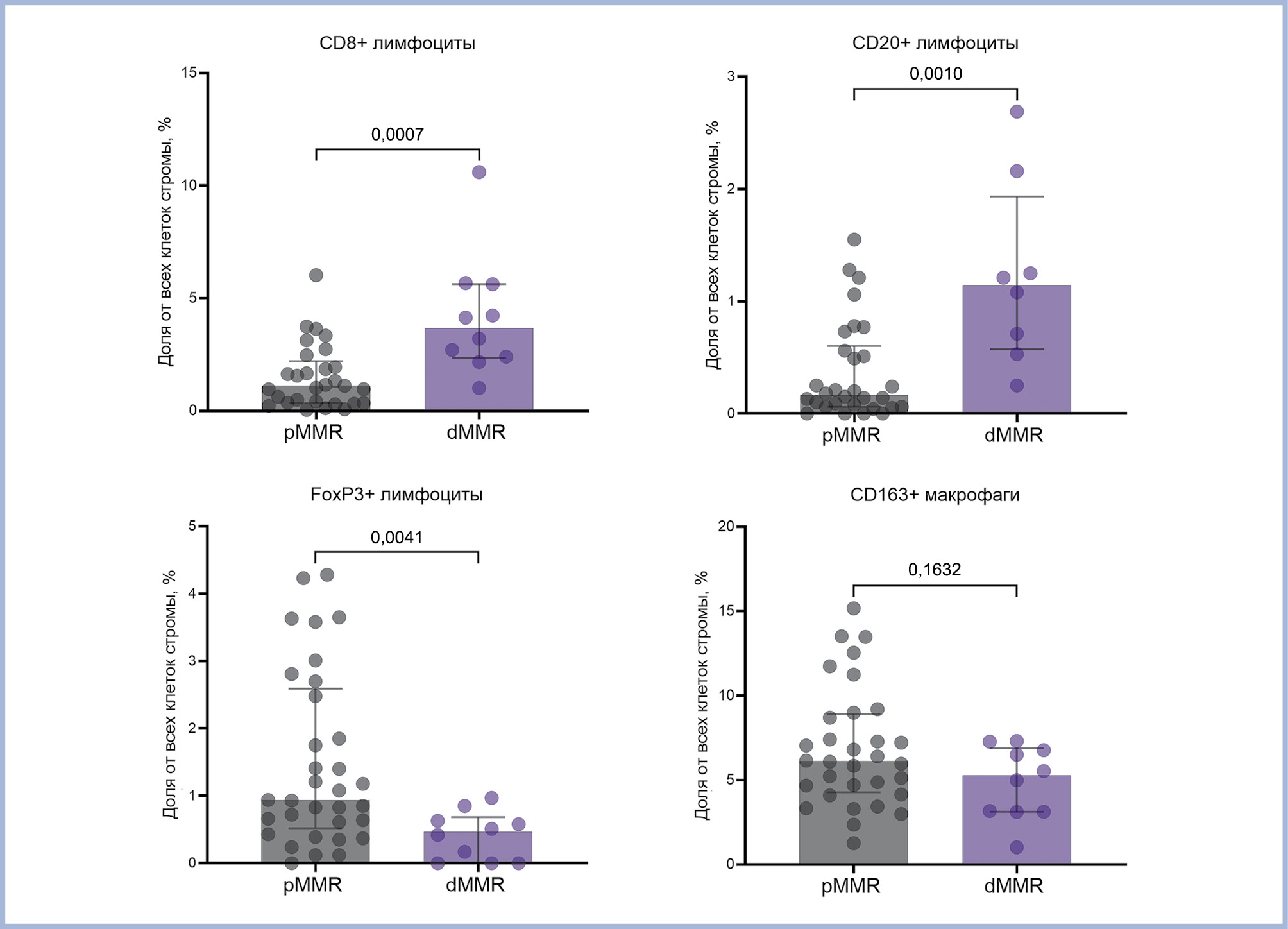
Рис. 4. Количество CD8+ T-лимфоцитов, CD20+ B-лимфоцитов, FoxP3+ T-лимфоцитов и макрофагов CD163+ в опухолевом микроокружении у больных раком эндометрия в зависимости от статуса системы мисматч-репарации.
Однако, изучая особенности иммунной инфильтрации опухоли, более информативным и клинически значимым может являться оценка пространственного расположения в опухоли, а именно интраэпителиально (между опухолевыми клетками) или в строме опухоли, располагающейся между гнезд опухолевых клеток. При изучении клеточного состава опухолевого микроокружения проводили отдельный анализ количества CD8+ цитотоксических лимфоцитов и макрофагов CD163+, расположенных в строме и интраэпителиально (рис. 5).
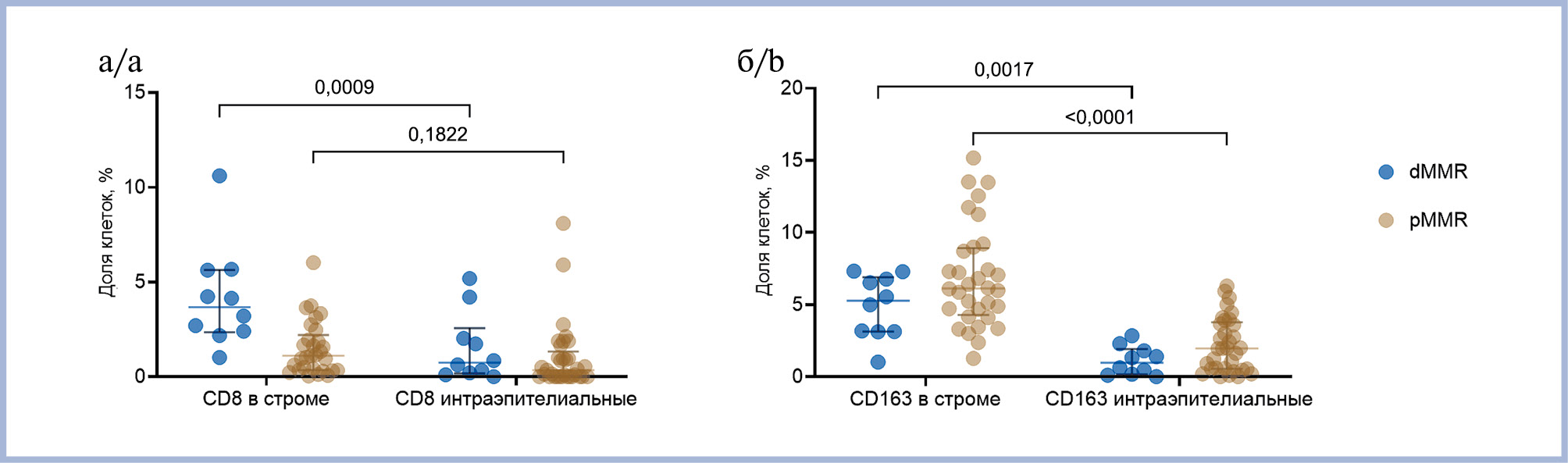
Рис. 5. Количество CD8+ T-лимфоцитов (а) и CD163+ макрофагов (б), расположенных стромально и интраэпителиально у больных раком эндометрия в зависимости от статуса системы мисматч-репарации.
У пациенток с dMMR-опухолями количество CD8+ T-лимфоцитов и макрофагов CD163+ было выше в строме в сравнении с уровнем данных клеток, расположенных интраэпителиально (CD8+ T-лимфоциты: 3,67(2,34—5,63)% и 0,74(0,17—2,56)%; p=0,0009; макрофаги CD163+: 5,26(3,12—6,89)% и 0,96(0,16—1,91)%; p=0,0017). В pMMR-опухолях не различалось количество CD8+ T-лимфоцитов, расположенных в строме и интраэпителиально, но при этом макрофагов CD163+ было больше в строме (CD8+ T-лимфоциты: 1,11(0,34—2,20)% и 0,35(0,00—1,33)%; p=0,1822; макрофаги CD163+: 6,12(4,28—8,91)% и 1,96(0,54—3,78)%; p<0,0001).
Одной из терапевтических опций у больных, включенных в исследование, является иммунотерапия пембролизумабом (терапевтическим антителом к PD-1) в монорежиме или сочетающаяся с мультикиназным ингибитором. Однако до сих пор неизвестно, различается ли уровень основных PD-1-положительных популяций иммуных клеток микроокружения с зависимости от статуса системы мисматч-репарации. В этой связи мы сравнили долю PD-1-положительных иммунных клеток в микроокружении dMMR- и pMMR-рака эндометрия (рис. 6).
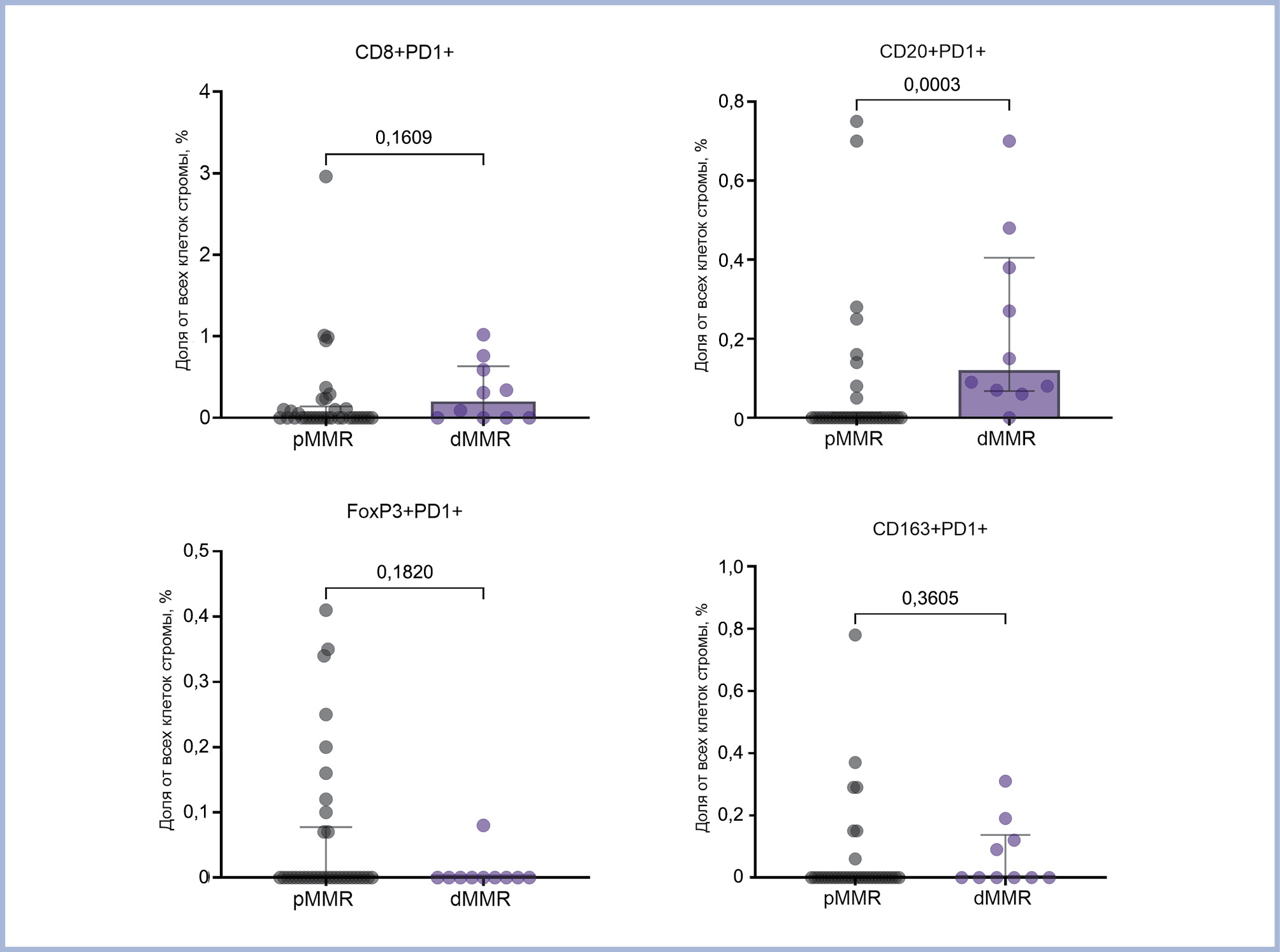
Рис. 6. Количество PD-1-экспрессирующих CD8+ T-лимфоцитов, CD20+ B-лимфоцитов, FoxP3+ T-лимфоцитов и макрофагов CD163+ в опухолевом микроокружении у больных раком эндометрия в зависимости от статуса системы мисматч-репарации.
Результаты показали, что одинаково редко и в одинаково малом количестве в строме опухоли обнаруживаются FoxP3+ T-лимфоциты и макрофаги CD163+, экспрессирующие PD-1 (dMMR: 0,00(0,00—0,00)% и 0,00(0,00—0,00)% соответственно; pMMR: 0,00(0,00—0,07)% и 0,00(0,00—0,13)% соответственно; p=0,1820, p=0,3605). У пациенток с dMMR-раком эндометрия было обнаружено достоверное увеличение доли CD20+ B-лимфоцитов, экспрессирующих PD-1 (dMMR: 0,12(0,06—0,40)% и pMMR: 0,00(0,00—0,01)%; p=0,0003). Доли CD8+ T-лимфоцитов, экспрессирующих PD-1, у пациенток с различным статусом системы мисматч-репарации, не различаются (dMMR: 0,20(0,00—0,63)% и pMMR: 0,00(0,00—0,14)%; p=0,1609).
Обсуждение
Включение молекулярного типирования рака эндометрия в рекомендации NCCN в 2020 г. свидетельствовало о наступлении эры новых стратегий ведения и лечения пациенток, включая иммунотерапию. Действительно, использование терапевтических анти-PD-1-антител позволило существенно продлить общую выживаемость пациенток с прогрессирующим или метастатическим раком эндометрия [9]. Статус системы репарации ошибочно спаренных нуклеотидов является агностическим биомаркером для назначения пембролизумаба [10]. В этом свете рак эндометрия является уникальным поскольку пембролизумаб может быть назначен даже в случае MMR-профицита, но в комбинации с ленватинибом. Более того, данные литературы [11] показывают, что экспрессия PD-L1 не является значимым биомаркером для назначения иммунотерапии и существенно не различается в опухолевых клетках среди POLE-, MSI- и MSS-подтипов. При этом уровень экспрессии PD-1 и PD-L1 при раке эндометрия необычайно высок: PD-1 экспрессируется примерно в 60—65% случаев, а PD-L1 — в 25—70% [12]. Это обстоятельство сигнализирует, что рак эндометрия имеет особенности, благоприятствующие эффектам анти-PD-1-терапии. Эти особенности могут заключаться в свойствах как локального иммунного ответа, так и в неиммунных механизмах действия PD-1/ PD-L1 [13].
Проведенное исследование позволило выявить ключевые характеристики состава опухолевого микроокружения MMR-дефицитных и MMR-профицитных случаев рака эндометрия. Оказалось, что дефицит MMR сопряжен со снижением количества FoxP3+ T-лимфоцитов и повышением CD8+ T-лимфоцитов и CD20+ B-лимфоцитов. Введенное ранее понятие «иммуновоспалительная реакция» (ИВР) [14] позволяет говорить, что при дефиците системы репарации ошибочно спаренных нуклеотидов в ткани рака молочной железы происходит сдвиг в сторону ИВР Th1-типа, сопряженной с более благоприятными исходами. Возможно, благоприятный ответ на иммунотерапию при раке эндометрия связан не столько с ожидаемыми эффектами самой блокады PD-1/PD-L1 (восстановление функции цитотоксических лимфоцитов и элиминация опухолевых клеток), сколько со сдвигом в сторону Th1-подобной ИВР, которая препятствует эпителиально-мезенхимальному переходу, инвазии и прогрессированию опухоли.
Интересно, что различия в уровне макрофагов CD163+ были обнаружены только при анализе, учитывающем пространственное расположение клеток. В нашем исследовании избирательно анализировали только CD8+ T-лимфоциты и макрофаги CD163+, опираясь на информацию о присущей этим клеткам функциональной активности при непосредственном контакте с опухолевыми клетками. В противовес нашим ожиданиям, только количество CD8+ T-лимфоцитов и макрофагов CD163+, локализованных в строме опухоли, а не интраэпителиально, имело достоверные различия в MMR-дефицитных и MMR-профицитных случаях рака эндометрия. Это косвенно подтверждает предположение, что большую значимость имеют неиммунные функции клеток опухолевого микроокружения.
Наибольшая клиническая ценность нашего исследования состоит в том, что были выявлены особенности рака эндометрия, позволяющие отбирать пациенток на иммунотерапию. Только часть пациенток при имеющихся показаниях демонстрирует длительный устойчивый ответ на терапию анти-PD-1-антителами. Эти обстоятельства обосновывают бурный интерес к поиску предикторных биомаркеров. В настоящем исследовании мы показали, что доля CD20+ B-лимфоцитов, экспрессирующих PD-1, у пациенток с MMR-дефицитным раком эндометрия значительно превосходит MMR-профицитные случаи. Это была единственная популяция клеток, имеющая различия. Можно предположить, что это различие лежит в основе лучшего ответа MMR-дефицитных опухолей на иммунотерапию по сравнению с MMR-профицитными. Интересно, что именно CD20+ лимфоциты, по последним данным, являются предикторами ответа на иммунотерапию при раке эндометрия. Исследование, проведенное J.F. Grau Bejar и соавт. [15] подчеркивает существенную роль наряду с цитотоксическими T-клетками гуморального иммунитета в эффективности иммунотерапии при MMR-дефицитном раке эндометрия, о чем свидетельствуют значительно более высокие уровни CD20+ лимфоцитов и третичных лимфоидных структур у пациенток, ответивших на терапию. Проведенные нами ранее исследования показывают, что и при MMR-профицитном раке эндометрия ключевую роль играют B-лимфоциты. Так, процентное содержание CD20+ B-лимфоцитов и соотношение CD8–/CD20-лимфоцитов было значительно выше у пациенток, ответивших на лечение [16]. Похожие данные были получены при изучении колоректального рака. J. Li и соавт. [17] доказали, что доля CD20+ B-клеток увеличилась у пациентов с полным морфологическим ответом, получавших анти-PD-1-терапию, по сравнению с пациентами без полного ответа. Они обнаружили, что высокое содержание CD20+ B-клеток в опухолях сопровождается высоким содержанием CD8+ эффекторных T-клеток памяти и низким содержанием CD8+ тканевых резидентных клеток памяти. Это позволяет предположить, что CD20+ B-клетки могут регулировать статус CD8+ T-клеток и способствовать ответу на иммунотерапию. Следует подчеркнуть, что их взаимодействие с CD8+ T-лимфоцитами через цитокины и рецепторные связи требует дальнейшего более углубленного изучения. Данное взаимодействие может регулировать степень активации и эффекторной функции T-клеток, что в конечном итоге может влиять на терапевтический результат.
Заключение
Результаты проведенного исследования подчеркивают важность изучения иммунного микроокружения рака эндометрия для оптимизации терапии. Установлено, что MMR-дефицитные опухоли характеризуются увеличением доли CD8+ T-лимфоцитов и CD20+ B-лимфоцитов, что может быть связано с лучшим ответом на иммунотерапию. Выявленные различия в пространственном распределении CD8+ T-лимфоцитов и макрофагов CD163+ подтверждают значимость локализации иммунных клеток для прогноза и эффективности лечения. В будущем интеграция данных об иммунном микроокружении с молекулярными характеристиками рака эндометрия позволит разработать персонализированные подходы к иммунотерапии. Данное исследование открывает новые горизонты для дальнейшего изучения механизмов резистентности и выявления биомаркеров, предсказывающих ответ на лечение, что является важным шагом на пути к совершенствованию онкологической помощи.
Работа выполнена при финансовой поддержке Российского научного фонда (грант № 20-75-10033-П).
Участие авторов:
Концепция и дизайн исследования — Таширева Л.А.
Сбор и обработка материала — Калинчук А.Ю., Мальцева А.А., Царенкова Е.А., Лоос Д.М., Коломиец Л.А.
Статистическая обработка данных —Таширева Л.А.
Написание текста — Таширева Л.А., Калинчук А.Ю.
Редактирование — Вторушин С.В.
Авторы заявляют об отсутствии конфликта интересов.
The authors declare no conflict s of interest.
- Vanderwalde, A., Spetzler, D., Xiao, N., Gatalica, Z., Marshall, J. Microsatellite instability status determined by next-generation sequencing and compared with PD-L1 and tumor mutational burden in 11,348 patients. Cancer medicine. 2018; 7(3): 746-756. https://doi.org/10.1002/cam4.1372
- Fan C-T, Hsu S-T, Sun L, Hwang S-F, Liu C-K, Shih Y-H, Chen M-J, Li H-N, Wang J-S, Wen M-C, et al. Improved Progression-Free Survival Associated with Tumor-Infiltrating Lymphocytes in High-Grade Endometrial Cancer. Journal of Clinical Medicine. 2023;12(2):603. https://doi.org/10.3390/jcm12020603
- Kono-Sato T, Miyai K, Yamagishi Y, Miyamoto M, Takano M, Matsukuma S, Sato K, Tsuda H. Intraepithelial lymphocytes are indicators of better prognosis in surgically resected endometrioid-type endometrial carcinomas at early and advanced stages. BMC Cancer. 2022;22:361. https://doi.org/10.1186/s12885-022-09363-0
- Horeweg N, de Bruyn M, Nout RA, Stelloo E, Kedziersza K, León-Castillo A, Plat A, Mertz KD, Osse M, Jürgenliemk-Schulz IM et al. Prognostic integrated image-based immune and molecular profiling in early-stage endometrial cancer. Cancer Immunology Research. 2020;8(12):1508-1519. https://doi.org/10.1158/2326-6066.CIR-20-0149
- Munakata S, Ito T, Asano T, Yamashita T. Tumor-Infiltrating CD8-Positive T-Cells Associated with MMR and p53 Protein Expression Can Stratify Endometrial Carcinoma for Prognosis. Diagnostics. 2023;13(12):1985. https://doi.org/10.3390/diagnostics13121985
- Yamagami W, Susumu N, Tanaka H, Hirasawa A, Banno K, Suzuki N, Tsuda H, Tsukazaki K, Aoki D. Immunofluorescence-Detected Infiltration of CD4+FOXP3+ Regulatory T Cells Is Relevant to the Prognosis of Patients With Endometrial Cancer. International Journal of Gynecological Cancer. 2011;21(9):1628-1634. https://doi.org/10.1097/IGC.0b013e31822c271f
- Pakish JB, Zhang Q, Chen Z, Liang H, Chisholm GB, Yuan Y, Mok SC, Broaddus RR, Lu KH, Yates MS. Immune Microenvironment in Microsatellite-Instable Endometrial Cancers: Hereditary or Sporadic Origin Matters. Clinical cancer research. 2017;23(15):4473-4481. https://doi.org/10.1158/1078-0432.CCR-16-2655
- Dai Y, Zhao L, Hua D, Cui L, Zhang X, Kang N, Qu L, Li L, Li H, Shen D et al. Tumor immune microenvironment in endometrial cancer of different molecular subtypes: evidence from a retrospective observational study. Frontiers in Immunology. 2022;13:1035616. https://doi.org/10.3389/fimmu.2022.1035616
- Maiorano BA, Maiorano MFP, Cormio G, Maglione A, Lorusso D, Maiello E. How immunotherapy modified the therapeutic scenario of endometrial cancer: A systematic review. Frontiers in Oncology. 2022;12:844801. https://doi.org/10.3389/fonc.2022.844801
- Lemery S, Keegan P, Pazdur R. First FDA approval agnostic of cancer site — when a biomarker defines the indication. New England Journal of Medicine. 2017;377(15):1409-1412. https://doi.org/10.1056/NEJMp1709968
- Cao W, Ma X, Fischer JV, Sun C, Kong B, Zhang Q. Immunotherapy in endometrial cancer: rationale, practice and perspectives. Biomarker Research. 2021;9:49. https://doi.org/10.1186/s40364-021-00301-z
- Mamat Yusof MN, Chew KT, Kampan NC, Shafiee MN. Expression of PD-1 and PD-L1 in Endometrial Cancer: Molecular and Clinical Significance. International journal of molecular sciences. 2023;24(20):15233. https://doi.org/10.3390/ijms242015233
- Deng J, Jiang W, Liu L, Zhan W, Wu Y, Xu X. Research progress on the intrinsic non-immune function of PD-L1 in tumors (Review). Oncology Letters. 2022;25(1):10. https://doi.org/10.3892/ol.2022.13596
- Tashireva LA, Perelmuter VM, Manskikh VN, Denisov EV, Savelieva OE, Kaygorodova EV, Zavyalova MV. Types of Immune-Inflammatory Responses as a Reflection of Cell-Cell Interactions under Conditions of Tissue Regeneration and Tumor Growth. Biochemistry (Mosc). 2017;82(5):542-555. https://doi.org/10.1134/S0006297917050029
- Grau Bejar JF, Yaniz Galende E, Zeng Q, Genestie C, Rouleau E, de Bruyn M, Klein C, Le Formal A, Edmond E, Moreau M et al. Immune predictors of response to immune checkpoint inhibitors in mismatch repair-deficient endometrial cancer. Journal for ImmunoTherapy of Cancer. 2024;12(7):e009143. https://doi.org/10.1136/jitc-2024-009143
- Maltseva A, Kalinchuk A, Chernorubashkina N, Sisakyan V, Lots I, Gofman A, Anzhiganova Y, Martynova E, Zukov R, Aleksandrova E et al. Predicting Response to Immunotargeted Therapy in Endometrial Cancer via Tumor Immune Microenvironment: A Multicenter, Observational Study. International Journal of Molecular Sciences. 2024;25(7):3933. https://doi.org/10.3390/ijms25073933
- Li J, Wu C, Hu H, Qin G, Wu X, Bai F, Zhang J, Cai Y, Huang Y, Wang C et al. Remodeling of the immune and stromal cell compartment by PD-1 blockade in mismatch repair-deficient colorectal cancer. Cancer Cell. 2023;41(6):1152-1169.e7. https://doi.org/10.1016/j.ccell.2023.04.011


Рекомендуем статьи по данной теме:
Клинический и морфологический анализ состояния гематосаливарного барьера в биоптате слизистой оболочки щеки при эрозивно-язвенной форме (L43.82) плоского лишая.Оперативная хирургия и клиническая анатомия (Пироговский научный журнал). 2026;10(3):39-47
Сравнение лапароскопического и робот-ассистированного доступов при хирургическом лечении больных раком эндометрия и морбидным ожирением: предварительные результаты.Российский вестник акушера-гинеколога. 2026;26(4):47-54
Эндометриоидная аденокарцинома эндометрия IA стадии, ассоциированная с беременностью: возможности отсрочки лечения (клиническое наблюдение и обзор литературы).Онкология. Журнал им. П.А. Герцена. 2026;15(4):76-81
Спонтанный регресс метастаза колоректального рака в печени.Архив патологии. 2026;88(3):66-72
Назначение менопаузальной гормональной терапии на фоне и после завершения лечения злокачественных опухолей органов репродуктивной системы женщины: систематический обзор современных клинических руководств.Онкология. Журнал им. П.А. Герцена. 2026;15(3):99-111
Вклад лучевой терапии в лечение больных раком эндометрия.Онкология. Журнал им. П.А. Герцена. 2026;15(3):86-90
Роль опухолевого микроокружения и экспрессии белка BAP1 в прогнозе увеальной меланомы.Вестник офтальмологии. 2026;142(2):21-28
Роль липополисахарида в развитии воспаления в плацентарной ткани при преэклампсии.Проблемы репродукции. 2026;32(2):97-103
Гетерогенность иммуногистохимической экспрессии маркеров системы репарации неспаренных оснований в опухолях.Архив патологии. 2026;88(1):73-79
Аденокарцинома эндометрия с мутациями в генах POLE, TP53 и микросателлитной нестабильностью.Архив патологии. 2024;86(6):58-62