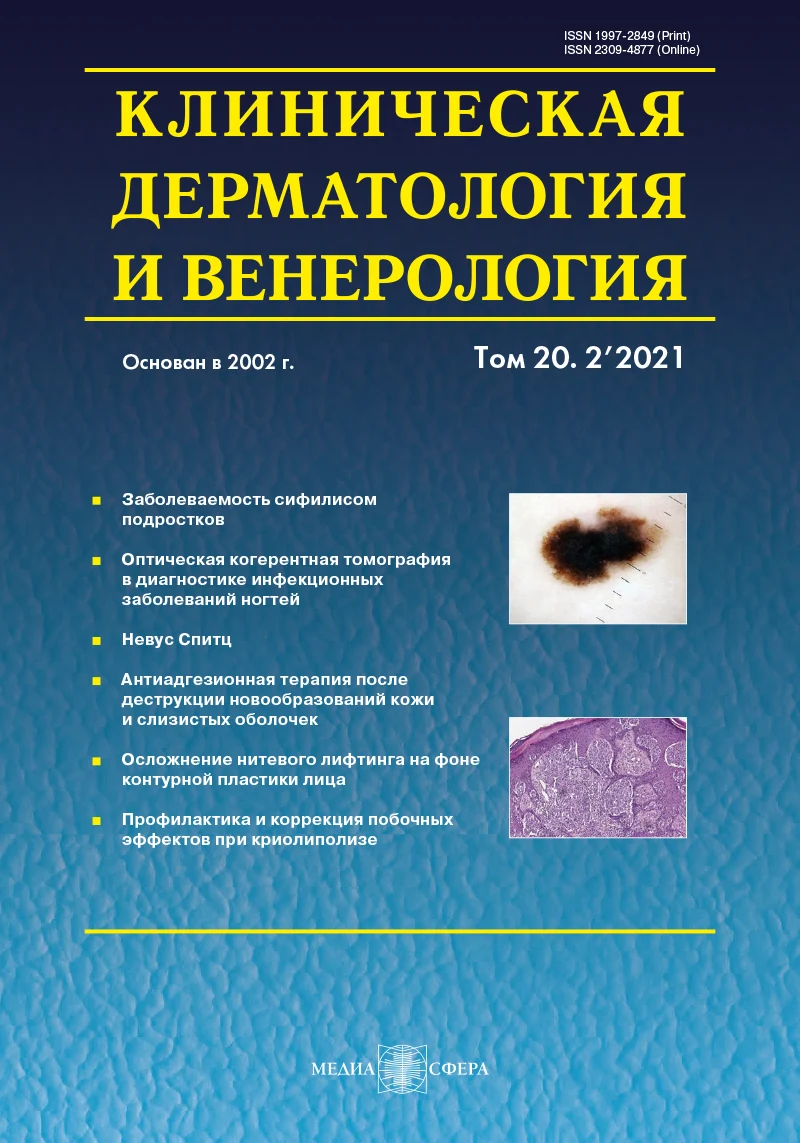
Профилактика и коррекция побочных эффектов и нежелательных явлений, развивающихся при проведении криолиполиза
Журнал: Клиническая дерматология и венерология. 2021;20(2):114-123.
DOI: 10.17116/klinderma202120021114
Прочитано: 31655 раз
Резюме
Криолиполиз является одной из самых распространенных процедур в аппаратной эстетической медицине. Особенности холодового воздействия обусловливают специфические побочные эффекты и противопоказания к использованию данной технологии. В научной литературе имеется большое количество публикаций, посвященных нежелательным явлениям, развивающимся при проведении криолиполиза, однако существует потребность в систематизации методов их диагностики и коррекции.
ЦЕЛЬ ИССЛЕДОВАНИЯ
Установить наиболее тяжелые побочные эффекты, развивающиеся при проведении криолиполиза, систематизировать методы их диагностики и коррекции, определить портрет пациента, у которого имеются факторы риска развития нежелательных явлений.
МАТЕРИАЛ И МЕТОДЫ
С целью оценки ранних и отдаленных нежелательных явлений при использовании криолиполиза, благоприятных и неблагоприятных профилей пациентов, а также эффективности основных методов профилактики и терапии побочных эффектов проведено второе заседание Совета экспертов по криолиполизу. На основе анализа данных литературы и личного опыта эксперты составили рекомендации, которые позволят специалистам повысить безопасность данной технологии и улучшить удовлетворенность пациентов.
РЕЗУЛЬТАТЫ
Эксперты отметили благоприятный профиль безопасности криолиполиза и низкий риск развития таких нежелательных явлений, как обморожение и гиперпигментация. В результате проведенного анализа составлены рекомендации по диагностике и лечению ряда побочных эффектов криолиполиза: парадоксальной жировой гиперплазии, отсроченной боли, холодового панникулита, а также предотвращению развития асимметрии тканей и чувства неудовлетворенности больного результатом процедуры. Пациенты с метаболическим синдромом, инсулинорезистентностью, гормональным дисбалансом и отягощенным личным или семейным анамнезом по аутоиммунной патологии должны быть более тщательно обследованы перед проведением процедуры.
ВЫВОДЫ
Криолиполиз является эффективной и безопасной технологией, применяющейся для коррекции избыточных жировых отложений.
Ключевые слова
- криолиполиз
- нежелательные явления
- парадоксальная жировая гиперплазия
- отсроченная боль
- холодовой панникулит
Дата поступления: 28.01.2021
Дата принятия в печать: 13.03.2021
Дата публикации: 15.04.2021
Криолиполиз — это процедура удаления жировых отложений при помощи холода, которая зарекомендовала себя как эффективный и безопасный метод [1–4]. Первым и наиболее изученным устройством для проведения криолиполиза, которое одобрено такими глобальными регуляторами, как Управление по надзору за качеством пищевых продуктов и медикаментов (Food and drug administration, FDA, США) и Европейское медицинское агентство (European medicines agency), был аппарат CoolSculpting [5, 6]. Данное оборудование производится компанией «Allergan an AbbVie Company», являющейся владельцем эксклюзивных прав на технологию криолиполиза [7–10]. С момента одобрения FDA в 2010 г. процедура CoolSculpting стала к настоящему времени одной из самых распространенных процедур, применяющихся в косметологии. В мировой практике ее проводят более 4 млн раз в год [11]. Известно, что воздействие низких температур более губительно для адипоцитов, богатых липидами, нежели для окружающих тканей, насыщенных водой. Под действием холода цитоплазматические липиды кристаллизуются, запуская программируемую гибель (апоптоз) клеток жировой ткани. Развивается воспалительный процесс, в результате которого адипоциты элиминируются из жировой ткани, что занимает около 3 мес [1, 2]. В ходе клинических исследований и многолетнего применения получены доказательства безопасности и эффективности криолиполиза CoolSculpting [1–4]. Использование технологии возможно на любых участках тела при условии, что толщина подкожной жировой клетчатки в зоне обработки составляет не менее 1 см [12].
В научной литературе имеется большое количество публикаций, посвященных нежелательным явлениям, развивающимся при проведении криолиполиза, однако существует потребность в систематизации методов их диагностики и коррекции.
Цель исследования — установить наиболее тяжелые побочные эффекты, развивающиеся при проведении криолиполиза, систематизировать методы их диагностики и коррекции, определить портрет пациента, у которого имеются факторы риска развития нежелательных явлений.
Материал и методы
12 октября 2020 г. в Москве состоялось второе заседание Российского совета экспертов по криолиполизу, посвященное обсуждению нежелательных явлений, ассоциированных с процедурой криолиполиза. Показания для применения процедуры CoolSculpting в режиме монотерапии и в комбинации с другими аппаратными методами коррекции, особенности портрета пациента, а также эффективность использования данной технологии рассмотрены экспертами ранее, на первом заседании Совета экспертов [13]. В рамках второго заседания на основе анализа международных публикаций и личного опыта экспертов организована дискуссия по вопросам безопасности применения криолиполиза и методам коррекции осложнений. В совещании приняли участие авторы настоящей статьи, имеющие многолетний опыт работы с методом CoolSculpting.
Оценка риска развития нежелательных явлений перед процедурой
Эксперты отметили важность объективизации анамнеза при отборе пациентов для процедуры криолиполиза. Врачу необходимо убедиться в отсутствии у пациента заболеваний, являющихся абсолютными противопоказаниями к холодовому воздействию: криоглобулинемии, пароксизмальной холодовой гемоглобинурии и холодовой агглютининовой болезни [12]. Все они относятся к достаточно редким заболеваниям, однако нельзя исключить вероятность обращения пациента с данной патологией к косметологу [14–16]. Кроме того, согласно инструкции по применению аппарата, рекомендуется очень осторожно подходить к проведению процедуры пациентам с чувствительностью к холоду, нарушениями периферического кровообращения (например, с болезнью Рейно), повышенной чувствительностью к компонентам, которые входят в изолирующие салфетки, невропатиями или нарушениями кожной чувствительности. Не следует проводить процедуру при наличии у больного любых воспалительных заболеваний кожи в зоне предполагаемого наложения аппликаторов [12].
Эксперты не рекомендуют проводить процедуру ранее, чем через 6 мес после оперативного вмешательства. Такой срок обусловлен воздействием вакуума при использовании аппарата с целью фиксации кожной складки в аппликаторе, которое теоретически может негативно сказаться на состоятельности рубца.
В ходе заседания выделены также состояния, к которым следует относиться с повышенной настороженностью. Эти состояния не описаны в инструкции, но могут встретиться в повседневной работе косметолога. Так, при наличии в анамнезе у пациента онкологических заболеваний процедуру криолиполиза необходимо проводить в периоде стойкой ремиссии, продолжающейся не менее 5 лет, и только после получения письменного согласия лечащего онколога. Липомы или атеромы, имеющиеся у больных в зоне предполагаемого наложения аппликаторов, следует предварительно удалить, а процедура может быть проведена пациенту через 6–12 мес после удаления новообразований. При наличии келоидных или гипертрофических рубцов необходимо добиться прекращения их прогрессирования или трансформации в нормотрофические рубцы. Если у больного имеется патология, которая может сопровождаться феноменом Кебнера (псориаз, склеродермия, витилиго, красный плоский лишай и др.), процедура может быть проведена в случае устойчивой ремиссии заболевания и при наличии информированного согласия пациента.
Кроме того, эксперты выделили несколько категорий пациентов, которым процедура криолиполиза может быть назначена, однако они должны более тщательно наблюдаться в период реабилитации, так как имеется повышенный риск развития нежелательных явлений:
— пациенты с метаболическим синдромом (индекс массы тела выше 30 кг/м2, окружность живота >80 см у женщин и 94 см у мужчин, дислипидемия) или инсулинорезистентностью;
— пациенты с особенностями пищевого поведения (нерегулярный прием пищи, прием пищи после 22:00, частое употребление алкоголя, превалирование в рационе рафинированных продуктов, недостаточное употребление в пищу клетчатки, нарушение питьевого режима с употреблением <0,5 л воды в день);
— пациенты с эндокринными нарушениями (нарушения функции щитовидной или поджелудочной железы, сопровождающиеся изменением уровня гормонов относительно физиологической нормы);
— беременные (процедура может быть проведена не ранее, чем через 3 мес после родов), кормящие матери;
— пациенты в период подготовки к процедуре экстракорпорального оплодотворения;
— пациентки в менопаузе;
— больные с наличием аутоиммунных заболеваний (в том числе по данным семейного анамнеза) и отягощенного аллергологического анамнеза;
— пациенты с признаками нарушения периферического кровообращения (ливедо и др.);
— пациенты с ранее установленными аутодермальными трансплантатами или нитями для коррекции грыж или диастаза;
— эмоционально лабильные пациенты, а также пациенты, имевшие негативный опыт эстетической коррекции.
Побочные эффекты, развивающиеся во время процедуры криолиполиза
Известен ряд эффектов, которые достаточно часто развиваются при проведении криолиполиза (табл. 1) [12]. Действие криолиполиза проявляется не сразу, поскольку связано с апоптозом адипоцитов, продолжающимся в течение 3 мес после процедуры. Местные реакции могут развиваться как во время процедуры и/или сразу после нее (рис. 1), так и спустя 10–14 дней после коррекции.
Таблица 1. Возможные локальные реакции, связанные с процедурой криолиполиза CoolSculpting [12]
Во время коррекции | Сразу после коррекции | Через 1–2 нед после коррекции |
Ощущение стянутости и натяжения кожи, а также легкого пощипывания в зоне коррекции; сильное ощущение холода, покалывания, жжения, ноющая или спазмирующая боль (интенсивность указанных ощущений может уменьшаться при онемении зоны коррекции) | Покраснение и уплотнение кожи и подлежащих тканей в зоне коррекции; временное побледнение и/или появление небольших очагов подкожного кровоизлияния вокруг зоны коррекции; покалывание и жжение | Покраснение кожи, подкожные кровоизлияния и отек; болезненность, спазмирующая боль; зуд, повышенная чувствительность кожи, покалывание и онемение (может сохраняться до нескольких недель после процедуры); ощущение отечности задней стенки глотки после коррекции субментальной зоны |

Рис. 1. Немедленные реакции в зоне криолиполиза (а—г — адаптировано из C. Dierickx и соавт. [9], д — из личного архива А.Н. Лихтиновой).
а — эритема и уплотнение кожи на боковых участках талии до процедуры; б — сразу после коррекции; в — кожа передней брюшной стенки сразу после процедуры, визуально напоминает «кусок застывшего масла»; г —через 6 мин — рельеф разглаживается, но эритема еще остается; д — подкожное кровоизлияние после процедуры криолиполиза.
Редкие нежелательные явления
Существует ряд редких нежелательных явлений (НЯ), о риске развития и методах терапии которых необходимо помнить специалисту, использующему криолиполиз.
Парадоксальная жировая гиперплазия
К одному из редких НЯ криолиполиза относят пароксизмальную жировую гиперплазию (paradoxical adipose hyperplasia, PAH). PAH может развиваться спустя 2–9 мес после коррекции и проявляется в виде увеличения объема жировой ткани в зоне воздействия по сравнению с исходным состоянием (рис. 2) [17–19]. Область PAH обычно безболезненна при пальпации, имеет более плотную структуру, чем окружающие участки тела [18]. Согласно данным производителя аппарата CoolSculpting, частота PAH составляет около 1 случая на 4000 процедур [19].

Рис. 2. Парадоксальная жировая гиперплазия (из личного архива А.Н. Лихтиновой и Ж.Ю. Юсовой).
В литературе описаны факторы, предрасполагающие к развитию РАН: мужской пол, испанское или латиноамериканское происхождение, большая мощность вакуумной насадки, применение аппликаторов больших размеров, плотная жировая ткань, наличие в зоне коррекции депо висцерального жира [18, 20–24]. По мнению экспертов, высокий риск развития РАН могут иметь пациенты с метаболическим синдромом или нарушением уровня половых гормонов. Повышенный уровень тестостерона [25] и инсулинорезистентность (сахарный диабет) [26] могут быть связаны с данным НЯ. У больных с нарушением содержания половых гормонов желательно контролировать уровень эстрогенов, андрогенов, прогестерона, фолликулостимулирующего гормона и дегидроэпиандростерона.
Диагноз РАН устанавливается по фотографиям пациента, выполненным на вдохе и выдохе до и после процедуры. При ультразвуковом исследовании можно выявить наличие фиброза в обработанной области, однако этот метод нельзя считать основным. При гистологическом исследовании биоптатов РАН может выглядеть по-разному: у некоторых пациентов фиксируется усиление васкуляризации и утолщение септальных перегородок [17, 20], в то время как у других — жировая ткань выглядит абсолютно нормальной [27]. При использовании калиперометрии можно зафиксировать утолщение жировой складки, но фотодокументирование остается основным методом подтверждения диагноза.
При развитии PAH единственным эффективным методом лечения является хирургическое вмешательство — липосакция [18]. По мнению экспертов, консервативное ведение пациентов с PAH — применение инъекционных липолитиков на основе дезоксихолевой кислоты [28], повторное проведение криолиполиза в зоне гиперплазии [25] — не может служить альтернативой хирургической коррекции.
Отсроченная боль
К числу редких НЯ криолиполиза относится отсроченная боль, которая может возникать у 1% больных. Этот вид боли имеет невропатическое происхождение, проявляется острыми, колющими, стреляющими ощущениями в зоне коррекции, усиливается по ночам и может нарушать сон. Отсроченная боль появляется через 3–4 дня после процедуры и может иметь очень высокую интенсивность (10 баллов из 10). Терапия отстроченной боли нестероидными противовоспалительными препаратами неэффективна. Несмотря на то что в течение 2 нед боль, как правило, разрешается самостоятельно [29], пациентам с невропатической болью необходимо назначение рациональной терапии, направленной на адекватную аналгезию.
Диагностировать отсроченную боль можно при наличии у пациента минимум двух из указанных симптомов:
— невропатические симптомы (колющая, жгучая, стреляющая боль в области проведения криолиполиза);
— нарастание боли в ночное время, что может мешать нормальному сну;
— отсутствие эффекта от применения анальгетиков [29].
Согласно рекомендациям Российского общества по изучению боли, к первой линии терапии невропатической боли относятся трициклические антидепрессанты, антиконвульсанты и опиоидные анальгетики (табл. 2) [30]. В зависимости от условий организации работы клиники возможно привлечение к принятию решений и назначению терапии невролога или специалиста по лечению боли. Однако большинство косметологических клиник, не оказывающих услуги пластической хирургии, не имеет такой возможности, а врачи-косметологи не могут назначать наркотические анальгетики и тем более антиконвульсанты. Эксперты рекомендуют таким пациентам ношение компрессионного белья, которое значительно снижает или полностью купирует болевой синдром. Эффективными являются топические средства на основе лидокаина и антигистаминные препараты, обладающие противоотечным действием. Для улучшения микроциркуляции в данной области целесообразно также проведение карбокситерапии [31].
Таблица 2. Терапия отсроченной невропатической боли (Методические рекомендации по диагностике и лечению невропатической боли Российского общества по изучению боли) [30]
Терапия 1-й линии | Терапия 2-й линии | Терапия 3-й линии |
Трициклические антидепрессанты: дулоксетин 60 мг/сут; габапентин 1200–3600 мг/сут; прегабалин 150–600 мг/сут | Опиоиды | Капсаицин |
Опиоидные анальгетики (морфин 15–300 мг/сут) | Ламотриджин | Мексилетин |
Трамадол 200–400 мг/сут | — | Мемантин |
— | — | Клонидин местно |
Эксперты отметили, что развитие невропатической боли не оказывает влияния на эффективность коррекции (рис. 3).

Рис. 3. Эффект криолиполиза у пациентов с отсроченной болью (из личного архива Е.В. Круглик).
а, в — вид анфас; б, г — вид 3/4; а, б — до коррекции; в, г — после коррекции.
Холодовой панникулит
У здоровых взрослых холодовой панникулит встречается редко (у молодых женщин риск его развития несколько выше) [32]. Возникновение холодового панникулита после криолиполиза описано лишь в одной работе [33]. При данном типе панникулита развивается асептическая воспалительная инфильтрация подкожной клетчатки, в меньшей степени кожи, которая сопровождается эритемой кожи и отеком, а также локальным болевым синдромом и гипертермией (рис. 4). Эксперты полагают, что в большинстве случаев холодовой панникулит развивается у пациентов с недиагностированными ранее аутоиммунными заболеваниями. Иногда он может быть ассоциирован с лимфаденитами и ангиитами.

Рис. 4. Холодовой панникулит после проведения криолиполиза (из личного архива Ю.Ю. Чеботаревой).
а — перед началом терапии панникулита (болезненный отек и покраснение в области наложения аппликаторов через 3 дня после процедуры криолиполиза); б — отсутствие эффекта при проведении терапии 1-й линии (нимесулид 5 г/сут, преднизолон 25—50 мг/сут, азитромицин 1000 мг/сут в течение 5 дней); в — регресс симптомов через 5 дней после курса терапии 2-й линии (амоксициллин/клавулановая кислота 2 г/сут, азитромицин 1000 мг/сут, метилпреднизолон в максимальной достигнутой дозе 20 мг/сут, местно — диметилсульфоксид и хлорамфеникол).
Лечение холодового панникулита в легких случаях заключается в применении преднизолона и левофлоксацина (до 500 мг/сут) [33]. В более сложных случаях (например, при наличии выпота в тканях) проводится двух- или трехкомпонентная антибиотикотерапия в сочетании с применением метилпреднизолона (до 20 мг/сут). Местно назначают компрессы с диметилсульфоксидом.
Остаточные явления панникулита могут сохраняться на протяжении нескольких недель.
Узловое уплотнение подкожно-жировой клетчатки
В 2,5% случаев описано развитие уплотнения подкожно-жировой клетчатки в области проведения криолиполиза. Данный вид НЯ может быть связан в том числе с некачественным выполнением массажа, который проводят после процедуры криолиполиза для улучшения результатов коррекции и профилактики развития побочных эффектов.
Уплотнение появляется в течение 1–2 нед после процедуры и проявляется локальным покраснением и болью, которые при лечении нестероидными противовоспалительными препаратами разрешаются в течение 1–3 нед [34]. Эксперты отметили, что для ускорения разрешения уплотнения можно применять магнитотерапию или ионофорез с гиалуронидазой (рис. 5).

Рис. 5. Уплотнение подкожно-жировой клетчатки после криолиполиза (из личного архива Е.Н. Глаголевой).
а — покраснение и болезненное уплотнение в месте наложения аппликатора после сеанса криолиполиза (до назначения магнитотерапии); б — разрешение уплотнения после 3 сеансов магнитотерапии (интервалы между сеансами 6—10 дней).
Асимметрия тканей
У некоторых пациентов после процедуры криолиполиза возможно появление асимметрии тканей (рис. 6). Для профилактики развития асимметрии тканей эксперты рекомендуют осуществлять тщательное картирование пациента, контролировать технику наложения аппликаторов и обязательно проводить после процедуры мануальный массаж.

Рис. 6. Асимметрия тканей после проведения криолиполиза (из личного архива А.Н. Саромыцкой).
В случае появления зон избыточного липолиза («минус-ткани») эксперты рекомендуют применять в качестве методов коррекции липофилинг, инъекции препаратов, стимулирующих синтез коллагена (например, препаратов L-полимолочной кислоты) или высококогезивные филлеры на основе гиалуроновой кислоты.
Неудовлетворяющий или недостаточный результат процедуры. Неудовлетворенный пациент
В некоторых случаях косметолог может столкнуться с результатом, который не соответствует ожиданиям врача или пациента. Данные ситуации не являются осложнениями, но косметолог должен быть готов к ним. Эксперты обсудили вероятность неудовлетворенности пациентов результатами криолиполиза. Чаще всего причинами неудовлетворенности пациента являются нереалистичные ожидания, некорректное выполнение криолиполиза (недостаточное количество наложений аппликаторов), а также феномен «потребительского терроризма», который, к сожалению, становится все более распространенным в косметологии. В качестве профилактики эксперты предлагают проводить фотографирование пациентов до и после коррекции на вдохе и выдохе (что позволит избежать «симулирования» недостаточности результата). Кроме того, важно формировать у пациента реалистичные ожидания (за один сеанс толщина жировой складки может сократиться в среднем на 27% [35]), составлять корректный план терапии (с достаточным количеством наложений аппликаторов) и при необходимости подключать комбинированные методы коррекции. Важны эмоциональная поддержка и контакт с пациентом (особенно эмоционально лабильным) в реабилитационном периоде.
Безопасность технологии CoolSculpting
Эксперты оценили CoolSculpting как один из наиболее безопасных аппаратов для проведения криолиполиза благодаря использованию технологий Freeze Detect и Cool Control [12]. Участники совещания отметили, что никогда не встречали в своей практике случаев развития гиперпигментации, обморожений и холодовых повреждений при использовании аппарата CoolSculpting, хотя и наблюдали такие явления при использовании аппаратов-аналогов. По мнению экспертов, техника коррекции гиперпигментации, возникающей после криолиполиза, не отличается от техники, применяющейся при коррекции посттравматической гиперпигментации. Наиболее распространенные побочные явления криолиполиза встречаются примерно у 0,82% пациентов [34] и имеют легкую и умеренную степень тяжести [36].
Выводы
CoolSculpting является безопасным и эффективным медицинским оборудованием для проведения криолиполиза. Широкий опыт применения данного аппарата и значительное количество проведенных клинических исследований позволили разработать рекомендации по подбору пациентов и профилактике нежелательных явлений. Клинический опыт показывает, что тяжелые нежелательные явления при использовании технологии CoolSculpting развиваются редко. Тем не менее для терапии и профилактики побочных эффектов разработаны эффективные подходы, при использовании которых врач и пациент смогут добиться хороших результатов коррекции с минимальным риском развития осложнений.
Авторы заявляют об отсутствии конфликта интересов.
- Manstein D, Laubach H, Watanabe K, Farinelli W, Zurakowski D, Anderson RR. Selective cryolysis: a novel method of non-invasive fat removal. Lasers in Surgery and Medicine. 2008;40(9):595-604. https://doi.org/10.1002/lsm.20719
- Zelickson B, Egbert BM, Preciado J, Allison J, Springer K, Rhoades RW, Manstein D. Cryolipolysis for noninvasive fat cell destruction: initial results from a pig model. Dermatologic Surgery. 2009;35(10):1462-1470. https://doi.org/10.1111/j.1524-4725.2009.01259.x
- Avram MM, Harry RS. Cryolipolysis for subcutaneous fat layer reduction. Lasers in Surgery and Medicine. 2009;41(10):703-708. https://doi.org/10.1002/lsm.20864
- Nelson AA, Wasserman D, Avram MM. Cryolipolysis for reduction of excess adipose tissue. Seminars in Cutaneous Medicine and Surgery. 2009; 28(4):244-249. https://doi.org/10.1016/j.sder.2009.11.004
- Krueger N, Mai SV, Luebberding S, Sadick NS. Cryolipolysis for noninvasive body contouring: clinical efficacy and patient satisfaction. Clinical, Cosmetic and Investigational Dermatology. 2014;7:201-205. https://doi.org/10.2147/CCID.S44371
- FDA. ZELTIQ CoolSculpting System 510(k). Public Health Service; 2015.
- Allergan Inc. Patent — Control unit. US D568,258 S. 2008.
- Allergan Inc. Patent — Monitoring the Cooling of Subcutaneous Lipid-Rich Cells, Such as the Cooling of Adipose Tissue. US 8,285,390 B2. 2012.
- Allergan Inc. Patent — System for Treating Lipid-Rich Regions. US 8,523,297 B2. 2013.
- Allergan Inc. Patent — Device, System and Method of Removing Heat from Subcutaneous Lipid-Rich Cells. US 8,702,774,B2. 2014.
- Klein KB, Bachelor EP, Becker EV, Bowes LE. Multiple same day cryolipolysis treatments for the reduction of subcutaneous fat are safe and do not affect serum lipid levels or liver function tests. Lasers in Surgery and Medicine. 2017;49(7):640-644. https://doi.org/10.1002/lsm.22674
- Регистрационное удостоверение ФСЗ 2011/09450. Руководство по эксплуатации. Система криотерапевтическая Coolsculpting с принадлежностями. Ссылка активна на 14.01.21. https://roszdravnadzor.gov.ru/services/misearch
- Круглик Е.В., Лихтинова А.Н., Саромыцкая А.Н., Чеботарева Ю.Ю., Юсова Ж.Ю. Применение криолиполиза для контурной пластики тела в виде монотерапии и в комбинации с другими методами эстетической коррекции. Клиническая дерматология и венерология. 2020;19(5): 771-780. https://doi.org/10.17116/klinderma202019051771
- Swiecicki PL, Hegerova LT, Gertz MA. Cold agglutinin disease. Blood. 2013;122(7):1114-1121. https://doi.org/10.1182/blood-2013-02-474437
- Takada S, Shimizu T, Hadano Y, Matsumoto K, Kataoka Y, Arima Y, Inoue T, Sorano S. Cryoglobulinemia (review). Molecular Medicine Reports. 2012;6(1):3-8. https://doi.org/10.3892/mmr.2012.861
- Shanbhag S, Spivak J. Paroxysmal cold hemoglobinuria. Hematology/Oncology Clinics of North America. 2015;29(3):473-478. https://doi.org/10.1016/j.hoc.2015.01.004
- Singh SM, Geddes ER, Boutrous SG, Galiano RD, Friedman PM. Paradoxical adipose hyperplasia secondary to cryolipolysis: An underreported entity? Lasers in Surgery and Medicine. 2015;47(6):476-478. https://doi.org/10.1002/lsm.22380
- Kelly ME, Rodríguez-Feliz J, Torres C, Kelly E. Treatment of Paradoxical Adipose Hyperplasia following Cryolipolysis: A Single-Center Experience. Plastic and Reconstructive Surgery. 2018;142(1):17-22. https://doi.org/10.1097/PRS.0000000000004523
- Sasaki GH. Reply: Cryolipolysis for Fat Reduction and Body Contouring: Safety and Efficacy of Current Treatment Paradigms. Plastic and Reconstructive Surgery. 2016;137(3):640-641. https://doi.org/10.1097/01.prs.0000479983.49996.c0
- Jalian HR, Avram MM, Garibyan L, Mihm MC, Anderson RR. Paradoxical adipose hyperplasia after cryolipolysis. JAMA Dermatology. 2014;150(3): 317-319. https://doi.org/10.1001/jamadermatol.2013.8071
- Keaney TC, Naga LI. Men at risk for paradoxical adipose hyperplasia after cryolipolysis. Journal of Cosmetic Dermatology. 2016;15(4):575-577. https://doi.org/10.1111/jocd.12256
- Ho D, Jagdeo J. Systematic Review of Paradoxical Adipose Hyperplasia (PAH) Post-Cryolipolysis. Journal of Drugs in Dermatology: JDD. 2017;16(1): 62-67.
- Stroumza N, Gauthier N, Senet P, Moguelet P, Nail Barthelemy R, Atlan M. Paradoxical Adipose Hypertrophy (PAH). Aesthetic Surgery Journal. 2018;38(4):411-417. https://doi.org/10.1093/asj/sjx159
- Karcher C, Katz B, Sadick N. Paradoxical Hyperplasia Post Cryolipolysis and Management. Dermatologic Surgery. 2017;43(3):467-470. https://doi.org/10.1097/DSS.0000000000000941
- Nikolis A, Enright KM. A Multicenter Evaluation of Paradoxical Adipose Hyperplasia Following Cryolipolysis for Fat Reduction and Body Contouring: A Review of 8,658 Cycles in 2,114 Patients. Aesthetic Surgery Journal. 2020;sjaa310. https://doi.org/10.1093/asj/sjaa310
- Moustafa F, Christman M, Zachary C, Kaminer MS. Paradoxical Hyperplasia after Cryolipolysis in 2 Patients with Diabetes on Insulin Pumps. Dermatologic Surgery. 2020;10.1097/DSS.0000000000002818. https://doi.org/10.1097/DSS.0000000000002818
- Stefani WA. Adipose Hypertrophy Following Cryolipolysis. Aesthetic Surgery Journal. 2015;35(7):218-220. https://doi.org/10.1093/asj/sjv069
- Ward CE, Li JY, Friedman PM. ATX-101 (Deoxycholic Acid Injection) for Paradoxical Adipose Hyperplasia Secondary to Cryolipolysis. Dermatologic Surgery. 2018;44(5):752-754. https://doi.org/10.1097/DSS.0000000000001317
- Keaney TC, Gudas AT, Alster TS. Delayed Onset Pain Associated with Cryolipolysis Treatment: A Retrospective Study with Treatment Recommendations. Dermatologic Surgery. 2015;41(11):1296-1299. https://doi.org/10.1097/DSS.0000000000000502
- Российское общество по изучению боли. Методические рекомендации по диагностике и лечению невропатической боли. Ссылка активна на 14.01.21. https://painrussia.ru/%D0%BC%D0%B5%D1%82%D0%BE%D0%B4%D0%B8%D1%87%D0%BA%D0%B0%20%D0%B1%D0%BE%D0%BB%D1%8C.pdf
- Герасименко М.Ю., Аксененко И.П. Инъекционная карбокситерапия как метод в коррекции локальных нежелательных явлений (отек, нейропатия) в косметологии. Физиотерапевт. 2019;4:38-44.
- Quesada-Cortés A, Campos-Muñoz L, Díaz-Díaz RM, Casado-Jiménez M. Cold panniculitis. Dermatologic Clinics. 2008;26(4):485-489. https://doi.org/10.1016/j.det.2008.05.015
- Juhász MLW, Marmur ES. Cold Panniculitis after Cryolipolysis Treatment of the Abdomen. Dermatologic Surgery. 2018;44(10):1357-1359. https://doi.org/10.1097/DSS.0000000000001436
- Derrick CD, Shridharani SM, Broyles JM. The Safety and Efficacy of Cryolipolysis: A Systematic Review of Available Literature. Aesthetic Surgery Journal. 2015;35(7):830-836. https://doi.org/10.1093/asj/sjv039
- Sasaki GH, Abelev N, Tevez-Ortiz A. Noninvasive selective cryolipolysis and reperfusion recovery for localized natural fat reduction and contouring. Aesthetic Surgery Journal. 2014;34(3):420-431. https://doi.org/10.1177/1090820X13520320
- Jain M, Savage NE, Spiteri K, Snell BJ. A 3-Dimensional Quantitative Analysis of Volume Loss Following Submental Cryolipolysis. Aesthetic Surgery Journal. 2020;40(2):123-132. https://doi.org/10.1093/asj/sjz145


Рекомендуем статьи по данной теме:
Влияние социально-психологических факторов, нежелательных явлений гормональной терапии на отказ пациенток от ее проведения или прерывание ими терапии после хирургического лечения эндометриоза яичников.Российский вестник акушера-гинеколога. 2026;26(4):55-61
Влияние ингаляций стабилизированного водорода на клинико-функциональные показатели пациентов с хронической обструктивной болезнью легких.Профилактическая медицина. 2026;29(6):58-67
Ультразвуковая и морфологическая характеристика изменений тканей нижней трети лица в подчелюстной и подподбородочной областях после применения криолиполиза и его комбинации с микросфокусированным ультразвуком.Клиническая дерматология и венерология. 2026;25(3):497-506
Нежелательные явления при проведении ботулинотерапии в области мышц лица и шеи по эстетическим и неврологическим показаниям и рекомендации по их профилактике. Возможности использования ультразвуковой навигации.Пластическая хирургия и эстетическая медицина. 2026;(1):132-143
Клей-индуцированная местная реакция гиперчувствительности замедленного типа: результаты 5-летнего опыта лечения.Флебология. 2026;20(1):42-49
Опыт эндоскопического лечения пациентов с аденомами большого сосочка двенадцатиперстной кишки при семейном аденоматозном полипозе.Хирургия. Журнал им. Н.И. Пирогова. 2025;(9):5-11
Осложнения при диагностических и лечебных эндоскопических вмешательствах на нижних отделах желудочно-кишечного тракта. Коллегиальное обсуждение информированного добровольного согласия Ассоциацией врачей-экспертов качества медицинской помощи.Доказательная гастроэнтерология. 2025;14(2):94-105
Осложнения периоперационного периода в хирургии краниосиностоза у детей: систематический обзор и метаанализ.Вопросы нейрохирургии имени Н.Н. Бурденко. 2025;89(3):114-121
Ингибиторы протонной помпы: положительные и отрицательные свойства. К 45-летию открытия.Профилактическая медицина. 2024;27(11):135-140
Профиль безопасности внутрибрюшной аэрозольной химиотерапии под давлением при лечении рака яичников.Онкология. Журнал им. П.А. Герцена. 2024;13(5):25-30