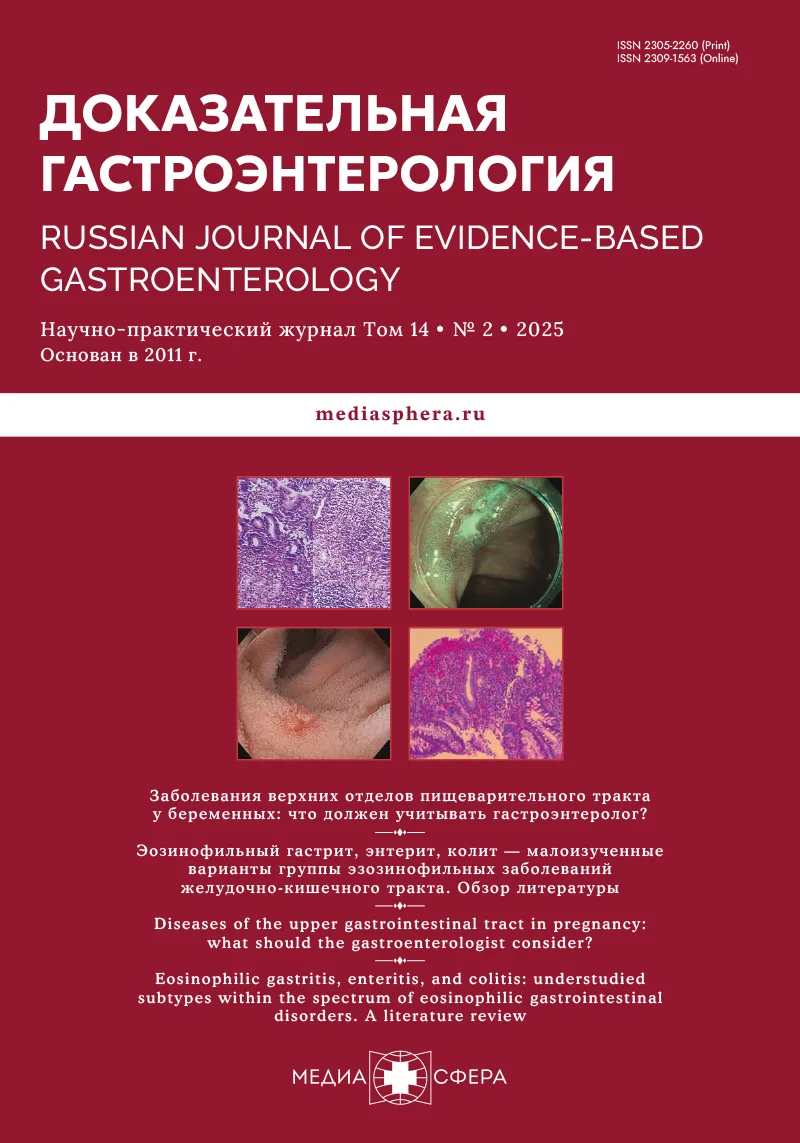
Эозинофильный гастрит, энтерит, колит — малоизученные варианты группы эзозинофильных заболеваний желудочно-кишечного тракта. Обзор литературы
Журнал: Доказательная гастроэнтерология. 2025;14(2):50-67.
DOI: 10.17116/dokgastro20251402150
Прочитано: 4995 раз
Резюме
За последние годы опубликовано несколько ключевых консенсусных документов, посвященных эозинофильным заболеваниям различных отделов желудочно-кишечного тракта.
ЦЕЛЬ ОБЗОРА
Выполнить анализ основных положений, касающихся эозинофильных заболеваний, включая номенклатуру и классификацию, этиологию, патогенез и лечение эозинофильного гастрита, энтерита и колита.
ОСНОВНЫЕ ПОЛОЖЕНИЯ
Эозинофильные заболевания желудочно-кишечного тракта — группа иммуноопосредованных заболеваний неизвестной этиологии, характеризующихся эозинофильной инфильтрацией стенки полых органов (возможно поражение от слизистой оболочки до серозного слоя) желудочно-кишечного тракта, что может приводить к развитию выраженных клинических симптомов, эндоскопических изменений, в некоторых случаях осложнений (перфорации, кровотечения, асцит, кишечная непроходимость). В первом консенсусном документе, посвященном эозинофильным поражениям желудочно-кишечного тракта (2022), предложено использовать следующую нозологическую терминологию в зависимости от пораженного отдела: эозинофильный эзофагит, эозинофильный гастрит, эозинофильный энтерит, эозинофильный колит. Клиническая картина заболеваний крайне вариабельна и неспецифична, определяется глубиной распространения воспалительного процесса в толщу органа: слизистая, мышечная или серозная оболочка. Валидизированные эндоскопические критерии эозинофильных поражений желудка и кишечника не разработаны. Диагноз эозинофильного гастрита, энтерита или колита устанавливается по совокупности клинической картины, данных эндоскопического исследования, мультифокальной биопсии слизистой оболочки с последующей гистологической оценкой. Общепринятые рекомендации по лечению эозинофильных поражений желудка и кишечника не разработаны, эмпирически применяются системные и топические глюкокортикостероиды, биологические препараты и элиминационные диеты.
ЗАКЛЮЧЕНИЕ
Диагностика эозинофильных заболеваний желудка и кишечника сложна вследствие неспецифической клинической и эндоскопической картины, отсутствия четких критериев патоморфологической диагностики. Данная группа заболеваний встречается нечасто и малознакома практикующим врачам. Стратегии лечения включают назначение диеты, топических или системных кортикостероидов, таргетной терапии.
Ключевые слова
- эозинофильный гастрит
- эозинофильный дуоденит
- эозинофильный еюнит
- эозинофильный илеит
- эозинофильный колит
Дата поступления: 11.03.2025
Дата принятия в печать: 11.04.2025
Дата публикации: 16.06.2025
Введение
Эозинофильные заболевания желудочно-кишечного тракта (ЖКТ) — это группа хронических иммуноопосредованных заболеваний, которые характеризуются патологической эозинофильной инфильтрацией стенки соответствующего отдела ЖКТ при отсутствии вторичных причин эозинофилии [1]. Клинические проявления эозинофильных заболеваний ЖКТ зависят от локализации и глубины проникновения воспалительного процесса в толщу стенки органа (слизистая оболочка, мышечный слой, серозная оболочка). Достаточно хорошо изученным вариантом эозинофильных заболеваний является эозинофильный эзофагит (ЭоЭ), который встречается наиболее часто. Для ЭоЭ разработаны диагностические критерии, включающие клинико-анамнестические данные, эндоскопические и патоморфологические признаки с высоким уровнем согласованности между специалистами. При этом представления об эозинофильном гастрите, энтерите и колите остаются крайне скудными, а выявляемость вне специализированных центров — низкой.
Одним из ключевых препятствий в изучении и диагностике эозинофильных заболеваний ЖКТ является отсутствие общепризнанных норм количества и распределения эозинофилов в зависимости от отдела ЖКТ. В пищеводе наличие 15 и более эозинофилов в поле зрения при гистологическом исследовании считается диагностическим критерием воспалительного процесса, так как в норме этот отдел ЖКТ практически лишен эозинофилов. В нижележащих отделах ЖКТ эозинофилы, напротив, являются естественным компонентом клеточной архитектоники слизистой оболочки. Поэтому важно не только обнаружить эозинофилы в тканях желудка или кишечника, но и провести детальный количественный анализ, чтобы убедиться, что их количество достигает порогового уровня, необходимого для установления диагноза.
В 2024 г. опубликован консенсус, в котором впервые систематизированы рекомендуемые пороговые значения эозинофилов для каждого из отделов ЖКТ у детей, позволяющие устанавливать диагноз эозинофильных заболеваний ЖКТ (табл. 1) [1]. В отношении информации о взрослых пациентах доступны единичные исследования, в которых описаны пороговые значения количества эозинофилов в различных отделах ЖКТ (табл. 2) [2—4].
Таблица 1. Пиковые пороговые значения эозинофилов для диагностики эозинофильных заболеваний желудочно-кишечного тракта у детей [1]
Отдел ЖКТ | Пиковые значения (эозинофилы/0,27 мм2 в поле зрения при большом увеличении) | Пиковые значения (эозинофилы/мм2) |
Желудок | ≥30 | ≥110 |
Двенадцатиперстная кишка | ≥50 | ≥185 |
Терминальный отдел подвздошной кишки | ≥60 | ≥220 |
Слепая и восходящая ободочная кишка | ≥110 | ≥370 |
Поперечная и нисходящая ободочная кишка | ≥80 | ≥300 |
Прямая и сигмовидная кишка | ≥60 | ≥220 |
Примечание. ЖКТ — желудочно-кишечный тракт.
Таблица 2. Пиковые пороговые значения эозинофилов для диагностики эозинофильных заболеваний желудочно-кишечного тракта у взрослых [2—4]
Отдел ЖКТ | Минимальное количество эозинофилов для установления диагноза (эозинофилы/0,237 мм2 в поле зрения при большом увеличении) | Автор, год | Среднее количество эозинофилов в норме |
Желудок | ≥20 в 5 полях зрения или ≥33 в 1 поле зрения | Dellon и соавт., 2024 [3] | 1—2 эозинофила в собственной пластинке слизистой оболочки, отсутствие межэпителиальных эозинофилов |
Двенадцатиперстная кишка | ≥33 в 3 полях зрения или ≥37 в 1 поле зрения | Dellon и соавт., 2024 [3] | До 10 эозинофилов в собственной пластинке слизистой оболочки, единичные межэпителиальные эозинофилы |
Слепая и восходящая ободочная кишка | ≥50 | Turner и соавт., 2017 [4] | 10—30 эозинофилов |
Поперечная ободочная кишка | ≥35 | Turner и соавт., 2017 [4] | |
Нисходящая ободочная кишка | 25 | ||
Прямая и сигмовидная кишка, ободочная кишка | ≥25 | Turner и соавт., 2017 [4] |
Примечание. ЖКТ — желудочно-кишечный тракт.
Важным событием в изучении эозинофильных заболеваний ЖКТ стала разработка номенклатуры. Предложенная номенклатура имеет иерархический тип строения. На первом уровне эозинофильные заболевания подразделяются на ЭоЭ и «не-ЭоЭ эозинофильные заболевания ЖКТ», включающие другие локализации эозинофильного поражения (рис. 1). Дальнейшее деление происходит в зависимости от отдела ЖКТ: эозинофильный гастрит (ЭоГ, EoG), эозинофильный энтерит (ЭоЭнт, EoN), эозинофильный колит (ЭоК, EoC). На втором уровне номенклатуры приводится дальнейшая детализация одного или нескольких пораженных сегментов ЖКТ (эозинофильный дуоденит (ЭоД), эозинофильный еюнит (ЭоЕн), эозинофильный илеит — ЭоИ). При поражении желудка и тонкой кишки следует использовать термин «эозинофильный гастрит и энтерит», а при вовлечении желудка и двенадцатиперстной кишки — «эозинофильный гастрит и дуоденит». Термин «эозинофильный гастроэнтерит» (ЭоГЭ) применятся для описания случаев с вовлечением желудка и тонкой кишки [1, 5].

Рис. 1. Номенклатура эозинофильных заболеваний желудочно-кишечного тракта [5].
Кроме того, следует указать глубину поражения стенки ЖКТ, если она известна (слизистая, мышечная, серозная оболочки), а также осложнения, в том числе энтеропатию с потерей белка, асцит, анемию, стриктуры, язвы, перфорации и др. [1, 5—7].
Патофизиология эозинофильных заболеваний желудочно-кишечного тракта
В ЖКТ эозинофилы в норме находятся преимущественно в собственной пластинке слизистой оболочки в отделах, покрытых цилиндрическим эпителием, где их основная функция заключается в защите от крупных многоклеточных паразитов (гельминтов). Кроме того, они играют ключевую роль в модуляции гуморального иммунного ответа IgA и T-клеточных реакций, а также в поддержании гомеостаза тканей. Привлечение эозинофилов к месту инвазии инфекта происходит за счет высвобождения T-лимфоцитами цитокинов (ИЛ-4, ИЛ-5, ИЛ-13). Как и другие типы цитотоксических клеток, эозинофилы поражают свои мишени, выделяя вблизи них содержимое внутриклеточных гранул (эозинофильный катионный белок, эозинофильный нейротоксин, главный основной белок), способны к образованию активных форм кислорода, реагируют на специфический хемокин — эотаксин-3.
При эозинофильных поражениях ЖКТ в роли триггера воспалительного процесса выступают, как правило, пищевые аллергены, которые распознаются антигенпрезентирующими клетками с последующим представлением антигенов T-лимфоцитам. В условиях гиперэкспрессии тимического стромального лимфопоэтина T-лимфоциты дифференцируются по пути образования T-хелперов 2-го типа (Th2), высвобождающих крайне активную группу цитокинов ИЛ-4, ИЛ-5, ИЛ-13.
Данные цитокины обладают огромным разнообразием эффектов, приводя к гиперэкспрессии эотаксина-3 клетками эпителия слизистой оболочки, стимулируют пролиферацию эозинофилов в костном мозге, выход их в периферическое кровеносное русло, увеличивают продолжительность жизни эозинофилов. Гиперпродукция эотаксина-3 эпителиоцитами вызывает хемоаттракцию эозинофилов в слизистую оболочку определенного отдела ЖКТ, где они дегранулируют, высвобождая главный основной белок, обладающий свойствами гистаминазы, катионный белок эозинофилов, эозинофильную пероксидазу, эозинофильный нейротоксин. Высвобождение цитотоксичных веществ из эозинофильных гранул приводит к острому повреждению ткани, нарушению барьерной функции эпителия.
Массивное повреждение слизистой оболочки иммунокомпетентными клетками быстро приводит к вовлечению в процесс фибробластов и эндотелиоцитов, происходит гиперплазия базального слоя эпителия и гладкомышечных клеток, активация фиброзогенеза и ангионеогенеза в подслизистом слое, что в итоге реализуется потерей эластичности мышечной ткани и образованием стриктур стенки органа.
По-видимому, аллергические реакции немедленного типа с участием иммуноглобулина E не имеют значимой роли в патогенезе эозинофильных заболеваний ЖКТ, однако данные заболевания часто могут сочетаться с пищевой аллергией. Эозинофильные заболевания ЖКТ иногда относят к группе так называемой не-IgE-опосредованной пищевой аллергии, подчеркивая, что идентификация конкретного белкового аллергена, скорее всего, не имеет значения в терапии заболеваний [8—13].
Описанные механизмы патогенеза играют ключевую роль в развитии ЭоЭ и ЭоГ. В то же время патогенез ЭоК демонстрирует лишь слабую связь с реакциями гиперчувствительности замедленного типа, опосредованными Th2-лимфоцитами. Это может указывать на то, что ЭоК представляет собой отдельную нозологическую единицу, что означает необходимость дальнейших исследований для уточнения ее патогенетических аспектов [1].
Эпидемиология
Истинную распространенность эозинофильных заболеваний ЖКТ еще предстоит выяснить, но, по-видимому, она имеет тенденцию к увеличению. Отсутствие общепринятых диагностических критериев и, как следствие, низкая выявляемость являются основными причинами того, что заболеваемость и распространенность эозинофильных заболеваний остаются неопределенными. По данным крупного популяционного исследования, распространенность ЭоГ/ЭоЭнт составляет около 5,1 на 100 000 человек с преобладанием женщин (женщины — 5,3 и мужчины — 4,8 на 100 000 человек) (ОР 1,11; 95% ДИ 1,01—1,21, p=0,0338) европеоидной расы (распространенность 6,3 на 100 000 человек) по сравнению с азиатской расой (распространенность 4,3 на 100 000 человек) и афроамериканцами (распространенность 5,5 на 100 000 человек) [6]. В исследовании, основанном на анализе информации из баз данных Северной Америки за 2009—2011 гг. (более 75 млн человек в возрасте 0—64 года), распространенность ЭоГ и ЭоК составила 6,3 на 100 000 и 3,3 на 100 000 человек соответственно [7].
В этом же исследовании показано, что женщины чаще болеют ЭоГ (7,9 на 100 000) по сравнению с мужчинами (5,4 на 100 000), средний возраст пациентов с ЭоГ 39,8±17,4 года. Интересно, что у женщин распространенность увеличивалась с возрастом, будучи самой высокой в возрасте 60—64 лет.
Эозинофильный гастроэнтерит чаще диагностируется у детей, чем у взрослых, с распространенностью 10,7 на 100 000 среди лиц моложе 20 лет и 7,1 на 100 000 среди лиц в возрасте от 20 до 64 лет. Самая высокая распространенность отмечена среди детей младше 5 лет (17,6 на 100 000 среди мальчиков и 16,7 на 100 000 среди девочек) [7].
Важно, что пациенты с эозинофильными заболеваниями ЖКТ значительно чаще, чем лица в общей популяции, болеют сопутствующими аллергическими и атопическими заболеваниями [7], такими как бронхиальная астма, атопический дерматит, сезонная и пищевая аллергия, экзема, крапивница, ринит, синусит. Около 50% взрослых и детей с эозинофильными заболеваниями ЖКТ имеют в анамнезе, по крайней мере, 1 атопическое заболевание [1].
Клиническая картина
Клинические проявления эозинофильных заболеваний ЖКТ неспецифичны, зависят от пораженного сегмента, степени эозинофильного воспаления и глубины воспалительной инфильтрации стенки желудка и кишечника. Основываясь на этих различиях, N. Klein и соавт. впервые разделили эозинофильные заболевания ЖКТ на слизистый, мышечный и серозный подтипы [13]. Клинические и инструментальные данные ЭоГ, ЭоЭнт и ЭоК в зависимости от глубины поражения стенки желудка и кишечника представлены в табл. 3.
Таблица 3. Типы эозинофильных заболеваний желудочно-кишечного тракта в зависимости от глубины поражения [1]
Тип | Глубина поражения | Клинические проявления | ЭГДС/КТ/МРТ/УЗИ органов брюшной полости |
Тип 1 Слизистый | Слизистая оболочка и подслизистый слой | ЭоГ: боль/спазмы в животе, вздутие живота, рвота (в том числе с кровью), снижение аппетита, чувство быстрого насыщения, изжога, мелена, похудание, железодефицитная анемия | Гиперемия, отек, утолщение складок, эрозии, язвы |
ЭоЭнт: диарея, боли в животе, тошнота, рвота, железодефицитная анемия, гипоальбуминемия | |||
ЭоК: боль в животе, тошнота, рвота, тенезмы, диарея, гематохезия, запор | |||
Тип 2 Мышечный | Мышечный слой | ЭоГ: боль в животе, персистирующая рвота, пилоростеноз | Стриктуры, сужение просвета органа Нарушения моторики |
ЭоЭнт и ЭоК: боль в животе, персистирующая рвота, тяжелые запоры, инвагинация и перфорация кишечника | |||
Тип 3 Серозный | Серозная и субсерозная оболочка (только для кишечника) | ЭоЭнт и ЭоК: асцит, перитонит | Признаки перфорации кишечника |
Примечание. КТ — компьютерная томография; МРТ — магнитно-резонансная томография; УЗИ — ультразвуковое исследование; ЭоГ — эозинофильный гастроэнтерит; ЭоЭнт — эозинофильный энтерит; ЭоК — эозинофильный колит.
Отмечено, что ЭоГ и ЭоЭнт чаще протекают с поражением в пределах слизистой оболочки (тип 1) и не имеют патогномоничных симптомов. Чаще всего пациентов беспокоят эпигастральная боль, тяжесть и быстрое насыщение, тошнота, снижение аппетита; наблюдаемые симптомы могут быть ошибочно интерпретированы как проявления функциональных расстройств. При этом ЭоГ может протекать в более тяжелых формах, включая интенсивную боль по типу «острого живота» и/или желудочное кровотечение, манифестирующее рвотой «кофейной гущей».
При ЭоК симптомы могут включать боль в животе, тенезмы, запор и/или диарею, а также слизь или кровь в стуле. В редких случаях рвота, задержка стула, боль в животе могут возникать из-за инвагинации или перфорации кишечника. Если воспалительный процесс проникает глубоко в стенку толстой кишки и затрагивает субсерозный уровень, возможно возникновение асцита и перитонита [1]. Важно, что тяжесть и выраженность симптомов не всегда коррелируют со степенью воспаления и глубиной поражения стенки органа.
Диагностика эозинофильных заболеваний желудочно-кишечного тракта
Для установления диагноза эозинофильных заболеваний ЖКТ необходимо соблюдение трех условий, которые предложены и описаны еще в 1990 г. N. Talley и соавт. [1, 14]:
1. Обязательное наличие клинической симптоматики (боль в животе, тошнота, рвота, диарея и др.);
2. Патологическая эозинофильная инфильтрация стенки органа, подтвержденная при патоморфологическом исследовании биоптатов, или наличие большого количества эозинофилов в асцитической жидкости при типе 3;
3. Исключение вторичных причин тканевой эозинофилии.
При анализе причин вторичной эозинофилии необходимо исключать воспалительные заболевания кишечника (ВЗК), инфекции, паразитарные инвазии, первичные иммунодефициты. В круг дифференциальной диагностики включают также васкулит (синдром Черджа—Стросса, узелковый периартериит), заболевания соединительной ткани (склеродермия, дерматомиозит, полимиозит), целиакию, злокачественные новообразования (хронический эозинофильный лейкоз, системный мастоцитоз, злокачественная лимфома) и др. (табл. 4) [1, 15—17].
Таблица 4. Заболевания, которые могут быть причиной развития вторичной эозинофилии [1]
Локализация | Заболевания, которые необходимо исключить |
Эозинофильный гастрит | Инфекции (паразиты/гельминты, вирусные, Helicobacter pylori) Воспалительные заболевания кишечника Заболевания соединительной ткани Гиперэозинофильный синдром Надпочечниковая недостаточность |
Эозинофильный энтерит | Воспалительные заболевания кишечника Гиперэозинофильный синдром Лейкемия и другие злокачественные новообразования Инфекции (паразиты/гельминты, вирусные) Надпочечниковая недостаточность Заболевания соединительной ткани Аутоиммунные заболевания и васкулиты (гранулематоз Черджа—Стросса/эозинофильный с полиангиитом) Реакции гиперчувствительности к лекарственным препаратам Токсические или пищевые воздействия Болезнь «трансплантат против хозяина» |
Эозинофильный колит | Пищевая и лекарственная аллергия Инфекции (паразиты/гельминты, вирусные) Гиперэозинофильный синдром Воспалительные заболевания кишечника Аутоиммунные заболевания Злокачественные новообразования Реакция «трансплантат против хозяина» |
Вторичная эозинофильная инфильтрация, ассоциированная с паразитарной инвазией, может быть выявлена при аскаридозе, токсокарозе, трихинеллезе, шистосомозе, тениозе, анкилостомозе, трихоцефалезе, ангиостронгилезе и энтеробиозе.
Вместе с тем выраженная эозинофильная инфильтрация в дебюте ВЗК может ошибочно указывать на ЭоК. Так, по данным S. Zammit и соавт., у 25% пациентов с первоначальным диагнозом ЭоК позднее установлен диагноз ВЗК: болезнь Крона — в 28% случаев, язвенный колит — в 47%, неопределенный колит — в 5% [18].
Потенциально любые лекарственные средства могут провоцировать аллергические реакции с гиперэозинофилией в периферической крови и инфильтрацией слизистой оболочки пищеварительного тракта эозинофилами, которая преимущественно носит непостоянный и непродолжительный характер. Наиболее частой причиной лекарственно-индуцированной эозинофилии является прием нестероидных противовоспалительных препаратов (в частности, ибупрофена), карбамазепина, рифампицина, габапентина, прегабалина, такролимуса и сульфасалазина. При этом макроскопические и микроскопические изменения обычно локализуются в левой половине ободочной кишки, что служит дифференциально-диагностическим признаком, отличающим это состояние от ЭоК [19]. Эозинофильные инфильтраты толстой кишки также наблюдаются в биоптатах пациентов с микроскопическим колитом.
Наконец, важно исключить гиперэозинофильный синдром, который характеризуется эозинофилией в периферической крови >1500/мм3 в течение более 6 мес и поражением одного или нескольких внутренних органов. Гиперэозинофильный синдром встречается в 4 раза чаще у мужчин, чем у женщин. Нет гистологических критериев, позволяющих дифференцировать ЭоК от гиперэозинофильного синдрома с поражением толстой кишки. Стойкая и часто значительная эозинофилия периферической крови, полиорганное поражение, которое может протекать с клинической манифестацией, реже — бессимптомно, являются двумя критериями, которые могут помочь различить эти два патологических состояния [1, 19].
Лабораторная диагностика
Эозинофилия в клиническом анализе крови (возможно повышение уровня эозинофилов до 50%) наблюдается, по разным данным, у 15—92% пациентов с эозинофильными заболеваниями ЖКТ, повышение уровня IgE в сыворотке крови ≥100 МЕ/мл — у 62% [1, 14—16]. В то же время даже у пациентов с очень тяжелым течением заболевания может быть нормальное количество эозинофилов в периферической крови [1]. Необходимо помнить, что уровни эозинофилов и иммуноглобулина E могут повышаться у пациентов в связи с сопутствующими аллергическими и атопическими заболеваниями. Данные лабораторные показатели не являются высокоспецифичными, не отражают тяжесть заболевания, что не позволяет использовать их как необходимый или достаточный критерий в установлении диагноза эозинофильных заболеваний ЖКТ и оценке эффективности терапии [1, 14, 15].
Несмотря на то что лабораторные маркеры имеют невысокую диагностическую ценность на этапе установления диагноза, пациентам с эозинофильными заболеваниями рекомендуются мониторирование показателей клинического анализа крови с оценкой уровня гемоглобина, исследование уровня сывороточного альбумина, иммуноглобулина G и ферритина. Это обоснованно, поскольку у пациентов с эозинофильными заболеваниями ЖКТ с преимущественным поражением слизистой оболочки (тип 1) желудка и тонкой кишки часто обнаруживаются признаки железодефицитной анемии (у 15—54%) и гипоальбуминемии (у 62%) [1, 16]. Железодефицитная анемия развивается у таких пациентов вследствие нарушения всасывания железа и/или скрытого желудочно-кишечного кровотечения. Гипоальбуминемия и низкие уровни иммуноглобулинов могут быть следствием энтеропатии и мальабсорбции [1].
У пациентов с асцитом и подозрением на серозную форму эозинофильного колита или энтерита рекомендуется проведение анализа асцитической жидкости. В отличие от низкой чувствительности и специфичности периферической эозинофилии обнаружение лейкоцитоза с преобладанием эозинофильных гранулоцитов (обычно >50%, но до 100%) в асцитической жидкости является маркером серозного поражения [1].
Определение уровня фекального кальпротектина при эозинофильных заболеваниях ЖКТ не используется в качестве диагностического теста, поскольку он является маркером нейтрофильного воспаления и не содержится в эозинофилах [1]. Однако в случае необходимости дифференциальной диагностики ЭоК и ВЗК содержание фекального кальпротектина может быть использовано в качестве дополнительного критерия.
Эндоскопическая диагностика с патоморфологическим исследованием биоптатов
Эндоскопическая картина при эозинофильных заболеваниях ЖКТ может варьировать от отсутствия/минимальных изменений слизистой оболочки до обнаружения эрозий, язв, кровотечений, перфораций и стриктур (табл. 5) [20, 21]. Интересно, что публикации, посвященные изучению эндоскопических признаков эозинофильных заболеваний ЖКТ, практически единогласно свидетельствуют об отсутствии изменений у большинства пациентов. Многоцентровое ретроспективное исследование с включением 317 детей и 56 взрослых пациентов с эозинофильными заболеваниями ЖКТ показало нормальную эндоскопическую картину в желудке у 66% пациентов, в двенадцатиперстной кишке у 83%, в тощей кишке у 67% и в подвздошной кишке у 81% [20].
Таблица 5. Эндоскопическая семиотика эозинофильных заболеваний желудочно-кишечного тракта
Локализация | Эндоскопические изменения |
Эозинофильный гастрит, дуоденит, энтерит с поражением слизистой оболочки | — нормальная слизистая оболочка — отек, эритема, контактная кровоточивость — утолщение складок желудка и тонкой кишки — нодулярность, зернистость, рыхлость слизистой оболочки — эрозии и язвы (в том числе осложненные кровотечением или перфорацией) |
Эозинофильный гастрит, дуоденит, энтерит с поражением мышечного слоя | — сужение просвета — стеноз пилорического канала |
Эозинофильный колит | — нормальная слизистая оболочка — гиперемия, отек — эрозии, язвы — нодулярность слизистой оболочки — контактная кровоточивость слизистой оболочки — псевдополипы |
В работе R. Pesek и соавт. неизмененная слизистая оболочка желудка наблюдалась у 62% пациентов с эозинофильным гастроэнтеритом [22]. В другом исследовании у 60% детей и 22% взрослых с верифицированным морфологически эозинофильным гастритом также не наблюдалось никаких эндоскопических изменений [23].
В целом, по данным ретроспективных исследований, эндоскопические признаки ЭоГ включают эритему (24—72%), эрозии/изъязвления (28—39%) и нодулярность (0—28%) [20, 21]. В исследовании, проведенном T. Lwin и соавт., эритема и эрозии описаны как наиболее частые эндоскопические проявления ЭоГ [23].
С целью стандартизации эндоскопической оценки ЭоГ I. Hirano и соавт. [24] разработали референтную систему EG-REFS, смоделированную на основе эндоскопической шкалы ЭоЭ (EREFS). Система EG-REFS включает такие признаки, как: эрозии/язвы, зернистость, приподнятые поражения, эритема, рыхлость, утолщение складок и пилоростеноз. Согласно системе, признаки EG-REFS оцениваются отдельно в дне, теле и антральном отделе желудка. Общее количество баллов EG-REFS рассчитывается как сумма баллов EG-REFS для каждого признака из трех локализаций (за исключением стеноза привратника) с максимальным общим количеством баллов 46 (табл. 6).
Таблица 6. Система оценки эозинофильного гастрита (EG-REFS) [24]
Признак | Градация признака |
Эрозия/язва «EG-REFS» erosion/ulceration | 0 — Нет эрозий/язв 1 — <5 эрозий 2 — 5 эрозий или более 3 — Неглубокие/поверхностные язвы 4 — Глубокие язвы <25% площади поверхности указанной локализации 5 — Глубокие язвы 25—50% площади поверхности указанной локализации 6 — Глубокие язвы >50% площади поверхности указанной локализации |
Зернистость «EG-REFS» granularity | 0 — Нет 1 — Мелкозернистый вид слизистой оболочки 2 — Крупнозернистый вид слизистой оболочки |
Приподнятые участки (нодулярность) «EG-REFS» raised lesions | 0 — Нет 1 — Легкая (приподнятые участки, ширина которых больше высоты) 2 — Тяжелая (приподнятые участки, высота которых больше ширины) |
Эритема «EG-REFS» erythema | 0 — Нет 1 — Легкая (розовая) 2 — Тяжелая (красная/геморрагическая) |
Рыхлость слизистой оболочки/Кровоточивость «EG-REFS» friability | 0 — Нет 1 — Легкая (контактная кровоточивость) 2 — Тяжелая (спонтанная кровоточивость) |
Утолщение складок «EG-REFS» folds | 0 — Нет 1 — Утолщенные складки |
Стеноз привратника «EG-REFS» pyloric stenosis | 0 — Нет 1 — Есть (невозможность проведения диагностического гастроскопа 8—10 мм) |
В исследовании оценены и другие признаки ЭоГ, которые не вошли в окончательную систему EG-REFS: трещины слизистой оболочки, кольца и белесый экссудат.
По данным авторов исследования, изменения слизистой оболочки желудка значительно чаще встречались в антральном отделе по сравнению с телом или дном желудка. Выраженность эндоскопических признаков не зависела от возраста, пола или атопического статуса, но коррелировала с продолжительностью заболевания. Из ограничений и недостатков представленной системы авторы отметили, что EG-REFS основана на мнении экспертов и обзоре литературы и не может являться проверенным инструментом [24].
По данным многоцентрового рандомизированного двойного слепого плацебо-контролируемого исследования препарата лирентелимаб (антитело против Siglec-8), в котором эндоскопические изменения у пациентов с ЭоГ оценивали по шкале EG-REFS, оказалось, что у 91% пациентов оценка по EG-REFS была ≤15 и не отличалась от таковой у лиц группы контроля (пациенты без ЭоГ). Не обнаружена корреляция между оценкой по EG-REFS и выраженностью клинической симптоматики или гистологической активностью заболевания [25].
Таким образом, имеющиеся на сегодняшний день данные свидетельствуют о том, что установление диагноза ЭоГ на основании оценки эндоскопической картины без данных патоморфологического исследования биоптатов невозможно. Однако и тут есть большие сложности: учитывая сегментарность эозинофильного поражения и разную глубину проникновения воспалительного процесса, необходимо получить достаточное количество правильно ориентированного биопсийного материала.
Согласно последним рекомендациям, при подозрении на эозинофильный гастрит или дуоденит даже в случае нормальной эндоскопической картины следует проводить множественные биопсии, включая антральный отдел желудка, тело желудка и двенадцатиперстную кишку (минимум по 4 биоптата из антрального отдела и из тела желудка, 4—6 биоптатов из двенадцатиперстной кишки). Биоптаты из разных отделов должны быть помещены в различные контейнеры [1].
При ЭоЭнт наиболее часто в патологический процесс вовлекается подвздошная кишка, при этом примерно в 30% случаев отмечается ее изолированное поражение. Как и другие эозинофильные поражения ЖКТ, ЭоЭнт может протекать без каких-либо эндоскопических признаков заболевания. Если изменения выявляются, то, как правило, носят неспецифический характер и минимальную степень выраженности. По данным Y. Sasaki и соавт., очаговая гиперемия слизистой оболочки подвздошной кишки была наиболее часто встречающейся эндоскопической находкой, реже выявлялись атрофия ворсинок, отек, эрозии, изъязвления и стеноз. Среди редко выявляемых эндоскопических признаков ЭоЭнт были застойные изменения слизистой оболочки, белесый экссудат, укорочение и отечность ворсин. Изолированное поражение тощей кишки (эозинофильный еюнит) отмечено в 20% случаев [26]. В исследовании R. Pesek и соавт. (123 пациента с ЭоГЭ) основные эндоскопические изменения в тонкой кишке включали рыхлость слизистой оболочки, гиперемию, нодулярность, изъязвления, стриктуры [22].
У пациентов с ЭоК также не удается обнаружить специфичных эндоскопических признаков. У большинства из них (74% пациентов) наблюдается нормальная эндоскопическая картина. В остальных случаях обнаруживаются узелковая лимфоидная гиперплазия, отек илеоцекального клапана, воспалительные полипы, эрозии, язвы и кровотечения [27—31]. В исследовании, проведенном K. Turner и соавт., в котором приняли участие 194 пациента с ЭоК, наиболее распространенной эндоскопической находкой была эритема слизистой оболочки, реже встречались эрозии, зернистость и афтозные язвы [32]. В ретроспективном исследовании с участием 38 детей с ЭоК у 33% пациентов обнаружены эритема, лимфоидная гиперплазия и смазанность/отсутствие сосудистого рисунка [3].
Эндоскопические критерии ЭоК, аналогичные EREFS и EG-REFS, используемые для визуальной оценки слизистой оболочки при ЭоЭ и ЭоГ, в настоящее время не разработаны.
Как и при поражениях пищевода и желудка, эозинофильная инфильтрация стенки кишки носит сегментарный характер, чем и обусловлена необходимость проведения множественной биопсии для выявления ЭоК [31].
Необходимый и достаточный объем биопсийного материала, а также отделы толстой кишки, из которых следует получить биоптаты, остаются предметом обсуждения. Наиболее распространенная рекомендация — выполнять множественные биопсии как минимум из 3 сегментов толстой кишки (слепой/восходящей ободочной кишки, поперечной/нисходящей ободочной кишки, сигмовидной кишки/прямой кишки) и прицельную биопсию любых видимых изменений. Кроме того, настоятельно рекомендуется получить не менее 2 биоптатов из терминального отдела подвздошной кишки [1, 31]. Биоптаты из разных отделов должны быть распределены в отдельные маркированные контейнеры [1].
Патоморфологическое исследование биоптатов из желудка, тонкой и толстой кишки
Клинико-лабораторные и эндоскопические данные не являются специфичными и достаточными для установления диагноза, поэтому необходима морфологическая верификация с выявлением эозинофильной инфильтрации соответствующего отдела ЖКТ (см. табл. 1, 2) [1].
Для получения корректных патоморфологических результатов необходим правильный забор достаточного количества биоптатов (8 — из желудка, 4 — из двенадцатиперстной кишки, 2 — из терминального отдела подвздошной кишки и не менее 6 — из различных отделов толстой кишки). Помимо проведения биопсии, критически важным этапом диагностики является информирование патоморфолога о подозрении на эозинофильные заболевания желудочно-кишечного тракта и необходимости проведения количественной оценки пиковых значений эозинофилов в исследуемых образцах [1, 31].
Корректный гистологический анализ возможен при условии правильной ориентации биоптатов: срезы должны быть выполнены строго перпендикулярно просвету желудка или двенадцатиперстной кишки, поскольку тангенциальные срезы не пригодны для надлежащей оценки. Кроме того, необходимо исключить механические повреждения и артефакты в тканевых фрагментах, чтобы минимизировать риск диагностических ошибок. В правильно ориентированном фрагменте слизистая оболочка желудка или тонкой кишки должна располагаться на всю толщу, включая мышечную пластинку слизистой оболочки [32]. Если фрагменты соответствуют этим условиям, можно приступать к оценке количества и распределения эозинофилов в слизистой оболочке. Подсчет эозинофилов выполняется последовательно с применением одного из стандартных методов: линейного сканирования (слева направо), перемещения по полоскам (сверху вниз) или радиального сканирования (от центра к периферии).
Каждый патоморфолог вправе выбрать наиболее удобный для себя метод подсчета, однако использование стандартной схемы является обязательным для обеспечения точности определения количества эозинофилов. Это позволяет минимизировать риск двойного учета одних и тех же клеток.
Объединенный анализ четырех проспективных исследований с участием 740 человек показал, что диагностическим критерием ЭоГ у взрослых является увеличение количества эозинофилов до ≥20 клеток в 5 полях зрения или ≥33 клеток в 1 поле зрения при увеличении ×400 [3]. Для подсчета необходимо выбирать 5 несмежных (несоседствующих) полей зрения с максимальной плотностью эозинофилов; диагностика эозинофильного поражения двенадцатиперстной кишки у взрослых проводится при выявлении ≥33 эозинофилов в 3 полях зрения или ≥37 эозинофилов в 1 поле зрения при увеличении ×400 [3].
В слизистой оболочке фундального отдела эозинофилы расположены в собственной пластинке слизистой оболочки между железами, в антральном отделе желудка — между железами и в базальных отделах. В желудке при выраженной эозинофильной инфильтрации (>80 эозинофилов в поле зрения), как правило, наблюдаются поверхностное повреждение слизистой оболочки, обеднение эпителиальных клеток муцином и фовеолярная гиперплазия. В двенадцатиперстной кишке эозинофилы преобладают на уровне основания крипт, однако при выраженной инфильтрации поднимаются до вершин ворсинок, при этом наблюдаются некоторое укорочение и расширение ворсин [32].
При массивной эозинофильной инфильтрации эозинофилы располагаются в виде цепочек, кластеров и агрегатов, могут формироваться структуры по типу эозинофильных абсцессов, может быть хорошо заметна дегрануляция эозинофилов [31].
Поля эозинофилов в собственной пластинке, формирование структур типа перигландулярных воротников из эозинофилов (periglandular circumferential collars) и эозинофильный гландулит — 3 признака, показавших наиболее сильную корреляционную связь с экспрессией профиля генов, ассоциированных с ЭоГ у детей и взрослых (особенно с экспрессией генов CCL26 и IL13RA2) [12]. При этом нелишне заметить, что при подсчете эозинофилов учитываются клетки, содержащие ядра либо лопастные, либо вытянутые, но с явно определяемыми эозинофильными гранулами, с четкими очертаниями клеток. Эозинофильные гранулы без четких клеточных очертаний не должны учитываться при подсчете количества эозинофилов. Криптит и крипт-абсцессы нехарактерны для ЭоГ/ЭоГЭ [22].
Дополнительными критериями, подтверждающими диагноз при наличии эозинофильной инфильтрации слизистой оболочки ЖКТ служат признаки хронического воспалительного процесса: атрофия, фиброз и гиперплазия гладких мышц собственной пластинки слизистой оболочки в желудке и двенадцатиперстной кишке, а также атрофия ворсинок в тонкой кишке, разветвление, деформация крипт в толстой кишке [1].
Для диагностики ЭоК (после исключения других причин эозинофилии слизистой оболочки толстой кишки) количество эозинофилов в правых отделах должно быть ≥50 в поле зрения при увеличении ×400, в поперечной ободочной кишке — ≥35 в поле зрения при увеличении ×400, в левых отделах толстой кишки — ≥25 в поле зрения при увеличении ×400 [3]. Формирование эозинофильных микроабсцессов, выраженная дегрануляция эозинофилов также характерны для ЭоК. Дополнительными признаками служат нарушение архитектоники, уменьшение продукции слизи, атрофия и фиброз слизистой оболочки, рассеянная инфильтрация лимфоцитами и плазмоцитами с фолликулярной лимфоидной гиперплазией (табл. 7) [2, 28, 29].
Таблица 7. Дополнительные гистологические признаки при эозинофильных заболеваниях желудочно-кишечного тракта у взрослых и детей [1]
Отдел ЖКТ | Гистологический признак |
Желудок | — эозинофильный гландулит — эозинофильный абсцесс — эозинофилы в мышечной пластинке слизистой оболочки — эозинофилы в подслизистом слое — фиброз собственной пластинки слизистой оболочки — гиперплазия гладких мышц собственной пластинки слизистой оболочки — реактивные изменения эпителия — острое и хроническое воспаление — эрозия/язва |
Подвздошная кишка или толстая кишка | — эозинофильный криптит — дегрануляция эозинофилов — эозинофильные микроабсцессы — распространение эозинофилов в мышечную и подслизистую оболочку |
Толстая кишка | — дегрануляция эозинофилов — эозинофильный криптит — эозинофильные крипт-абсцессы — лимфоидные агрегаты — хроническое воспаление с лимфоидными агрегатами |
Признаки острого нейтрофильного воспаления, нейтрофильный гландулит/криптит и гранулемы характерны для группы воспалительных заболеваний кишечника, но не исключают диагноза эозинофильных заболеваний ЖКТ [1].
Рентгенологические и ультразвуковые методы диагностики эозинофильных заболеваний желудочно-кишечного тракта
Ультразвуковое исследование (УЗИ), компьютерная томография (КТ) и магнитно-резонансная томография (МРТ) органов брюшной полости служат дополнительными методами диагностики, позволяющими оценить глубину поражения стенки органа и выявить распространение воспалительного процесса на мышечный или серозный слои.
Данные методы позволяют с той или иной степенью надежности визуализировать утолщение стенки полого органа, гипертрофию мышечного слоя, утолщение брыжейки, расширение петель кишечника, сужение просвета полого органа, увеличение брыжеечных лимфатических узлов и наличие свободной жидкости в брюшной полости [1, 27, 28]. Эндоскопическую ультрасонографию (ЭндоУЗИ) можно использовать для измерения толщины стенки органа в случае развития фиброза или при трансмуральном воспалении [1].
Алгоритм обследования пациента с подозрением на эозинофильные заболевания желудочно-кишечного тракта
Пациентам с подозрением на эозинофильные заболевания ЖКТ (симптомы со стороны ЖКТ, которые не могут быть объяснены другими причинами или рефрактерны к проводимой терапии, атопические и аллергические заболевания в анамнезе) необходимо проведение эндоскопического исследования (эзофагогастродуоденоскопия (ЭГДС) и/или колоноскопия) с множественной биопсией (рис. 2).

Рис. 2. Алгоритм диагностики эозинофильных заболеваний желудочно-кишечного тракта [1].
ЭГДС — эзофагогастродуоденоскопия; КТ — компьютерная томография; МРТ — магнитно-резонансная томография; УЗИ — ультразвуковое исследование.
Дополнительно, в зависимости от конкретной клинической ситуации, могут быть проведены следующие диагностические исследования:
— клинический анализ крови с оценкой лейкоцитарной формулы и скорости оседания эритроцитов (СОЭ);
— определение уровня C-реактивного белка (для исключения вторичных причин поражения стенки ЖКТ, таких как воспалительные заболевания кишечника);
— оценка уровней общего белка, альбумина и иммуноглобулинов сыворотки крови;
— исследование уровня сывороточного ферритина;
— диагностика инфекции H. pylori;
— микроскопическое исследование кала на наличие яиц гельминтов и цист простейших;
— серологическое исследование крови для выявления антител к Strongyloides и Toxocara (в соответствии с местной эпидемиологической ситуацией и данными анамнеза);
— серологическое тестирование на маркеры целиакии;
— определение уровня гормонов щитовидной железы и адренокортикотропного гормона;
— определение уровня фекального кальпротектина при подозрении на ВЗК;
— диагностический парацентез при наличии асцита;
— консультация онколога/гематолога при подозрении на гиперэозинофильный синдром или злокачественные заболевания;
— направление к ревматологу или аллергологу/иммунологу при подозрении на ревматологические или аутоиммунные заболевания [1].
Проведение двухбаллонной энтероскопии/видеокапсульной эндоскопии необходимо при подозрении на поражение тощей кишки или начальных отделов подвздошной кишки [1].
Лечение
Лечение эозинофильных заболеваний ЖКТ преследует следующие цели: купирование клинических симптомов, достижение гистологической ремиссии, предупреждение развития осложнений. В настоящее время не разработаны общепринятые рекомендации по лечению и поддерживающей терапии, поскольку данных, основанных на принципах доказательной медицины, нет. Большинство источников литературы ограничивается описанием наблюдений за небольшими группами пациентов, при этом рандомизированные плацебо-контролируемые исследования практически отсутствуют [1]. Кроме того, отсутствие корреляции симптомов с данными гистологической картины означает необходимость проведения повторных эндоскопических исследований с биопсией, кратность которых не определена. Считается, что выбор метода лечения должен быть индивидуальным в зависимости от пораженного органа, глубины воспаления, характеристик пациента (возраст, клиническая картина, статус питания и сопутствующие заболевания) [1].
В качестве немедикаментозного метода лечения обсуждаются различные варианты элиминационных диет, аналогичные таковым при ЭоЭ. В метаанализе 30 исследований (86 пациентов), изучающих эффективность диетических режимов при ЭоГ и ЭоК, клинический ответ наблюдался у 87% детей и 88% взрослых [33].
При оценке гистологической эффективности элиминационных диет установлено, что у 80% пациентов наблюдалось улучшение или исчезновение эозинофилии тканей. При анализе эффективности различных вариантов диеты в достижении клинической ремиссии показано, что элементная диета на основе смеси аминокислот привела к клинической ремиссии у 75,8% пациентов, диета с исключением молочных продуктов — у 62,5%. Элиминационная диета с исключением 6 групп продуктов у пациентов с гастроэнтеритом и колитом была эффективной в 85,3% случаев [33]. Таким образом, на сегодняшний день эмпирические элиминационные диеты могут рассматриваться у отдельных пациентов в качестве варианта лечения эозинофильных заболеваний ЖКТ. Важно, что выбор диеты не должен основываться на результатах аллергологического тестирования, поскольку такой подход показал отсутствие эффективности в лечении ЭоГ и ЭоК [1].
В качестве медикаментозной терапии в лечении эозинофильных заболеваний ЖКТ с тяжелыми клиническими (рвота с кровью, боль в животе, диарея с кровью) или эндоскопическими (язвы, стриктуры, кровотечения) проявлениями могут использоваться системные пероральные ГКС, например преднизолон, применение которого было эффективным в индукции клинической и гистологической ремиссии у большинства пациентов с гастритом, гастроэнтеритом и колитом в серии клинических наблюдений [34, 35]. В настоящее время не разработаны стандартизированные клинические рекомендации, регламентирующие критерии отбора пациентов для проведения терапии ГКС, а также устанавливающие доказательно обоснованные параметры дозирования и продолжительности лечения [1]. Согласно рекомендациям ESPGHAN/NASPGHAN, для индукции ремиссии предлагается терапия пероральным преднизолоном в дозе 0,5—1 мг на 1 кг массы тела у детей (но не более 40 мг) или 40 мг у взрослых в течение 2 нед. В последующем производят постепенное снижение дозы преднизолона до достижения минимально эффективной дозы, поддерживающей клиническую ремиссию [1, 36, 37].
В качестве поддерживающей терапии также могут использоваться топические кортикостероиды. Так, для лечения ЭоК и ЭоИ хорошо подходит лекарственная форма будесонида с контролируемым высвобождением в подвздошной кишке, разработанная для лечения ВЗК. Преимущество будесонида в указанной форме состоит в том, что он оказывает в основном местное действие, сводя к минимуму долгосрочные побочные эффекты, связанные с ГКС [38]. Применение топических стероидов для лечения эозинофильных заболеваний желудка и тонкой кишки затруднено в связи с отсутствием лекарственных форм, обеспечивающих доставку препарата к пораженному сегменту ЖКТ. В литературе описаны случаи достижения ремиссии ЭоГ на фоне применения вскрытых или измельченных капсул будесонида. Предлагаемая доза будесонида составляет 9 мг/сут, затем ее можно снизить до 6 мг/сут и, наконец, до 3 мг/сут для поддерживающей терапии. С целью обеспечения максимальной продолжительности действия рекомендуется принимать препарат перорально натощак перед сном [39, 40].
Относительно использования других групп препаратов при эозинофильных заболеваниях ЖКТ известно немного. Так, азатиоприн в сочетании с терапией ГКС показал эффективность у пациентов с рецидивирующим ЭоЭнт. Антагонисты лейкотриеновых рецепторов (монтелукаст), стабилизаторы мембран тучных клеток (кромогликат натрия) и антигистаминные препараты (кетотифен) в серии клинических наблюдений также демонстрировали определенную клиническую эффективность у небольшой группы пациентов с ЭоГ, однако гистологической ремиссии достичь не удалось. В настоящее время нет доказательно обоснованных клинических рекомендаций, регламентирующих использование азатиоприна, антигистаминных препаратов, ингибиторов лейкотриеновых рецепторов или стабилизаторов тучных клеток в качестве единственного лечения эозинофильных заболеваний [1, 2, 30].
Для эозинофильных заболеваний ЖКТ, протекающих с эрозиями/язвами в желудке и двенадцатиперстной кишке, целесообразно добавление к терапии ИПП. Несмотря на то что эффект данных препаратов, вероятнее всего, связан с их основным механизмом действия — угнетением продукции соляной кислоты, что создает условия для заживления эрозивно-язвенных повреждений, для ИПП описаны и собственные противовоспалительные эффекты, обусловленные ингибированием синтеза эотаксина-3 и цитокинов Th2. Известно, что ИПП эффективны примерно у 50% пациентов с ЭоЭ в достижении клинической и гистологической ремиссии, что также открывает перспективы для применения данной группы препаратов в лечении эозинофильных заболеваний верхних отделов пищеварительного тракта [40].
Исследования биологических препаратов, таких как бенрализумаб, антолимаб и лирентелимаб, показали неоднозначные результаты, в частности достижение гистологической, но не клинической ремиссии у большинства пациентов [41—45].
Небольшое исследование по применению ведолизумаба (антитело против интегрина α4β7) при ЭоГ/ЭоЭнт показало способность препарата снижать гистологическую активность заболевания у некоторых пациентов [46].
Применение омализумаба (моноклональное антитело против IgE) у пациентов с аллергией, опосредованной IgE, высокоэффективно. Однако в серии наблюдений, включавшей 9 пациентов с эозинофильными заболеваниями ЖКТ, на фоне применения омализумаба не удалось достичь гистологической ремиссии [47].
Цендакимаб (антитело против ИЛ-13) и дупилумаб (гуманизированное моноклональное антитело, связывающее α-субъединицу гетеродимерного рецептора, общего для ИЛ-4 и ИЛ-13) являются двумя потенциально перспективными молекулами для лечения эозинофильных заболеваний ЖКТ [1, 2, 30]. В настоящее время проводятся клинические исследования 2-й фазы применения дупилумаба у пациентов старше 12 лет с ЭоГ и 2—3-й фазы у лиц старше 12 лет с ЭоГ в сочетании или без ЭоД (ENGAGE). В рамках исследования 2-й фазы LIBERTY-UC SUCCEED проводится изучение эффективности и безопасности терапии дупилумабом по сравнению с плацебо у пациентов в возрасте ≥18 лет с активным язвенным колитом с эозинофильным фенотипом [48—50]. В настоящее время дупилумаб является единственным антиинтерлейкиновым препаратом, доказавшим свою эффективность в достижении клинической и гистологической ремиссии, официально одобренным для лечения ЭоЭ (в том числе в Российской Федерации) [50].
Хирургическое и/или эндоскопическое вмешательство становится необходимым у пациентов с эозинофильными заболеваниями ЖКТ при развитии осложнений, таких как кишечная непроходимость, перфорация стенки кишечника, асцит или перитонит, которые чаще ассоциированы с мышечным или серозным фенотипом заболевания и резистентностью к стандартной медикаментозной терапии [1]. Предлагаемый алгоритм лечения эозинофильных заболеваний представлен на рис. 3.

Рис. 3. Алгоритм лечения не-ЭоЭ эозинофильных заболеваний желудочно-кишечного тракта.
ИПП — ингибиторы протонной помпы.
Таким образом, согласно современным рекомендациям, терапией первой линии при не-ЭоЭ эозинофильных заболеваниях ЖКТ являются системные ГКС в дозе 0,5—1 мг на 1 кг массы тела в сутки (но не более 40 мг/сут) с последующим своевременным снижением дозы. Элиминационные диеты могут рассматриваться в качестве альтернативы терапии ГКС исключительно у пациентов с высокой приверженностью лечению и нетяжелыми формами заболевания. В процессе лечения возможно добавление к терапии ИПП, антигистаминных препаратов и препаратов из других групп при клинической необходимости (сопутствующие аллергические, атопические, кислотозависимые заболевания). В случае выявления симптомов или эндоскопических признаков, указывающих на эрозивно-язвенные поражения толстой кишки (диарея с кровью), рекомендуется рассмотреть возможность добавления к терапии препаратов на основе 5-аминосалициловой кислоты [20].
Сроки, продолжительность лечения, конкретные дозы, возможность отмены препаратов следует определять на основе тяжести заболевания пациента. Например, 18-летнему пациенту с ЭоГ, госпитализированному по поводу жизнеугрожающего кровотечения из антральной язвы, может потребоваться стационарное лечение с внутривенным введением преднизолона и последующим переходом на пероральную терапию. В то же время 32-летнему пациенту с ЭоГ, испытывающему невыраженную абдоминальную боль при отсутствии эндоскопических изменений, может быть назначен прием измельченной капсулы будесонида. Для 3-летнего ребенка с ЭоЭнт, у которого наблюдаются диарея и умеренные боли в животе, эффективной стратегией может стать исключение молока из питания [1].
При сочетании эозинофильных заболеваний ЖКТ с другими T2-заболеваниями, такими как бронхиальная астма, полипозный риносинусит, атопический дерматит, возможно применение биологических препаратов, воздействующих на цитокины Th2 (дупилумаб) [1].
Поскольку на сегодняшний день не было ни одного клинического исследования, посвященного естественному (без лечения) течению не-ЭоЭ эозинофильных заболеваний, потенциальной длительности поддерживающей терапии, пациентам с тяжелым течением заболевания, достигшим ремиссии, рекомендовано назначать поддерживающую терапию до тех пор, пока не появятся дополнительные данные. Сроки эндоскопического наблюдения с биопсией на фоне лечения определяются индивидуально [1]. Стратегии поддерживающей терапии включают применение низких доз преднизолона или топических стероидов или элиминационную диету. Преимущества и риск постоянного использования этих методов, длительность поддерживающего лечения следует обсудить с пациентом. Если принято решение о прекращении лечения, рекомендуется обязательное динамическое наблюдение, поскольку характер естественного течения, включая спектр потенциальных осложнений, неизвестен.
При решении применять фармакотерапию только в периоды рецидива симптомов следует рассмотреть возможность повторного эндоскопического и патоморфологического обследования перед возобновлением лечения, чтобы убедиться в наличии эозинофильного воспаления [1].
Заключение
Увеличение распространенности эозинофильных заболеваний желудочно-кишечного тракта вызывает существенную озабоченность специалистов по всему миру. Текущий этап изучения данной группы нозологий заключается в накоплении и систематизации научных данных с целью формирования в дальнейшем единого унифицированного подхода к диагностике, профилактике и лечению. В настоящее время в диагностике эозинофильного поражения желудочно-кишечного тракта решающую роль играет эндоскопическое исследование с мультифокальной биопсией и последующей гистологической оценкой. Существенным достижением последних лет стала разработка номенклатуры эозинофильных заболеваний желудочно-кишечного тракта, обеспечившая возможность применения надлежащей терминологии в научных исследованиях и повседневной клинической практике. Учитывая актуальность проблемы, необходимо повышать осведомленность врачей-клиницистов, эндоскопистов и морфологов о широком спектре эозинофильных заболеваний желудочно-кишечного тракта, не ограничивающихся эозинофильным эзофагитом.
Авторы заявляют об отсутствии конфликта интересов.
- Papadopoulou A, Amil-Dias J, Auth MK, Chehade M, Collins MH, Gupta SK, Gutiérrez-Junquera C, Orel R, Vieira MC, Zevit N, Atkins D, Bredenoord AJ, Carneiro F, Dellon ES, Gonsalves N, Menard-Katcher C, Koletzko S, Liacouras C, Marderfeld L, Oliva S, Ohtsuka Y, Rothenberg ME, Strauman A, Thapar N, Yang GY, Furuta GT. Joint ESPGHAN/NASPGHAN Guidelines on Childhood Eosinophilic Gastrointestinal Disorders Beyond Eosinophilic Esophagitis. Journal of Pediatric Gastroenterology and Nutrition. 2024;78(1):122-152. https://doi.org/10.1097/MPG.0000000000003877
- Barchi A, Vespa E, Passaretti S, Dell’Anna G, Fasulo E, Yacoub MR, Albarello L, Sinagra E, Massimino L, Ungaro F, Danese S, Mandarino FV. The Dual Lens of Endoscopy and Histology in the Diagnosis and Management of Eosinophilic Gastrointestinal Disorders-A Comprehensive Review. Diagnostics (Basel). 2024;14(8):858. https://doi.org/10.3390/diagnostics14080858
- Dellon ES, Bortey E, Chang AT, Paterson CA, Turner K, Genta RM. Determination of Optimal Eosinophil Thresholds for Diagnosis of Eosinophilic Gastritis and Duodenitis: A Pooled Analysis of 4 Prospective Studies. Clinical and Translational Gastroenterology. 2024;15(1):e00656. https://doi.org/10.14309/ctg.0000000000000656
- Turner KO, Sinkre RA, Neumann WL, Genta RM. Primary Colonic Eosinophilia and Eosinophilic Colitis in Adults. American Journal of Surgical Pathology. 2017;41(2):225-233. https://doi.org/10.1097/PAS.0000000000000760
- Dellon ES, Gonsalves N, Abonia JP, Alexander JA, Arva NC, Atkins D, Attwood SE, Auth MKH, Bailey DD, Biederman L, Blanchard C, Bonis PA, Bose P, Bredenoord AJ, Chang JW, Chehade M, Collins MH, Di Lorenzo C, Dias JA, Dohil R, Dupont C, Falk GW, Ferreira CT, Fox AT, Genta RM, Greuter T, Gupta SK, Hirano I, Hiremath GS, Horsley-Silva JL, Ishihara S, Ishimura N, Jensen ET, Gutiérrez-Junquera C, Katzka DA, Khoury P, Kinoshita Y, Kliewer KL, Koletzko S, Leung J, Liacouras CA, Lucendo AJ, Martin LJ, McGowan EC, Menard-Katcher C, Metz DC, Miller TL, Moawad FJ, Muir AB, Mukkada VA, Murch S, Nhu QM, Nomura I, Nurko S, Ohtsuka Y, Oliva S, Orel R, Papadopoulou A, Patel DA, Pesek RD, Peterson KA, Philpott H, Putnam PE, Richter JE, Rosen R, Ruffner MA, Safroneeva E, Schreiner P, Schoepfer A, Schroeder SR, Shah N, Souza RF, Spechler SJ, Spergel JM, Straumann A, Talley NJ, Thapar N, Vandenplas Y, Venkatesh RD, Vieira MC, von Arnim U, Walker MM, Wechsler JB, Wershil BK, Wright BL, Yamada Y, Yang GY, Zevit N, Rothenberg ME, Furuta GT, Aceves SS. International Consensus Recommendations for Eosinophilic Gastrointestinal Disease Nomenclature. Clinical Gastroenterology and Hepatology. 2022;20(11):2474-2484.e3. https://doi.org/10.1016/j.cgh.2022.02.017
- Mansoor E, Saleh MA, Cooper GS. Prevalence of Eosinophilic Gastroenteritis and Colitis in a Population-Based Study, From 2012 to 2017. Clinical Gastroenterology and Hepatology. 2017;15(11): 1733-1741. https://doi.org/10.1016/j.cgh.2017.05.050
- Jensen ET, Martin CF, Kappelman MD, Dellon ES. Prevalence of Eosinophilic Gastritis, Gastroenteritis, and Colitis: Estimates from a National Administrative Database. Journal of Pediatric Gastroenterology and Nutrition. 2016;62(1):36-42. https://doi.org/10.1097/MPG.0000000000000865
- Marasco G, Visaggi P, Vassallo M, Fiocca M, Cremon C, Barbaro MR, De Bortoli N, Bellini M, Stanghellini V, Savarino EV, Barbara G. Current and Novel Therapies for Eosinophilic Gastrointestinal Diseases. International Journal of Molecular Sciences. 2023;24(20):15165. https://doi.org/10.3390/ijms242015165
- Корниенко Е.А., Моисеенкова Ю.А., Волкова Н.Л., Лобода Т.Б. Эозинофильные поражения желудка и кишечника: клиника, диагностика, лечение. Альманах клинической медицины. 2018;5:482-496. https://doi.org/10.18786/2072-0505-2018-46-5-482-496
- Caldwell JM, Collins MH, Stucke EM, Putnam PE, Franciosi JP, Kushner JP, Abonia JP, Rothenberg ME. Histologic eosinophilic gastritis is a systemic disorder associated with blood and extragastric eosinophilia, TH2 immunity, and a unique gastric transcriptome. Journal of Allergy and Clinical Immunology. 2014;134(5): 1114-1124. https://doi.org/10.1016/j.jaci.2014.07.026
- Foroughi S, Foster B, Kim N, Bernardino LB, Scott LM, Hamilton RG, Metcalfe DD, Mannon PJ, Prussin C. Anti-IgE treatment of eosinophil-associated gastrointestinal disorders. Journal of Allergy and Clinical Immunology. 2007;120(3):594-601. https://doi.org/10.1016/j.jaci.2007.06.015
- Shoda T, Wen T, Caldwell JM, Collins MH, Besse JA, Osswald GA, Abonia JP, Arva NC, Atkins D, Capocelli KE, Dellon ES, Falk GW, Gonsalves N, Gupta SK, Hirano I, Mukkada VA, Putnam PE, Sheridan RM, Rudman Spergel AK, Spergel JM, Wechsler JB, Yang GY, Aceves SS, Furuta GT, Rothenberg ME; Consortium of Eosinophilic Gastrointestinal Disease Researchers (CEGIR). Molecular, endoscopic, histologic, and circulating biomarker-based diagnosis of eosinophilic gastritis: Multi-site study. Journal of Allergy and Clinical Immunology. 2020;145(1):255-269. https://doi.org/10.1016/j.jaci.2019.11.007
- Klein NC, Hargrove RL, Sleisenger MH, Jeffries GH. Eosinophilic gastroenteritis. Medicine (Baltimore). 1970;49(4):299-319. https://doi.org/10.1097/00005792-197007000-00003
- Talley NJ, Shorter RG, Phillips SF, Zinsmeister AR. Eosinophilic gastroenteritis: a clinicopathological study of patients with disease of the mucosa, muscle layer, and subserosal tissues. Gut. 1990;31(1):54-58. https://doi.org/10.1136/gut.31.1.54
- Pineton de Chambrun G, Gonzalez F, Canva JY, Gonzalez S, Houssin L, Desreumaux P, Cortot A, Colombel JF. Natural history of eosinophilic gastroenteritis. Clinical Gastroenterology and Hepatology. 2011;9(11):950-956.e1. https://doi.org/10.1016/j.cgh.2011.07.017
- Tien FM, Wu JF, Jeng YM, Hsu HY, Ni YH, Chang MH, Lin DT, Chen HL. Clinical features and treatment responses of children with eosinophilic gastroenteritis. Pediatrics and Neonatology. 2011;52(5):272-278. https://doi.org/10.1016/j.pedneo.2011.06.006
- Walker MM, Potter M, Talley NJ. Eosinophilic gastroenteritis and other eosinophilic gut diseases distal to the oesophagus. Lancet. Gastroenterology and Hepatology. 2018;3(4):271-280. https://doi.org/10.1016/S2468-1253(18)30005-0
- Zammit SC, Cachia M, Sapiano K, Gauci J, Montefort S, Ellul P. Eosinophilic gastrointestinal disorder: is it what it seems to be? Annals of Gastroenterology. 2018;31(4):475-479. https://doi.org/10.20524/aog.2018.0263
- Macaigne G. Eosinophilic colitis in adults. Clinics and Research in Hepatology and Gastroenterology. 2020;44(5):630-637. https://doi.org/10.1016/j.clinre.2020.02.019
- Pesek RD, Reed CC, Muir AB, Fulkerson PC, Menard-Katcher C, Falk GW, Kuhl J, Martin EK, Magier AZ, Ahmed F, Demarshall M, Gupta A, Gross J, Ashorobi T, Carpenter CL, Krischer JP, Gonsalves N, Spergel JM, Gupta SK, Furuta GT, Rothenberg ME, Dellon ES; Consortium of Eosinophilic Gastrointestinal Disease Researchers (CEGIR). Increasing Rates of Diagnosis, Substantial Co-Occurrence, and Variable Treatment Patterns of Eosinophilic Gastritis, Gastroenteritis, and Colitis Based on 10-Year Data Across a Multicenter Consortium. American Journal of Gastroenterology. 2019;114(6):984-994. https://doi.org/10.14309/ajg.0000000000000228
- Fujiwara Y, Tanoue K, Higashimori A, Nishida Y, Maruyama M, Itani S, Ominami M, Nadatani Y, Fukunaga S, Otani K, Hosomi S, Tanaka F, Kamata N, Nagami Y, Taira K, Machida H, Tanigawa T, Watanabe T, Ohsawa M; F-Study group. Endoscopic findings of gastric lesions in patients with eosinophilic gastrointestinal disorders. Endoscopy International Open. 2020;8(12):E1817-E1825. https://doi.org/10.1055/a-1268-7312
- Pesek RD, Reed CC, Collins MH, Muir AB, Fulkerson PC, Menard-Katcher C, Falk GW, Kuhl J, Magier AZ, Ahmed FN, Demarshall M, Gupta A, Gross J, Ashorobi T, Carpenter CL, Krischer JP, Gonsalves N, Hirano I, Spergel JM, Gupta SK, Furuta GT, Rothenberg ME, Dellon ES; Consortium of Eosinophilic Gastrointestinal Disease Researchers (CEGIR). Association Between Endoscopic and Histologic Findings in a Multicenter Retrospective Cohort of Patients with Non-esophageal Eosinophilic Gastrointestinal Disorders. Digestive Diseases and Sciences. 2020;65(7):2024-2035. https://doi.org/10.1007/s10620-019-05961-4
- Lwin T, Melton SD, Genta RM. Eosinophilic gastritis: histopathological characterization and quantification of the normal gastric eosinophil content. Modern Pathology. 2011;24(4):556-563. https://doi.org/10.1038/modpathol.2010.221
- Hirano I, Collins MH, King E, Sun Q, Chehade M, Abonia JP, Bonis PA, Capocelli KE, Dellon ES, Falk GW, Gonsalves N, Gupta SK, Leung J, Katzka D, Menard-Katcher P, Khoury P, Klion A, Mukkada VA, Peterson K, Shoda T, Rudman-Spergel AK, Spergel JA, Yang GY, Rothenberg ME, Aceves SS, Furuta GT; CEGIR investigators. Prospective Endoscopic Activity Assessment for Eosinophilic Gastritis in a Multisite Cohort. American Journal of Gastroenterology. 2022;117(3):413-423. https://doi.org/10.14309/ajg.0000000000001625
- Dellon ES, Peterson KA, Murray JA, Falk GW, Gonsalves N, Chehade M, Genta RM, Leung J, Khoury P, Klion AD, Hazan S, Vaezi M, Bledsoe AC, Durrani SR, Wang C, Shaw C, Chang AT, Singh B, Kamboj AP, Rasmussen HS, Rothenberg ME, Hirano I. Anti-Siglec-8 Antibody for Eosinophilic Gastritis and Duodenitis. New England Journal of Medicine. 2020;383(17):1624-1634. https://doi.org/10.1056/NEJMoa2012047
- Sasaki Y, Abe Y, Mizumoto N, Nomura E, Ueno Y. Small Bowel Endoscopic Features of Eosinophilic Gastroenteritis. Diagnostics (Basel). 2022;13(1):113. https://doi.org/10.3390/diagnostics13010113
- Raffaele A, Vatta F, Votto M, Licari A, Ruffoli M, Brunero M, Marseglia G, Riccipetitoni G. Eosinophilic colitis in children: a new and elusive enemy? Pediatric Surgery International. 2021;37(4):485-490. https://doi.org/10.1007/s00383-020-04832-8
- Díaz Del Arco C, Taxonera C, Muñoz LE, Olivares D, Fernández Aceñero MJ. Eosinophilic colitis: experience in a large tertiary hospital. Romanian Journal of Morphology and Embryology. 2017;58(3):783-789.
- Reggiani Bonetti L, Leoncini G, Daperno M, Principi MB, Baronchelli C, Manenti S, Caprioli F, Armuzzi A, Caputo A, Parente P, Cadei M, Villanacci V. Histopathology of non-IBD colitis practical recommendations from pathologists of IG-IBD Group. Digestive and Liver Disease. 2021;53(8):950-957. https://doi.org/10.1016/j.dld.2021.01.026
- Visaggi P, Ghisa M, Barberio B, Maniero D, Greco E, Savarino V, Black CJ, Ford AC, de Bortoli N, Savarino E. Treatment Trends for Eosinophilic Esophagitis and the Other Eosinophilic Gastrointestinal Diseases: Systematic Review of Clinical Trials. Digestive and Liver Disease. 2023;55(2):208-222. https://doi.org/10.1016/j.dld.2022.05.004
- Dellon ES, Gonsalves N, Rothenberg ME, Hirano I, Chehade M, Peterson KA, Falk GW, Murray JA, Gehman LT, Chang AT, Singh B, Rasmussen HS, Genta RM. Determination of Biopsy Yield That Optimally Detects Eosinophilic Gastritis and/or Duodenitis in a Randomized Trial of Lirentelimab. Clinical Gastroenterology and Hepatology. 2022;20(3):535-545.e15. https://doi.org/10.1016/j.cgh.2021.05.053
- Turner KO, Collins MH, Walker MM, Genta RM. Quantification of Mucosal Eosinophils for the Histopathologic Diagnosis of Eosinophilic Gastritis and Duodenitis: A Primer for Practicing Pathologists. American Journal of Surgical Pathology. 2022;46(4): 557-566. https://doi.org/10.1097/PAS.0000000000001843
- Lucendo AJ, Serrano-Montalbán B, Arias Á, Redondo O, Tenias JM. Efficacy of Dietary Treatment for Inducing Disease Remission in Eosinophilic Gastroenteritis. Journal of Pediatric Gastroenterology and Nutrition. 2015;61(1):56-64. https://doi.org/10.1097/MPG.0000000000000766
- Lee CM, Changchien CS, Chen PC, Lin DY, Sheen IS, Wang CS, Tai DI, Sheen-Chen SM, Chen WJ, Wu CS. Eosinophilic gastroenteritis: 10 years experience. American Journal of Gastroenterology. 1993;88(1):70-74.
- Mori A, Enweluzo C, Grier D, Badireddy M. Eosinophilic gastroenteritis: review of a rare and treatable disease of the gastrointestinal tract. Case Reports in Gastroenterology. 2013;7(2):293-298. https://doi.org/10.1159/000354147
- Choi JS, Choi SJ, Lee KJ, Kim A, Yoo JK, Yang HR, Moon JS, Chang JY, Ko JS, Kang GH. Clinical Manifestations and Treatment Outcomes of Eosinophilic Gastroenteritis in Children. Pediatric Gastroenterology, Hepatology and Nutrition. 2015;18(4): 253-260. https://doi.org/10.5223/pghn.2015.18.4.253
- Sheikh RA, Prindiville TP, Pecha RE, Ruebner BH. Unusual presentations of eosinophilic gastroenteritis: case series and review of literature. World Journal of Gastroenterology. 2009;15(17):2156-2161. https://doi.org/10.3748/wjg.15.2156
- Tan AC, Kruimel JW, Naber TH. Eosinophilic gastroenteritis treated with non-enteric-coated budesonide tablets. European Journal of Gastroenterology and Hepatology. 2001;13(4):425-427. https://doi.org/10.1097/00042737-200104000-00021
- Kennedy K, Muir AB, Grossman A, Brown-Whitehorn T, Cianferoni A, Spergel JM, Furuta GT, Wilkins BJ, Shuker M, Ruffner MA. Modified oral enteric-coated budesonide regimens to treat pediatric eosinophilic gastroenteritis, a single center experience. Journal of Allergy and Clinical Immunology. 2019;7(6):2059-2061. https://doi.org/10.1016/j.jaip.2019.01.053
- Ammoury RF, Rosenman MB, Roettcher D, Gupta SK. Incidental gastric eosinophils in patients with eosinophilic esophagitis: do they matter? Journal of Pediatric Gastroenterology and Nutrition. 2010;51(6):723-726. https://doi.org/10.1097/MPG.0b013e3181d98e6c
- Ko HM, Morotti RA, Yershov O, Chehade M. Eosinophilic gastritis in children: clinicopathological correlation, disease course, and response to therapy. American Journal of Gastroenterology. 2014;109(8):1277-1285. https://doi.org/10.1038/ajg.2014.166
- Dellon ES, Spergel JM. Biologics in eosinophilic gastrointestinal diseases. Annals of Allergy, Asthma and Immunology. 2023; 130(1):21-27. https://doi.org/10.1016/j.anai.2022.06.015
- Youngblood BA, Brock EC, Leung J, Falahati R, Bryce PJ, Bright J, Williams J, Shultz LD, Greiner DL, Brehm MA, Bebbington C, Tomasevic N. AK002, a Humanized Sialic Acid-Binding Immunoglobulin-Like Lectin-8 Antibody that Induces Antibody-Dependent Cell-Mediated Cytotoxicity against Human Eosinophils and Inhibits Mast Cell-Mediated Anaphylaxis in Mice. International Archives of Allergy and Immunology. 2019;180(2):91-102. https://doi.org/10.1159/000501637
- Kliewer KL, Murray-Petzold C, Collins MH, Abonia JP, Bolton SM, DiTommaso LA, Martin LJ, Zhang X, Mukkada VA, Putnam PE, Kellner ES, Devonshire AL, Schwartz JT, Kunnathur VA, Rosenberg CE, Lyles JL, Shoda T, Klion AD, Rothenberg ME. Benralizumab for eosinophilic gastritis: a single-site, randomised, double-blind, placebo-controlled, phase 2 trial. Lancet. Gastroenterology and Hepatology. 2023;8(9):803-815. https://doi.org/10.1016/S2468-1253(23)00145-0
- Kim HP, Reed CC, Herfarth HH, Dellon ES. Vedolizumab Treatment May Reduce Steroid Burden and Improve Histology in Patients with Eosinophilic Gastroenteritis. Clinical Gastroenterology and Hepatology. 2018;16(12):1992-1994. https://doi.org/10.1016/j.cgh.2018.03.024
- Foster B, Foroughi S, Yin Y, Prussin C. Effect of anti-IgE therapy on food allergen specific T cell responses in eosinophil associated gastrointestinal disorders. Clinical and Molecular Allergy. 2011;9(1):7. https://doi.org/10.1186/1476-7961-9-7
- Dupilumab in Eosinophilic Gastritis. Accessed February 26, 2025. https://clinicaltrials.gov/study/NCT03678545?cond=Eosinophilic%20Esophagitis&page=2&rank=185
- A Trial to Learn if Dupilumab is Safe for and Helps Adult and Adolescent Participants With Eosinophilic Gastritis with or Without Eosinophilic Duodenitis (ENGAGE). Accessed February 26, 2025. https://clinicaltrials.gov/study/NCT05831176?cond=Eosinophilic%20Esophagitis&page=3&rank=202
- A Study to Investigate the Efficacy and Safety of Dupilumab Therapy Compared with Placebo in Participants Aged ≥18 Years with Moderately to Severely Active Ulcerative Colitis With an Eosinophilic Phenotype (LIBERTY-UC SUCCEED (Study in UC for Clinical Efficacy Evaluation of Dupilumab)). Accessed February 26, 2025. https://clinicaltrials.gov/study/NCT05731128?cond=Eosinophilic%20Gastroenteritis&intr=Dupilumab&rank=13
- Кайбышева В.О., Драпкина О.М., Бернс С.А., Кашин С.В., Федоров Е.Д., Михалева Л.М., Масленкина К.С., Никонов Е.Л., Шепель Р.Н. Диагностика и лечение эозинофильного эзофагита. Методические рекомендации. М.: РОПНИЗ; 2024. https://doi.org/10.15829/ROPNIZ-k7-2024




Рекомендуем статьи по данной теме:
Развитие сочетанного эозинофильного поражения пищевода и желудка и современные возможности терапии.Доказательная гастроэнтерология. 2025;14(4):94-103
Эозинофильный гастрит, энтерит, колит — малоизученные варианты группы эзозинофильных заболеваний желудочно-кишечного тракта. Серия клинических случаев.Доказательная гастроэнтерология. 2025;14(3):118-126