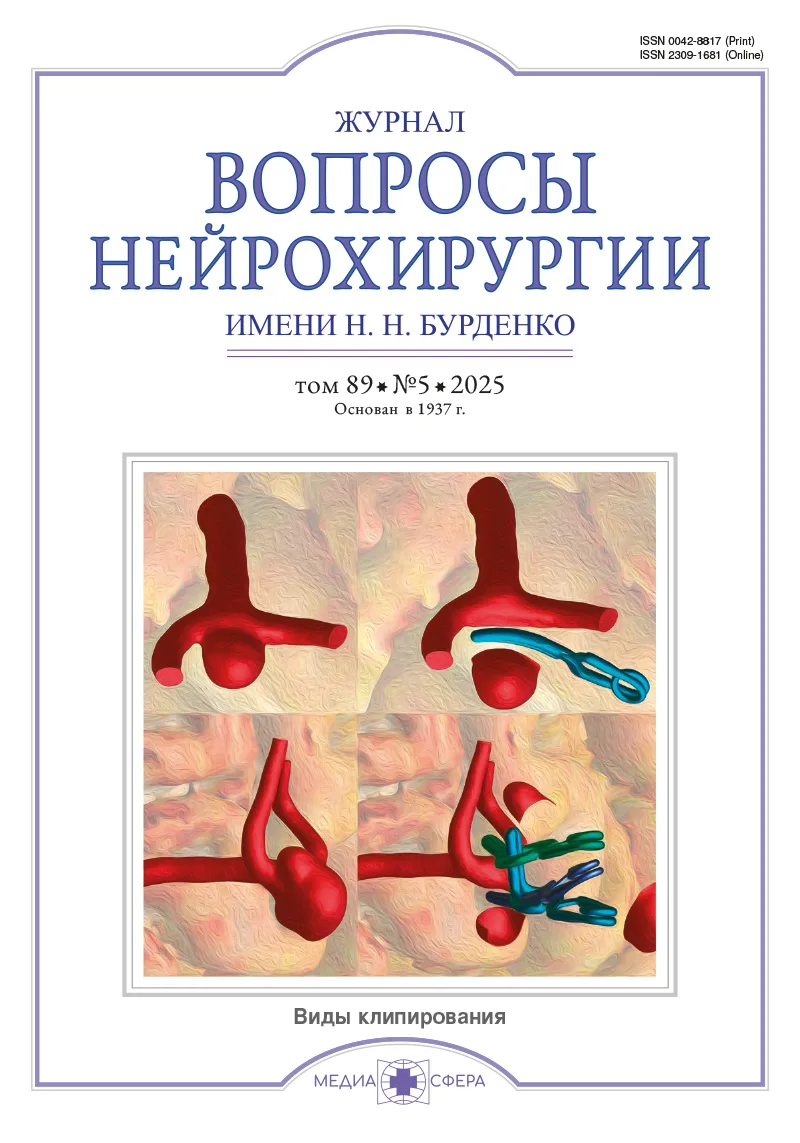
Двойные экстра-интракраниальные микроанастомозы при деконструктивных операциях по поводу гигантских аневризм внутренних сонных и средних мозговых артерий
Журнал: Вопросы нейрохирургии имени Н.Н. Бурденко. 2025;89(5):16-27.
DOI: 10.17116/neiro20258905116
Прочитано: 1953 раза
Резюме
ВВЕДЕНИЕ
Деконструктивные вмешательства с выключением несущей артерии из кровотока являются одним из возможных методов лечения гигантских и фузиформных аневризм церебральных артерий в случаях, когда окклюзия аневризмы микроспиралями или использование поток-перенаправляющего стента технически невыполнимы. Подобные вмешательства сопряжены с высокими рисками нарушений мозгового кровообращения. В подобных случаях для снижения рисков ишемических осложнений, периоперационной летальности и улучшения отдаленных неврологических исходов возникает вопрос применения хирургической реваскуляризации с использованием двойных экстра-интракраниальных микроанастомозов (ЭИКМА)
МАТЕРИАЛ И МЕТОДЫ
В исследование вошли 25 пациентов с крупными и гигантскими аневризмами внутренних сонных артерий (ВСА) и средних мозговых артерий (СМА), которым в период с 2015 по 2025 г. в НМИЦ нейрохирургии им. акад. Н.Н. Бурденко было проведено создание двойного ЭИКМА с последующим выключением аневризмы из кровотока эндоваскулярным или открытым способом.
РЕЗУЛЬТАТЫ
Медиана катамнеза составила 11 мес (интерквартильный размах 6; 25 мес). У 24 (96%) пациентов достигнуто радикальное выключение аневризмы. Ишемические осложнения отмечались у 7 (28%) пациентов. Причины ишемических осложнений были различными: недостаточный объем реваскуляризации (n=3); тромбоз одной из ветвей ЭИКМА (n=1); ишемия в бассейне перфорантов (n=3). Риски ишемических осложнений были выше в группе пациентов с аневризмами СМА и супраклиноидного сегмента ВСА по сравнению с кавернозной и параклиноидной локализацией.
ЗАКЛЮЧЕНИЕ
Создание двойного ЭИКМА между ветвями поверхностной височной артерии и корковыми ветвями М4 СМА позволяет обеспечить достаточную реваскуляризацию, снизить риски ишемических осложнений при последующей окклюзии ВСА по поводу гигантской аневризмы. Для достижения хороших функциональных исходов необходим персонализированный подход к выбору акцепторных артерий с учетом расположения аневризмы и естественного коллатерального кровообращения.
Ключевые слова
- двойной ЭИКМА
- гигантские аневризмы
- фузиформные аневризмы
- деконструктивные вмешательства
- реваскуляризация
Дата поступления: 03.06.2025
Дата принятия в печать: 18.07.2025
Дата публикации: 16.10.2025
Список сокращений
mRS — модифицированная шкала Рэнкина (modified Rankin Scale)
БОТ — баллон-окклюзионный тест
ВСА — внутренняя сонная артерия
ИР — интерквартильный размах
ЛСК — линейная скорость кровотока
ОФЭКТ — однофотонная эмиссионная компьютерная томография
САК — субарахноидальное кровоизлияние
СМА — средняя мозговая артерия
ТК-УЗДГ — транскраниальная ультразвуковая доплерография
ЦАГ — церебральная ангиография
ЦО — церебральная оксиметрия
ЭИКМА — экстра-интракраниальный микроанастомоз
ЭЭГ — электроэнцефалография
Введение
Фузиформные аневризмы являются редким цереброваскулярным заболеванием, составляя 5—7% от всех интракраниальных аневризм, их распространенность в общей популяции составляет 0,05% [1, 2]. Гигантские аневризмы могут быть ассоциированы с синдромом Марфана, синдромом Элерса–Данло и другими заболеваниями. Некоторые фузиформные аневризмы связаны с атеросклерозом, что может быть выявлено при гистологическом исследовании стенки артерии. Подобные аневризмы также могут возникать вследствие диссекции стенки артерии с повреждением интимы, на фоне системной артериальной гипертензии или в результате травмы. Ежегодный риск разрыва гигантских (более 25 мм) интракраниальных аневризм составляет 8—10%, а риски летального исхода при отсутствии лечения достигают 68—100% в течение 2 лет наблюдения [2].
Подходы к лечению фузиформных и гигантских интракраниальных аневризм отличаются от лечения обычных мешотчатых аневризм. Их морфология и размеры ограничивают использование реконструктивных методов, таких как окклюзия микроспиралями или микрохирургическое клипирование.
Деконструкция несущей артерии позволяет выключить гигантскую аневризму из кровотока, снижая риски развития геморрагических и тромбоэмболических осложнений, очаговой неврологической симптоматики, однако связана со значительным риском периоперационного инсульта, частота которого может достигать 30% и увеличивается с возрастом пациента [1]. Исследования стратегии лечения гигантских и фузиформных аневризм ВСА, опирающиеся на данные высокого уровня доказательности, отсутствуют, однако для снижения рисков инсульта предложено использование операций экстра-интракраниального шунтирования.
В данной статье мы представляем серию случаев лечения гигантских и фузиформных аневризм ВСА и СМА, при которых было проведено гибридное хирургическое лечение — реваскуляризация (создание двойного ЭИКМА) с целью поток-дополнения и снижения риска ишемических осложнений с последующим выключением аневризмы путем эндоваскулярной окклюзии ВСА, ее проксимального клипирования или треппинга аневризмы.
Материал и методы
Проведено ретроспективное исследование, включающее 25 пациентов с крупными и гигантскими аневризмами ВСА или СМА, которым в НМИЦ нейрохирургии им. акад. Н.Н. Бурденко в период с 2015 по 2025 г. проводилось комбинированное хирургическое лечение в объеме наложения двойного ЭИКМА с последующей деконструкцией несущей артерии.
Предоперационные исследования пациентов включали КТ-ангиографию сосудов головы и шеи с последующей трехмерной мультипланарной реконструкцией и МРТ головного мозга в режимах FLAIR, DWI, SWAN с целью уточнения топографо-анатомических особенностей аневризмы, диагностики возможных ишемических очагов и определения наличия тромбов в полости аневризмы, что рассматривалось в качестве дополнительного показания к проведению хирургического лечения.
Селективная ЦАГ выполнялась у 9 (36%) пациентов с целью уточнения ангиоархитектоники аневризмы, исследования системы коллатерального кровоснабжения и попытки реконструктивного эндоваскулярного вмешательства. После принятия решения о невозможности реконструктивной операции (установки поток-перенаправляющего стента или эндоваскулярной окклюзии аневризмы микроспиралями со стент-ассистенцией) для оценки переносимости пережатия ВСА у пациентов с аневризмами ВСА проводился БОТ (6 наблюдений). У пациентов с аневризмами СМА проведение временной окклюзии СМА выполнялось в связи с безусловной необходимостью реваскуляризации.
БОТ проводился пациентам в сознании в условиях местной анестезии области пункции бедренной артерии и поверхностной седации с непрерывным ТК-УЗДГ-мониторингом кровотока в СМА на стороне временной окклюзии ВСА и ЦО. Неотделяемый баллон-катетер устанавливался на уровне основания черепа в шейном сегменте ВСА, раздувался, после чего проводилось наблюдение за состоянием пациента в течение 15 мин или до появления неврологической симптоматики. Оценивались уровень сознания пациента, наличие психомоторного возбуждения, очаговая неврологическая симптоматика, динамика изменений ЛСК в СМА и данных ЦО.
При стабильном клиническом течении дополнительно выполнялась селективная ангиография сонных и позвоночных артерий с целью изучения состояния артерий артериального круга большого мозга и функции естественных экстра-интракраниальных и лептоменингеальных коллатералей. Дополнительно проводилась оценка неврологического дефицита и параметров церебральной гемодинамики в условиях артериальной гипотензии (ниже 100/80 мм рт.ст.). На основании полученных данных принималось следующее решение о переносимости выключения ВСА из кровотока:
1. Грубая декомпенсация — при угнетении уровня бодрствования, появлении очагового неврологического дефицита в течение 5 мин на фоне разомкнутого виллизиева круга, падении ЛСК в ипсилатеральной СМА ниже 20 см/с, снижении ЦО более чем на 10%.
2. Начальная декомпенсация — появление умеренного неврологического дефицита в более поздние сроки или на фоне снижения артериального давления без угнетения сознания. Снижение кровотока в СМА более чем на 50% от исходного с изменением спектра кровотока (коллатеральный тип). Снижение ЦО более чем на 5%.
3. Субкомпенсация — отсутствие неврологического дефицита, в том числе в условиях артериальной гипотензии в течение 10 мин, при изменении параметров церебральной гемодинамики — снижении ЛСК более чем на 50% и ЦО более чем на 5%.
4. Компенсация — отсутствие неврологического дефицита, в том числе в условиях артериальной гипотензии в течение 10 мин, при сохранении параметров церебральной гемодинамики — снижении ЛСК в СМА менее чем на 50% (магистральный тип кровотока) и ЦО менее чем на 5%.
В исследование включались лишь пациенты с признаками субкомпенсации и начальной декомпенсации кровотока в бассейне окклюзируемой ВСА. При выявлении признаков компенсации деконструктивное вмешательство выполнялось без этапной реваскуляризации, а в случае выявления грубой декомпенсации принималось решение о наложении широкопросветного анастомоза или о динамическом наблюдении за пациентом.
Тактика хирургического лечения пациентов различалась в зависимости от локализации аневризмы. Пациентам с фузиформными аневризмами СМА выполнялись одномоментные микрохирургические вмешательства. После диссекции основного ствола М1 и крупных исходящих из аневризмы ветвей выполнялось исследование кровотока в них на фоне временного проксимального клипирования с использованием контактной доплерографии или флоуметрии, определявшее показания к реваскуляризации. Анастомозы накладывались преимущественно с корковыми ветвями сегмента М4, выбранными из топографо-анатомических соображений и доступности донорских артерий: одна ветвь — в бассейн височной ветви М2, одна ветвь — в бассейн лобной ветви М2 СМА. После верификации кровотока в анастомозе выполнялся микрохирургический треппинг.
У пациентов с гигантскими аневризмами ВСА выполнялось этапное хирургическое вмешательство — микрохирургическая реваскуляризация бассейна СМА двумя ветвями поверхностной височной артерии с последующей эндоваскулярной окклюзией ВСА. Тактика реваскуляризации несколько различалась. В качестве акцепторных артерий предпочтительными являлись лобная центральная и прецентральная, а также ангулярная ветви с целью приоритетной реваскуляризации функционально значимой области центральных извилин (рис. 1). После наложения и контроля функции созданных анастомозов пациент без пробуждения перемещался в рентген-операционную, где ему выполнялась деконструктивная операция — постоянная окклюзия ВСА микроспиралями проксимальнее аневризмы, на уровне каменистого сегмента артерии. В раннем послеоперационном периоде для оценки функции анастомоза, степени компенсации перфузионного дефицита и выявления возможного кровотока в аневризме выполнялась МРТ головы, в том числе в режимах времяпролетной магнитно-резонансной ангиографии 3D-TOF и ASL-перфузии. Такой же протокол МРТ использовался для катамнестического наблюдения.
Результаты
В общей сложности было выполнено 16 одномоментных микрохирургических вмешательств и 9 этапных эндоваскулярных деконструктивных операций в сочетании с микрохирургической реваскуляризацией на стороне окклюзии ВСА.
Данные пациентов представлены в таблице. Медиана возраста на момент лечения составила 38 лет (ИР 19; 57 лет). Медиана максимального линейного размера аневризмы составила 32 мм (ИР 27; 37 мм). Все аневризмы были фузиформными или гигантскими, реконструктивное микрохирургическое или эндоваскулярное выключение аневризмы из кровотока было невозможным.
Клиническая характеристика пациентов
№ | Возраст, годы | Пол | Расположение | Размеры, мм | Симптомы | Баллон-окклюзионный тест | Способ выключения аневризмы | Осложнения | Исход, mRS |
1 | 12 | Ж | М1 СМА | >25 | Выраженные застойные диски зрительных нервов с кровоизлияниями | Не проводился | Треппинг | Ишемия (перфоранты) | 3 |
2 | 19 | М | Бифуркация СМА | >25 | САК, подострый период | Не проводился | Треппинг | Ишемия (перфоранты) | 3 |
3 | 33 | Ж | М2 СМА | 15—24 | Головные боли | Не проводился | Иссечение | 0 | |
4 | 59 | М | М1 СМА | 15—24 | САК, холодный период | Не проводился | Проксимальное клипирование | Ишемия (перфоранты) | 2 |
5 | 6 | Ж | ВСА параклиноидная | 35 | САК, острый период | Не проводился | Треппинг | 2 | |
6 | 17 | Ж | М1 СМА | >25 | Головные боли | Не проводился | Проксимальное клипирование | 0 | |
7 | 54 | М | М1 СМА | >25 | Ишемический инсульт в бассейне правой СМА, эпилептические приступы | Не проводился | Проксимальное клипирование | Ишемия (тромбоз одной ветви ЭИКМА) | 4 |
8 | 58 | Ж | Бифуркация СМА | 35 | САК, холодный период | Не проводился | Треппинг | Ишемия (гипоперфузия) | 4 |
9 | 38 | Ж | Бифуркация СМА | 17 | Случайная находка | Не проводился | Клипирование с формированием просвета | 0 | |
10 | 74 | Ж | М3 и дистальная СМА | 46 | Прогрессирующее снижение зрения OD | Не проводился | Проксимальное клипирование | 1 | |
11 | 52 | М | ВСА супраклиноидная | >25 | Головные боли, транзиторная ишемическая атака в бассейне правой ВСА, левосторонняя нижнеквадрантная гемианопсия | Не проводился | Проксимальное клипирование | 2 | |
12 | 58 | Ж | бифуркация СМА | 30 | Головные боли | Не проводился | Проксимальное клипирование | 0 | |
13 | 14 | М | ВСА параклиноидная | 25 | Снижение зрения OU, расходящееся косоглазие левого глаза | Не проводился | Треппинг | 0 | |
14 | 36 | Ж | ВСА параклиноидная | 27 | Снижение зрения OS | Не проводился | Треппинг | 2 | |
15 | 65 | Ж | ВСА параклиноидная | >25 | Головные боли, приступы онемения нижней половины туловища и нижних конечностей | Не проводился | Треппинг | Ишемия (гипоперфузия) | 4 |
16 | 57 | М | ВСА параклиноидная | 19 | Инсульт в бассейне левой СМА: парез в правой руке (4 балла), речевые нарушения | Не проводился | Эндоваскулярная проксимальная окклюзия ВСА | 2 | |
17 | 15 | М | ВСА кавернозная | 47 | Головные боли, увеличение размеров аневризмы в динамике | Переносит; снижение ЛСК со 112 до 98 см/с | Эндоваскулярная проксимальная окклюзия ВСА | 0 | |
Клиническая характеристика пациентов | |||||||||
№ | Возраст, годы | Пол | Расположение | Размеры, мм | Симптомы | Баллон-окклюзионный тест | Способ выключения аневризмы | Осложнения | Исход, mRS |
18 | 53 | Ж | ВСА кавернозная | 32 | Двоение, преходящий дефицит III черепного нерва слева | На 9 мин афазия, снижение ЛСК с 80 до 45 см/с | Эндоваскулярная проксимальная окклюзия ВСА | 1 | |
19 | 65 | Ж | ВСА кавернозная | 37 | Головные боли, асимметричный хиазмальный синдром справа (аденома гипофиза); дефицит III, V, VI черепных нервов справа; психические нарушения | Не проводился — психические нарушения | Эндоваскулярная проксимальная окклюзия ВСА | 3 | |
20 | 33 | М | ВСА кавернозная | 30 | Головные боли, двоение, преходящий дефицит VI черепного нерва справа | Переносит; снижение ЛСК более чем на 50% | Эндоваскулярная проксимальная окклюзия ВСА | 2 | |
21 | 56 | Ж | ВСА кавернозная | 44 | Дефицит III черепного нерва справа, хиазмальный синдром | Не проводился | Эндоваскулярная проксимальная окклюзия ВСА | 1 | |
22 | 28 | Ж | ВСА кавернозная | 36 | Головные боли | Снижение ЛСК с 60 до 30 см/с | Эндоваскулярная проксимальная окклюзия ВСА | 0 | |
23 | 32 | Ж | ВСА кавернозная | 23 | Головные боли | На 12 мин парез в руке; снижение ЛСК с 90 до 70 см/с | Эндоваскулярная проксимальная окклюзия ВСА | 0 | |
24 | 2 | М | М1 СМА | 30 | Случайная находка | Не проводился | Треппинг | Ишемия (гипоперфузия) | 3 |
25 | 39 | М | ВСА параклиноидная | 35 | Правосторонняя гомонимная гемианопсия | Переносит; снижение ЛСК с 60 до 30 см/с | Эндоваскулярная проксимальная окклюзия ВСА | 1 | |
Примечание. mRS — модифицированная шкала Рэнкина (modified Rankin Scale); СМА — средняя мозговая артерия; САК — субарахноидальное кровоизлияние; ВСА — внутренняя сонная артерия; ЛСК — линейная скорость кровотока; ЭИКМА — экстра-интракраниальный микроанастомоз.
В 24 (96%) случаях удалось добиться полного выключения аневризмы из кровотока. Частичное ретроградное заполнение фузиформной аневризмы СМА наблюдалось лишь у 1 пациента после проксимального клипирования сегмента М1 СМА ввиду высоких ишемических рисков выполнения полного треппинга аневризмы.
Ранний послеоперационной контроль во всех случаях подтвердил функционирование анастомоза, лишь в 1 случае выявив окклюзию одной из его ветвей. Во всех случаях этапного хирургического лечения после наложения анастомоза ангиографически были визуализированы обе его ветви, несмотря на то, что в течение нескольких часов между этапами ЭИКМА функционировал в условиях работающей ВСА.
Послеоперационной летальности не наблюдалось, однако у 7 (28%) пациентов отмечены ишемические осложнения разной степени выраженности (см. таблицу). Все они развились в группе пациентов с одномоментным микрохирургическим вмешательством: у пациентов с аневризмами СМА (6 наблюдений) и параклиноидной локализации (1 наблюдение) — в 50% всех выполненных подобных вмешательств. У 3 пациентов, несмотря на ангиографически подтвержденную функцию анастомозов, развились локальные инфаркты головного мозга в зонах смежного кровообращения лобных долей, вероятно обусловленные недостаточным объемом реваскуляризации. У 3 пациентов с аневризмами СМА после треппинга или проксимального клипирования на фоне функционирующих ЭИКМА отмечались инфаркты в бассейне перфорантов. Формирование подобных очагов ишемии связано с особенностями расположения аневризмы, наличием исходящих из нее мелких ветвей, которые могут быть выключены из кровотока вместе с аневризмой при треппинге. У 1 пациента с фузиформной аневризмой сегмента М1 инсульт был связан с тромбозом одной из ветвей ЭИКМА в раннем послеоперационном периоде.
У пациентов с этапным хирургическим лечением гигантских аневризм ВСА ишемических осложнений не определялось.
Катамнез прослежен у всех пациентов, медиана катамнеза составила 11 мес (ИР 6; 25 мес). Был отмечен 1 эпизод фатального субарахноидального кровоизлияния через 1 мес после операции, источник кровоизлияния не был установлен по данным аутопсии. Среди пациентов с очаговой неврологической симптоматикой у 50% отмечались стабилизация, улучшение или полный регресс неврологических нарушений.
Клинический пример представлен на рис. 1—5.

Рис. 1. Пациентка С., 28 лет. Прямая ангиография правой общей сонной артерии до операции в прямой (а) и боковой (б) проекциях.
Визуализируется гигантская аневризма кавернозного сегмента правой внутренней сонной артерии размерами до 36 мм.

Рис. 2. Контрольная ангиография после создания двойного экстра-интракраниального микроанастомоза справа на фоне временной окклюзии правой внутренней сонной артерии в прямой (а) и боковой (б) проекциях.
Область центральных извилин заполняется из бассейна наружной сонной артерии через 2 ветви экстра-интракраниального микроанастомоза. Гигантская аневризма правой внутренней сонной артерии не контрастируется.

Рис. 3. Ранний послеоперационный контроль: магнитно-резонансные томограммы в 1-е сутки после операции.
а — режим FLAIR; б — в режиме DWI визуализируется точечный очаг в проекции головки хвостатого ядра справа; в — в режиме ASL перфузия компенсирована, без межполушарной асимметрии.

Рис. 4. Контрольные магнитно-резонансные томограммы через 6 мес после операции.
а — режим FLAIR; б — режим DWI: новых ишемических очагов не обнаружено; в — в режиме ASL кровоток компенсирован.

Рис. 5. Контрольные магнитно-резонансные томограммы через 6 мес после операции.
а — прямая проекция; б — боковая проекция. В режиме 3D-TOF визуализируются две ветви экстра-интракраниального микроанастомоза справа. Аневризма правой внутренней сонной артерии не визуализируется.
Обсуждение
Существуют методики микрохирургического лечения гигантских и фузиформных аневризм ВСА, например клипирование с использованием внутрисосудистой аспирации крови [3, 4]. Несмотря на это, радикальность их подобного выключения остается недостаточной. Так, в исследовании Ш.Ш. Элиавы и соавт., включающем 600 пациентов, полное выключение мешотчатых аневризм было достигнуто в 92,2% случаев, в то время как фузиформных — лишь в 69,5% случаев [3]. Часть гигантских аневризм ВСА, у которых выявляется атеросклеротически измененная плотная стенка или которые распространяются глубоко в кавернозный синус, являются недоступными для клипирования с сохранением просвета артерии [5].
Использование поток-перенаправляющих стентов произвело революцию в лечении сложных аневризм ВСА. Клинические исследования, в которых изучалось эндоваскулярное лечение различных сложных аневризм ВСА, показали частоту их полной окклюзии от 77,8% до 83,3%, при этом риски инсульта достигали 12,8% [6, 7]. Возможные риски, связанные с использованием поток-перенаправляющих стентов, включают риски рецидива, особенно в случае крупных аневризм; риски инфаркта в бассейне глубоких перфорантов; риски, связанные с длительной антиагрегантной терапией [1, 2, 6, 7]. Несмотря на то, что использование эндоваскулярных методов лечения при аневризмах каменистого, кавернозного и параклиноидного сегментов ВСА является предпочтительным, в ряде случае реконструктивное вмешательство остается технически невозможным [1].
История проксимального выключения кровотока в лечении аневризм восходит к середине XVIII века, когда хирург J. Hunter впервые предложил перевязывать артерию проксимальнее аневризмы. Данная методика продемонстрировала свою эффективность и в лечении гигантских аневризм ВСА, позволив снизить риски геморрагических и тромбоэмболических осложнений. В настоящее время проксимальная окклюзия ВСА может быть произведена различными способами: как открытыми (перевязка ВСА, проксимальное клипирование ВСА), так и эндоваскулярными (окклюзия ВСА микроспиралями). В случаях значительного ретроградного заполнения аневризмы по данным ангиографии (например, при фетальном типе задней соединительной артерии) или в случае разорвавшихся аневризм может быть целесообразен треппинг аневризмы [1, 2].
Существенным недостатком данной методики, однако, являются высокие риски ишемических осложнений, которые могут достигать 30% [1, 8]. С развитием микрохирургической техники для решения данной проблемы были предложены методы дополнительной реваскуляризации, когда окклюзия несущей артерии может быть выполнена в качестве первого этапа хирургического лечения, после реваскуляризации, или постепенно, прогрессивным образом (зажим Selverstone), с целью «созревания» коллатералей [9].
Наиболее целесообразна реваскуляризация у пациентов молодого возраста, т.к. окклюзия ВСА увеличивает риск инсульта в течение жизни и риск формирования вторичных гемодинамических аневризм [10]. Отдаленные риски редукции анастомоза при этой патологии относительно низкие и составляют 2,9—5,3% [1]. В раннем послеоперационном периоде у части пациентов наблюдается преходящая неврологическая симптоматика, связанная с гипоперфузией на фоне колебаний артериального давления, которая, однако, не приводит к формированию необратимой ишемии.
Непереносимость окклюзии ВСА в течение 30 мин является признаком недостаточного коллатерального кровообращения, позволяя выявить группу пациентов с высокими рисками инсульта в случае окклюзии ВСА [11]. В исследовании M.E. Linskey и соавт. риски инсульта после окклюзии ВСА составили 26% в группе без БОТ и 13% в группе пациентов, которые переносили баллон-окклюзионную пробу [12]. Тем не менее ложноотрицательные результаты БОТ могут приводить к инсульту у 10—22% пациентов [1]. При проведении БОТ используется оценка клинического состояния, гемодинамики (данные ЦАГ, ТКДГ, ЦО, КТ-перфузии, ОФЭКТ), электрофизиологические методы (ЭЭГ), а также провокационные пробы (контролируемая гипотензия). Использование этих методов может повысить предиктивное значение БОТ [10].
Представляется целесообразным разделение результатов БОТ на 4 группы, сопоставимые со степенями перфузионного дефицита по данным магнитно-резонансной перфузии [13]. Появление очаговой неврологической симптоматики в течение первых 3—5 мин теста или снижение уровня бодрствования на любом этапе БОТ соответствует декомпенсации коллатерального кровотока, его неполноценности, что может требовать полного замещения кровотока в каротидном бассейне с использованием высокопоточного шунтирования. Возникновение очаговой неврологической симптоматики позже 3—5 мин после временной окклюзии или на фоне пробы со снижением артериального давления говорит о начальной декомпенсации кровотока. В таком случае реваскуляризация в объеме двойного ЭИКМА будет достаточной. Такой временной интервал соответствует длительности безопасной временной окклюзии артерий, допустимой при микрохирургическом лечении неразорвавшихся аневризм [14].
Даже у пациентов без появления неврологической симптоматики могут быть диагностированы грубые изменения церебральной гемодинамики, относящие их в группу повышенного риска ишемического инсульта (стадия субкомпенсации). Переносимость БОТ говорит о компенсации мозгового кровотока за счет естественных коллатералей, в таком случае хирургическая реваскуляризация может быть избыточна, существуют высокие риски гемодинамической конкуренции и тромбоза ЭИКМА.
Ряд авторов предлагают использование реваскуляризации при проведении деконструктивных операций с окклюзией ВСА вне зависимости от результатов БОТ [1, 2]. В качестве аргументов приводятся значительное число ложноотрицательных результатов БОТ, риски тяжелых неврологических осложнений, отдаленные риски инсульта и риски формирования аневризм de novo. При аневризмах СМА БОТ в большинстве случаев не имеет смысла в связи с отсутствием крупных коллатеральных сетей дистальнее аневризмы.
Дифференцированный подход к выбору методики двойного анастомозирования у пациентов с гигантскими аневризмами ВСА, основанный на результатах БОТ, позволил в нашей серии наблюдений во всех случаях избежать инсульта и стойкого неврологического дефицита, а в отдаленном периоде обеспечить реваскуляризацию всего бассейна СМА. При этом удалось избежать применения более инвазивного широкопросветного шунтирования. Присутствие двух ветвей анастомоза позволяет обеспечить селективное распределение потока между ветвями в зависимости от потребности. В отдаленном периоде это проявляется избирательной гипертрофией одной из ветвей, что может быть продемонстрировано по данным ангиографических исследований и УЗИ. Количественно двойной ЭИКМА может обеспечить значительно больший кровоток, чем обычный ЭИКМА с одной ветвью [15]. По данным J. Cherian и соавт., средний суммарный объемный кровоток по двойному ЭИКМА составил 69 мл/мин против 39 мл/мин у ЭИКМА с одной ветвью [16].
Более опасным является лечение фузиформных аневризм СМА, что связано со сложными топографо-анатомическими характеристиками аневризм, вовлечением в процесс перфорирующих артерий, ограниченными возможностями коллатерального кровообращения. Так, в 3 наблюдениях (38% всех ишемических осложнений) развилась ишемия в подкорковых ганглиях, которая не могла быть предотвращена дополнительной реваскуляризацией. В то же время в том же количестве наблюдений ишемические осложнения были связаны с недостаточным объемом реваскуляризации, несмотря на функционирующие ветви ЭИКМА.
В случае треппинга СМА функционирование обоих анастомозов и выбор акцепторных ветвей в бассейне функционально значимых областей головного мозга имеют особенно важное значение в связи с отсутствием альтернативных путей коллатерального кровообращения.
С развитием современных технологий дополнительные возможности контроля эффективности компенсации перфузионного дефицита предоставляют методики интраоперационной контактной доплерографии и интраоперационной МРТ в режиме ASL [13, 17, 18]. Данные методики позволяют более корректно выделить акцепторные артерии для реваскуляризации, избежать гемодинамической конкуренции между анастомозами, избежать замещающей реваскуляризации естественных лептоменингеальных коллатералей и добиться более полной компенсации возникающего вследствие деконструкции перфузионного дефицита.
Заключение
Деконструктивные операции с окклюзией несущей артерии остаются необходимым методом лечения у отдельных пациентов с гигантскими и фузиформными аневризмами. Этот метод лечения обеспечивает высокую частоту полной окклюзии аневризм в сочетании с низкими рисками отдаленных осложнений. Окклюзия внутренней сонной артерии сопряжена с высокими рисками периоперационного инсульта. Использование баллон-окклюзионной пробы в сочетании с мультимодальным мониторингом позволяет выявить пациентов с недостаточным коллатеральным кровотоком и высокими рисками инсульта при окклюзии внутренней сонной артерии. Создание двойного экстра-интракраниального микроанастомоза между ветвями поверхностной височной артерии и корковыми ветвями М4 средней мозговой артерии позволяет обеспечить достаточную реваскуляризацию, снизить риски ишемических осложнений. При аневризмах кавернозной и параклиноидной локализации двойной экстра-интракраниальный микроанастомоз достаточен для поток-замещения в бассейне средней мозговой артерии; высокопоточное шунтирование представляется излишним, т.к. сопряжено с большими рисками периоперационных осложнений. В случае расположения аневризмы в супраклиноидном сегменте внутренней сонной артерии или при поражении средней мозговой артерии риски ишемических осложнений остаются крайне высокими, необходим индивидуальный подход и приоритетная реваскуляризация функционально значимых зон для достижения хороших функциональных исходов, а также использование методик контактной доплерографии и интраоперационной или ранней послеоперационной МРТ в режиме ASL для исследования церебральной гемодинамики после реваскуляризации бассейна окклюзируемой артерии.
Участие авторов:
Концепция и дизайн исследования — Лукшин В.А., Пилипенко Ю.В., Усачев Д.Ю.
Сбор и обработка материала — Кобяков Н.Г., Пилипенко Ю.В., Шульгина А.А., Кондаков М.В.
Статистическая обработка данных — Кобяков Н.Г., Лукшин В.А.
Написание текста — Кобяков Н.Г.
Редактирование — Лукшин В.А., Пилипенко Ю.В., Шульгина А.А.
Авторы заявляют об отсутствии конфликта интересов.
Комментарий
Статья посвящена актуальной медицинской проблеме — лечению сложных и гигантских аневризм сосудов головного мозга. На сегодняшний день хорошо известны и широко описаны хирургические методы открытого клипирования и эндоваскулярного койлинга аневризм. Однако работ, посвященных лечению сложных аневризм головного мозга, крайне мало как в отечественной, так и в зарубежной литературе. Не существует рандомизированных исследований, направленных на изучение данной проблемы. Хирургический опыт выполнений вмешательств на сложных аневризмах скуден и исчисляется лишь несколькими десятками операций даже у самых именитых хирургов. В ряде наблюдений открытое клипирование и эндоваскулярное лечение сложных аневризм не представляется возможным ввиду технических сложностей и риска развития послеоперационных ишемических осложнений. Поэтому с целью нивелирования хирургических рисков с конца 1980-х гг. разрабатывались методики выполнения симультанного треппинга несущей аневризму артерии и наложения высокопоточных обходных шунтов. С 2008 г. данную технику начали применять и в РФ (Воронеж — 2008 г., Москва — 2011 г.). В настоящее время ведутся работы по поиску оптимальных артерий доноров и реципиентов, измерению достаточного потока крови для замещения необходимого артериального бассейна и по выбору шунта. У пациентов с гигантскими аневризмами внутренних сонных артерий с целью объективизации толерантности головного мозга к пережатию внутренней сонной артерии выполняют баллон-окклюзионный тест. В результате теста определяют компенсаторные возможности коллатерального кровотока и степень функциональных нарушений, возникающих в связи с его недостаточностью. В зависимости от этого выбирают следующую тактику хирургического лечения: деконструкция артерии без дополнительного шунтирования, деконструкция с выполнением экстра-интракраниального микроанастомоза (ЭИКМА), двойного ЭИКМА, среднего или высокопоточного шунта. Именно степень и быстрота развития функционального неврологического дефицита при временном пережатии несущей артерии являются определяющим фактором в выборе метода заместительной реваскуляризации. Авторы статьи представили опыт применения одного из возможных методов реваскуляризации у пациентов с гигантскими аневризмами внутренней сонной и средней мозговой артерий.
В работе проанализировано выполнение 25 операций пациентам со сложными и гигантскими аневризмами внутренних сонных и средних мозговых артерий, проведенных в плановом порядке. Описана методика операции, проанализированы результаты, проведено обсуждение.
В качестве научной дискуссии хотелось бы обсудить следующее: представляется спорным суждение авторов об излишнем и опасном использовании высокопоточных и среднепоточных шунтов у пациентов с данной патологией. К сожалению, по данным литературы, нашему опыту, опыту авторов статьи (у 1/3 пациентов в послеоперационном периоде отмечены ишемические осложнения), двойной микроанастомоз не всегда является достаточным для замещения бассейна внутренней сонной артерии, а иногда и средней мозговой артерии у пациентов с положительным баллон-окклюзионным тестом, низкой толерантностью головного мозга к пережатию крупной артерии и является только одной из методик, применяемых в заместительной реваскуляризации. На наш взгляд, выбор метода шунтирования должен быть максимально объективизирован исходя из достаточности заместительного кровообращения, необходимого потока крови и прогноза ишемических осложнений.
В целом статья производит благоприятное впечатление. Авторы, несомненно, затронули в своей работе малоизученный и интересный вопрос возможности выполнения обходного шунтирования головного мозга с использованием двойного микроанастомоза в качестве эффективной и безопасной методики выключения из кровотока сложных аневризм. Опыт проведения 25 подобных операций является одним из крупнейших в РФ.
Статья является, без сомнения, актуальной, представляет большой интерес для неврологов и практикующих ангио- и нейрохирургов.
В.А. Лукьянчиков (Москва)
- Peeters SM, Colby GP, Kim WJ, Bae WI, Sparks H, Reitz K, Tateshima S, Jahan R, Szeder V, Nour M, Duckwiler GR, Vinuela F, Martin NA, Wang AC. Proximal Internal Carotid Artery Occlusion and Extracranial-Intracranial Bypass for Treatment of Fusiform and Giant Internal Carotid Artery Aneurysms. World Neurosurgery. 2023;180:e494-e505. https://doi.org/10.1016/j.wneu.2023.09.097
- Santoro A, Armocida D, Paglia F, Iacobucci M, Berra LV, D’Angelo L, Cirelli C, Guidetti G, Biraschi F, Cantore G. Treatment of giant intracranial aneurysms: long-term outcomes in surgical versus endovascular management. Neurosurgical Review. 2022;45(6):3759-3770. https://doi.org/10.1007/s10143-022-01884-3
- Элиава Ш.Ш., Пилипенко Ю.В., Холматов М.Б., Белоусова О.Б., Хейреддин А.С., Окишев Д.Н., Коновалов Ан.Н., Гребенев Ф.В. Результаты микрохирургического лечения 723 церебральных аневризм на основании одноцентрового проспективного исследования. Вопросы нейрохирургии им. Н.Н. Бурденко. 2025;89(3):60-67. https://doi.org/10.17116/neiro20258903160
- Dzhindzhikhadze R, Bogdanovich I, Zaitsev A, Ermolaev A. How I do it: The microsurgical clipping of the giant paraclinoid aneurysm using the retrograde suction decompression technique. Acta Neurochirurgica. 2023;165(4): 1021-1026. https://doi.org/10.1007/s00701-023-05525-6
- Xu BN, Sun ZH, Romani R, Jiang JL, Wu C, Zhou DB, Yu XG, Hernesniemi J, Li BM. Microsurgical management of large and giant paraclinoid aneurysms. World Neurosurgery. 2010;73(3):137-146; discussion e17, e19. https://doi.org/10.1016/j.surneu.2009.07.042
- Meyers PM, Coon AL, Kan P, Dogan A, Bain M, Welch BG, Ebersole K, De Vries J, Wakhloo AK, Taussky P, Jenkins P, Hanel RA; SCENT Investigators. Five-year results of the SCENT trial with Surpass flow diverters to treat large or giant wide-neck aneurysms. Journal of NeuroInterventional Surgery. 2025:jnis-2024-022977. https://doi.org/10.1136/jnis-2024-022977
- Hanel RA, Cortez GM, Lopes DK, Nelson PK, Siddiqui AH, Jabbour P, Pereira VM, István IS, Zaidat OO, Bettegowda C, Colby GP, Mokin M, Schirmer CM, Hellinger FR, Given C, Krings T, Taussky P, Toth G, Fraser JF, et al. Prospective study on embolization of intracranial aneurysms with the pipeline device (PREMIER study): 3-year results with the application of a flow diverter specific occlusion classification. Journal of NeuroInterventional Surgery. 2023;15(3):248-254. https://doi.org/10.1136/neurintsurg-2021-018501
- Пилипенко Ю.В., Элиава Ш.Ш., Коновалов А.Н., Гребенев Ф.В., Барчунов Б.В. Результаты хирургического лечения гигантских аневризм средних мозговых артерий: ретроспективное исследование. Альманах клинической медицины. 2023;51(1):32-44. https://doi.org/10.18786/2072-0505-2023-51-005
- Serbinenko FA, Filatov JM, Spallone A, Tchurilov MV, Lazarev VA. Management of giant intracranial ICA aneurysms with combined extracranial-intracranial anastomosis and endovascular occlusion. Journal of Neurosurgery. 1990;73(1):57-63. https://doi.org/10.3171/jns.1990.73.1.0057
- Zhu W, Tian YL, Zhou LF, Song DL, Xu B, Mao Y. Treatment strategies for complex internal carotid artery (ICA) aneurysms: Direct ICA sacrifice or combined with extracranial-to-intracranial bypass. World Neurosurgery. 2011;75(3-4):476-484. https://doi.org/10.1016/j.wneu.2010.07.043
- Арустамян С.Р., Яковлев С.Б., Шахнович А.Р., Красноперов И.В., Сазонова О.Б., Бочаров А.В., Бухарин Е.Ю., Белоусова О.Б., Кафтанов А.Н. Результаты деконструктивных эндоваскулярных операций при лечении крупных и гигантских интракраниальных аневризм. Вопросы нейрохирургии им. Н.Н. Бурденко. 2016;80(5):22-31. https://doi.org/10.17116/neiro201680522-31
- Linskey ME, Jungreis CA, Yonas H, Hirsch WL, Sekhar LN, Horton JA, Janosky JE, Eskridge JM. Stroke risk after abrupt internal carotid artery sacrifice: Accuracy of preoperative assessment with balloon test occlusion and stable xenon-enhanced CT. American Journal of Neuroradiology. 1994;15(5):829-846.
- Лукшин В.А., Усачев Д.Ю., Шульгина А.А., Куликов А.С., Пронин И.Н., Баталов А.И., Кобяков Н.Г. Первое применение интраоперационной МРТ для исследования церебральной перфузии при хирургической реваскуляризации головного мозга. Вопросы нейрохирургии им. Н.Н. Бурденко. 2023;87(4):5-16. https://doi.org/10.17116/neiro2023870415
- Doron O, Silverstein JW, Likowski D, Kohut K, Ellis JA. Temporary vessel occlusion in cerebral aneurysm surgery guided by direct cortical motor evoked potentials. Acta Neurochirurgica. 2022;164(5):1255-1263. https://doi.org/10.1007/s00701-022-05158-1
- Devalckeneer A, Haddad G, Kuschcinski G, Leclerc X, Bourgeois P, Delhem N, Menovsky T, Aboukaïs R, Bretzner M. Virtual cut flow, an innovative noninvasive 4D ASL MRI biomarker of EIC bypass patency. Neurosurgical Review. 2025;48(1):1-8. https://doi.org/10.1007/s10143-025-03618-7
- Cherian J, Srinivasan V, Kan P, Duckworth EAM. Double-barrel superficial temporal artery-middle cerebral artery bypass: Can it be considered “high-flow?”. Operative Neurosurgery. 2018;14(3):288-294. https://doi.org/10.1093/ons/opx119
- Лукшин В.А., Усачев Д.Ю., Шульгина А.А., Шевченко Е.В. Локальная гемодинамика после создания ЭИКМА у пациентов с симптоматическими окклюзиями сонных артерий. Вопросы нейрохирургии им. Н.Н. Бурденко. 2019;83(3):29-41. https://doi.org/10.17116/neiro20198303129
- Шульгина А.А., Лукшин В.А., Шульц Е.И., Баталов А.И., Пронин И.Н., Усачев Д.Ю. Методика оценки цереброваскулярной недостаточности у пациентов с ангиопатией мойя-мойя методом МР-ASL-перфузии. Медицинская визуализация. 2021;25(2):102-115. https://doi.org/10.24835/1607-0763-883


Рекомендуем статьи по данной теме:
Сравнительная эффективность методов реваскуляризации при ишемическом инсульте в клинической практике.Журнал неврологии и психиатрии им. С.С. Корсакова. Спецвыпуски. 2026;126(8-2):45-53
Высокая эффективность когнитивной реабилитации в позднем восстановительном периоде после реваскуляризации.Журнал неврологии и психиатрии им. С.С. Корсакова. Спецвыпуски. 2026;126(4-2):100-106
Характеристика хирургической и медикаментозной терапии пациентов кардиологического профиля, госпитализированных в федеральный медицинский исследовательский центр.Профилактическая медицина. 2026;29(1):20-27
Оказание медицинской помощи пациентам с синдромом диабетической стопы и облитерирующим атеросклерозом сосудов нижних конечностей: проблемы и перспективы.Медицинские технологии. Оценка и выбор. 2025;47(4):42-53
Аневризмы, ассоциированные с ангиопатией мойя-мойя (клинические наблюдения).Вопросы нейрохирургии имени Н.Н. Бурденко. 2025;89(6):96-104
Характеристики, особенности лечения и госпитальная летальность пациентов с инфарктом миокарда 75 лет и старше в России по данным регистра РЕГИОН-ИМ.Кардиологический вестник. 2025;20(1):22-38
Первый российский опыт педиатрической субтотальной реплантации лица.Пластическая хирургия и эстетическая медицина. 2024;(4):5-15