Ассоциация генов ESR2, AR и CYP19A1 в мужской выборке российских пациентов с врожденными необратимыми нарушениями половой самоидентификации
Журнал: Молекулярная генетика, микробиология и вирусология. 2025;43(3):55-62.
DOI: 10.17116/molgen20254303155
Прочитано: 956 раз
Резюме
ВВЕДЕНИЕ
Этиология транссексуализма до настоящего времени остается неустановленной, поскольку этот феномен обусловлен комплексом причин. Семейные исследования подтвердили роль генетических факторов в нарушении половой самоидентификации. Были получены данные об ассоциации между полиморфизмом генов, участвующих в системе гормональной регуляции, андрогенового (AR) и эстрогенового (ESR2) рецепторов, а также ароматазы (CYP19A1) — и транссексуализмом в разных выборках. В России подобные исследования до настоящего времени не проводились. Целью настоящего исследования является изучение генетической ассоциации генов AR, ESR2 и CYP19A1 с диагнозом транссексуализм в выборке российских пациентов.
МАТЕРИАЛ И МЕТОДЫ
Исследование проведено на выборке пациентов мужского пола с врожденными необратимыми нарушениями половой самоидентификации (n=191) с разной степенью выраженности клинической картины («ядерная» форма, «переходная» и «краевая») и контрольной группе мужчин, не имеющих гендерной дисфории (n=129).
РЕЗУЛЬТАТЫ
Статистически значимой ассоциации между транссексуализмом и полиморфными вариантами трех генов не обнаружено, что согласуется с ранее опубликованными исследованиями. В группе пациентов частота генотипов SS (содержащих только аллели с длиной меньше медианного значения) гена ESR2 (57,07%) и генотипа L (длиной больше медианного значения) гена AR (53,93%) выше, чем в контрольной группе (48,46% и 43,41% соответственно). Также при включении в группу только «ядерных» и «переходных» пациентов выявлена тенденция к усилению наблюдаемых различий с мужчинами, не имеющими гендерной дисфории (p=0,06).
ЗАКЛЮЧЕНИЕ
Результаты настоящей работы косвенно подтверждают вовлеченность андрогенового рецептора в развитие транссексуализма. В дальнейшем желательно расширить спектр изучаемых маркеров на предмет связи с ним, а также провести подобные исследования на новых выборках.
Ключевые слова
- половая самоидентификация
- расстройство гендерной идентичности
- генетические причины расстройства гендерной идентичности
- транссексуализм
- ген ароматазы
- гены андрогенового и эстрогенового рецепторов
Дата поступления: 10.12.2024
Дата принятия в печать: 09.01.2025
Дата публикации: 02.10.2025
Введение
Транссексуализм (ТС) — клинический диагноз, критериями которого являются желание жить и быть принятым в качестве лица противоположного пола, обычно сочетающееся с чувством неадекватности или дискомфорта от своего анатомического пола и желанием получать гормональное и хирургическое лечение с целью сделать свое тело как можно более соответствующим избранному им полу (МКБ-10: F64.0) [1]. Гендерная дисфория (ГД) — наиболее тяжелое состояние, вызванное нарушением половой идентификации, усложняющей социальную адаптацию. Выделяют женский и мужской ТС. Термин «MtF» (англ: male-to-female) определяет индивидов с установленным при рождении мужским полом, с явлениями гендерной дисфории на маскулинные внешние, анатомические, физиологические проявления и невозможностью адаптации в мужской социальной роли в обществе [2].
В большинстве случаев у лиц с нарушением половой идентификации генетический, гонадный, внутренний и внешний морфологический пол соответствуют биологическому. Многие исследователи считают, что одной из причин развития транссексуализма является нарушение половой дифференцировки мозга (ПДМ), происходящей у человеческого плода между 4-м и 7-м месяцами внутриутробного развития, что подтверждается результатами нейробиологических исследований [3]. В последние десятилетия накапливается все больше данных о том, что строение некоторых участков мозга транссексуалов отличается от строения соответствующих участков мозга мужчин и женщин, не имеющих ГД, и приближается к таковому строению этих участков у людей противоположного анатомического и генетического пола [3—6]. На ПДМ млекопитающих значительное влияние оказывают стероидные гормоны, такие как андрогены, эстрогены и ферменты превращения андрогенов в эстрогены [3].
Участие генетических факторов в формировании ТС было показано на основе семейных исследований [7, 8]. Ранее в поисках генетического компонента у лиц с ТС исследовались вариации генов-кандидатов, участвующих в половой системе гормональной регуляции, полиморфизм которых может влиять на ПДМ [9]. В частности, были получены противоречивые результаты по связи полиморфизма генов андрогенового (AR) и эстрогенового (ESR2) рецепторов, ароматазы (CYP19A1) с ТС в испанских, шведских, японских, австралийских выборках [9—13]. Так, например, для гена AR ассоциации с ТС были показаны на шведских и австралийских выборках, тогда как в японских и испанских они не были выявлены. При изучении гена ESR2 положительные ассоциации с ТС были выявлены только в шведской выборке MtF, а в других их не обнаружили. Исследований пациентов с ТС на генетическом уровне в мире крайне мало, в России такие работы еще не проводились. В России транссексуализм особенно отягощен суицидальным поведением, которое отмечается у 86,4% пациентов с данным диагнозом [14]. Целью данного исследования было изучение ассоциации генов AR, ESR2 и CYP19A1 в российской выборке пациентов с диагнозом транссексуализм с клинически разной степенью выраженности симптомов ГД (ядерные, переходные, краевые).
Материал и методы
Исследованы клинически гетерогенные пациенты (n=191) с разной степенью тяжести ГД (ядерные n=64, переходные n=44, краевые n=32) и в качестве контрольной группы мужчины, не имеющих проблем с половой идентификацией (n=129). Обе группы включали европеоидов в возрасте от 18 до 70 лет.
В группу пациентов (группа MtF) входили лица с установленным при рождении биологическим мужским полом, обратившиеся за помощью в Научный центр персонализированной медицины с 2016 по 2022 г. с жалобами на гендерную дисфорию, неприятие маскулинных внешних, анатомических, физиологических проявлений и невозможность адаптации в мужской социальной роли в обществе, запросом на изменение гендерного маркера в документах и/или гендерно-аффирмативные мероприятия (гормональную и/или хирургическую коррекцию).
Диагнозы установлены врачебной комиссией психиатров согласно диагностическим критериям МКБ-10, рубрики F64 «Транссексуализм». Все пациенты наблюдались психиатром, сексологом, эндокринологом, прошли экспериментально психологическое обследование, электроэнцефалографию. Использовались методики анкетирования — интервью с целью сбора подробного субъективного семейного, социального анамнеза, сведений об этапности развития гендерного несоответствия, степени выраженности ГД, особенности реагирования, способов борьбы с ГД и опыта обращения за помощью ранее.
В исследуемой группе пациентов отсутствовали первичные психотические состояния, а также хромосомные аномалии, эндокринные нарушения и заболевания гипоталамо-гипофизарной системы. Критериями исключения стали: умственная отсталость, отсутствие зрелости личности и потребности в смене пола на протяжении не менее 2 лет, нарушения кариотипа, первичная патология эндокринной системы, ставшая причиной нарушения формирования пола, активная стадия употребления алкоголя и других психоактивных веществ.
Распределение пациентов на «ядерные», «переходные» и «краевые» клинические группы осуществлено с учетом возраста возникновения первых симптомов гендерного несоответствия на этапах психосексуального развития, результатов педагогического коррекционного воздействия и способности социальной адаптации в паспортном поле [15]. В группе «ядерных» форм транссексуализма нарушение полового самосознания стартовало в пара- и препубертате (до 13 лет), отличалось высокой стойкостью, выраженностью и не поддавалось коррекции, часто сопровождалось депрессивной симптоматикой, более высокой частотой суицидальной активности и самоповреждающим поведением. В группе «краевых» пациентов симптоматика дебютировала в более поздние сроки, степень ее выраженности была не столь значительна при ее стойкости и стабильности; отмечена частичная адаптация в социуме без полноценной гендерно-аффирмативной помощи за счет исключения частых социальных контактов или помощи близких (семья, друзья), удаленной учебы или работы и иных адаптивных мероприятий. В «переходной» группе лиц с гендерным несоответствием присутствуют черты как 1-й, так и 2-й групп, но достигнута своевременная адаптация как результат возможности жить в обществе в желаемой гендерной роли за счет внешней схожести при использовании одежды, аксессуаров желаемого пола или раннего старта гормональной терапии по личной инициативе.
Исследование проведено на основании полученного информированного согласия пациентов и одобрено локальным этическим комитетом при АО «Научный центр персонализированной медицины».
Выделение ДНК производили с помощью набора реагентов DiatomTM DNA Prep 200 (ООО «Лаборатория Изоген», Россия) согласно протоколу производителя. Для амплификации изучаемых фрагментов генов AR, ESR2 и CYP19A1 использовали реакционную смесь, содержащую 10 нг матричной ДНК, 2 пМ каждого флуоресцентно-меченного праймера, 250 мкМ каждого dNTP в 67 мМ трис-HCl-буфере, pH 8.8, 16 мМ (NH4)2SO4, 0.1% Tween 2.0, 2.5 мМ MgCl2, 1.0 ед. Taq-полимеразы («Fermentas»). Последовательности праймеров и температуры их отжига представлены в табл. 1. Реакцию проводили на амплификаторе «Терцик» по следующей программе: 94 °C — 5 мин; 35 циклов: 94 °C — 30 с, (56—62 °C) — 30 с, 72 °C — 30 с; 72 °C — 10 мин.
Таблица 1. Последовательности и температура отжига праймеров и номенклатура аллелей для исследуемых локусов
Локус | Последовательности праймеров 5`→3` | Температура отжига праймеров | Аллели (размер фрагментов, п.н.) | Ссылка |
AR (CAG)n | F: (FAM)TCCAGAGCGTGCGCGAAGTGAT R: (FAM)CGACTGCGGCTGTGAAGGTTG | 56 °C | 15r (245) — 34r (302) | [16] |
ESR2 (AC)n | F: (ROX)GGTAAACCATGGTCTGTACC R: (ROX)AACAAAATGTTGAATGAGTGGG | 60 °C | 148—180* | [17] |
CYP19A1 (ТТТА) n | F: (R6G)GCAGGTACTTAGTTAGCTAC R: (R6G)TTACAGTGAGCCAAGGTCGT | 62 °C | 6 r (167) — 15r (203) | [9] |
Примечания: r — число тандемных повторов. * — микросателлитный кластер содержит несовершенные повторы, поэтому приводится только длина
Фракционирование амплификантов проводилось научно-производственной компанией «Синтол» на приборе Applide Biosystems 3100. Результаты анализировали с помощью программы Peak Scanner Software v. 1.0.
Статистический анализ результатов проводился в среде R (version 4.4.0) [18]. Для сравнения групп по размерам аллелей использовали непараметрический тест Манна—Уитни (Mann—Whitney U test). Медианные значения длин аллелей в контрольной группе являлись критерием деления их на длинные (L) и короткие (S). Различия в частотах аллелей и генотипов между группами определяли, анализируя таблицы сопряженности с помощью критерия χ2 Пирсона. Для поправки на множественные сравнения использовали метод коррекции Холма—Бонферрони. Анализ ассоциаций и расчет значений отношений шансов (ОШ) для нескольких генетических моделей (кодоминантная, доминантная, рецессивная) проводили с помощью пакетов SNPassoc [19] и epitools [20]. Статистически значимыми считали результаты анализа при значении p<0.05. Все графические построения выполнены с использованием пакетов ggplot2 [21] и ggstatsplot [22].
Результаты и обсуждение
Проведенное нами исследование позволило выявить аллельный полиморфизм генов андрогенового (AR) и эстрогенового (ESR2) рецепторов и гена ароматазы (CYP19A1) в группе российской пациентов с диагнозом транссексуализм.
Полиморфизм гена AR обусловлен вариациями длины микросателлитного кластера (CAG)n в экзоне 1, и с этим связаны конформационные и, возможно, функциональные характеристики рецептора [23]. Всего было выявлено 19 аллельных вариантов, содержащих от 15 до 36 микросателлитных повторов. В контрольной группе выявлено 14 аллельных вариантов по данному локусу, а в выборке MtF — 18 вариантов. В обеих выборках преобладают аллельные варианты со средним количеством (от 20 до 27) микросателлитных CAG-повторов (80 % в общей группе обследованных) (рис. 1 а). Полиморфизм гена эстрогенового рецептора ESR2 определяется вариацией длины (CA) n — кластера в пятом интроне [12]. Нами было выявлено 22 аллельных варианта, которых представлена на рис. 1 б. Наиболее часто как в группе MtF, так и в контрольной группе встречаются варианты с длиной повторов 162, 164 и 166 п.н. (54,5%). Полиморфизм гена ароматазы CYP19A1 обусловлен числом микросателлитных повторов (TTTA)n в четвертом интроне [9]. Распределение аллельных вариантов гена CYP19A1 представлено на рис. 1 в; наиболее распространенными были варианты с 8 и 12 повторами. Значимых различий в распределении микросателлитных повторов трех изученных локусов между группами MtF и контроля с помощью теста Манна-Уитни выявлено не было (табл. 2). Для дальнейшего анализа частоты встречаемости аллелей и генотипов аллели были разделены на короткие (S) и длинные (L), основываясь на медианном значении для группы контроля. Так, при длине повторов, меньшем либо равным 164 п.н. для гена ESR2, аллель считался коротким, а при длине больше 164 п.н. — длинным. Пороговым значением для гена AR являлось 24 повтора, а для локуса CYP19A1 — 9 повторов (табл. 3). Анализ распределения аллелей показал, что у пациентов MtF чаще встречаются короткие аллели гена ESR2 (73,3% против 68,5% в контрольной группе) и длинные варианты аллелей гена AR (53,93% по сравнению с 43,41% в группе контроля), однако эти различия статистически не значимы (см. табл. 3). Анализ распределения генотипов также не выявил значимых различий между пациентами и группой контроля (табл. 4), тем не менее, в MtF группе выше частота встречаемости генотипов SS гена ESR2 (57,07%), чем в группе контроля (48,46%) и генотипа L гена AR (частоты встречаемости генотипов для данного локуса совпадают с аналогичными частотами аллелей, поскольку это гемизиготный локус, расположенный на X-хромосоме).
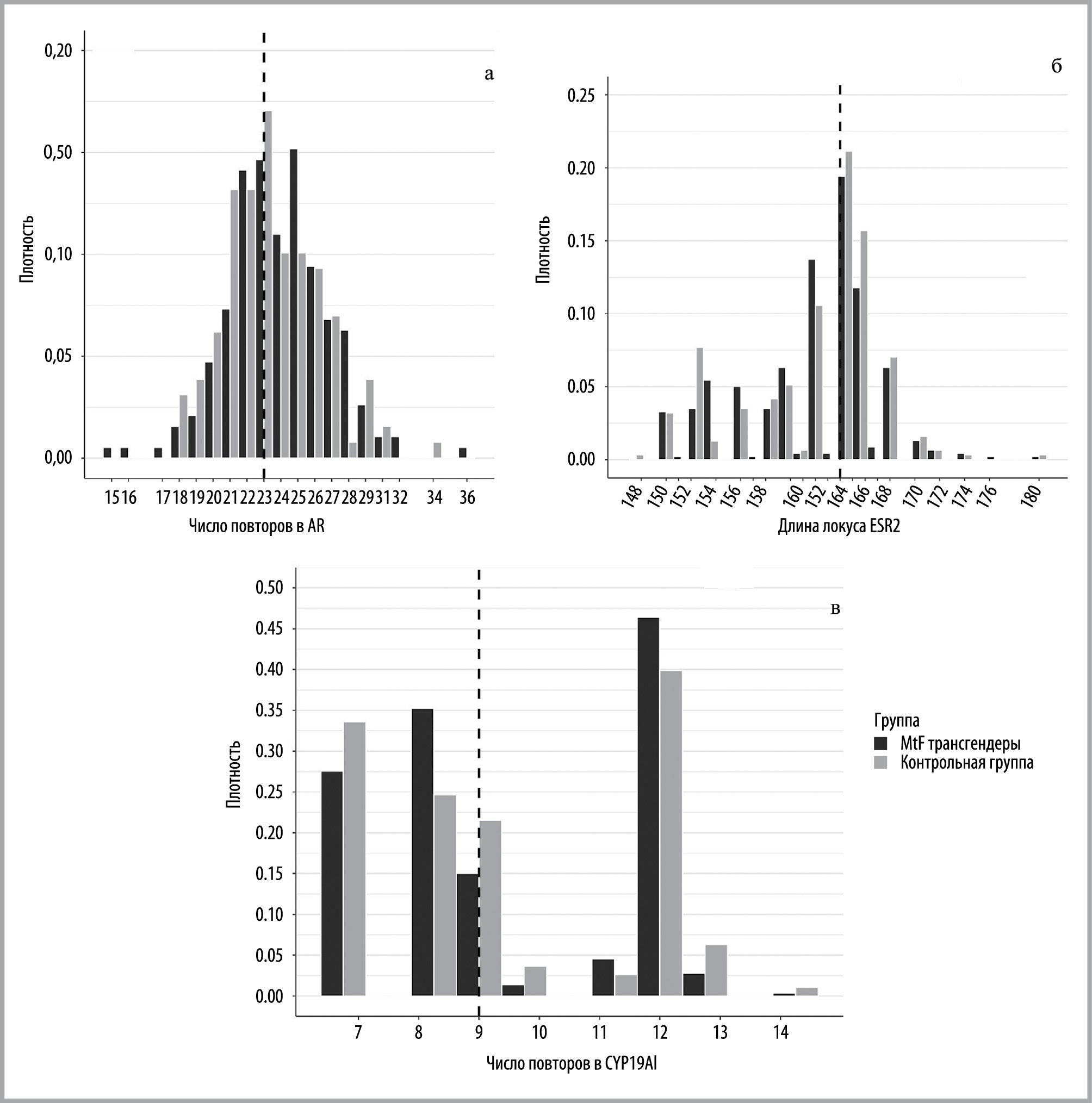
Рисунок 1. Распределение частот аллелей локусов (а) AR, (б) ESR2 и (в) CYP19A1 в MtF и контрольной группах.
Таблица 2. Характеристики медиан тандемных повторов ESR2, AR и CYP19A1 в MtF и контрольных группах
Локус | Группа | N | Среднее тандемных повторов | SD | Медиана тандемных повторов | U-критерий Mann-Whitney | p-value |
ESR2 | контроль | 130 | 161,98 | 5,26 | 164,0 | 47267,50 | 0,29 |
MtF | 191 | 161,76 | 5,49 | 162,5 | |||
AR | контроль | 129 | 24,95 | 2,84 | 24 | 13835,50 | 0,06 |
MtF | 191 | 24,95 | 2,96 | 25 | |||
CYP 19A1 | контроль | 127 | 9,50 | 2,17 | 9 | 48828,5 | 0,89 |
MtF | 191 | 9,54 | 2,12 | 9 |
Таблица 3. Данные частот аллелей локусов ESR2, AR и CYP19A1 после разделения на короткие и длинные аллели
Локус | Аллели | Частоты в MtF группе (%) | Частоты в контрольной группе (%) | Хи-квадрат тест | p-value | |
ESR2 | Корот. | ≤164 | 280 (73,3) | 178 (68,5) | 1,77 | 0,183 |
Длин. | >164 | 102 (26,7) | 82 (31,5) | |||
Всего | 382 (100) | 260 (100) | ||||
AR | Корот. | ≤24 | 88 (46,07) | 73 (56,58) | 3,406 | 0,083 |
Длин. | >24 | 103 (53,93) | 56 (43,41) | |||
Всего | 191 (100) | 129 (100) | ||||
CYP 19A1 | Корот. | ≤9 | 223 (58,4) | 152 (59,8) | 0,08 | 0,713 |
Длин. | >9 | 159 (41,6) | 102 (40,2) | |||
Всего | 382 (100) | 254 (100) | ||||
Таблица 4. Частоты генотипов ESR2, AR и CYP19A1, сгруппированных по длине аллелей на SS, SL и LL
Локус | Генотипы | Частоты в MtF группе (%) | Частоты в контрольной группе (%) | Хи-квадрат тест | p-value |
ESR2 | SS | 109 (57,07) | 63 (48,46) | 2,3881 | 0,303 |
SL | 62 (32,46) | 52 (40,00) | |||
LL | 20 (10,47) | 15 (11,54) | |||
Всего | 191 (100) | 130 (100) | |||
AR | S | 88 (46,07) | 73 (56,58) | 2,9983 | 0,083 |
L | 103 (53,93) | 56 (43,42) | |||
Всего | 191 (100) | 129 (100) | |||
CYP 19A1 | SS | 69 (36,13) | 46 (36,22) | 0,46236 | 0,793 |
SL | 85 (44,50) | 60 (47,24) | |||
LL | 37 (19,37) | 21 (16,54) | |||
Всего | 191 (100) | 127 (100) |
На следующем этапе статистического анализа был применен метод логистической регрессии для выявления ассоциаций между генотипами рассматриваемых локусов и клинической картиной ТС с учетом степени выраженности ГД у MtF. Были протестированы кодоминантная, доминантная и рецессивная модели и рассчитан информационный критерий Акаике (Akaike information criterion, AIC), однако статистически значимых ассоциаций не было выявлено (табл. 5).
Таблица 5. Ассоциации между аллельным полиморфизмом изученных генов и MtF транссексуализмом
Генотип | Контрольная группа, N (%) | MtF, N (%) | Модель | ОШ; 95% ДИ |
Ген ESR2 | ||||
LL | 15 (11,5) | 20 (10,5) | Кодоминантная, p=0,303, AIC=437 | 1,00 |
SL | 52 (40,0) | 62 (32,5) | 0,89; 0,42—1,92 | |
SS | 63 (48,5) | 109 (57,1) | 1,30; 0,62—2,71 | |
LL | 15 (11,5) | 20 (10,5) | Доминантная, p=0,764, AIC=437,2 | 1,00 |
SL—SS | 115 (88,5) | 171 (89,5) | 1,12; 0,55—2,27 | |
LL—SL | 67 (51,5) | 82 (42,9) | Рецессивная, p=0,129, AIC=435,0 | 1,00 |
SS | 63 (48,5) | 109 (57,1) | 1,41; 0,90—2,21 | |
Ген CYP 19A1 | ||||
SS | 46 (36,2) | 69 (36,1) | Кодоминантная, p=0,792, AIC=433,4 | 1,00 |
SL | 60 (47,2) | 85 (44,5) | 0,94; 0,57—1,55 | |
LL | 21 (16,5) | 37 (19,4) | 1,17; 0,61—2,26 | |
SS | 46 (36,2) | 69 (36,1) | Доминантная, p=0,986, AIC=431,9 | 1,00 |
Sl—LL | 81 (63,8) | 122 (63,9) | 1,00; 0,63—1,60 | |
SS—SL | 106 (835) | 154 (80,6) | Рецессивная, p=0,519, AIC=431,5 | 1,00 |
LL | 21 (16,5) | 37 (19,4) | 1,21; 0,67—2,19 | |
Примечание. ОШ — отношение шансов; ДИ — доверительный интервал; AIC — информационный критерий Акаике.
При делении выборки MtF на три подгруппы (ядерные, переходные и краевые) были рассчитаны медианные значения числа повторов для гена андрогенового рецептора. Медианное значение для ядерных и переходных трансгендеров оказалось одинаковым — 25 повторов, в то время как для краевых оно составило 24,5 повтора. Поскольку в группе контроля медиана равна 24 повторам, значение для краевых трансгендеров оказалось средним между контрольной группой и двумя другими подгруппами MtF. При сравнении объединенной группы ядерных и переходных MtF с группой контроля была получена близкая к статистической значимости тенденция к различию этих вариантов MtF с мужчинами, не имеющими проблем половой идентификации (p=0,06). Данные по гену AR представлены в табл. 2.
Исследования, направленные на изучение генетической основы транссексуализма немногочисленны и зачастую демонстрируют противоречивые результаты, как это показано для выборок из Испании, Австралии и Японии [10—13]. Наша работа является первой подобного рода в России. Нами изучены 191 пациент MtF с различной по степени выраженности клинической картиной ТС и 129 индивидов, не страдающих гендерной дисфорией по трём локусам (AR, ESR2 и CYP19A1). По итогам нашего исследования статистически значимых ассоциаций между транссексуализмом и этими генами найдено не было, что согласуется с результатами работ других исследователей [10,11,13]. Однако ранее была показана ассоциация ТС на выборке MtF с длинными аллелями гена андрогенового рецептора AR, длинными аллелями гена эстрогенового рецептора ESR2 и с геном ароматазы CYP19A1 [9, 10]. Следует отметить, что разделение пациентов на подгруппы с различной степенью выраженности клинических проявлений ТС в зарубежных работах не проводилось. Противоречивые результаты, полученные разными группами ученых, связаны с тем, что они использовали выборки из разных географических регионов, часто различающихся по численности. Вопрос о частотах встречаемости разных аллелей трех рассматриваемых локусов в разных популяциях еще недостаточно изучен. Аналогично с другими подобными работами, в нашем исследовании все аллели были сгруппированы в длинные и короткие. Разные исследователи по-разному классифицировали аллели как длинные и короткие, что также могло оказать влияние на полученные результаты. В нашей работе, как и в работах L. Hare и соавт. (2009) и R. Fernándes и соавт. (2014), для этой цели использовано медианное значение числа повторов для изучаемой выборки [10,13]. H. Ujike и соавт. (2009) использовали пороговые значения для длинных и коротких аллелей, взятые из работы L. Hare и соавт. (2009), а S. Henningsson и соавт. (2005) взяли такое число аллелей, чтобы при делении на короткие и длинные, эти группы получились одинакового размера [9—11].
Наши оценки частоты встречаемости у MtF генотипов SS гена ESR2 и генотипа L гена AR могут быть скорректированы при расширении выборки и окажутся статистически значимыми. Также при сравнении группы MtF с «ядерной» и «переходной» клиническими формами транссексуализма с контрольной выборкой нами обнаружены близкие к статистической значимости различия в распределении числа микросателлитных повторов гена AR. Известно, что именно длинные аллели гена AR ассоциированы с феминизацией мозга за счет снижения эффективности передачи сигнала тестостерону [10]. Поскольку гормональный фон матери влияет на развитие организма, начиная с внутриутробного периода, некоторые гормоны одновременно с влиянием на развитие мозга оказывают влияние и на развитие скелета человека [24]. Можно предположить, что у индивидов с нарушением половой идентификации есть и определенные фенотипические особенности, еще до начала гормональной терапии, например, в пропорциях скелета. Так, ранее было показано, что индивиды MtF имеют относительно более длинные конечности и большее число CAG-повторов гена AR, чем в группе FtM (англ: female -to- male) [24].
Заключение
Таким образом, результаты настоящей работы косвенно подтверждают вовлеченность андрогенового рецептора в развитие ТС. В дальнейшем желательно расширить спектр изучаемых маркеров на предмет связи с ТС [25, 26], а также провести подобные исследования на новых выборках.
Финансирование работы. Работа выполнена при финансовой поддержке гранта РНФ № 23-24-00123 «Разработка молекулярно-генетических маркёров, ассоциированных с врождёнными необратимыми нарушениями половой самоидентификации человека».
Соблюдение этических стандартов. Исследование проведено на основании полученного информированного согласия пациентов и одобрено локальным этическим комитетом (№ 172 от 06.11.2024 г) при АО «Научный центр персонализированной медицины».
Авторы заявляют об отсутствии конфликта интересов.
- International Statistical Classification of Diseases and Related Health Problems 10th Revision. Accessed November 26, 2024. https://icd.who.int/browse10/2019/en#/F64.0
- ICD-11 for Mortality and Morbidity Statistics (ICD-11 MMS, Version: 01/2023). Accessed November 26, 2024. https://icd.who.int/browse11/lm/en/#/http%3a%2f%2fid.who.int%2ficd%2fentity%2f41140068
- Курило Л.Ф., Хаят С.Ш., Калинченко С.Ю., Слонимский Б.Ю., Сорокина Т.М. Нарушение развития структур головного мозга при транссексуализме (обзор литературы). Андрология и генитальная хирургия. 2013;3:12-18.
- Bao A-M, Swaab DF. Sexual differentiation of the human brain: relation to gender identity, sexual orientation and neuropsychiatric disorders. Front Neuroendocrinol. 2011;32(2):214-226. https://doi.org/10.1016/j.yfrne.2011.02.007
- Luders E, Sánchez FJ, Tosun D, Shattuck DW, Gaser C, Vilain E, Toga AW. Increased Cortical Thickness in Male-to-Female Transsexualism J Behav Brain Sci. 2012;2(3):357-362. https://doi.org/10.4236/jbbs.2012.23040
- Rametti G, Carrillo B, Gómez-Gil E, Junque C, Zubiarre-Elorza L, Segovia S,er al. The microstructure of white matter in male to female transsexuals before cross-sex hormonal treatment. A DTI study. J Psychiatr Res. 2011;45(7):949-954. https://doi.org/10.1016/j.jpsychires.2010.11.007
- Heylens G, De Cuypere G, Zucker KJ, Schelfaut C, Elaut E, Vanden Bossche H, et al. Gender identity disorder in twins: a review of the case report literature. J. Sex Med. 2012;9(3):751-757. https://doi.org/10.1111/j.1743-6109.2011.02567.x
- Karamanis G, Karalexi M, White R, Frisell T, Isaksson J, Skalkidou A & Papadopoulos F.C. Gender dysphoria in twins: a register-based population study. Sci. Rep. 2022;12,13439. https://doi.org/10.1038/s41598-022-17749-0
- Henningsson S, Westberg L., Nilsson S, Lundström B, Ekselius L, Bodlund O, et al. Sex steroid-related genes and male-to-female transsexualism. Psychoneuroendocrinology. 2005;30(7):657-664. https://doi.org/10.1016/j.psyneuen.2005.02.006
- Hare L, Bernard P, Sánchez F, Baird P, Vilain E, Kennedy T, Harley V. Androgen receptor repeat length polymorphism associated with Male-to-Female transsexualism. Biol Psychiatry. 2009;65:93-96. https://doi.org/10.1016/j.biopsych.2008.08.033
- Ujike H, Otani K, Nakatsuka M, Ishii K, Sasaki A, Oishi T, et al. Association study of gender identity disorder and sex hormone-related genes. Prog Neuropsychopharmacol Biol Psychiatry. 2009;33(7):1241-1244. https://doi.org/10.1016/j.pnpbp.2009.07.008
- Fernández R, Esteva I, Gómez-Gil E, Rumbo T, Almaraz MC, Roda E, et al. The (CA)n polymorphism of ERβ gene is associated with FtM transsexualism. J. Sex. Med. 2014; 11(3):720-728. https://doi.org/10.1111/jsm.12398
- Fernández R, Esteva I, Gómez-Gil E, Rumbo T, Almaraz MC, Roda E, et al. Association study of ERβ, AR, and CYP19A1 genes and MtF transsexualism. J. Sex. Med. 2014; 11(12):2986-2994. https://doi.org/10.1111/jsm.12673
- Бухановский А.О. О клинической картине и формировании транссексуализма. Журнал невропатологии и психиатрии им. С.С. Корсакова. 1986;86(2):270-276.
- Васильченко Г.С. Частная сексопатология: (Руководство для врачей). Т.2. М.: Медицина, 1983;53-65.
- Butovskaya ML, Vasilyev VA, Lazebny OL, Burkova VN, Kulikov AV, Mabulla A, et al. Aggression, digit ratio, and variation in the androgen receptor, serotonin transporter, and dopamine D4 receptor genes in African foragers: the Hadza. Behav. Genet. 2012;42:647-662. https://doi.org/10.1007/s10519-012-9533-2
- Tsukamoto K, Inoue S, Hosoi T, Orimo H, Emi M. Isolation and radiation hybrid mapping of dinucleotide repeat polymorphism at the human estrogen receptor beta locus. J Hum. Genet. 1998;43:73-74. https://doi.org/10.1007/s100380050043
- R Core Team (2024). R: A language and environment for statistical computing. R Foundation for Statistical Computing, Vienna, Austria. https://www.R-project.org/
- González JR, Armengol L, Solé X, Guinó E, Mercader JM, Estivill X, Moreno V. SNPassoc: An R Package to Perform Whole Genome Association Studies. Bioinformatics 2007;23,654-655. https://doi.org/10.1093/bioinformatics/btm025
- Aragon TJ, Fay MP, Wollschlaeger D, Omidpanah A. Epitools: Epidemiology Tools. 2020. Accessed November 26, 2024. https://CRAN.Rproject.org/package=epitools.
- Wickham H. Ggplot2: elegant graphics for data analysis. New York: Springer. 2009 Accessed November 26, 2024. https://ms.mcmaster.ca/~bolker/misc/ggb.pdf
- Patil I. Visualizations with statistical details: The ‘ggstatsplot’ approach. Journal of Open Source Software. 2021;6(61):3167. https://doi.org/10.21105/joss.03167
- Chamberlain N, Driver E, Miesfeld R. The length and location of CAG trinucleotide repeats in the androgen receptor N-terminal domain affect transactivation function. Nucl. Acids Res. 1994;22(15):3181-3186. https://doi.org/10.1093/nar/22.15.3181
- Соловьева Н.В., Макарова Е.В., Вильянов Б.В., Кременицкая С.А., Чаусова С.В, Кичук И.В. и др. Особенности формирования скелета в зависимости от полиморфизма гена андрогенового рецептора у лиц с транссексуализмом. Молекулярная медицина. 2019;17(4):28-33. https://doi.org/10.29296/24999490-2019-04-05
- Foreman M, Hare L, York K, Balakrishnan K, Sánchez FJ, Harte F, et al. Genetic link between gender dysphoria and sex hormone signaling. J. Clin. Endocrinol. Metab. 2019;104(2):390-396. https://doi.org/10.1210/jc.2018-01105
- Juli G, Juli MR, Juli R, Juli L. Gender Dysphoria and DNA. Psychiatr Danub. 2023;35(2):179-181. PMID: 37800223.



Рекомендуем статьи по данной теме:
Профессор Виктор Николаевич Звягин. К 85-летию со дня рождения.Судебно-медицинская экспертиза. 2026;69(5):67-70
Профессор Виктор Ильич Прозоровский. К 125-летию со дня рождения.Судебно-медицинская экспертиза. 2026;69(5):65-66
Алевтина Михайловна Орлова. К 80-летию со дня рождения.Судебно-медицинская экспертиза. 2026;69(5):63-64
Профессиональная подготовка специалистов в области судебно-химической и химико-токсикологической экспертизы: ключевые аспекты.Судебно-медицинская экспертиза. 2026;69(5):56-62
К вопросу о судебно-медицинском значении трупной имбибиции вокруг подкожных вен в случаях смерти от общего переохлаждения.Судебно-медицинская экспертиза. 2026;69(5):49-55
Роль магнитно-резонансной томографии в диагностике диффузного аксонального повреждения.Судебно-медицинская экспертиза. 2026;69(5):42-48
Анатомические варианты, аномалии и другие неметрические характеристики скелета при судебно-медицинской экспертизе костных останков (случаи из практики).Судебно-медицинская экспертиза. 2026;69(5):38-41
Сравнительная характеристика огнестрельных повреждений, произведенных с разного расстояния самоснаряженными и фабрично изготовленными патронами 12-го калибра при выстрелах из ружья МЦ 21-12.Судебно-медицинская экспертиза. 2026;69(5):32-37
Электронно-микроскопическая характеристика повреждений волос, причиненных предметами различной остроты.Судебно-медицинская экспертиза. 2026;69(5):28-31
О возможности установления видовой принадлежности пятен слюны методом количественного иммуноферментного анализа.Судебно-медицинская экспертиза. 2026;69(5):24-27