Влияние инактивации гена гибридной гистидинкиназы на морфологию клеток у бактерий Azospirillum baldaniorum и Azospirillum brasilense
Журнал: Молекулярная генетика, микробиология и вирусология. 2025;43(3):47-54.
DOI: 10.17116/molgen20254303147
Прочитано: 623 раза
Резюме
ЦЕЛЬ
Работы — проверка гипотезы о влиянии расположенного на хромосоме гена HSHK-RR, кодирующего гибридную мультисенсорную гистидинкиназу, на морфологию бактерий рода Azospirillum.
МАТЕРИАЛ И МЕТОДЫ
В работе использовали штаммы A. baldaniorum Sp245, Lafˉ мутант Sp245.1062 (Sp245-HSHKDRR-Km), A. brasilense Sp7 и Sp7.10030 (Sp7-HSHKDRR-Km). Морфология бактерий и их подвижность охарактеризованы с применением электронной микроскопии. Относительный уровень транскрипции генов определяли методом ПЦР в реальном времени.
РЕЗУЛЬТАТЫ
Гены гибридной мультисенсорной гистидинкиназы (HSHK-RR) у штаммов Sp245 (AZOBR_150176) и Sp7 (AMK58_10030) на 95% гомологичны. Для получения мутанта штамма Sp7 мы произвели замену гена AMK58_10030 на конструкцию HSHKDRR-Km, созданную на основе AZOBR_150176. Замена внутреннего фрагмента гена HSHK-RR на ген устойчивости к канамицину приводила у мутантов Sp245-HSHKDRR-Km и Sp7-HSHKDRR-Km к изменению морфологии и подвижности клеток в полужидком агаре. Клетки мутантов были короче клеток родительских штаммов Sp245 и Sp7 и двигались медленнее в полужидком агаре, образуя колонии значительно меньшего диаметра. Оба мутанта сохраняли синтез функционирующего полярного жгутика (Fla). Однако в случае Sp7-HSHKDRR-Km до 45% клеток синтезировали на агаризованных средах редкие или единичные латеральные жгутики (Laf), тогда как у Sp245-HSHKDRR-Km таких бактерий было не более 15%.
ЗАКЛЮЧЕНИЕ
Установлено, что биогенез Laf находится под многоступенчатым контролем, включающим двухкомпонентную систему передачи сигналов с участием HSHK-RR, кодируемой хромосомными генами, у Sp245 и Sp7, соответственно, штаммам AZOBR_150176 и AMK58_10030. Анализ фенотипов мутантов по генам AZOBR_150176 и AMK58_10030 показал, что исследуемая HSHK-RR модулирует подвижность Sp245 и Sp7 в условиях механического стресса, участвуя в контроле транскрипции генов флагеллина laf1 и компонентов экспортной системы сборки латеральных жгутиков.
Ключевые слова
- Azospirillum
- смешанное жгутикование
- подвижность
- гистидинкиназа
- жгутики
Дата поступления: 05.02.2025
Дата принятия в печать: 12.04.2025
Дата публикации: 02.10.2025
Альфапротеобактерии рода Azospirillum известны как ризосферные микроорганизмы, стимулирующие рост и развитие растений [1, 2]. Эффективность взаимодействия азоспирилл с растениями определяется подвижностью, хемо- и аэротаксисом, прикреплением бактерий к корням и дальнейшей их адаптацией к существованию в этой экологической нише [1, 3]. Определенную роль в восприятии бактериями сигналов окружающей среды и приспособлении к изменяющимся условиям играют двухкомпонентные системы передачи сигнала (TCS, two component signal transduction systems) [3, 4]. TCS участвуют в регуляции экспрессии генов адаптации ризосферных бактерий к динамичным условиям почвы [3, 5]. Геном A. baldaniorum Sp245 содержит не менее 259 предполагаемых генов двухкомпонентных сенсорных систем, включая 129 гистидинкиназ — 74 классических и 55 генов предполагаемых гибридных сенсорных гистидинкиназ ( HSHK—RR, hybrid sensor histidine kinase/response regulator [3]. В целом, это свидетельствует о сложной организации путей передачи сигналов, влияющих на активность генов у азоспирилл [3, 5]. На хромосоме A. baldaniorum Sp245 в кластере генов биогенеза Fla находится ген, кодирующий белок HSHK—RR [6]. Этот белок содержит два трансмембранных участка в пределах своей N-концевой области и, таким образом, связан с цитоплазматической мембраной, а наличие в сенсорной части трех сенсорных PAS доменов предполагает, что это мультисенсорный белок [3, 6]. Домены PAS могут воспринимать широкий спектр сигналов. Кроме гистидинкиназного домена белок также содержит промежуточный домен REC регулятора ответа (RR). Очевидно, мультисенсорный белок HSHK-RR, способный аккумулировать широкий диапазон сигналов, модулирует несколько клеточных процессов. В хромосоме A. brasilense Sp7 ген, кодирующий похожий белок, также связан с кластером генов биогенеза Fla.
У азоспирилл гены, опосредующие синтез жгутиков, подвижность и хемотаксис, диспергированы по геному. Например, у Sp245 гены биогенеза Laf распределены на плазмиде AZOBR_p4, а гены, необходимые для синтеза Fla, локализованы на хромосоме, AZOBR_p1 и AZOBR_p3 [2, 6—8]. Процессы, запускающие изменение морфологии бактерий и активацию подвижности при участии Fla и Laf (роение), позволяют Sp245 и Sp7 приспосабливаться к стрессу, вызванному повышением плотности окружающей среды [6—10]. Получены данные об участии в этих процессах у Sp245 HSHK-RR [6, 11].
Целью данной работы являлась проверка гипотезы о влиянии расположенного на хромосоме гена HSHK-RR, кодирующего гибридную мультисенсорную гистидинкиназу, на морфологию бактерий рода Azospirillum.
Материал и методы
Бактериальные штаммы, среды и условия культивирования. Использованные в работе штаммы бактерий представлены в табл. 1. Бактерии культивировали при 30 °C или 37 °C на малатно-солевой среде (МСС) [12] и LB [13]. При необходимости в среды добавляли канамицин (Km; 50 мкг/мл), тетрациклин (Tc; 25 мкг/мл) и Бакто агар (1,8, 0,4 и 0,2%).
Таблица 1. Штаммы бактерий, плазмиды и праймеры, использованные в работе
Штамм или плазмида | Характеристика | Источник |
Штаммы: Azospirillum baldaniorum: Sp245 (IBPPM 219) | Дикий тип, выделен в Бразилии из корней пшеницы (Triticum sp.) | [14, 15] |
Sp245.1062 | Мутант штамма Sp245, у которого вместо PstI-фрагмента гена AZOBR_150176 клонирован ген устойчивости к канамицину, KmR | [11] |
Sp245.1062(pRK415-150176) | Производный штамма Sp245.1062, содержащий pRK415-150176, KmR, TcR | [11] |
Azospirillum brasilense: Sp7 (IBPPM 150) | Дикий тип, выделен в Бразилии из ризосферы росички лежачей (Digitaria decumbens) | [16] |
Sp7.10030 | Мутант штамма Sp7, у которого произведена замена гена AMK58_10030 на ген AZOBR_150176, у которого вместо внутреннего PstI-фрагмента гена длиной 666 п.н. клонирован ген устойчивости к канамицину, KmR | Данная работа |
Escherichia coli: K802 | supE hsdR gal metB, использован для поддержания плазмиды pRK2013 | [13] |
DH5α | supE44 ΔlacU169 (ϕ80 lacZ ΔM15) hsdR17 recA1 endA1 gyrA96 thi-1 relA1; использован для поддержания плазмид pRK415, pEX18Tc, pUC4K и полученных нами генетических конструкций | [13] |
Плазмиды: pRK2013 | Плазмида-помощник узкого круга хозяев, repColE1, Tra+, 48 т.п.н., KmR | [17] |
pEX18Tc-HSHKDRR-Km | pEX18Tc, содержащая фрагмент ДНК A. baldaniorum Sp245 с CDS AZOBR_150176, у которого вместо внутреннего PstI-фрагмента гена AZOBR_150176 длиной 666 п.н. клонирован ген устойчивости к канамицину из pUC4K, TcRKmR | [11] |
Праймеры к Km-кассете: Km-F Km-R | CATCGGGCTTCCCATACA TGCCATTCTCACCGGATT | |
Праймеры для анализа транскрипции генов, размер ПЦР-фрагмента | ||
AZOBR_150176/ AMK58_10030, 279 п.н. 150176-F 150176-R | CATCGTCACCTCCAACCATGT GGCAGCAGGATGGTAAAGGT | |
AZOBR_p410056 / AMK58_26185 (laf1), 232 п.н. laf1-rt-F laf1-rt-R | TCTCAAGGTCAACAACGCCA GTCGTTCTGGATCAGCGACT | |
rpoD, 118 п.н. rpoD-118-rt-F rpoD-118-rt-R | Cgtcacctatgacgagctga Ctcttccgattcgacgatgt | |
Выделение и очистка ДНК и РНК, ОТ-ПЦР и РВ-ПЦР. Геномную ДНК выделяли с использованием набора GeneJET Genomic DNA Purification Kit (ThermoScientific, США). Праймеры для ПЦР (см. табл. 1) синтезировали в компании Синтол (Москва, Россия). ПЦР проводили в термоциклере T100 (BioRad Laboratories, США). Для выделения РНК бактериальные клетки с агаризованной среды собирали, отмывали 50 мМ фосфатным буфером (ФБ, pH 7) и суспендировали в нем до ОП590=1. РНК выделяли, используя NucleoZOL (Macherey-Nagel, Германия), обрабатывали ДНКазой I (ThermoFS, США). Концентрацию РНК определяли с помощью набора Qubit RNA BR Assay Kits на флуориметре Qubit 4 (ThermoFS, США). кДНК синтезировали (ОТ-ПЦР), используя набор MMLV RT kit (Евроген, Россия) с добавлением ингибитора рибонуклеаз Ribolock (ThermoFS, США). Чистоту РНК проверяли ПЦР на РНК и полученной кДНК с использованием праймеров (см. табл. 1) для амплификации гена rpoD [18]. ПЦР в реальном времени (РВ-ПЦР) проводили с использованием набора для ПЦР qPCRmix-HS SYBR+HighROX (Евроген, Россия) на приборе Applied Biosystems 7300 (Applied Biosystems, USA) при следующих условиях: 5 мин при 95 °C, затем 40 циклов по 15 с при 95 °C, 30 с при 60 °C и 30 с при 72 °C. В качестве эндогенного контроля использовали ген rpoD [18]. Профили экспрессии генов-мишеней определяли относительно уровня экспрессии rpoD с использованием метода 2-ΔΔCT [19].
Проведение мутагенеза. Для мутагенеза CDS AZOBR_150176 (Sp245) и CDS AMK58_10030 (Sp7) использована конструкция pEX18Tc-HSHKDRR-Km [11], в которой вместо внутреннего PstI-фрагмента гена AZOBR_150176 длиной 666 п.н. был клонирован ген устойчивости к канамицину из pUC4K (aphAI). Введение в клетки азоспирилл pEX18Tc-HSHKDRR-Km проводили с помощью трехродительского скрещивания (с использованием плазмиды-помощника pRK2013) способом, описанным ранее [11]. Для подтверждения присутствия гена aphAI вместо PstI-фрагмента гена AMK58_10030, у полученных мутантов Sp7-HSHKDRR-Km (Sp7.10030) проводили ПЦР с праймерами к aphAI в парах с праймерами к последовательностям ДНК, прилегающим к AMK58_10030, с последующим секвенированием полученных фрагментов ДНК.
Анализ скорости роста и движения клеток, жгутикования и подвижности бактерий. Для изучения скорости роста планктонные культуры разводили до значений ОП590=0,05—0,10 (l=0,5 см) жидкой МСС и инкубировали при 140 об/мин, измеряя ОП590 каждые 2 ч. Скорость движения клеток в жидких средах определяли способом, описанным ранее [11]. Подвижность на полужидких средах оценивали, измеряя диаметр колоний, сформированных через 24—72 ч. Размер клеток и наличие жгутиков определяли, анализируя результаты электронной микроскопии способом, описанным ранее [6]. Электронную микроскопию клеток выполняли на микроскопе Libra 120 (“Carl Zeiss”, Германия), находящегося в ЦКП «Симбиоз» ИБФРМ РАН (Саратов, Россия).
Статистическая обработка результатов. Доверительные интервалы определяли для 95% уровня значимости. Статистически значимые различия выявляли с использованием однофакторного дисперсионного анализа (ANOVA) при уровне значимости 0,05.
Результаты и обсуждения
Нуклеотидные последовательности AZOBR_150176 и AMK58_10030, кодирующие HSHK‒RR, расположены среди генов биогенеза Fla, соответственно, на хромосомах Sp245 и Sp7. Сравнение нуклеотидных последовательностей AZOBR_150176 или AMK58_10030 показало наличие гомологии (95%). Для поиска промоторов, расположенных перед AZOBR_150176 и AMK58_10030, была использована программа iPromoter-2L (https://bliulab.net/iPromoter-2L/server [20]. Мы обнаружили область, содержащую последовательности промоторов σ70 и σ32 [20—22], которая располагались на 38 п.н. выше AZOBR_150176 или AMK58_10030. Следующий участок, содержащий последовательности промоторов σ70 и σ32, был обнаружен выше гена flgB. Это позволяет предположить, что ген AZOBR_150176 может транскрибироваться независимо от генов flgB, flgC, fliE, fliQ2, fliR и flhB1, которые транскрибируются в том же направлении и, повидимому, образуют оперон. Последовательности σ32- и σ70-зависимых промоторов могут перекрываться [22].
В результате трехродительского скрещивания был получен мутант штамма Sp7 — Sp7.10030. У мутанта Sp7.10030 произошла замена гена AMK58_10030 на конструкцию HSHKDRR-Km. Можно было ожидать, что мутантный белок Sp7.10030 сохранит трансмембранные участки N-концевой области, PAS домены сенсорной части HSHK—RR и 64 аминокислотных остатка (домен His_Kin) гистидинкиназного домена (His_Kin), остальная часть белка будет утрачена, как и в случае HSHKDRR-Km мутанта штамма Sp245 (Lafˉ мутант Sp245.1062 [11]). Результаты РВ-ПЦР с использованием праймеров к утраченной части гена HSHK—RR (из последовательности гена было удалено 666 п.н. [11]) показали, что у Sp7.10030, как и у Sp245.1062 отсутствовал сигнал (рис. 1, 2). У родительских штаммов Sp7 и Sp245 относительный уровень транскрипции (ОУТ) HSHK—RR не отличался (см. рис. 2 а). В клетках Lafˉ мутанта Sp245.1062 транскрипция laf1 снижалась в 7,2 раза, а в случае Sp7.10030 в 2,3 раза(см. рис. 2 б). У штаммов Sp7 и Sp245 laf1 транскрибировался одинаково (см. рис. 2 б). Снижение уровня транскрипции laf1 позволяет ожидать нарушение биогенеза Laf и у мутанта Sp7.10030.
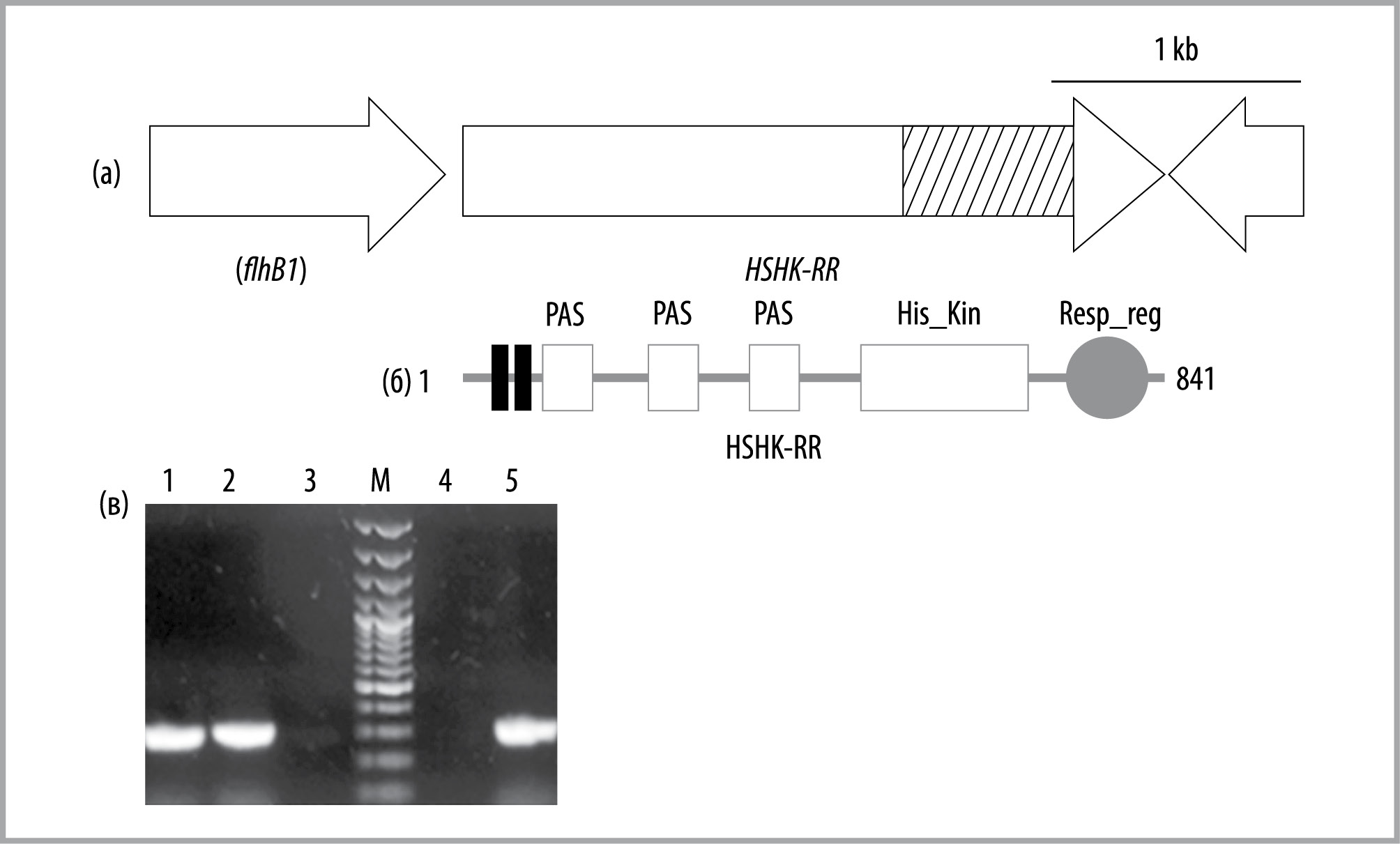
Рис. 1. Результаты РВ-ПЦР: а — схема участка хромосомной ДНК A. baldaniorum Sp245/A. brasilense Sp7/
Широкие горизонтальные стрелки указывают положение и ориентацию CDS; у мутантов HSHKDRR-Km произведена замена внутреннего фрагмента PstI (заштрихованный прямоугольник гена HSHK-RR) на кассету KmR; б — доменная организация прогнозируемых продуктов трансляции гена HSHK-RR (HSHK-RR, гибридная сенсорная гистидин-киназа/регулятор ответа; 841 аминокислотный остаток): PAS, сенсорные домены PAS; His_Kin, домен гистидинкиназы; Resp_reg, принимающий домен регулятора ответа в системе передачи сигнала; в — результаты электрофореза в 2% агарозном геле продуктов РВ-ПЦР с кДНК Sp245 (дорожка 1), Sp245.1062(pRK415-150176) (дорожка 2), Sp245.1062 (дорожка 3), Sp7.10030 (дорожка 4), Sp7 (дорожка 5) с праймерами к области удаленного фрагмента ДНК (заштрихованный прямоугольник гена HSHK—RR (А)). Дорожка М — маркеры молекулярной массы GeneRuler 100 bp Plus (Fermentas) (набор из фрагментов длиной 100, 200, 300, 400, 500, 600, 700, 800, 900, 1031, 1200, 1500, 2000, 3000 н.п.).
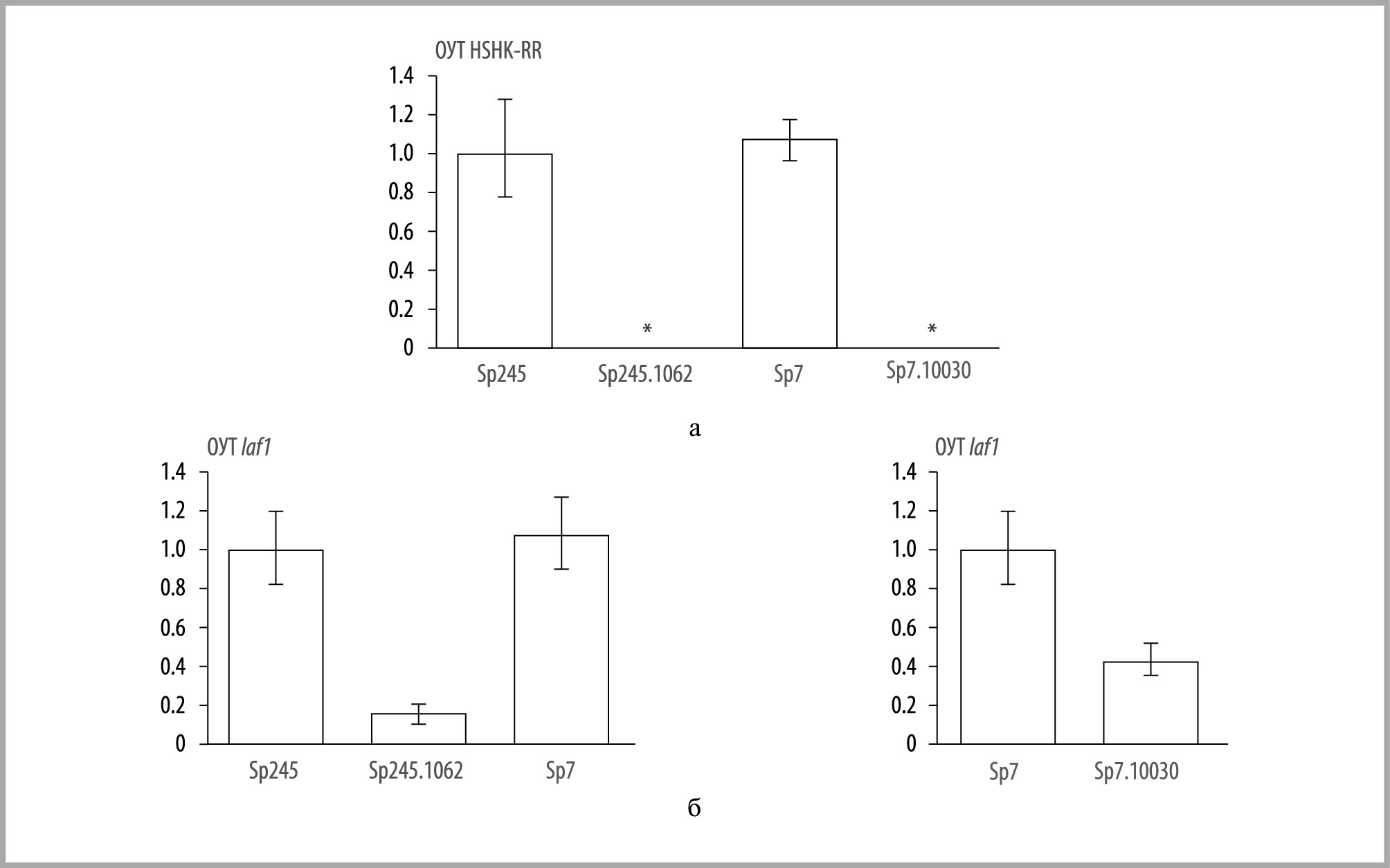
Рис. 2. Результаты анализа транскрипции HSHK—RR ((панель А) AZOBR_150176 (Sp245) и AMK58_10030 (Sp7)) и laf1 ((панель Б) AZOBR_p410056 (Sp245) и AMK58_26185 (Sp7)) в клетках A. baldaniorum и A. brasilense.
Относительный уровень транскрипции (ОУТ) — отношение результатов ПЦР в реальном времени с кДНК исследуемых генов штаммов Sp245.1062, Sp7 и Sp7.10030 к аналогичным результатам Sp245 или Sp7. * — сигнал отсутствовал.
Мутанты Sp7.10030 и Sp245.1062 не отличались от родительских штаммов скоростью роста. Клетки мутантов синтезировали длинный Fla, при помощи которого плавали в жидких средах со скоростью, характерной для Sp7 или Sp245 (табл. 2). В среде с 0,2% агара мутанты, так же, как и родительские штаммы, формировали колонии одинакового размера. На средах с концентрацией агара 0,4% роящиеся клетки Laf–-мутанта Sp245.1062 двигались медленнее клеток Sp245 и имели тенденцию к образованию колоний значительно меньшего диаметра. Такая же тенденция наблюдалась и в случае Sp7.10030 (см. табл. 2).
Таблица 2. Подвижность бактерий в жидкой и полужидкой малатно-солевых средах (МСС)
Штамм | Скорость движения клеток (мкм/с) в жидкой MCC | Длина клеток на агаризованной среде MCC | Диаметр (мм) колец роения (колоний), сформированных на MCC + 0.4 % Бакто агара |
Sp245 | 29,1±1,8 а | 2,7±0,1 б | 19,7±0,9 в |
Sp245.1062 | 27,6±2,0 а | 1,7±0,1 а | 8,9±0,5 б |
Sp245.1062(pRK415-150176) | 28,2±1,8 а | 2,5±0,1 б | 18,4±1,1 в |
Sp7 | 27,9±1.5 А | 2,8±0,2 Б | 20,7±1,4 Б |
Sp7.10030 | 27,8±1,7 А | 1,9±0,2 А | 8,8±0,5 А |
Примечания: бактерии инкубировали 24 ч в жидкой или 48 ч в полужидкой MCC; диаметр зоны инокуляции бактерий в полужидкой среде составлял 5.1±0.3 мм. Приведены средние значения±доверительные интервалы для 95% уровня значимости; различными буквами в столбцах обозначены статистически значимые различия (а и А — минимальные значения), выявленные с помощью однофакторного дисперсионного анализа (ANOVA; P< .05).
У азоспирилл на средах, содержащих от 0.4% агара, происходит индукция синтеза Laf [5, 10]. Клетки штаммов Sp245 и Sp7, выросшие на плотных агаризованных средах, несут многочисленные Laf (рис. 3). В популяции Sp245.1062 13—18% клеток синтезировали редкие или единичные Laf, в случае Sp7.10030 доля таких особей составляла 42-45%. Остальные клетки Sp7.10030 были лишены Laf (см. рис. 3). Оба мутанта сохраняли синтез Fla. Клетки мутантов были короче клеток Sp245 и Sp7 (см. табл. 2).
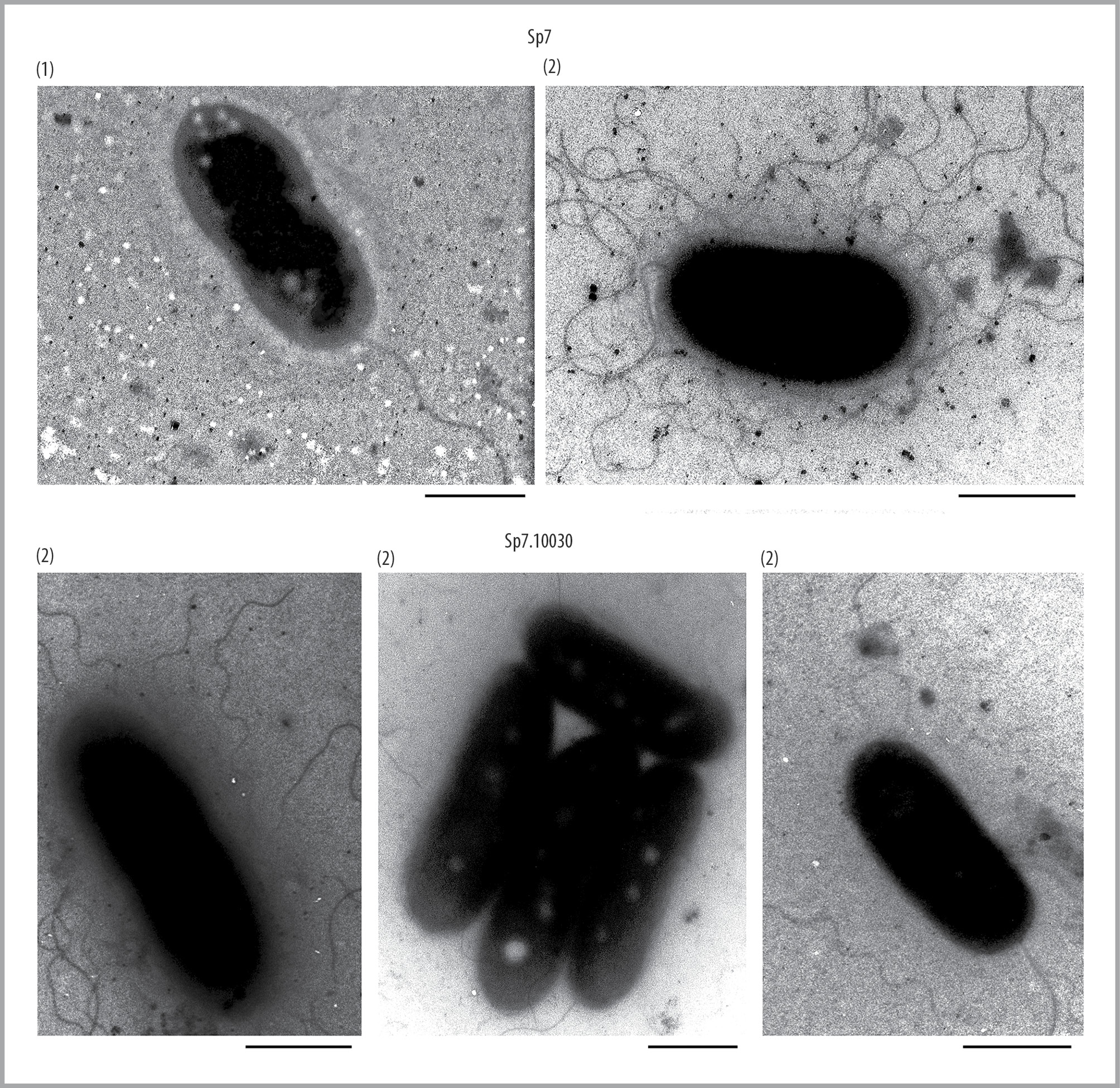
Рис. 3. Просвечивающая электронная микроскопия клеток A. brasilense Sp7 и его мутанта Sp7.10030.
Бактерии выращивали при 30 °C в жидкой МСС 18 ч (1) или на агаризованной МСС 42 ч (2). Масштабная линейка соответствует 1 мкм. Электронную микроскопию клеток выполняли на микроскопе Libra 120 (Carl Zeiss, Германия).
Заключение
В данной работе представлены результаты, свидетельствующие о сложной организации регуляторных сетей TCS у Azospirillum. Так, наличие в популяции Sp7.10030 и Sp245.1062 разной доли клеток, синтезирующих единичные Laf, может являться результатом пересечения HSHK—RR- зависимого пути с другими путями передачи сигналов TCS [4]. В геноме штамма A. brasilense Sp7 имеются четыре гомолога CheY, контролирующие плавание, реакции хемо- и аэротаксиса, влияющие на размер клеток, синтез Laf и роение [8]. Результаты мутагенеза N-концевого трансмембранного домена гистидинкиназы CheA1 из хемотактического пути Che1 показали его участие в регуляции длины клеток Sp7 в жидких средах [23]. Наличие N-концевого трансмембранного домена у CheA1 A. brasilense Sp7 является штамм-специфичной чертой, не выявленной у A. baldaniorum Sp245. Более того, в случае Sp245 мутация в гомологе гена cheA1 не оказала влияния на среднюю длину клеток этого штамма [23]. Анализ фенотипа полученных нами мутантов позволяет полагать, что исследуемая HSHK—RR является частью пути, контролирующего синтез многочисленных Laf и удлинение клеток. Например, одной из конечных мишеней передачи сигнала с участием HSHK—RR может являться регулятор ответа, положительно влияющий на синтез laf1. Эти процессы необходимы для эффективного роения азоспирилл — перемещения по полужидким средам, что позволяет им адаптироваться к механическому стрессу (повышению вязкости/плотности среды). Подобная морфологическая дифференциация характерна для A. baldaniorum, A. brasilense и других видов бактерий [8, 24, 25].
Финансирование. Финансирования не было.
Соблюдение этических стандартов. Авторы заявляют об отсутствии конфликта интересов.
В ходе исследования эксперименты на людях или животных не проводились.
Авторы заявляют об отсутствии конфликта интересов.
- Fukami J, Cerezini P, Hungria M. Azospirillum: benefits that go far beyond biological nitrogen fixation. AMB Express. 2018;8:73. https://doi.org/10.1186/s13568-018-0608-1
- Wisniewski-Dyé F, Borziak K, Khalsa-Moyers G, Alexandre G, Sukharnikov LO, Wuichet K, Hurst GB, McDonald WH, Robertson JS, Barbe V., Calteau A, Rouy Z, Mangenot S, Prigent-Combaret C, Normand P, Boyer M, Siguier P, Dessaux Y, Elmerich C, Condemine G, Krishnen G, Kennedy I, Paterson AH, González V, Mavingui P, Zhulin IB. Azospirillum genomes reveal transition of bacteria from aquatic to terrestrial environments. PLoS Genetics. 2011;7:e1002430. https://doi.org/10.1371/journal.pgen.1002430
- Borland S, Oudart A, Prigent-Combaret C, BrochierArmanet C, Wisniewski-Dyé F. Genome-wide survey of two-component signal transduction systems in the plant growth-promoting bacterium Azospirillum. BMC Genomics. 2015;16:e833. https://doi.org/10.1186/s12864-015-1962-x
- Laub MT, Goulian M. Specificity in two-component signal transduction pathways. Annu Rev Genet. 2007;41:121-145. https://doi.org/10.1146/annurev.genet.41.042007.170548
- Lipa P, Janczarek M. Phosphorylation systems in symbiotic nitrogen-fixing bacteria and their role in bacterial adaptation to various environmental stresses. Peer J. 2020;8:e8466. https://doi.org/10.7717/peerj.8466
- Filip’echeva Yu, Shelud’ko A, Prilipov A, Telesheva E, Mokeev D, Burov A, Petrova L, Katsy E. Chromosomal flhB1 gene of the alphaproteobacterium Azospirillum brasilense Sp245 is essential for correct assembly of both constitutive polar flagellum and inducible lateral flagella. Folia Microbiol. 2018;63:147-153. https://doi.org/10.1007/s12223-017-0543-6
- Dubey AP, Pandey P, Singh VS, Mishra MN, Singh S, Mishra R, Tripathi AK. An ECF41 family σ factor controls motility and biogenesis of lateral flagella in Azospirillum brasilense Sp245. J. Bacteriol. 2020;202:e00231-20. https://doi.org/10.1128/JB.00231-20
- Ganusova EE, Vo LT, Mukherjee T, Alexandre G. Multiple CheY proteins control surface-associated lifestyles of Azospirillum brasilense. Front. Microbiol. 2021;12:664826. https://doi.org/10.3389/fmicb.2021.664826
- Chawla R, Gupta R, Lele TP, Lele PP. A skeptic’s guide to bacterial mechanosensing. J. Molecular Biology. 2020;432:523-533. https://doi.org/10.1016/j.jmb.2019.09.004.
- Moens S, Schloter M, Vanderleyden J. Expression of the structural gene, laf1, encoding the flagellin of the lateral flagella in Azospirillum brasilense Sp7. J. Bacteriol. 1996;178:5017-5019. https://doi.org/10.1128/jb.178.16.5017-5019.1996
- Shelud’ko A, Volokhina I, Mokeev D, Telesheva E, Yevstigneeva S, Burov A, Tugarova A, Shirokov A, Burigin G, Matora L, Petrova L. Chromosomal gene of hybrid multisensor histidine kinase is involved in motility regulation in the rhizobacterium Azospirillum baldaniorum Sp245 under mechanical and water stress. World J Microbiol Biotechnol. 2023;39:336. https://doi.org/10.1007/s11274-023-03785-z
- Döbereiner J, Day JM. Associative symbiosis in tropical grass: Characterization of microorganisms and dinitrogen fixing sites, Symposium on Nitrogen Fixation / eds. Newton WE, Nijmans CJ. Pullman, Washington State University Press; 1976:518-538.
- Sambrook J, Fritsch EF, Maniatis T, eds. Molecular Cloning: A Laboratory Manual. New York: Cold Spring Harbor Laboratory Press, 1989.
- Baldani JI. Survival of endophytic diazotrophic bacteria in soil under different moisture intensities. Braz J Microbiol. 2004;35:295-299. https://doi.org/10.1590/S1517-83822004000300005
- Ferreira NdS, Sant’Anna FH, Reis VM, Ambrosini A, Volpiano CG, Rothballer M, Schwab S, Baura VA, Balsanelli E, Pedrosa FdO, Passaglia LMP, Souza EM, Hartmann A, Cassan F, Zilli JE. Genome-based reclassification of Azospirillum brasilense Sp245 as the type strain of Azospirillum baldaniorum sp. Nov. Microbiol. Society. 2020;70:6203-6212. https://doi.org/10.1099/ijsem.0.004517
- Tarrand JX, Krieg NE, Döbereiner J. A taxonomic study of the Spirillum lipoferum group, with descriptions of a new genus, Azospirillum gen. nov. and two species, Azospirillum lipoferum (Beijerinck) comb. nov. and Azospirillum brasilense sp. nov. Can. J. Microbiol. 1978;24:967-980. https://doi.org/10.1139/m78-160
- Figurski DH, Helinski DR. Replication of an origin-containing derivative of plasmid RK2 dependent on a plasmid function provided in trans. PNAS USA. 1979;76:1648-1652. https://doi.org/10.1073/pnas.76.4.1648
- Kumar S, Rai AK, Mishra MN, Shukla M, Singh PK, Tripathi AK. RpoH2 sigma factor controls the photooxidative stress response in a nonphotosynthetic rhizobacterium, Azospirillum brasilense Sp7. Microbiology. 2012;158:2891-2902. https://doi.org/10.1099/mic.0.062380-0
- Livak KJ, Schmittgen TD. Analysis of relative gene expression data using real-time quantitative PCR and the 2(-Delta Delta C(T)) Method. Methods. 2001;25(4):402-408. https://doi.org/10.1006/meth.2001.1262
- Paget MS, Helmann JD. The σ70 family of sigma factors. Genome Biol. 2003;4:203. https://doi.org/10.1186/gb-2003-4-1-203
- Kazmierczak MJ, Wiedmann M, Boo KJ. Alternative sigma factors and their roles in bacterial virulence. Microbiol Mol Biol Rev. 2005;69:527-543. https://doi.org/10.1128/mmbr.69.4.527-543.2005
- Nonaka G, Blankschien M, Herman C, Gross CA, Rhodius VA. Regulon and promoter analysis of the E. coli heat-shock factor, σ32, reveals a multifaceted cellular response to heat stress. Genes Dev. 2006;20:1776-1789. https://www.genesdev.org/cgi/doi.org/10.1101/gad.1428206.
- Gullett JM, Bible A, Alexandre G. Distinct domains of CheA confer unique functions in chemotaxis and cell length in Azospirillum brasilense Sp7. J. Bacteriol. 2017;199:e00189-e00117. https://doi.org/10.1128/JB.00189-17
- Kim W, Killam T, Sood V, Surette MG. Swarm-cell differentiation in Salmonella enterica serovar typhimurium results in elevated resistance to multiple antibiotics. J. Bacteriol. 2003;185:3111-3117. https://doi.org/10.1128/jb.185.10.3111-3117.2003
- Little K, Austerman J, Zheng J, Gibbs KA. Cell shape and population migration are distinct steps of Proteus mirabilis swarming that are decoupled on high-percentage agar. J. Bacteriol. 2019;201:e00726-e00718. https://doi.org/10.1128/jb.00726-18


Рекомендуем статьи по данной теме:
Острое отравление метадоном и α-пирролидиновалерофеноном тяжелой степени, осложненное остановкой кровообращения.Журнал неврологии и психиатрии им. С.С. Корсакова. 2026;126(8):110-119
Влияние социальных сетей на формирование дисморфофобий и риск развития расстройств пищевого поведения у студентов.Журнал неврологии и психиатрии им. С.С. Корсакова. 2026;126(8):104-109
Здоровые молодые взрослые с семейной отягощенностью по алкогольной зависимости: суицидальные мысли, тревога и «поиск новизны».Журнал неврологии и психиатрии им. С.С. Корсакова. 2026;126(8):96-103
Кетогенная диета в лечении фармакорезистентной эпилепсии у детей: оценка клинической эффективности, потребления ресурсов здравоохранения и прямых медицинских затрат.Журнал неврологии и психиатрии им. С.С. Корсакова. 2026;126(8):86-95
Клинико-функциональные особенности болезни Паркинсона при хронической болезни почек.Журнал неврологии и психиатрии им. С.С. Корсакова. 2026;126(8):79-85
Факторы, ассоциированные с прогрессированием умеренных когнитивных нарушений у пациентов с фибрилляцией предсердий.Журнал неврологии и психиатрии им. С.С. Корсакова. 2026;126(8):71-78
Распространенность рассеянного склероза в Республике Дагестан.Журнал неврологии и психиатрии им. С.С. Корсакова. 2026;126(8):66-70
Современный взгляд на немедикаментозную коррекцию когнитивных нарушений.Журнал неврологии и психиатрии им. С.С. Корсакова. 2026;126(8):59-65
Двигательные дисфункции как промежуточный фенотип шизофрении: систематизированный обзор.Журнал неврологии и психиатрии им. С.С. Корсакова. 2026;126(8):51-58
Молекулярные и системные механизмы когнитивных нарушений, ассоциированных с коронавирусной инфекцией.Журнал неврологии и психиатрии им. С.С. Корсакова. 2026;126(8):40-50