The site of the Media Sphera Publishers contains materials intended solely for healthcare professionals.
By closing this message, you confirm that you are a certified medical professional or a student of a medical educational institution.
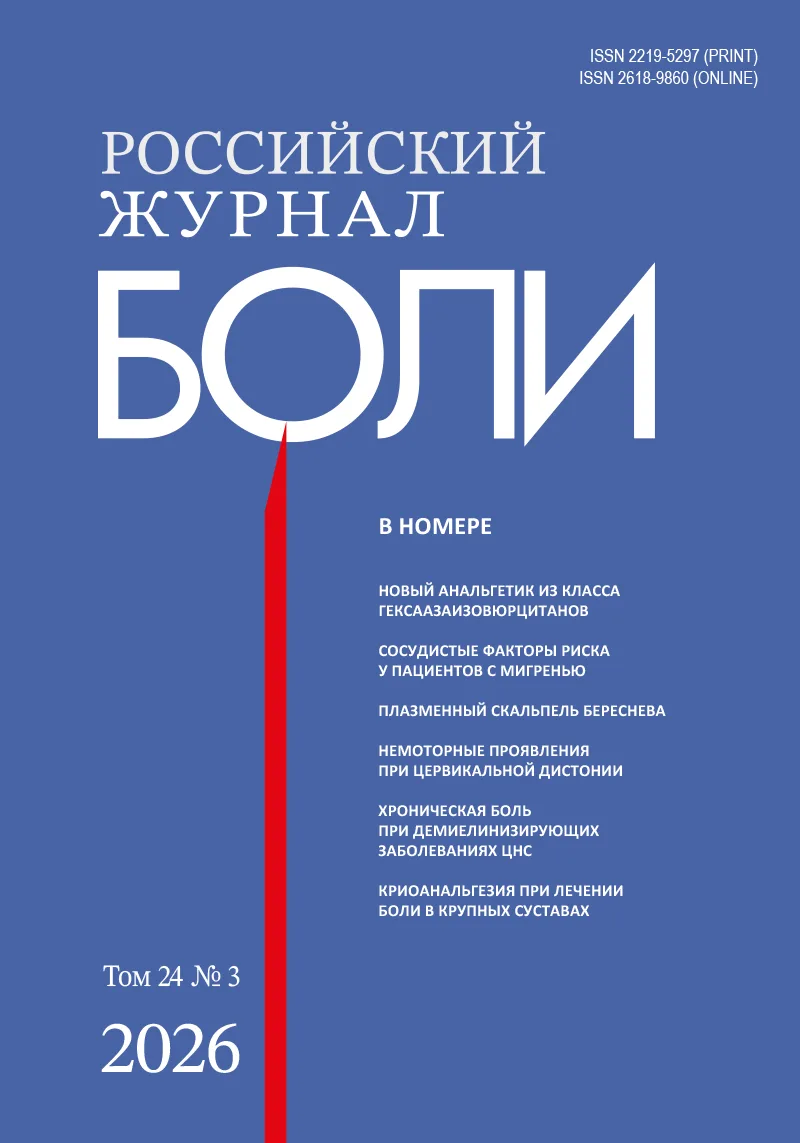
The journal is dedicated to the problem of pain, and covers many research areas related to the physiology and pathophysiology of pain, methods of assessment and diagnosis of pain, features of clinic nociceptive, neuropathic and psychogenic pain syndromes and methods of treatment.
Language of publication:
Subscription distribution model: open access.
This is an open access journal which means that all content is freely available without charge to the user or his/her institution. Users are allowed to read, download, copy, distribute, print, search, or link to the full texts of the articles, or use them for any other lawful purpose, without asking prior permission from the publisher or the author. This is in accordance with the BOAI definition of open access.
Materials of the journal are available under the Creative Commons Attribution-NonCommercial 4.0 International (CC BY-NC 4.0): it is allowed to use, copy, quote for noncommercial purposes with the obligatory indication of the name of the author of the work and the source of borrowing. Full text of the license.
The journal was founded in 2010. Previously published under the title "Pain" from 2003 to 2009.
Since 2020, the journal has been published by Media Sphere Publishing House.
It publishes articles of authors-applicants of a scientific degree of candidate of medical Sciences. The journal is dedicated to the problem of pain, and covers many research areas related to the physiology and pathophysiology of pain, methods of assessment and diagnosis of pain, features of clinic nociceptive, neuropathic and psychogenic pain syndromes and methods of treatment.
The articles reflected the most current ideas on the pathogenesis of pain syndromes, the clinical picture, modern methods of drug and non-drug therapy, prevention and rehabilitation of patients with various forms of chronic pain. Regularly published scientific literature reviews and lectures on the problem of pain. All articles are accompanied by a bibliography with full citation of the source.
The journal is included in the list of the leading peer-reviewed journals and editions of the Higher Attestation Commission under the Ministry of Education and Science of the Russian Federation, in which scientific results of dissertations for the degree of Candidate of Science and Doctor of Science should be published. Included in the RISC database.
The main sections of the journal:
No fee is charged for the publication of articles.
Each article received by the editorial board is registered and considered after peer-reviewing at the meeting of the editorial board, which decides on its publication.
Head of the Editorial – Lyudmila Nikolayevna Afanasyeva
A4
Frequency – 4 times a year
1. Russian Index of Science Citation
Analysis of the journal's publication activity
2. Scopus CiteScore
Anesthesiology and Pain Medicine
3. SJR (Scimago Journal & Country Rank)
Resolve all issues through the electronic edition service
Additional services for the preparation of articles
Advices on publication ethics
By submitting an article to the publisher, you agree to the terms of the offer agreement
Mikhail L. Kukushkin
Editor-in-Chief, Prof., MD, PhD, Laboratory of Fundamental and Applied Pain Problems, Institute of General Pathology and Pathophysiology, Moscow, Russia
Nikolay N. Yakhno
Member of the Editorial Board, Member of the RAS, Prof., MD, PhD, Professor, I.M. Sechenov First Moscow State Medical University (Sechenov University) (Moscow, Russia)
Oleg S. Davydov
Executive Secretary, PhD, Leading researcher at the Laboratory of Fundamental and Applied Pain Problems, Research Institute of General Pathology and Pathophysiology (Moscow, Russia).
Ludmila A. Medvedeva
Executive Secretary, MD, PhD, Chief Researcher, Clinic for the Study and Treatment of Pain, B.V. Petrovsky Russian Scientific Center of Surgery (Moscow, Russia)
Maksim V. Churyukanov
Executive Secretary, Assoc. Prof., PhD, Department of Nervous Diseases and Neurosurgery, I.M. Sechenov First Moscow State Medical University; Senior Researcher, Clinic for Pain Research and Treatment, B.V. Petrovsky Russian Research Center of Surgery; Member of the Board of the European Pain Federation EFIC (Moscow, Russia)
Guzal R. Abuzarova
Member of the Editorial Advisory Board, Prof., MD, PhD, Department of Oncology and Palliative Care, Russian Medical Academy of Continuing Professional Education; Head of the Center for Palliative Care for Cancer Patients, P.A. Herzen Moscow Research Cancer Institute (Russia)
Aleksandr V. Amelin
Member of the Editorial Advisory Board, Prof., MD, PhD, Department of Neurology, I.P. Pavlov St. Petersburg State Medical University; Head of the Laboratory of Neurophysiology and Pain Pharmacology, A.V. Waldman Institute of Pharmacology (Russia)
Viktor A. Balyazin
Member of the Editorial Advisory Board, Prof., MD, PhD, Head of the Department of Neurology and Neurosurgery, Rostov State Medical University, Vice-President of the Russian Society for the Study of Pain (Russia)
Anatoliy F. Belyaev
Member of the Editorial Board, Prof., MD, PhD, Head of the Department of Restorative Medicine, Vladivostok State Medical University (Russia)
Didier Bouhassira
Member of the Editorial Advisory Board, Prof., MD, Centre for the Study and Treatment of Pain, University of Versailles Saint Quentin (France)
Dmitriy Yu. Veltishchev
Member of the Editorial Advisory Board, Prof., MD, PhD, Head of the Department of Stress Disorders, Moscow Research Institute of Psychiatry - branch of the Scientific Center of Mental Health (Russia)
Oleg N. Dreval
Deputy Editor-in-Chief, Prof., MD, PhD, Head of Department, Russian Medical Academy of Post-Graduate Education (Moscow, Russia)
Grigoriy Yu. Evzikov
Member of the Editorial Board, Prof., MD, PhD, Head of the Neurosurgery Department, Kozhevnikov Nervous Diseases Clinic (University Clinical Hospital No.3 at Sechenov First Moscow State Medical University) (Moscow, Russia)
Aleksandr A. Eremenko
Member of the Editorial Board, Prof., Corr. Member of the RAS, MD, PhD, Head of the intensive care unit, Russian Scientific Center of Surgery (Moscow, Russia)
Oleg I. Zagorulko
Member of the Editorial Advisory Board, Prof., MD, PhD, Head of the Clinic for the Study and Treatment of Pain, B.V. Petrovsky Russian Scientific Center for Surgery (Russia)
Andrey E. Karateev
Member of the Editorial Advisory Board, MD, PhD, Head of the Laboratory of Pain Pathophysiology and Polymorphism of Skeletal-Muscular Diseases, V.A. Nasonova Research Institute of Rheumatology (Russia)
Nataliya A. Krupina
Member of the Editorial Advisory Board, Docror of Biology, PhD, Chief Researcher, Nervous System Pathophysiology Laboratory, Research Institute of General Pathology and Pathophysiology (Russia)
Elena Yu. Maychuk
Member of the Editorial Advisory Board, Prof., MD, PhD, Head of the Department of Internal Diseases No. 1, A.I. Evdokimov Moscow State Medical and Dental University (Russia)
André Mouraux
Member of the Editorial Advisory Board, Prof., MD, Pain Research Group, Institute of Neuroscience (Belgium)
Evgeniy L. Nasonov
Member of the Editorial Board, prof., acad. of the RAS, MD, PhD, Scientific Director, V.A. Nasonova Rheumatology Research Institute, member of the American College of Rheumatologists (Moscow, Russia)
Vladimir V. Nikoda
Member of the Editorial Advisory Board, MD, PhD, Head of the general resuscitation department, B.V. Petrovsky Russian Scientific Center of Surgery (Russia)
Georgiy A. Novikov
Member of the Editorial Advisory Board, Prof., MD, PhD, President of the All-Russian public movement "Medicine for Quality of Life", Head of the Department of Palliative Medicine, A.I. Evdokimov Moscow State Medical and Dental University (Russia)
Alexei M. Ovechkin
Member of the Editorial Board, Prof., MD, PhD, I.M. Sechenov First Moscow State Medical University (Moscow, Russia)
Leon Plaghki
Member of the Editorial Advisory Board, Prof., MD, Honorary Professor, Catholic University of Levin (Belgium)
Solomon A. Rabinovich
Deputy Editor-in-Chief, Prof., MD, PhD, Honored Physician of the Russian Federation, Head of the Department of Anesthesia in Dentistry, A.I. Yevdokimov Moscow State University of Medicine and Dentistry (Moscow, Russia)
Evgeniy L. Sokov
Member of the Editorial Advisory Board, Prof., MD, PhD, Head of the Department of Algology and Rehabilitation, Institute of Oriental Medicine, Russian Peoples' Friendship University (Russia)
Igor A. Strokov
Member of the Editorial Advisory Board, Assoc. Prof., PhD, Associate Professor, Department of Nervous Diseases and Neurosurgery, Faculty of Medicine, I.M. Sechenov First Moscow State Medical University (Russia)
Gyuzyal R. Tabeyeva
Member of the Editorial Advisory Board, Prof., MD, PhD, President of the Russian Society for the Study of Headache, Professor of the Department of Nervous Diseases and Neurosurgery, I.M. Sechenov First Moscow State Medical University (Russia)
Farit A. Khabirov
Member of the Editorial Advisory Board, Prof., MD, PhD, Head of the Department of Vertebroneurology and Manual Therapy, Kazan State Medical Academy (Russia)
Vasiliy A. Shirokov
Member of the Editorial Advisory Board, Prof., MD, PhD, Head of the Scientific Department of the Neurological Clinic, Ekaterinburg Medical and Scientific Center for Prevention and Health Protection of Industrial Workers (Russia)
Christopher Ecclecston
Member of the Editorial Advisory Board, Prof., MD, Director, Centre for Pain Research, University of Bath (UK)
There is no fee for the publication of manuscripts.
By submitting an article to the publisher, the author agrees to the terms of the CONTRACT OFFER.
When preparing a manuscript, authors should follow Recommendations on conducting, describing, editing and publishing the results of scientific work in medical journals of the International Committee of Medical Journal Editors (ICMJE).
When reviewing an article, the editorial board can check the material using Anti-plagiarism system. If multiple borrowings are found, the editorial board acts according to the rules COPE.
|
Source type
|
Source
|
|
Standard journal article
|
Vega K. Heart Transplantation Is Associated with an Increased Risk for Pancreaticobiliary Disease. Annals of Internal Medicine. 1996;124(11):980. https://doi.org/10.7326/0003-4819-124-11-199606010-00005
|
|
Article in the issue with supplement
|
Crinò L, Cappuzzo F. Present and future treatment of advanced non–small cell lung cancer. Seminars in Oncology. 2002;29(3)(suppl 9):9-16. https://doi.org/10.1053/sonc.2002.34266
|
|
Book (authors)
|
Ringsven MK, Bond D. Gerontology and leadership skills for nurses. 2nd ed. Albany (NY): Delmar Publishers; 1996.
|
|
Book (edited by)
|
For the whole book:
Norman IJ, Redfern SJ, eds. Mental health care for elderly people. New York: Churchill Livingstone; 1996.
For the part in the book:
Lewinsohn P. Depression in adolescents. In: Gottlib IH, Hammen CL, eds. Handbook of Depression. New York, NY: Guilford Press; 2002:541-553. |
|
Legal materials (bills, codes, enactments, orders, federal standards, regulations)
(Citation is allowed only if available in the Internet public domain) |
Federal Law of the Russian Federation No. 323-F3 of November 21, 2011. "On the Fundamentals of Health Protection of Citizens of the Russian Federation". The link is active as of 12.12.2014. http://www.rosminzdrav.ru/documents/7025-federalnyy-zakon-323-fz-ot-21-noyabrya-2011-g
|
|
Patent
(Citation is allowed only if available in the Internet public domain) |
Rabiner RA, Hare BA, inventors; OmniSonics Medical Technologies Inc, assignee. Apparatus for removing plaque from blood vessels using ultrasonic energy. US patent 6,866,670. March 15, 2005.
|
|
Media and electronic materials
|
Hormone replacement therapy [audio]. National Public Radio. August 5, 2002. Accessed March 4, 2004. http://www.npr.org/templates/story/story.php?storyId=1147833
|
|
Journal article in electronic format
|
Duchin JS. Can preparedness for biological terrorism save us from pertussis? Arch Pediatr Adolesc Med. 2004;158(2):106-107. Accessed June 1, 2004. http://archpedi.ama-assn.org/cgi/content/full/158/2/106
|
The Editorial Board of the journal complies with the ethical standards approved by the international scientific community. The Editorial Board uses the Recommendations for the Conduct, Reporting, Editing and Publication of Scholarly Work in Medical Journals of the International Committee of Medical Journal Editors and recommendations of the Committee on Publication Ethics (COPE).
The Editorial Board is responsible for making decisions which of the submitted manuscripts will be accepted for publication. The Editorial Board makes the decision regarding a publication based on the journal’s policy, taking into account the current authors’ rights legislation and avoiding defamation and plagiarism. The editorial evaluation of the manuscript is independent of race, ethnicity and gender, religion, citizenship, or political views of the authors. Decision whether to publish an article or not is based exclusively on its scientific relevance, originality, clarity of presentation, and correspondence of the topic to journal’s specialization.
All the Editorial Board members are responsible for disclosing any information about the submitted manuscript to individuals other than authors, peer reviewers, potential peer reviewers, or publishers.
The unpublished materials disclosed in the submitted manuscript cannot be used by the Editorial Board members for their own research without written permission from the authors.
In case of an ethical complaint or a conflict situation regarding the manuscript or the published article, the Editorial Board should undertake reasonable countermeasures, together with the publisher, to restore the violated rights. If errors are revealed, the Editorial Board should assist in publishing corrections or refutations. Each reported case of unethical behavior will be considered, even if submitted several years after the article had been published.
The editorial board is guided by the following policy regarding the retraction of publications (download .pdf).
The review process is aimed at facilitating the Editorial Board in editorial decision-making and may also help the author to improve the manuscript.
If a reviewer selected by the Editorial Board does not feel competent for reviewing the manuscript or feels that it is not possible to meet the deadline of the review, he/she should promptly notify the Editorial Board and decline to perform the review.
Any material under review should be regarded as confidential. The material should not be shared or discussed with anyone outside the review process unless approved by the editor.
Reviewing should be objective. Subjective critique of the author is not allowed. Reviewer’s opinion should be stated clearly and supported by arguments.
The reviewer is responsible for determining the cases when the relevant publications have not been cited in the manuscript or listed in the References section. Furthermore, the reviewer should determine whether all the statements, conclusions, and ideas borrowed from other publications had the corresponding references. If the reviewer detects that the manuscript under review significantly coincides with or is similar to another known publication, he/she should notify the Editorial Board.
Non-disclosable information and ideas must be regarded as confidential and cannot be used for one’s personal advantage. Experts should not review manuscripts if they have any possible conflict of interest due to competitive, collaborative, or other relationships with the manuscript authors, as well as companies or institutions related to the manuscript.
If the manuscript is based on an original study, the authors must submit the reliable results of their work and an objective discussion of significance of the study. The manuscript should contain all the key data, accurate description of the study details and references in order to ensure reproducibility of the results. Data falsification or the intentionally invalid statements in the manuscript are regarded as unethical and are inappropriate.
The Editorial Board can request the authors to submit raw data in addition to the manuscript. The author must be ready to provide public access to these data, provided that public access to the data violates neither confidentiality of the research participants nor rights of an individual or a company owning these data.
Authors must submit only original studies. Authors must properly and accurately acknowledge the work of others. Publications that had significantly contributed to preparing the study or underlied its design should also be acknowledged.
In general, materials describing the contents of the same study should not be published in more than one journal. Submitting the manuscript to more than one journal is considered unethical and inappropriate. Copyrighted materials that have already been published cannot be submitted to the journal. Furthermore, materials under consideration by the Editorial Board must not be submitted to be published elsewhere. When submitting an article, the author must inform the editor about all the previous presentations of the study that can be regarded as a duplicate publication. The author must notify the editor if the manuscript contains the information published by the author in previous reports or submitted for publication elsewhere. In this case, the new article should contain references to the previously published material.
Authorship is limited to the individuals that have made a significant contribution to 1) conception and design of the study; data acquisition and interpretation; 2) preparing the first draft of the article or editing the article to improve its quality; and 3) final approval of the manuscript for publication. Each author must participate in the study to an extent sufficient to take public responsibility for the corresponding part of the content of his/her article. Involvement consisting in funding or selecting material for the article is not sufficient reason for inclusion in the list of authors. General guidance of the research group is not sufficient for including in the list of authors.
All the authors must approve the final manuscript and its submission to the journal for publication.
When submitting an article to the journal, all authors must sign the form disclosing financial or any other substantive conflict of interest that can be considered to have influenced the study results or their interpretation. All funding sources of the submitted studies must be specified.
After the peer review process, the article can be sent to the author for improvement. Authors should be actively involved in the review process: promptly answer the questions and, if necessary, correct the manuscript in accordance with the reviewer’s comments.
Policy on the Use of Artificial Intelligence of the Media Sphere Publisher
Effective date: 15.12.2025
Last updated: 15.12.2025
The Use of AI Tools in the Publications of Journals of the Media Sphere Publisher
We welcome the responsible and transparent use of artificial intelligence (AI) in scientific medical research and the preparation of manuscripts for scientific periodicals of the Media Sphere Publisher. AI can be a powerful tool to improve the quality and efficiency of your work.
We are committed to maintaining scientific integrity and encourage authors, reviewers, and editors to use AI as an aid, not as a substitute for critical thinking and ethical practices.
AI Use Policy for Authors of Media Sphere Publisher
Key principles for authors when preparing a manuscript using AI
Acceptable uses of AI by authors
· Language and style improvements: Paraphrasing, readability improvements, grammar and spelling checks (but not body text generation).
Restrictions and prohibitions for authors
General principles
Prohibited Practices
2. Fabrication and falsification of data through AI
3. Manipulating Medical Research Images
4. Violation of the confidentiality and security of personal data
5. Copyright infringement and plagiarism with AI
6. Uncontrolled withdrawal and medical advice
7. Mass automation of submission and manipulation of the review system
8. Limitations on methodology and reproducibility
9. Liability and consequences of violations
Disclosure of Authors' Use of AI
Best practices for safe use of AI by creators
Exceptions: The use of basic grammar and spelling checking tools (such as Microsoft Word spell-check) that are not based on generative AI does not require mandatory disclosure.
AI Use Policy for Reviewers of Media Sphere Publisher
· This policy establishes recommendations and requirements for the use of AI tools by reviewers who evaluate manuscripts for scientific medical journals of Media Sphere Publisher. The goal is to ensure transparency, protect confidentiality, and maintain scientific integrity when integrating AI into the peer review process.
· The policy applies to all external and internal reviewers involved in the peer review of manuscripts (scientific articles, reviews, clinical cases, etc.), as well as to editorial staff who use AI in the preparation of recommendations for reviews.
General principles
· Peer review should remain professional, independent and based on the expert knowledge of the individual. AI tools can only be used as an aid; Final judgments and recommendations must be made by a human reviewer. The reviewer is responsible for the completeness, accuracy and ethics of the review.
Permitted use of AI by reviewers
Prohibited use of AI by reviewers
Confidentiality and Reviewers' Work with Manuscript Data
Disclosure of reviewers' use of AI
Quality and Validation
Conflicts of interest
Consequences of non-compliance
Note to reviewers
AI is a useful tool, but it is not a substitute for professional expertise. Comply with privacy requirements and disclose the use of AI to maintain the trust of authors, reviewers, and readers.
AI Use Policy for Editors of Media Sphere Publisher
· This AI Policy is designed to ensure the responsible, ethical and transparent use of artificial intelligence (AI) technologies by editors of scientific medical journals of the Media Sphere Publisher. We recognize the potential of AI to improve the efficiency of editorial processes, but emphasize the need to preserve academic integrity, confidentiality, and professional judgment.
· This Policy applies to all editors (editors-in-chief, deputy editors, members of the editorial boards, executive editors and everyone who participates in editorial decision-making) of scientific medical journals published by Media Sphere Publisher.
1. Basic principles of using AI by editors
2. Allowed use of AI by editors (with restrictions and mandatory verification)
· Grammar, spelling, and stylistics checking: Use AI to improve the readability of the manuscript text or accompanying materials.
3. Prohibiting the use of AI by editors
It is strictly forbidden to use AI for the following purposes:
· Editorial decision-making: AI cannot make decisions about rejecting, accepting, or sending manuscripts for revision. These decisions should always be left to the human editor.
4. Data privacy and security
· Editors should pay maximum attention to the confidentiality of unpublished manuscripts and related materials.
5. Disclosure of the use of AI
· In the case of using AI to perform tasks that may affect the content or review process of the manuscript, the editor should be ready to disclose this at the request of the publisher or in case of questions.
6. Training and support
· The publisher will provide information and training on the responsible use of AI tools, and will update this policy as technology and ethical guidelines evolve.
7. Consequences of non-compliance
· Violation of this Policy may result in disciplinary action, including, but not limited to, revocation of editorial authority and termination of cooperation with the publisher. In the case of serious violations affecting scientific integrity or confidentiality, additional action may be taken.
Updates to the AI Policy by Media Sphere Publisher
· This Policy will be regularly reviewed and updated to align with rapidly evolving AI technologies and best practices in scientific publishing.
All the manuscripts submitted for publication in the journal are peer reviewed by two independent experts who are non-members of the Editorial Board of the journal.
The journal provides peer reviewing of all the submitted materials that are within the remit of the journal for expert evaluation. All peer reviewers are the acknowledged experts who specialize in the field relevant to the reviewed materials and have had publications relevant to the topic of the article being reviewed over the past 3 years. The peer reviews are stored in the publishing and editorial office for 5 years.
The article is sent to reviewers without names or contact information of the authors (the so-called blind review).
Reviewers treat the article as confidential material and strictly follow the author’s right for non-disclosure of the data reported in the manuscript before the article is published. The reviewer may engage additional experts only with permission fr om the Editorial Board and on a confidential basis.
Reviewers’ comments are sent to the author without disclosing the reviewers’ identity. The Editorial Board makes a final decision whether to publish the manuscript or not after the peer reviews and authors’ answers were received. The Editorial Board sends copies of peer reviews or a substantiated rejection to the authors and also sends copies of the peer reviews to the Ministry of Education and Science of the Russian Federation if a request has been received by the Editorial Board.
In some cases, the Editorial Board can send the article for an additional peer review, including statistical and methodological reviewing.
The Editorial Board constantly monitors the quality of peer review using the Russian version of the Review Quality Instrument questionnaire (Version 3.2), van Rooyen S., Black N., Godlee F. J Clin Epidemiol 1999;52:625-9.
The English version of the Review Quality Instrument questionnaire is available here (download – PDF file).
Our readers and customers expect us to be trustworthy and independent, so our advertising should support that expectation.
We accept advertising and sponsorship from competitors.
We do not accept advertising or sponsorship relating to tobacco products, or to products and services from tobacco companies, and alcohol, as well as their related companies and funds.
We do not accept advertising of uncertified drugs and equipment.
Advertisements and sponsorship must be legal, truthful and comply with the relevant laws & regulations of the Russian Federation.
Our users should immediately be able to distinguish between advertising and editorial content.
Sponsored content should be clearly identifiable.
The nature of any commercial relationship must be transparent to our users.
Our advertising policy does not allow advertising or sponsorship to influence editorial decisions.
Online advertising or sponsorship should not impede users’ access to editorial content.
Advertising and sponsorship are subject to publishers’ oversight.
If a proposal is refused for reasons outside these guidelines, Media Sphere will provide an explanation.
Buying the print version you get an access for electronic version of journal in your account.
The subscription price is for individuals.
For subscription fees and billing for legal entities, please send inquiries to: podpiska@mediasphera.ru
Please write the correct address when ordering the print version.
Email Confirmation
An email was sent to test@gmail.com with a confirmation link. Follow the link from the letter to complete the registration on the site.
Email Confirmation
Log in to the site using your account in one of the services
We use cооkies to improve the performance of the site. By staying on our site, you agree to the terms of use of cооkies. To view our Privacy and Cookie Policy, please. click here.